
When a person gets arrested, everything feels overwhelming and uncertain. Suddenly, you're navigating a confusing legal system, and one of the first and most important concepts you'll face is bail. Understanding how bail works in Georgia is a helpful first step toward getting through this process.
Your First Questions About the Georgia Bail System
It’s best to think of bail not as a punishment or fine, but more like a security deposit. It’s a financial agreement with the court that guarantees the person arrested will show up for their future court dates. If they make every appearance, the bail money is usually returned once the case is over.
Essentially, bail is the key to getting out of jail while the legal case moves forward. The court's main goal is simple: to make sure the accused returns to face the charges.
The Initial Steps in the Bail Process
The clock starts ticking the moment an arrest is made. The first 24 to 72 hours are absolutely critical for securing a release from jail. While the specifics can change from one county to the next, the general path is pretty consistent. You can get a better sense of the early stages by reading more about what happens when you get arrested.
Soon after the arrest, there will be a first appearance hearing, sometimes called an arraignment. This is where a judge formally reviews the charges and, for most offenses, sets the bail amount. This isn't just a number pulled out of thin air; it's a calculated decision based on several important factors.
Please remember, the information provided throughout this guide is for educational purposes only. It is designed to help you understand the bail system in Georgia and should not be considered a substitute for consultation with a qualified professional regarding your specific circumstances.
Demystifying the Bail Amount
The judge has the final say on the bail amount. Their decision revolves around balancing the defendant's right to be free until proven guilty against the need to protect public safety.
Here’s what they typically consider:
- The seriousness of the alleged offense: More severe charges almost always mean higher bail.
- The defendant’s past record: A history of criminal convictions can lead a judge to set a higher bond.
- Ties to the community: Things like having a local job, family in the area, or owning property can show that a person is not a flight risk.
- Potential risk to the public: If the judge feels the person might be a danger to others, bail could be set extremely high—or even denied completely.
To give you a clearer picture of how these initial steps unfold, here’s a quick overview of the timeline you can generally expect.
Key Stages of the Georgia Bail Process at a Glance
| Stage | What Happens | Typical Timeframe |
|---|---|---|
| Arrest & Booking | The individual is taken into custody, processed, and fingerprinted. | 1-4 hours |
| Bail Schedule Review | For common, minor offenses, bail may be set according to a standard "schedule." | 4-12 hours |
| First Appearance | The defendant sees a judge who formally hears the charges and sets the bail amount. | 24-72 hours |
| Posting Bail | The defendant or their family arranges to pay the bond via cash, surety, or property. | Varies (minutes to days) |
| Release | Once bail is posted and processed, the defendant is released from custody. | 1-8 hours after posting |
This table provides a basic roadmap, but keep in mind that every case is unique. The next sections will get into the details of the different types of bonds available and what you can expect during a bond hearing.
How Judges Decide a Bail Amount in Georgia
When a Georgia judge sets a bail amount, that number isn't just pulled out of thin air. It’s a calculated decision, almost like a risk assessment, designed to balance a person's freedom against the safety of the community.
The core question the judge is trying to answer is simple: "What will it take to make sure this person shows up for their court dates without causing any trouble in the meantime?" The final dollar amount is the judge's answer to that question, and that decision is entirely up to them.
The Primary Factors Influencing Bail
Whether in a courtroom in Forsyth County or Cobb County, judges weigh a handful of key factors during a bail hearing. While every case has its own unique story, the thought process behind setting bail is pretty consistent across the state.
Three things almost always drive the decision:
- The Seriousness of the Alleged Crime: This is ground zero. A minor shoplifting charge is going to have a much lower bail than a serious felony. The potential jail time or penalties tied to the crime are a huge factor in how much risk the judge sees.
- The Defendant’s Criminal History: A person with a clean record is viewed in a completely different light than someone with a history of arrests. If someone has failed to appear for court in the past or has prior felony convictions, a judge is more likely to think a higher bail is needed to guarantee they show up this time.
- Community Ties and Flight Risk: This one is crucial. A judge wants to know how connected a person is to their community because strong ties make it less likely they’ll just disappear.
They’ll look at things like whether someone has a steady job, owns a home, or has family living nearby in places like Alpharetta, Roswell, or Marietta. Someone with deep local roots is considered less of a flight risk—which is just the court's way of saying they probably won't skip town to avoid their case.
Standard Bond Schedules and Judicial Discretion
For a lot of common or less serious offenses, many Georgia counties use what's called a bond schedule. Think of it as a pre-set menu of bail amounts for specific charges. For instance, a first-offense DUI might have a standard bond amount of $1,500 to $2,500.
But that schedule is just a starting point. A judge has the final say and can raise or lower that amount based on the specifics of the situation.
The bond schedule provides a baseline, but the judge's final decision is shaped by the individual details presented. Factors like aggravating circumstances or strong community support can lead to a deviation from the standard amount.
This gives the court the flexibility to treat each person and case individually instead of using a one-size-fits-all approach.
The Impact of Bail Reform and Ability to Pay
In the last few years, there’s been a major push to make the bail system fairer, built on the idea that someone’s freedom shouldn't hinge on how much money they have. Georgia even passed a bail reform law in 2018 to tackle this, especially for misdemeanor cases.
The law said courts had to consider a person's ability to pay when setting bail. In practice, however, it's been a mixed bag. A study of 51 Georgia counties found that many weren't fully on board. For example, only 48.7% of the counties surveyed were actually looking at a defendant's finances, and getting a timely hearing wasn't always a sure thing. You can see the full breakdown by reading more about bail reform in Georgia.
This just goes to show that while the law is on the books, how it's applied can change dramatically from one courthouse to another. How bail is handled in Johns Creek might be very different from the process in Cumming, which is why understanding the local court's tendencies is so important. In the end, it’s the judge’s job to weigh all of it—the charge, the defendant's history, their ties to the community, and sometimes their finances—to arrive at that final bail amount.
How to Post Bail: Understanding Your Bond Options
When a judge sets bail, the next hurdle is figuring out how to actually post it. Georgia law provides a few different ways to do this, and each one has its own set of rules, costs, and risks. This isn't a one-size-fits-all situation; it’s more like choosing the right tool for the job based on the family's finances and the specifics of the case.
Getting this choice right is crucial. Let’s break down the most common bond types you’ll encounter.
Cash Bonds: The Direct Approach
A Cash Bond is exactly what it sounds like: the full bail amount is paid directly to the court. This can usually be done with cash, a cashier's check, or a money order.
Think of it like a security deposit. The full amount is given to the court to guarantee that the accused person will show up for every required appearance. As long as they do, the court returns 100% of the money when the case is over.
The upside is obvious—the money can be returned. The major downside, however, is that bail is often set at thousands or even tens of thousands of dollars, an amount most families simply don't have sitting in a bank account.
Surety Bonds: Working With a Bail Bondsman
When a cash bond is out of reach, most people turn to a Surety Bond. This is where a professional bail bondsman is used.
A bondsman acts like an insurance agent for the court. Instead of paying the court the full bail amount, a non-refundable fee is paid to the bondsman—typically 10% to 15% of the total bond. In exchange, the bondsman posts a guarantee with the court for the full amount, taking on the financial risk if the defendant doesn't appear.
For example, on a $10,000 bond, a bondsman would be paid a fee of $1,000 to $1,500. This fee is their payment for taking the risk and is never returned, even if the case is dropped the next day.
This makes getting out of jail much more affordable upfront. Keep in mind, the bondsman may also require collateral, like a car title or a deed to a house, to protect them if the defendant skips court.
Property Bonds: Using Real Estate as Collateral
A Property Bond is a less common option where real estate owned in Georgia is used to secure someone's release. It can be a powerful tool, but it's also far more complicated and time-consuming.
The court is very particular about property bonds. Generally, the property must have clear equity equal to at least twice the bond amount. Why so much? Because if the bond is forfeited, the county has to go through a long, expensive process to seize and sell the property.
To use a property bond, a person will need to provide:
- Proof of Ownership: The original deed to the property.
- Equity Verification: A recent tax assessment or appraisal to prove its value.
- Lien Search: The court will check for any mortgages or liens against the property.
Because of all the paperwork and official checks involved, securing a release with a property bond can take days or even weeks.
Release on Recognizance (ROR): The No-Cost Option
The best-case scenario is a Release on Recognizance (ROR), often called a "signature bond." With an ROR bond, a judge agrees to release someone based on their written promise to return to court.
No money changes hands. This is an act of trust from the court, usually reserved for people accused of minor, non-violent crimes who have strong ties to the community and little to no criminal history. The judge is essentially deciding that the person's word is their bond.
How does a judge make these calls? They weigh several key factors about the individual and the case.
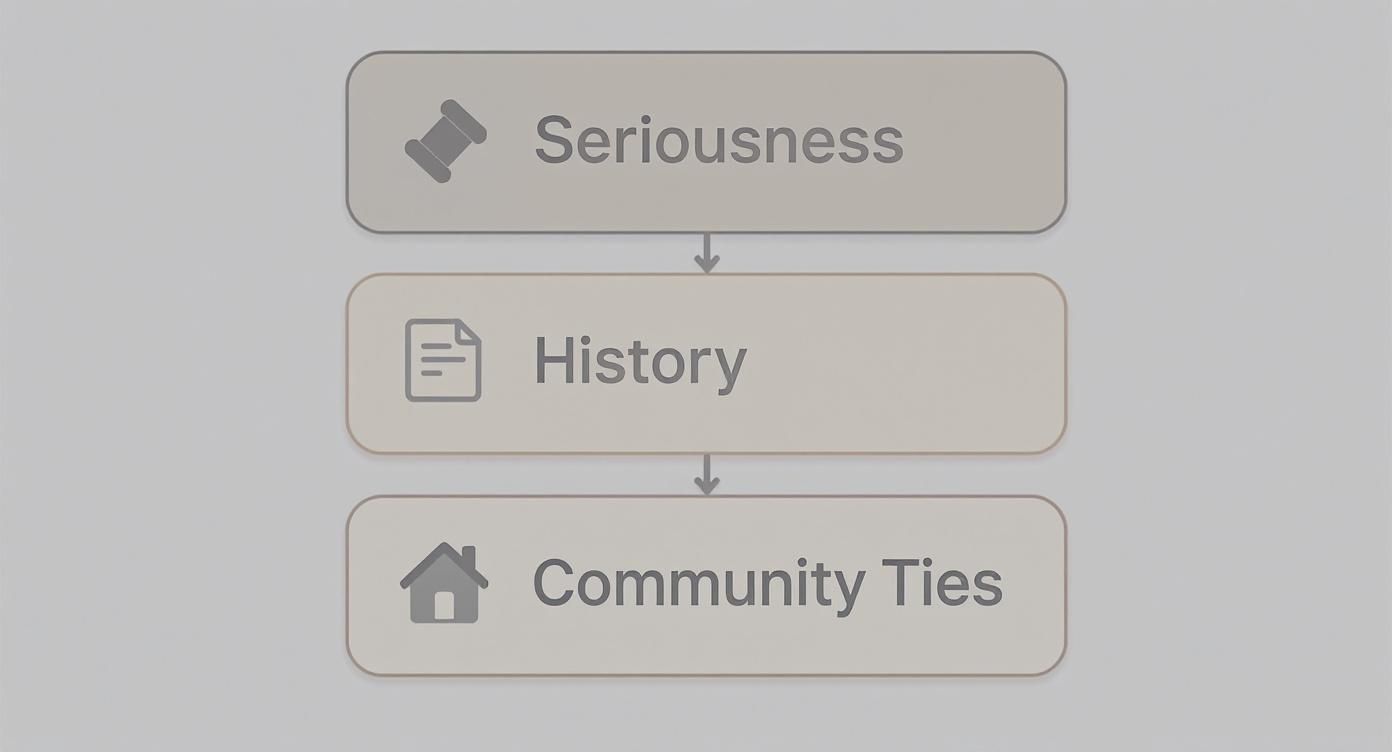
As you can see, the seriousness of the charge, a person's past history, and their stability in the community are all critical pieces of the puzzle. Understanding these factors and your bond options is a helpful first step toward navigating the system effectively.
To make things clearer, let's compare these options side-by-side.
Comparing Your Bail Bond Options in Georgia
The choice made has significant financial implications. This table breaks down the key differences between the bond types to help decide which path is most practical for a given situation.
| Bond Type | How It Works | Upfront Cost | What Happens to the Money? |
|---|---|---|---|
| Cash Bond | Pay the full bail amount directly to the court. | 100% of the bail amount. | The full amount can be returned, if all court dates are attended. |
| Surety Bond | Pay a fee to a bail bondsman, who posts the bond. | 10% to 15% of the bail amount (non-refundable fee). | Nothing is returned. The fee is the bondsman's payment for their service. |
| Property Bond | Pledge real estate with sufficient equity as collateral to the court. | $0 (but requires paperwork and lien fees). | The property is released, if all court dates are attended. |
| ROR Bond | The judge releases the individual on a written promise to appear in court. | $0. | No money was paid, so nothing is returned. |
Each option presents a trade-off between upfront cost, complexity, and what stands to be lost. Carefully considering available resources before deciding how to proceed is a common approach.
What to Expect at a Georgia Bail Hearing
Walking into a courtroom for a bail hearing is nerve-wracking. The whole environment is formal, the language is specific, and the stakes feel impossibly high. Knowing what actually happens during this crucial meeting can take a lot of that stress off and help a person feel more prepared.
In Georgia, this is often called a first appearance or arraignment, and it's the first formal interaction with the court after an arrest. The main point of this hearing is for a judge to review the initial charges, inform the defendant of their rights, and—most importantly—decide on the conditions for their release while the case moves forward. For most people, this is the moment when bail is officially set.
The timeline is fast. Georgia law requires that a person is brought before a magistrate judge within 48 to 72 hours of being taken into custody. That's the standard, but real-world things like a holiday weekend can sometimes cause minor delays.
Who Is in the Room
A courtroom can seem chaotic, but everyone there has a specific job. If you know who’s who, it's much easier to follow what’s going on.
- The Judge: This is the person in charge. They run the hearing, make the final call on the bail amount, and set any conditions to follow if released.
- The Prosecutor: This is the government's lawyer. They will present the state's side and will likely argue for a higher bail amount, pointing to the nature of the crime or a person's past history.
- The Defense Attorney: A defense attorney speaks for the defendant. Their job is to argue for a fair bail amount or, ideally, for a release on recognizance (an ROR bond).
- The Defendant: This is the person who was arrested. They will be present either in the courtroom itself or appear via a video feed from the jail.
The hearing itself is usually pretty quick, especially for misdemeanor charges. The judge listens to both the prosecutor and the defense attorney before making a decision.
The Focus of the Discussion
During the hearing, the arguments will circle back to the same key factors a judge uses to set a bond amount. The prosecutor is going to highlight anything that makes the defendant look like a flight risk or a potential danger to the community. They might bring up a prior criminal record or emphasize how serious the current charges are.
In return, the defense attorney will present arguments in the defendant's favor. This is their chance to show the judge that the person isn't a flight risk and can be trusted to show up for future court dates.
A powerful argument for a lower bond often comes down to showing strong ties to the community. This includes things like having a steady job in areas like Alpharetta or Marietta, owning a home, or having family in Forsyth or Cobb County who depend on the defendant.
Painting a clear picture of a person's stability and reliability is the goal. To get a more detailed look at the strategy behind these arguments, you can learn more by exploring what happens at a bond hearing and how a strong case is built.
Misdemeanors vs. Felonies
How the bail hearing plays out can also depend on just how serious the alleged crime is.
- Misdemeanor Cases: For less serious offenses, bail is typically set right there at the first appearance. The process is usually straightforward, and the judge might just use a standard bond schedule for that specific county.
- Felony Cases: When dealing with serious felony charges, the first appearance might just be the start. A more formal, in-depth bond hearing will likely be scheduled for a later date. This gives both sides more time to prepare their arguments about whether bond should be granted at all.
No matter the scenario, the judge's decision at this hearing is critical. It's what determines whether a person will wait for their trial at home or from inside a jail cell. Understanding the people, the process, and the purpose behind it all can demystify the experience and create a better position for everything that comes next.
Responsibilities and Rules After Posting Bail

Securing a release from jail is a huge relief, but it’s certainly not the end of the story. In fact, it’s the beginning of a new chapter governed by a strict set of rules. Think of posting bail as signing a contract with the court: in exchange for freedom, a person promises to follow every single condition the judge lays out.
This period of conditional release is all about ensuring two things: that the defendant will show up for all their court dates and that they won’t pose a risk to the community while the case is ongoing. Understanding and following these rules is absolutely critical, because one wrong move can have severe consequences.
Understanding Your Bail Conditions
When a judge grants bail, they almost always attach specific conditions to the release. These aren’t just suggestions—they are direct court orders that must be followed to the letter. While the specifics can be tailored to fit each case, some conditions are extremely common across Georgia, from Forsyth County to Cobb County.
It's the defendant's responsibility to know and follow these conditions. They will be provided in writing and should be reviewed carefully.
Here are some of the typical requirements:
- Mandatory Court Appearances: This is the big one. The defendant must be at every single scheduled court date, on time and ready to go.
- No Further Offenses: They cannot be arrested or charged with any new crimes while out on bond. Picking up another charge is a fast track to getting bail revoked.
- Geographic Restrictions: The judge might order the defendant to stay within a specific county or the state of Georgia. Leaving the area without the court's permission is a serious violation.
- No-Contact Orders: In cases involving another person, like domestic disputes or assault, the defendant will almost certainly be ordered to have zero contact with the alleged victim. This means no calls, texts, emails, social media messages, or even asking a friend to pass along a message.
It is vital to understand that bail is a conditional release. The freedom it provides is entirely dependent on strict compliance with the rules set by the court. Any deviation from these conditions puts that freedom—and the financial investment—at risk.
The Serious Consequences of Violating Bail Conditions
The court system takes breaking bail conditions very seriously. It’s viewed as a breach of trust, and the penalties are designed to be significant. Understanding how bail works in Georgia means recognizing what’s at stake if compliance is not met.
The first and most immediate consequence is often bond forfeiture. That’s the legal term for losing the money or property put up to get out of jail.
If a cash bond was posted, the court simply keeps all of it. If a bail bondsman was used, they will seek to recover the full bond amount they are now on the hook for. And if a property bond was used, the county can start the process of seizing and selling the real estate.
Beyond just losing money, the court will take other serious actions:
- A Bench Warrant for Your Arrest: The moment a condition is violated, especially by missing a court date, the judge will issue a warrant. That means law enforcement will be actively looking for the individual.
- Revocation of Your Bond: The judge will cancel the original bond. The defendant will be taken back into custody and will likely sit in jail until the case is over, with no chance for another bond.
- New Criminal Charges: In Georgia, failing to show up for court can lead to a new charge of “bail jumping,” which adds a whole new legal headache to the situation.
The rules are clear, and the penalties are harsh. Following every condition of release isn’t just a good idea—it’s the only way to avoid making a difficult situation a whole lot worse.
When Bail Is Denied or Is Unaffordable
The moment a judge sets bail can be a rollercoaster. There might be a rush of hope, but that can quickly sink into despair if the number is impossibly high—or if bail is denied altogether. These are tough situations, but understanding them is a critical part of knowing how bail works here in Georgia.
While the law generally favors pretrial release, it’s never a guarantee. Sometimes, a judge will decide that no amount of money is enough to ensure the accused will return to court or that the community will be safe.
Reasons a Judge Might Deny Bail
Bail denial isn't something that happens every day; it's reserved for the most serious cases. A Georgia judge has the power to deny bail if they're convinced the accused person is a significant threat to the community or a major flight risk.
The decision really boils down to a few key factors:
- The Nature of the Alleged Crime: Bail is frequently denied in cases involving serious violent felonies.
- Significant Danger to the Community: If the judge believes releasing someone would endanger specific people or the public at large, they’ll almost certainly deny bond.
- Extreme Flight Risk: Someone with the money and motivation to flee the country, especially with weak ties to the community, is often seen as too big a risk to release.
- Previous Failures to Appear: A history of skipping court is a huge red flag for any judge and makes a bond denial much more likely.
When bail is denied, the individual stays in jail for the entire case—from the first hearings all the way through a potential trial. This obviously makes preparing a defense much more difficult and highlights just how vital it is to have professional support from day one.
When Bail Is Simply Too High to Pay
What’s far more common than an outright denial is a bail amount that might as well be a million dollars to the average family. A $50,000 bond is an impossible mountain to climb when the $5,000 non-refundable fee for a bail bondsman can't be found.
This is the harsh reality for many: a person who is legally presumed innocent stays locked up simply because they don't have the money to get out. It's not just a personal problem; it has devastating consequences, often leading to lost jobs, lost housing, and incredible strain on families.
This isn't just a local issue; it mirrors a national crisis. Across the U.S., pretrial detention rates skyrocketed by 433% between 1970 and 2015. A huge number of those people were held simply because they couldn’t afford bail. You can dig into the data yourself in this comprehensive report on bail reform.
The inability to pay has the effect of criminalizing poverty, keeping people locked away long before their case ever sees a resolution.
Seeking a Bond Reduction
If the initial bail amount is out of reach, it may not be the final word. The next move is often to file a formal motion for bond reduction. This is a legal request asking the judge to take a second look at the amount, arguing that it’s excessive and, in practice, amounts to a denial of release.
At a hearing on this motion, an attorney can present new information or shine a spotlight on factors in the defendant's favor, such as:
- Strong ties to the community in places like Roswell or Johns Creek.
- Proof of a steady job.
- Family members who rely on them for support.
- A clean or minimal prior criminal record.
The entire goal is to persuade the judge that a lower, more reasonable bond is still more than enough to make sure the defendant shows up for court. An experienced criminal defense attorney near me knows how to frame these arguments effectively and can fight for a fair bond that gives a person a real chance at freedom while their case is pending.
A Few More Questions About Bail in Georgia
Even after getting a handle on the basics of the bail process, a few practical questions almost always pop up. Let's run through some of the most common ones.
Is Money From a Bail Bondsman Refundable?
No, it is not. The fee paid to the bondsman—usually 10-15% of the total bond—is their non-refundable payment for services rendered.
Think of it this way: the premium is paid to them to put up the full amount and take on all the financial risk with the court. They earn that fee the moment they post the bond, and it's theirs to keep no matter how the case turns out.
How Long Does it Take to Get Released After Posting Bail?
This is one of the most frustrating parts of the process because there’s no single answer. The time it takes to get released varies wildly from one jail to the next.
A lot depends on how busy the facility is and how many staff members are on duty. While a release can sometimes happen in just a few hours, it's far more common to wait anywhere from 6 to 12 hours—and sometimes even longer.
It's best to set expectations for a long wait. The time between posting the bond and walking out the door is eaten up by the jail's internal administrative process. It's all about paperwork, and unfortunately, it moves at its own pace.
What if the Arrest Happens in a Different County?
If an arrest happens in a county other than where the person lives, the entire bail process has to be handled right there, in the county of the arrest. Bail cannot be posted in a home county for an arrest that happened somewhere else in the state.
This means the individual or their family will have to deal directly with that county's court system. The way things are done in Forsyth County, for instance, might be completely different from how they work in Cobb County.
A bail bondsman who is licensed to do business in that specific Georgia county will also be needed, which can add another layer of complexity. The jurisdiction is strict.
Getting through the bail process is just the first hurdle. The next challenge is facing the charges ahead. At Brian Hansford Law, over 25 years of experience—including valuable time spent as a prosecutor—is leveraged to build a strong defense. If you or a family member needs help in Alpharetta, Cumming, or anywhere in the surrounding area, contact us for a consultation and let's start a discussion about protecting your rights.
