
When you're dealing with a past mistake, one of the first questions that often comes up is, "how long will this misdemeanor stay on my record?"
Let's be direct. In Georgia, the answer is serious and simple: a misdemeanor conviction stays on your criminal record forever—unless you take specific action to get it restricted. This isn't some temporary mark on your file; it's a permanent part of your history that doesn't just fade away with time.
The Permanent Shadow of a Georgia Misdemeanor Record

It’s a common—and dangerous—misconception that a misdemeanor record, especially for something minor, will just automatically disappear after a few years. That’s not how it works here.
In Georgia, your official criminal history is managed by the Georgia Crime Information Center (GCIC). Think of it less like a temporary note and more like a permanent file folder with your name on it. It’s a detailed report of your history that includes arrests and charges, even if they never led to a guilty verdict.
Unlike a credit score that can improve over time with good behavior, this record stays exactly as it is unless you actively pursue a remedy to change it.
What Your Criminal Record Actually Contains
It's critical to understand that a "criminal record" isn't just a single line item. It’s a comprehensive history that pops up during background checks. This document typically includes:
- Arrest Information: Details on when and why you were taken into custody.
- Charges Filed: The specific misdemeanor offenses you were accused of.
- Case Dispositions: The final outcome—conviction, dismissal, or completion of a diversion program.
- Sentencing Details: Any penalties, probation, or fines that were part of the sentence.
This is the full picture that potential employers, landlords, and professional licensing boards see when they run a background check, whether you're in Forsyth County or Cobb County. Even an old misdemeanor can throw up a major roadblock.
A criminal record is essentially a documented history of your interactions with the criminal justice system. Your record may be accessed by employers, landlords, higher education institutions, and sometimes even the general public, which is why addressing it is so important.
Here's a quick look at how different outcomes can affect your record's visibility.
Misdemeanor Record Timelines at a Glance
This table gives a high-level summary of how long a misdemeanor might appear on a public-facing record under different scenarios in Georgia.
| Case Outcome | Duration on Georgia Record (Without Action) | Potential Outcome with Record Restriction |
|---|---|---|
| Conviction | Permanent | Potentially eligible for restriction after a waiting period, depending on the offense. |
| Dismissal | Permanent | Generally eligible for immediate restriction. |
| First Offender/Diversion | Permanent (until program completion) | Becomes eligible for restriction once all court requirements are successfully met. |
| Not Guilty Verdict | Permanent | Immediately eligible for restriction. |
As you can see, even positive outcomes like a dismissal require you to take action. The record doesn't just clear itself.
The Scope of the Issue Nationwide
This isn't just a Georgia problem. Millions of Americans are dealing with the long-term consequences of a lingering criminal record. A staggering statistic reveals that as of July 1, 2015, more than 70 million Americans had criminal records indexed in state repositories.
In Georgia, the law is clear: misdemeanor convictions stay on your GCIC record indefinitely unless successfully sealed or restricted under O.C.G.A. § 35-3-37. You can find more details on these statistics about American criminal records and their impact.
This reality underscores why understanding the permanence of a misdemeanor is the crucial first step. Whether you're in Marietta, Roswell, Johns Creek, or Milton, the rules are the same. Your record won't fix itself, and doing nothing means it will follow you for life. The next sections will explore the different case outcomes and what you can actually do to manage this permanent shadow.
Understanding Misdemeanor Outcomes in Georgia
When a misdemeanor case wraps up, the final outcome is everything. It dictates how long that charge will follow you and what, if anything, you can do about it. Not all resolutions are created equal—some leave a permanent blemish on your record, while others offer a much cleaner path forward.
Think of your criminal record like a school transcript. A conviction is a permanent "F." It’s a final grade showing you were found guilty, and it’s there for everyone—from an employer in Alpharetta to a landlord in Cumming—to see for the rest of your life.
Other outcomes, however, are more like withdrawing from a class before it impacts your GPA. The charge still shows up on your initial registration (the arrest record), but your final transcript (your criminal history) shows you didn't fail. That distinction makes all the difference.
The Critical Difference: Conviction vs. Non-Conviction
The first and most important thing to figure out is whether your case ended in a conviction or a non-conviction. A conviction means you were found guilty by a judge or jury, or you entered a plea of guilty or "nolo contendere" (no contest). This is the most serious result when it comes to your record’s staying power.
A non-conviction, on the other hand, means the case was resolved in your favor before a guilty verdict was ever entered. These outcomes look much better, but here's the crucial part: they do not automatically disappear from your record.
Common non-conviction outcomes in Georgia include:
- Dismissal: The prosecutor decides to drop the charges entirely.
- Nolle Prosequi: A formal notice from the prosecutor that they are abandoning the case.
- Acquittal: You went to trial and were found "not guilty."
- Diversion Program Completion: You successfully finished a court-ordered program, leading the prosecutor to drop the charges.
Even with these wins, the initial arrest in places like Marietta or Roswell still hangs around on your record until you take steps to get it restricted.
What is a Diversion or Pre-Trial Program?
In many Georgia courts, including those in Forsyth and Cobb Counties, you might get a shot at a diversion or pre-trial intervention program. These are typically offered for certain first-time offenses.
The deal is straightforward: you agree to complete a list of requirements, which could include community service, counseling, or paying fines. If you hold up your end of the bargain, the prosecutor dismisses the charges. It’s a way to get the case resolved without a conviction staining your record. The conditions can feel a lot like probation, but the goal is dismissal, not punishment. You can learn more about what that entails by understanding the differences between felony and misdemeanor probation in Georgia.
Successfully completing a diversion program is a huge victory because it keeps a conviction off your record. But it’s a myth that the charge just vanishes. The arrest and the case itself remain visible until you formally get the record restricted.
Why the Outcome Matters for Your Future
The final disposition of your case is the key that unlocks your eligibility for record restriction (what Georgia used to call expungement).
If your case ended without a conviction—like a dismissal or acquittal—you are often eligible to have the record restricted almost immediately.
A conviction for something like DUI, simple battery, or shoplifting, however, starts a completely different clock. You may have to wait years after your sentence is complete before you can even ask the court to restrict the record from public view. And for some convictions, that option may never be on the table. This is why knowing the exact outcome of your case is the first step in figuring out what happens next.
So, you have a misdemeanor charge. Now what? The big question is always, "How long will this follow me around?" When you realize it doesn't just vanish on its own, you need a plan. In Georgia, that plan is called record restriction.
You might have heard the term "expungement" used before—that’s what this process used to be called. Today, it’s a specific procedure you have to start yourself to limit who can see a past criminal charge on your record. It’s not an eraser that wipes the slate clean, but it's the next best thing. It "restricts" the record from public view, which means most employers, landlords, and background check companies won't see it. Getting a record restricted can feel like a massive weight has been lifted, finally letting you move forward without an old mistake holding you back.
The path you take depends entirely on how your case ended. A dismissal is a very different story than a conviction.
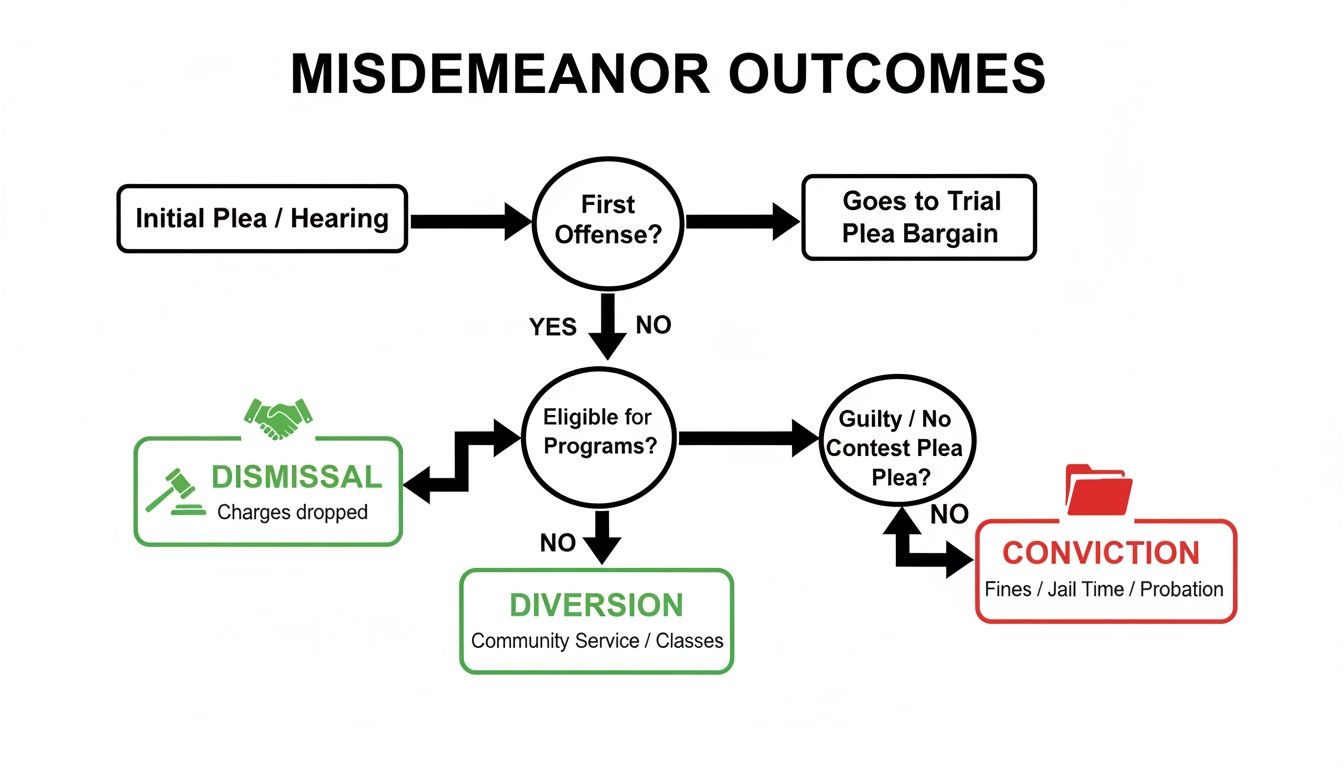
As you can see, getting your case dismissed or dropped opens a much clearer path to restriction. A conviction, on the other hand, makes things a bit more complicated and usually involves a waiting period.
The First Step Eligibility and Timelines
The whole process starts with one critical question: are you even eligible? Georgia law is very specific about this, and the rules depend on the crime itself and, most importantly, how your case was resolved. This isn't a one-size-fits-all deal; the exact steps for someone in Cobb County might differ slightly from the process in Forsyth County.
Here are the key things that determine eligibility:
- Non-Conviction Dispositions: If the prosecutor dropped the charges (a nolle prosequi), the case was dismissed, or you were found not guilty at trial, you're generally eligible to apply for record restriction right away. But remember, the arrest itself will stay on your record until you go through this process.
- Diversion or First Offender Programs: If you successfully finished a program like pretrial diversion or got First Offender treatment, the charges were likely dismissed. This makes the record eligible for restriction.
- Certain Misdemeanor Convictions: For some misdemeanor convictions, you may be eligible to apply after four years have passed since you completed your entire sentence—that means all probation, fines, and classes are done. You also can’t have any new convictions during that four-year waiting period.
It’s crucial to understand that not every conviction can be restricted. Certain offenses, especially serious traffic crimes like DUI, have their own set of tough, specific rules that make restriction much more difficult, if not impossible.
A General Overview of the Restriction Process
While the paperwork and procedures can feel a little different between jurisdictions like Marietta and Johns Creek, the overall process follows a pretty standard path. It’s a journey that demands precision and careful attention to court rules.
Here’s a look at the typical steps involved:
- Gathering Information: First, you’ll need to collect all the essential documents, like the final disposition of your case, the original arrest report, and any other court records.
- Completing the Correct Forms: You have to fill out the official application for record restriction. Any mistakes on this paperwork can cause major delays or even get your request denied outright.
- Filing with the Arresting Agency: The application usually gets submitted first to the police or sheriff's department that arrested you.
- Prosecutor's Review: Next, the prosecutor who handled your case will review your application to see if they agree that you qualify under Georgia law.
- Final Court Order: If the prosecutor approves it, the request goes to a judge who signs the final order to restrict your record. That order is then sent to the Georgia Crime Information Center (GCIC) to officially update your criminal history.
Navigating this can be tricky. For a more detailed breakdown, check out our guide on how you can expunge a misdemeanor in Georgia.
The whole point of record restriction is to get rid of the public stigma from a past charge. While law enforcement can still access the record for official business, it becomes invisible to the kind of background checks that stand between you and a new job, apartment, or loan.
The Everyday Impact of a Lingering Misdemeanor

A misdemeanor record isn't just a file tucked away in a government database. It’s a shadow that follows you into the most important parts of your life, throwing up roadblocks you never saw coming. Knowing how long misdemeanors stay on your record is one thing, but seeing the real-world consequences makes the problem personal and urgent.
Picture this: a highly qualified professional in Johns Creek finds the perfect apartment, but their application is denied because of a shoplifting charge from five years ago. Or a skilled worker in East Cobb gets passed over for a promotion again after a routine background check flags an old misdemeanor, making management question their judgment. These aren't just stories; they're the reality for countless people across Georgia.
The impact isn't just about feeling judged—it's about being shut out of opportunities. A misdemeanor can become a serious barrier affecting your financial stability, career growth, and overall quality of life long after you've paid your debt to the court.
Employment and Professional Licensing
One of the most immediate and damaging consequences of a misdemeanor record is the hit it takes on your career. Many employers, from small businesses in Roswell to large corporations in Cobb County, run background checks as a standard part of their hiring process.
A misdemeanor conviction can be an automatic "no" for certain jobs, especially those involving trust, finances, or working with vulnerable people. The simple fact of a record can cause a potential employer to pick another candidate, even if you’re the most qualified person for the job.
It doesn’t stop there. A criminal record can also prevent you from getting or renewing a professional license. Many licensing boards have strict character requirements that are tough to meet with a misdemeanor on your record. This can sideline careers in all sorts of fields:
- Nursing and Healthcare: A past record could stop you from getting the license you need to practice.
- Real Estate: Agents and brokers often face intense scrutiny during the licensing process.
- Education: A past charge can make it impossible to get a job in schools or working with children.
- Commercial Driving: Certain offenses can disqualify you from holding a commercial driver's license (CDL).
Housing and Financial Opportunities
The challenges extend well beyond your career. Landlords and property managers in competitive areas like Alpharetta and Forsyth County routinely run background checks on everyone who applies. A misdemeanor can be grounds for an immediate denial, forcing you into less desirable housing or making it incredibly difficult to find a place to live at all.
This scrutiny creeps into financial matters, too. When you apply for a mortgage or a personal loan, a background check might be part of the bank's risk assessment. A misdemeanor can also complicate applications for student loans or other financial aid, limiting your ability to go back to school and improve your situation.
The impact of even a minor criminal record can ripple through every aspect of life. It can create a cycle of lost opportunities, making it harder to secure stable employment, find safe housing, and build a secure future for yourself and your family.
These aren't small hurdles. In high-stakes areas like Forsyth County and Johns Creek, the sheer number of criminal records creates barriers that are just as significant as a lack of education. By 2015, 70 million people in the U.S. had records, with arrests hitting 48% of Black males and 38% of white males by age 23. This dooms countless young adults to constant scrutiny in the job markets around Alpharetta and Roswell. You can learn more by reading about the trends in mass incarceration and their effects.
How to Get a Copy of Your Georgia Criminal History
Before you can take any steps to clean up your record, you first have to know exactly what it says. You need the official version, not what some third-party website might show you. This is about getting your hands on the real-deal report that employers, licensing boards, and courts actually see.
The one and only authoritative source for this is the Georgia Crime Information Center (GCIC). While you'll find plenty of online services offering "background checks," the GCIC report is the official document. Getting a copy ensures you're working with the most accurate and complete information available.
Start With Local Law Enforcement
The most direct way to get your personal criminal history in Georgia is to go through a local law enforcement agency. This could be your county sheriff's office or a local police department. Whether you're in Milton, Alpharetta, or Marietta, most departments provide this service for a small fee.
You'll have to go in person and bring a valid, government-issued photo ID, like your driver's license or passport. This is a crucial step to verify your identity and make sure you're only requesting your own confidential information.
What to Expect When You Go
The process itself is pretty simple and routine for them. Here’s what will likely happen:
- You'll fill out a consent form. This gives the agency official permission to pull your GCIC record.
- You'll provide personal info. Be ready with your full name, date of birth, and social security number.
- You'll pay a small fee. The cost is usually nominal, typically around $20 to $25, but it can vary by agency.
- They might take your fingerprints. Many departments now use electronic fingerprinting to get an exact match with state and national databases, ensuring accuracy.
Once that's done, the agency will run your request and give you a printed copy of your official criminal history report.
It's so important to get your official GCIC report instead of relying on those third-party background check websites. Private services can have outdated or just plain wrong information. The GCIC report is what really matters—it's the document employers and courts will actually use.
How to Read Your Report
When you get the report, it can look a little intimidating. Take a moment and review it carefully. You're looking for accuracy on a few key details for each entry: the date of the arrest, the specific charges, and most importantly, the final disposition of the case.
That final outcome—whether it was a conviction, a dismissal, or you completed a diversion program—is the single most critical piece of information. It informs you of your options for getting the record restricted and is the foundation for any next steps.
Common Myths About Misdemeanor Records Debunked
There's a lot of bad information out there about criminal records, and unfortunately, that misinformation can lead people to do nothing, get their hopes up for the wrong reasons, or miss a real opportunity to clean up their past. It’s common for people in places like Cobb County and Marietta to make major life decisions based on things they've heard that just aren't true.
Let's clear the air and tackle some of the most common myths about how long a misdemeanor actually stays on your record in Georgia.
Myth 1: My Misdemeanor Will Vanish After Seven Years
This is easily one of the most persistent—and damaging—myths out there. It probably comes from the way credit bureaus handle old debts, which typically fall off a credit report after about seven years. But that rule has absolutely nothing to do with a Georgia criminal record.
Fact: A misdemeanor conviction in Georgia stays on your official criminal history permanently. It does not automatically expire or just disappear after seven years, ten years, or any other amount of time. Unless formal steps are taken to have that record restricted, it will remain visible to anyone who runs a background check on you, forever.
Myth 2: If My Case Was Dismissed, the Record Is Gone
It makes perfect sense to think that if your charges were dropped or you were found not guilty, the whole incident would just be wiped clean. Sadly, that’s not how the system is designed to work.
Fact: An arrest record is created the second you’re taken into custody. That arrest record exists completely separately from how your court case turns out. So even with a full dismissal or an acquittal at trial, the record of the arrest and the original charges are still sitting on your GCIC (Georgia Crime Information Center) report. It stays there, visible, until you go through the official record restriction process to have its access limited.
It's a common point of confusion, but a dismissed case doesn't erase the arrest. The system is designed to document the entire interaction, from start to finish, and only a formal court order can change what the public can see.
Myth 3: Record Restriction Erases My Criminal History
People often throw around words like "expungement," "sealing," and "restriction" as if they all mean the same thing. This leads to a lot of confusion about what the process really does, with many believing it completely destroys the record as if it never happened.
Fact: Record restriction does not destroy or erase anything. What it does is limit access to that record. For the vast majority of people—private employers, landlords, the general public—a restricted record becomes invisible. However, law enforcement and certain government agencies can still see the information for specific, official reasons. It's critical to know what you're actually getting, and you can learn more about the distinction between expunged and sealed records to understand why the terminology truly matters.
Common Questions About Georgia Misdemeanor Records
Even after you get the basics down, it's the specific "what if" scenarios that tend to cause the most stress. When you're trying to figure out how long a misdemeanor will follow you in Georgia, you're bound to run into some unique situations. Let's clear up a few of the most common questions.
If I Completed First Offender Treatment, Is It Still on My Record?
This is a big one. When a person successfully finishes a sentence under Georgia's First Offender Act, the good news is they are not considered to have a conviction. That's a huge win.
But here's the catch: the record of the charge and its special handling under the Act doesn't just vanish into thin air. It's sealed from the public's view, but it can still be accessed for certain sensitive background checks, like those for jobs in law enforcement or with the government. The key takeaway is that it doesn't completely disappear on its own.
Can a Misdemeanor from Another State Show Up on My Georgia Record?
Yes, and you should assume it will. States don't operate in a vacuum; they share criminal history information through massive national databases like the National Crime Information Center (NCIC).
Thanks to this interconnected system, a misdemeanor charge from Florida or Tennessee will almost certainly pop up during a thorough background check run here in Georgia. The laws of the state where the offense happened will be what matter for sealing it, but you can bet it will be visible across state lines.
Does Record Restriction Completely Erase My Misdemeanor?
"Erase" isn't quite the right word. Record restriction in Georgia doesn't destroy the record—it just severely limits who can see it.
Think of it like making a document confidential. For most private employers, landlords, and the general public, the restricted record becomes invisible. However, law enforcement and certain government agencies can still access the information for official business. The goal is to remove the barriers that record creates in your daily life.
So while it's not gone forever, for practical purposes like applying for a job in Cumming or an apartment in Roswell, it has a powerful, positive effect.
How Long Do I Have to Wait to Restrict a Misdemeanor in Georgia?
There's no single timeline; the waiting period depends entirely on how your case was resolved.
- Dismissals or Acquittals: If the prosecutor dropped the charges or you were found "not guilty" at trial, you can often apply for restriction almost immediately.
- Certain Convictions: If you were convicted of a qualifying misdemeanor, you may be eligible after four years have passed since you fully completed your sentence. That means all probation, fines, and conditions are done, and—this is critical—you have no new convictions or pending charges during that four-year window.
The rules are incredibly specific to each outcome, which is why it's so important to know exactly how your case was finalized.
Figuring out the details of your criminal history is the first step toward putting it behind you. If you have questions about a past charge in Alpharetta, Johns Creek, Milton, Marietta, Forsyth County, East Cobb, or Cobb County, contact Brian Hansford Law to discuss your specific situation. You can learn more at https://challengemycharge.com.
