
In Georgia, a bench warrant does not expire and stays active indefinitely until a judge resolves it. If you were hoping it would disappear with time, that’s the first and most important thing to understand.
A lot of people learn about a bench warrant in the worst possible way. A routine traffic stop in Alpharetta turns into handcuffs. A missed court date in Roswell comes back up when you try to clear a license issue. A probation check in Cobb County suddenly becomes a jail risk. The problem often starts small, then grows because nothing forced it back onto your calendar until law enforcement found it.
That doesn’t mean you’re out of options. It means the smart move is to deal with it before the warrant deals with you.
If you’re searching how long does a bench warrant last, you’re probably not looking for abstract legal theory. You want to know whether this can still affect you, whether you can be arrested, and what works in North Atlanta courts. Those are practical questions, and they deserve practical answers.
A bench warrant is serious, but it’s also often fixable with the right approach. In many cases, the difference between a controlled court appearance and an avoidable arrest comes down to speed, preparation, and local court knowledge. That matters in places like Fulton County, Forsyth County, and Cobb County, where procedure, timing, and how the court handles warrant recalls can shape the outcome.
Introduction You Have a Bench Warrant What Happens Now
The first move is simple. Take the warrant seriously and stop guessing.
People often call after a missed DUI court date, an old reckless driving case, an unpaid fine tied to a traffic ticket, or a probation issue that seemed minor at the time. They’re usually asking the same question in different forms: can I wait this out? In Georgia, the answer is no.
A bench warrant is a judge’s order that law enforcement bring you before the court. Once it’s active, it can follow you into ordinary parts of life. Driving to work in Johns Creek. Picking up your child in Milton. Traveling through Sandy Springs or Marietta. The warrant doesn’t care that you changed jobs, moved counties, or forgot about the original date.
Practical rule: If you know a warrant may exist, act before your next police contact, not after it.
That urgency matters even more for people already dealing with related legal pressure. If you’re looking for a DUI lawyer in Alpharetta, a reckless driving lawyer in Roswell, a traffic ticket attorney near me, or a drug possession lawyer in Cumming, a bench warrant can quickly become the issue that controls everything else. It can affect court scheduling, release conditions, license concerns, and how the judge views your reliability.
What to do first
There are three immediate priorities:
- Confirm the warrant status. Don’t rely on rumor, a missed call, or an old letter.
- Identify the court involved. A municipal court warrant is handled differently from a state or superior court problem.
- Get a defense lawyer involved before you walk into court alone. That’s often the difference between a planned resolution and a preventable booking.
What not to do
Some responses make the situation worse:
- Ignoring it: Time won’t clear the warrant.
- Showing up without preparation: A judge may decide to take you into custody on the spot.
- Assuming it’s only a ticket issue: Old speeding ticket and misdemeanor cases can still create very real arrest consequences.
If you deal with it early, you may be able to control the process. If you wait, the process usually controls you.
Understanding What a Bench Warrant Is and Why It Was Issued
A bench warrant is a direct order from a judge for your arrest. “Bench” refers to the judge’s bench. This isn’t the court investigating a new crime. It’s the court responding because it believes you didn’t follow a prior court order.
That distinction matters. In many North Atlanta cases, the person already had a case pending. Then something went wrong with compliance. The court’s answer was the warrant.
According to Shouse Law’s discussion of how long a bench warrant lasts, bench warrants do not expire and remain active indefinitely until cleared by a judge, and they’re commonly issued for failure to appear, probation violations, or unpaid fines. The same basic pattern applies in Georgia, where courts use warrants to enforce compliance with court orders.
The most common reasons judges issue them
Most bench warrants in this context come from one of a few situations:
- Failure to appear for court: This is the classic trigger. It can happen in a DUI case, a speeding ticket case, a reckless driving charge, a misdemeanor theft case, or a drug possession case.
- Failure to pay: Missing a required payment can become a court compliance issue.
- Probation violations: Missing a probation appointment, violating a condition, or failing to complete a required class can lead to a bench warrant.
A useful way to think about it is this. The original case may be about the charge itself. The bench warrant is about the court believing you didn’t follow the rules after the case began.
Why this catches people off guard
Many people don’t miss court on purpose. They moved. They misunderstood the date. They thought a lawyer or clerk would reset it. They assumed paying part of a fine was enough. Some people don’t even realize they had a mandatory appearance tied to a traffic or criminal case.
A bench warrant usually starts as a court compliance problem, but it can become a custody problem very quickly.
If you’re trying to understand the broader process behind warrants, this Georgia arrest warrant guide is a useful companion resource. It helps clarify the difference between warrant types and why court-issued warrants need a focused response.
The Indefinite Lifespan of a Georgia Bench Warrant
If your question is strictly about duration, the answer is direct. In Georgia, a bench warrant for failure to appear remains active without automatic expiration.

That surprises people because they assume every legal problem has a shelf life. Some do. This one usually doesn’t. The warrant stays live until a judge recalls it, quashes it, or otherwise resolves it through the court process.
Georgia is not a wait-it-out state
According to this Avvo analysis of how long a bench warrant stays active, some states such as Washington may set a 7-year expiration on certain warrants, but Georgia bench warrants under O.C.G.A. § 17-4-42 for failure to appear remain active without automatic expiration. That distinction is important for people in Cumming, East Cobb, Alpharetta, and surrounding North Atlanta courts because general internet advice often mixes state rules together.
A person reading national articles may come away with the wrong impression. Georgia courts don’t treat a bench warrant like an old parking receipt that eventually fades away. They treat it as an unresolved court order.
The myth that causes the most damage
One of the most common mistakes is confusing the statute of limitations on the original charge with the life of the warrant.
Those are not the same thing.
If someone missed court years ago on a misdemeanor matter, they may assume the age of the original case protects them now. Usually, it doesn’t. The failure to appear and the resulting bench warrant create a separate court enforcement issue. That’s why an old traffic matter or misdemeanor case can still produce a fresh arrest problem long after the original event.
What this means in practice in North Atlanta
Local courts don’t all move the same way, but they share one basic point. If the warrant is active, it needs affirmative action. In practical terms, that usually means one of these paths:
| Situation | Likely Reality |
|---|---|
| You ignore the warrant | It remains active |
| You wait for “the system” to clear it | It usually won’t |
| You address it through counsel or court process | You create a chance to resolve it |
The age of the case doesn’t neutralize the warrant. Court action does.
That’s why local procedure matters. A recall approach that works in one North Atlanta courtroom may need to be handled differently in another, especially when the underlying case involves DUI, probation, or a prior bond condition.
The Severe Consequences of an Unresolved Warrant
Individuals typically don’t feel the risk of a bench warrant every day. Then one day they do.
An unresolved warrant can turn an ordinary police encounter into an arrest. A stop for speeding in Roswell. A tag issue in Marietta. A traffic checkpoint in Forsyth County. Once the officer sees the warrant, the question usually stops being whether the case is old and starts being how fast the court can get you before a judge.
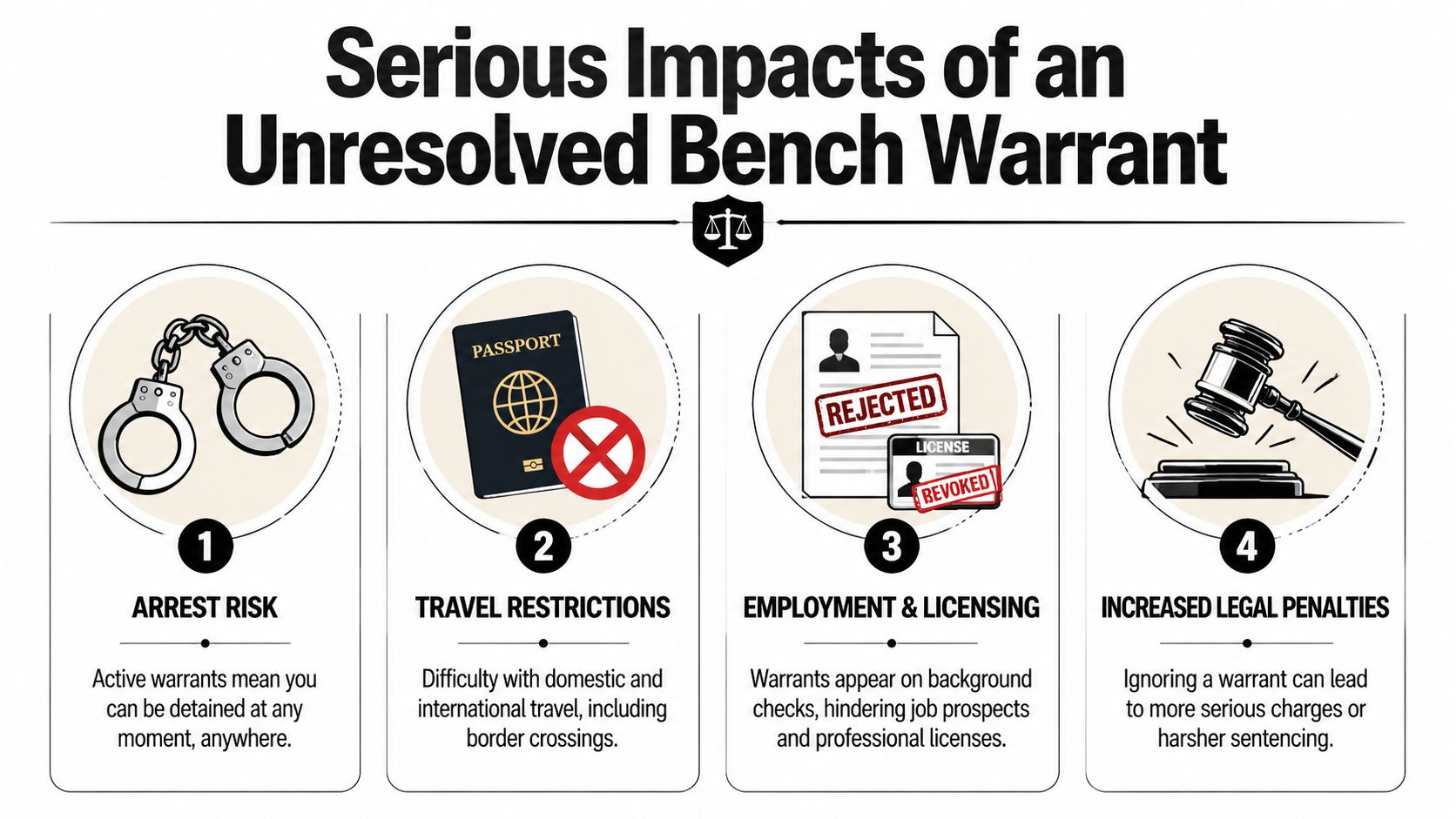
That’s why waiting is rarely the cheaper or safer option. It exposes you to sudden custody, missed work, family disruption, and a much harder legal posture when the case finally lands back in court.
How long you can be held
According to Top Criminal Law Firm’s discussion of bench warrant jail time, detention after arrest on a bench warrant can last from hours to weeks. Minor misdemeanor cases may be resolved the same day, while felony or probation violation warrants often lead to being held for several days or longer. The same source notes that in serious cases, 30-50% of these holds are no bond, which means a judge must review the case before release is even possible.
For someone with a missed court date on a traffic matter, that may mean a short but still damaging jail stay. For someone with a pending DUI, probation issue, or felony matter, the hold can last much longer and become much harder to unwind quickly.
The practical fallout people underestimate
The legal risk is only part of it. The disruption tends to spread into other parts of life:
- Work problems: Missing shifts, losing employer trust, or failing a background screening.
- Family strain: Childcare falls apart fast when someone is booked unexpectedly.
- Travel trouble: Even domestic travel can become risky when police contact happens at the wrong time.
- Licensing concerns: If you already face issues involving a suspended license, DDS consequences, or unresolved traffic court obligations, a warrant adds pressure.
If you want a fuller look at that collateral damage, this explanation of whether bench warrants show up on background checks is worth reading. It helps connect the criminal court issue to employment and screening realities.
Why unresolved warrants tend to get worse
Judges pay attention to whether a person addressed the issue voluntarily or got brought in by force. That doesn’t guarantee a specific result, but it affects how the situation is viewed. In court, timing often sends a message.
If you clear the issue proactively, you have a chance to explain it. If police arrest you on the warrant, the court starts from control, not cooperation.
For people searching for a DUI attorney in Johns Creek, speeding ticket lawyer in Cumming, license suspension lawyer near me, or misdemeanor defense attorney in Marietta, legal strategy is most critical. The bench warrant can become the pressure point that affects bond, scheduling, negotiations, and credibility with the judge.
Proactive Steps to Resolve a Georgia Bench Warrant
The worst plan is usually the one people try first. Ignore it. Stay off the roads. Hope nothing happens.
That approach fails because it gives you no control over timing, location, or custody. If police find you first, they choose the moment. The court then addresses the warrant under pressure, often with less room for preparation.

The better approach is usually attorney-led and deliberate.
What tends to work
In many cases, a lawyer can contact the court, confirm the warrant, review the underlying case, and determine whether filing a motion to quash or motion to recall makes sense. Those terms both refer to asking the court to withdraw the warrant and place the case back on track.
According to this analysis of pre-arrest recall motions, attorney intervention can cut potential jail time by 60-80% when a lawyer files coordinated recall motions before arrest. The same source notes that this strategy can allow a walk-in docket appearance instead of a multi-day jail stay in a probation violation context.
That doesn’t mean every warrant disappears with one filing. It means preparation changes the field.
A realistic sequence for North Atlanta cases
A strong response usually looks like this:
Confirm the warrant and the court
The first step is accuracy. You need the correct case number, court, and reason for issuance. If you’re trying to gather public record information, this guide to finding arrest records in Georgia can help you understand part of the record trail.
Review the underlying problem
Missing court on a speeding ticket is different from violating probation on a DUI. A lawyer needs to know which issue triggered the warrant, what the judge expected, and whether there were notice problems, compliance issues, or misunderstanding.
Choose the safest appearance strategy
Sometimes counsel can arrange a controlled return to court. In other cases, voluntary surrender may be the cleaner option. The right decision depends on the charge, the judge, prior history, and whether bond is likely to be revisited.
Present the fix, not just the excuse
Courts respond better when the person comes back ready to solve the problem. That can mean proof of treatment enrollment, completed classes, payment readiness, updated contact information, or a plan to reset the case promptly.
What clients should do before speaking freely
People often make the situation worse by discussing facts loosely over text, email, or with third parties before they’ve had a legal consultation. Keeping communications focused and protected matters. If you want a plain-English explanation of that issue, Documind on legal communication offers a helpful overview of how attorney-client privilege works and why careless sharing can create avoidable problems.
Resolve the warrant with a strategy, not an apology tour. Courts care most about whether the issue is being fixed correctly.
For North Atlanta cases, the right approach often depends on knowing how local judges and clerks handle recall requests, walk-in appearances, probation violations, and missed DUI court dates. Generic advice won’t tell you that.
Navigating North Atlanta Courts A Local Guide
Bench warrant problems are local. The right courthouse matters. The right clerk’s office matters. The right day to address the issue matters. If the case sits in the wrong court, you can waste time and increase risk by showing up in the wrong place.
For clients and families dealing with language barriers, clear communication with the court can matter just as much as timing. This guide on ensuring legal language access explains why a court-certified interpreter may be necessary in criminal proceedings.
North Atlanta Court Contact Information for Warrant Inquiries
| Jurisdiction | Court Name | Address | Phone Number |
|---|---|---|---|
| Alpharetta | Alpharetta Municipal Court | 12624 Broadwell Rd, Alpharetta, GA 30004 | (678) 297-6250 |
| Roswell | Roswell Municipal Court | 38 Hill Street, Roswell, GA 30075 | (770) 641-3844 |
| Milton | Milton Municipal Court | 13690 Highway 9, Milton, GA 30004 | (678) 242-2530 |
| Cumming | Forsyth County State Court | 1090 Tribble Gap Rd, Cumming, GA 30040 | (770) 781-2120 |
| Marietta | Cobb County State Court | 12 East Park Square, Marietta, GA 30090 | (770) 528-2660 |
Local practice points that matter
- Municipal court cases: These often involve traffic, speeding, reckless driving, or city ordinance matters. Missed dates can still create serious warrant exposure.
- State court cases: Many DUI, misdemeanor, and traffic cases in North Atlanta land here. Warrant recall procedure is often more formal, and preparation matters.
- Probation-linked warrants: These tend to require more careful handling than a simple missed ticket date because the court may revisit compliance and custody together.
Call volume and clerk practices vary. Some offices will confirm limited information by phone. Others won’t say much without a case number or lawyer involvement. That’s normal, and it’s one reason local court representation matters.
Frequently Asked Questions About Georgia Bench Warrants
Will a bench warrant show up on a background check
It can. Whether it appears in a given screening depends on the type of check being run and what databases the employer or agency uses. Even when a person isn’t arrested immediately, an active warrant can still create trouble in hiring, licensing, housing, and other screening settings.
Can I clear a Georgia warrant if I live out of state
Yes, sometimes. But distance doesn’t make the warrant less active. The main question is whether the court will allow counsel to appear, whether you must appear personally, and whether the underlying case makes voluntary surrender the safer route. That analysis is especially important in DUI, probation, and felony cases.
What’s the difference between a bench warrant and an arrest warrant
A bench warrant usually comes from the court because you didn’t comply with a court order, such as appearing, paying, or following probation terms. An arrest warrant is generally tied to law enforcement alleging criminal conduct and seeking authority to arrest based on that allegation. Different source. Different purpose. Similar risk if police find you.
Can I just walk into court and explain what happened
Sometimes that works. Sometimes it ends with you taken into custody. The danger is that people assume sincerity is enough. Courts also care about procedure, notice history, prior compliance, and the underlying charge. Walking in without a plan is often the wrong gamble.
If you have an active warrant in Alpharetta, Roswell, Johns Creek, Milton, Cumming, Marietta, or anywhere in North Atlanta, now is the time to deal with it. Brian Hansford Law helps clients address bench warrants, DUI charges, traffic cases, probation issues, and other criminal matters with local court knowledge and practical strategy. A fast response can mean the difference between a controlled resolution and an avoidable arrest.
