
Let's be blunt: when people ask how long a criminal record lasts in Georgia, they're hoping for an expiration date. The reality is much different. In Georgia, a criminal record is for life, unless specific action is taken to change that.
Does a Criminal Record Ever Go Away in Georgia?
Many people get this wrong. They assume a criminal record is like a bad mark on a credit report, that it will just fall off after seven or ten years. That's a common myth.
In reality, a conviction in Georgia is a permanent digital footprint. Once it’s created, it exists indefinitely in state databases, court records, and—critically—in the hands of private data brokers who collect and sell this information. An old charge can pop up on a background check for a new job, an apartment application, or a loan, even decades down the road.
The real question isn't whether the record exists—it does. The question is: who can see it?

The Permanent Nature of Public Records
This isn't a small problem. It's a massive one that creates lifelong hurdles for people trying to move on. Roughly 77 million Americans—that's about 1 in every 3 adults—have a criminal record of some kind.
This statistic, highlighted by the National Conference of State Legislatures, shows just how far these records reach beyond a courtroom. For folks right here in Alpharetta, Roswell, and Forsyth County, understanding that a record is permanent is the first step toward regaining control.
The crucial thing to grasp is the difference between a record's permanent existence and its public visibility. While history can't be erased, it is often possible to control who gets to see it.
This is where a proactive approach is helpful. The record itself might be forever, but its ability to sabotage a future isn't set in stone. Georgia law provides ways to limit who can view a past record, effectively shielding it from potential employers, landlords, and the general public.
Controlling Visibility Through Record Restriction
The main tool used in Georgia to manage a record's public impact is called record restriction. You might have heard the old term "expungement," but restriction is the current process. Think of it less like deleting a file and more like moving it into a locked cabinet that only a few people have the key to.
- Public View: Before restriction, a record is an open book for anyone running a background check.
- Restricted View: After restriction, it’s hidden from public view. Most employers, landlords, and credit agencies won't see it.
- Law Enforcement Access: Even after restriction, the record remains fully visible to law enforcement and for certain criminal justice purposes.
To give a clearer picture, here’s a quick summary of how different records typically appear to the public by default.
Default Visibility of Criminal Records in Georgia
This table summarizes the typical public duration of different records in Georgia before any action for restriction is taken.
| Type of Record | Default Public Visibility | Potential for Change |
|---|---|---|
| Arrest (No Conviction) | Indefinite, unless restricted | High potential for restriction |
| Misdemeanor Conviction | Permanent | Varies; eligible after sentence completion |
| Felony Conviction | Permanent | Limited; may require a pardon first |
| Juvenile Record | Generally sealed at 17/18 | Most automatically become non-public |
| DUI Conviction | Permanent | Not eligible for restriction |
This table shows the starting point. The good news is that for many of these, there are pathways to change that "permanent" visibility.
Understanding these options is vital. Our guide on getting records expunged breaks down the specific processes available here in Georgia. From here, we can dig into how different types of offenses impact your record and the options for managing them.
How Different Offenses Impact Your Record's Lifespan
Not all criminal records are the same, and their long-term impact swings wildly depending on the type and severity of the offense. There's no one-size-fits-all answer to how long a record lasts because the system treats each situation differently.
Think of it like this: an arrest that never leads to charges is like a library book someone requested but never actually checked out. A misdemeanor conviction is a popular paperback that stays in circulation for a long time. But a serious felony conviction? That's a rare reference book, permanently on display for everyone to see. The charge is always the deciding factor.

Arrests Without a Conviction
So, what happens if you were arrested, but the charges were dropped, dismissed, or you were found not guilty at trial? This is a huge point of confusion for many people. The arrest itself creates a record, and that record does not automatically disappear just because you were cleared.
That arrest record can still pop up on certain background checks, forcing awkward conversations and potentially costing a job or a place to live. The good news is that, in Georgia, these are often the most straightforward records to address.
The best news is that when a case doesn't end in a conviction, there is almost always eligibility to have the arrest record restricted. This process essentially seals it from public view, taking it off the table for standard background checks.
This is a critical first step. The path to restricting a non-conviction record is usually much clearer and faster than for one involving a guilty plea or verdict. It's a proactive move to ensure a dismissed case doesn't follow you around for years.
Misdemeanors: The Most Common Type of Conviction
Misdemeanors are less serious crimes, but a conviction still leaves a permanent criminal record. These can be anything from minor shoplifting and public intoxication to a first-offense possession of marijuana. While considered "minor" offenses, a misdemeanor on a record can create major roadblocks in life.
By default, the lifespan of a misdemeanor on a public record is permanent. But Georgia law does recognize that people make mistakes and deserve a second chance after paying their debt to society. For many non-violent misdemeanors, there are ways to get the conviction restricted from public view after a specific waiting period.
To get into the weeds on this, you can learn more about how long misdemeanors stay on your record and the specific rules that apply here in Georgia.
Felonies: The Most Serious Offenses
Felonies are the most serious category of crimes, and they carry the heaviest and most lasting consequences. A felony conviction—for crimes like aggravated assault, burglary, or drug trafficking—becomes a permanent, highly visible part of a public history.
Unlike most misdemeanors, getting a felony conviction restricted is far more complex and isn't even an option for many offenses. For most felony convictions in Georgia, a pardon must first be obtained before an individual can even ask the court to restrict the record.
This multi-step process shows just how seriously the system treats these offenses. The key differences are night and day:
- Eligibility: Many misdemeanors have a direct path to restriction after a sentence is done. Most felonies require a pardon first, which is a significant hurdle.
- Waiting Periods: The time one must wait before starting the process is generally much, much longer for felonies.
- Public Perception: The stigma of a felony conviction can be life-altering, impacting everything from job prospects to fundamental civil rights like voting or owning a firearm.
Ultimately, the type of offense is the single most important factor. Whether it's an arrest that went nowhere, a misdemeanor, or a serious felony, each follows a completely different set of rules dictating how permanent it is and what, if anything, can be done about it.
Here’s how a criminal record really impacts life: the moment someone runs a background check.
It doesn’t matter if it’s for a new job in Alpharetta, an apartment in Marietta, or a professional license—this is where the past collides with the present. To manage the future, it's helpful to first understand how this process actually works.
Most people assume a background check is a single, official file pulled directly from the government. The truth is far messier and much less organized. Think of a record's journey like a ripple in a pond. The initial court filing is the stone, and the information quickly spreads outward, feeding into countless commercial databases.
This is where private background check companies come in. They collect, package, and sell this data, and they are the primary source most employers and landlords use.
Official vs. Commercial Background Checks
It's absolutely critical to know the difference between the two main types of reports. First, there is the official state report from the Georgia Crime Information Center (GCIC). This is the authoritative source, tied directly to law enforcement and the courts.
Then there are the commercial reports run by private companies. These companies send people to courthouses to scrape public records or buy data in bulk. While they're often accurate, they can just as easily be outdated, incomplete, or flat-out wrong.
This is exactly why an old charge that was thought to be long gone can suddenly pop up and derail an opportunity. A private database might have captured an initial arrest but completely missed the update when the case was dismissed or restricted.
The core problem is that a record doesn't live in just one place. It exists in dozens of private databases, each with its own update schedule and level of accuracy. The only way to start cleaning up that downstream information is to address the record at its official source—the court and the GCIC.
This is why just waiting for a record to "fall off" is a losing strategy. A proactive approach is necessary.
What Employers Actually See
When a company in Forsyth County or East Cobb runs a check, they aren't just looking for a "yes" or "no." They get a detailed report that can include a whole range of information:
- Arrest Records: Yes, even if the charges were later dropped.
- Misdemeanor Convictions: Showing the specific charge, date, and sentence.
- Felony Convictions: These are almost always included in any comprehensive check.
- Pending Cases: Any active criminal cases that haven't been resolved yet.
The depth of the check usually depends on the job. A role in finance or childcare will trigger a much more thorough screening than a retail position. But at the end of the day, any mark on a record can become a serious hurdle, forcing an explanation of the past when the focus should be on the future.
The Widespread Impact of a Criminal Record
The consequences of a criminal record ripple out far beyond just one person. Consider this: an estimated 113 million American adults—that’s about 45% of the adult population—have had an immediate family member locked up for at least one night. This creates a massive ripple effect that impacts families and communities for generations.
When you add the 79 million Americans who have a criminal record of their own, the sheer scale of this issue becomes undeniable. If you want to learn more about this far-reaching impact, you can explore the findings on how families are affected.
The widespread nature of criminal records is precisely why understanding background checks is so important. A record isn't just a personal document; it’s a piece of a massive data ecosystem that dictates opportunities for millions. Knowing how that ecosystem works is the first step toward navigating it successfully and making sure the past doesn’t unfairly define the future.
Pathways to Limit a Record's Public Visibility
Just because a criminal record is permanent doesn’t mean its public impact has to be. While the past can't be erased, Georgia law provides specific ways to manage who gets to see it. It’s not about changing what happened; it's about controlling how a record shows up today, especially on the background checks that matter for jobs and housing.
Understanding these tools is the first step toward reclaiming your story. The main options are record restriction and pardons, and each one works differently. The right path for an individual will almost always come down to the specific offense, how the case ended, and how much time has passed since the sentence was completed.
What Is Record Restriction in Georgia?
The most common and powerful tool for managing a record's visibility in Georgia is record restriction. People still use the old term "expungement," but restriction is the modern process. The goal, however, is the same: to limit public access to a criminal record.
Think of it this way: an unrestricted record is like a book on a public library shelf, free for anyone to pick up and read. When a record is restricted, that book is moved to a locked, private archive. It still exists, but the general public—including most employers and landlords—can no longer get their hands on it.
Record restriction does not destroy or erase a criminal record. Instead, it seals it from public view, making it inaccessible for most standard background checks. Law enforcement and certain government agencies can still see the record for criminal justice purposes.
This distinction is crucial. The point isn’t to pretend something never happened. It's about giving people who have paid their debt to society a fair chance to move forward without being permanently held back by one mistake. The process effectively removes a major barrier to employment, housing, and other opportunities. To get a better handle on the nuts and bolts, you can learn more about how to seal criminal records.
This flowchart breaks down how information from a criminal record flows through various databases and ultimately appears—or is hidden—on a background check.
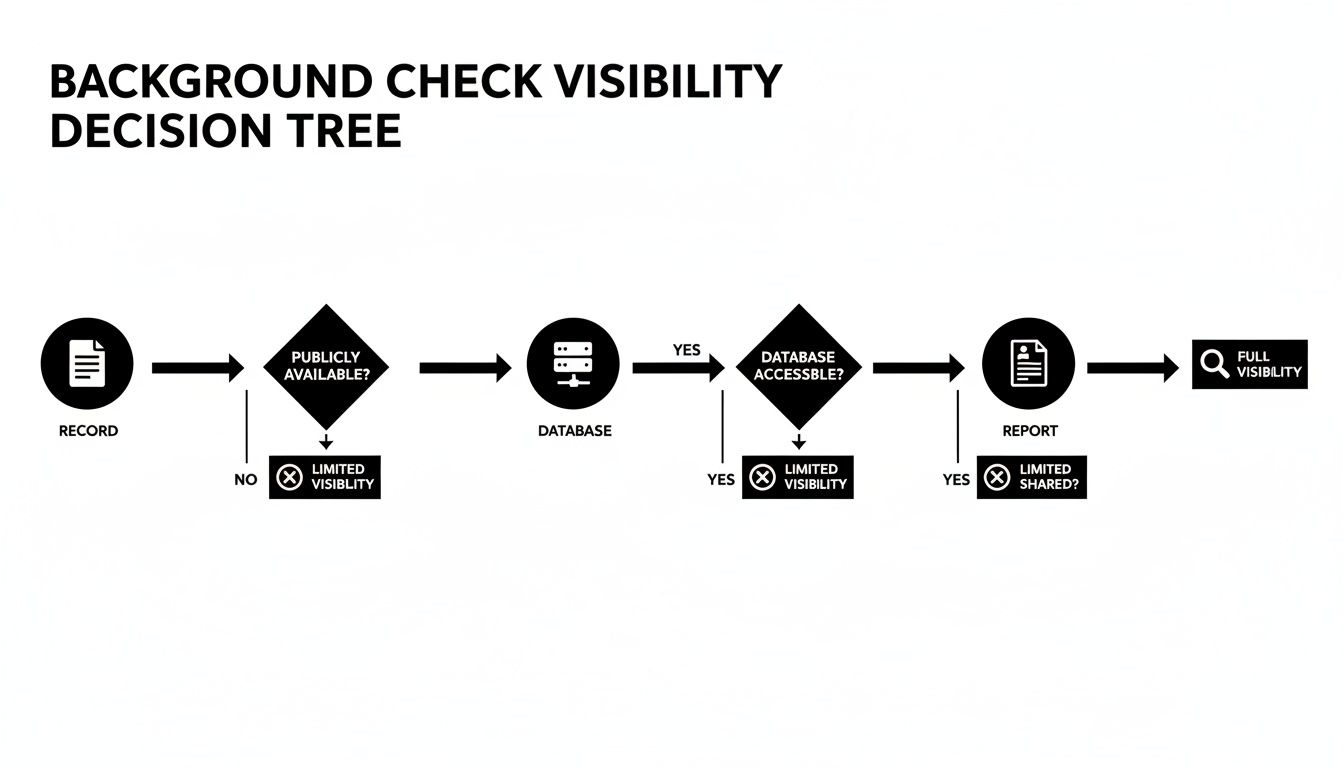
As you can see, without taking proactive steps like restriction, a record stays visible. That’s why understanding these pathways is so important.
Understanding Pardons and Their Role
A pardon is another tool, but it works very differently from restriction. A pardon is an official act of forgiveness from the state. It doesn't seal or hide the conviction—the record remains publicly visible.
So, what’s the point? A pardon restores civil rights that were lost because of a conviction, like the right to vote, serve on a jury, or hold public office. More importantly for many people, it sends a powerful signal to potential employers that a person has been formally forgiven and rehabilitated.
For most felony convictions in Georgia, a pardon is a mandatory first step before an application can be made to have the record restricted. This makes cleaning up a felony record a two-step journey: first forgiveness (the pardon), then limiting visibility (the restriction).
Comparing the Available Options
Seeing these processes side-by-side helps make their different roles clear. Each one serves a unique purpose and is meant for different situations.
Here’s a quick breakdown to help compare the relief options available in Georgia.
Comparing Record Relief Options in Georgia
| Process | Primary Goal | Effect on Public Visibility | Commonly Associated Offenses |
|---|---|---|---|
| Record Restriction | To seal a record from public view, limiting access on background checks. | Removes the record from most public and commercial databases. | Arrests without conviction, most misdemeanors, and some pardoned felonies. |
| Pardon | To grant official forgiveness and restore civil rights. | Does not change public visibility; the record remains public. | Primarily used for felony convictions as a first step toward restriction. |
Remember, eligibility for either pathway isn't automatic. It depends heavily on the specifics of a case, including:
- The nature of the offense (violent vs. non-violent)
- The outcome of the case (dismissal, first offender, conviction)
- Completion of the sentence (all fines, fees, and probation must be finished)
- Waiting periods (a set amount of time must pass without new offenses)
Navigating these rules is essential. For residents in communities like Johns Creek, Milton, and Cumming, knowing which pathway might apply is the first step in tackling a criminal record's long-term impact. While the question of "how long does a criminal record last" often starts with "forever," these tools show that its public lifespan can be actively managed.
Why Some Convictions Never Go Away
While Georgia law provides a path to seal many criminal records, it draws a firm line when it comes to certain offenses. Not every conviction can be restricted, and this isn't an oversight—it's a deliberate public policy choice meant to balance an individual's right to a second chance with the need for public safety.
The system essentially views different crimes through a lens of risk. Offenses that are seen as a higher threat to public harm are often designated as permanent fixtures on a person's record. This is why crimes like serious violent felonies and DUI are treated so differently from, say, a first-offense shoplifting charge.
Public Safety and Permanent Records
At its core, the reason some convictions are permanent is simple: public safety. Lawmakers have decided that for certain serious crimes, the public’s right to know outweighs an individual’s desire for a clean slate. This is built on the idea that employers, landlords, and professional licensing boards should have access to information that might signal a risk to others.
Georgia is especially strict with DUI convictions. A DUI cannot be restricted from a record, which means it will stay on both a criminal history and a driving record for life. This isn't a mistake; it's a strong policy statement designed to deter drunk driving by making the consequences permanent.
This same logic applies to many serious violent felonies and sexual offenses. The system is designed to keep these records fully accessible to help prevent people convicted of these crimes from getting into positions of trust where they might pose a danger to others.
State vs. Federal: A Critical Distinction
Adding another layer of complication is the difference between state and federal records. All the rules discussed so far about record restriction apply specifically to crimes prosecuted under Georgia state law. If a person is convicted of a federal crime—like bank fraud, drug trafficking across state lines, or certain gun offenses—it's a completely different ballpark.
The federal justice system operates under its own rules, and unfortunately, it offers almost no options for sealing or expunging an adult criminal conviction.
A federal conviction is, for all practical purposes, a life sentence for a record. Unlike Georgia, which has created specific tools like record restriction, the federal system provides virtually no way to limit a conviction's public visibility.
This means a federal record will follow a person forever, highlighting just how high the stakes are in a federal case. It underscores why having a powerful defense from day one is so critical, because the chance to clean up the record later simply doesn't exist. For residents in areas like Cumming, Marietta, and Cobb County, it’s worth noting the data on recidivism, which heavily influences these policies. Research shows that 83% of released prisoners were arrested again within 9 years, illustrating how a conviction can trap someone in a long-term cycle. You can read the full study about recidivism trends from the Bureau of Justice Statistics to learn more.
How Recidivism Shapes the Law
The policies that keep certain records permanent are heavily influenced by statistics on reoffending, also known as recidivism. When crafting laws, legislators often look at data showing the likelihood that someone convicted of a specific crime will commit another one. For many serious offenses, those rates can be high, which is used to justify keeping those records public.
Of course, this creates a massive, lifelong roadblock for individuals who have truly turned their lives around. It’s a tough balancing act, and the law reflects this ongoing debate between punishment, public safety, and personal redemption. Knowing that some records are designed to be permanent reinforces a critical point: the best—and sometimes only—way to control a record is to build the strongest possible defense from the very beginning.
What Are Your Next Steps?
We’ve covered a lot of ground, and if there’s one thing to take away, it’s that a criminal record isn't a simple, fixed thing. The real answer to “how long does a criminal record last?” depends entirely on the charge, how a case ended, and—most importantly—what is done after it’s all over.
The good news is that people are not stuck. Georgia law provides specific ways to restrict a record and keep a past mistake from defining the future. But navigating the rules for record restriction and expungement can get complicated fast. Eligibility hinges on the fine print of a specific case history, and there’s simply no one-size-fits-all answer.
If you have questions about a record in Forsyth County, Cumming, Alpharetta, or Roswell, the best first step is to get clarity. Understanding the unique circumstances of a case is key. This is especially true for more complex histories. Having a professional with experience as a former prosecutor can make a difference in mapping out the road ahead and providing a clear strategy for moving forward.
Common Questions About Criminal Records
When dealing with the fallout of a criminal charge, a lot of questions pop up. Here are some clear, direct answers to the most common concerns about how long a criminal record can follow you in Georgia.
Does a Criminal Record Just Go Away on Its Own in Georgia?
Generally, no. In Georgia, an adult criminal conviction is pretty much permanent unless specific steps are taken to get it restricted. There's no magic date on the calendar when a record automatically disappears after a certain number of years.
The main exception to this is for some juvenile records. Those are often sealed once a person becomes an adult, but only if they meet certain conditions.
My Case Was Dismissed. Will It Still Show Up on a Background Check?
Yes, it absolutely can. This is a surprise for a lot of people. Even if your case was dismissed or you were found not guilty at trial, the record of the arrest itself and the court filing can still pop up on more detailed background checks.
To keep that information from being seen by potential employers or landlords, the record restriction process must be completed for that specific arrest. If not, the arrest record stays out there for the public to find.
What's the Difference Between Record Restriction and Expungement?
In Georgia, "record restriction" is the official term for what most people still call "expungement." While you'll hear both terms used, they mean slightly different things.
Record restriction doesn't mean the record is physically destroyed. Instead, it’s like putting it in a locked file cabinet. Access is restricted so the general public, including most employers and landlords, can't see it anymore. Law enforcement can still access it for official criminal justice purposes, but it's hidden from public view.
Can I Get a DUI Conviction Restricted from My Record in Georgia?
Under current Georgia law, a conviction for Driving Under the Influence (DUI) is one of the few offenses that is specifically not eligible for record restriction.
This means a DUI conviction will stay on both a criminal history and a driving record for good. That policy really highlights why it's so critical to build a strong defense from the moment a person is charged with a DUI.
Understanding what's on your record and what can be done about it is the first real step toward putting it all behind you. If you have questions about your own situation in communities like Alpharetta, Roswell, or anywhere in Forsyth County, Brian Hansford Law is here to give you the clarity you need. Find out more by visiting us at https://challengemycharge.com.
