
Getting a speeding ticket in Georgia can feel like a simple, frustrating expense. But behind that fine is a point system that can have a much bigger impact on your life than you might realize. Depending on how fast you were going, a single ticket can add anywhere from 2 to 6 points to your license.
It’s not just about one ticket. It’s about how these points add up.
Understanding How Speeding Ticket Points Work in Georgia
So, you’ve been pulled over. The first question that probably pops into your head is, "How many points is this going to be?" In Georgia, there isn't one flat number. The Georgia Department of Driver Services (DDS) uses a tiered system where the penalty matches the speed.
Think of it as a running tab on your driving record. Every violation adds to your total, and if that total gets too high, you start facing serious consequences. Getting a handle on how this system works is your first line of defense in protecting your ability to drive.
Georgia's Point System for Speeding
The faster you go, the more points you get. It’s that simple. While creeping a few miles over the limit might not seem like a big deal, those points can stack up faster than you think, especially if you have a daily commute through busy areas like Alpharetta, Cumming, or anywhere in Forsyth County. This system is designed to flag risky driving before it leads to something much worse.
The chart below breaks down exactly how points are assigned. It’s a clear look at how quickly the penalties escalate with your speed.
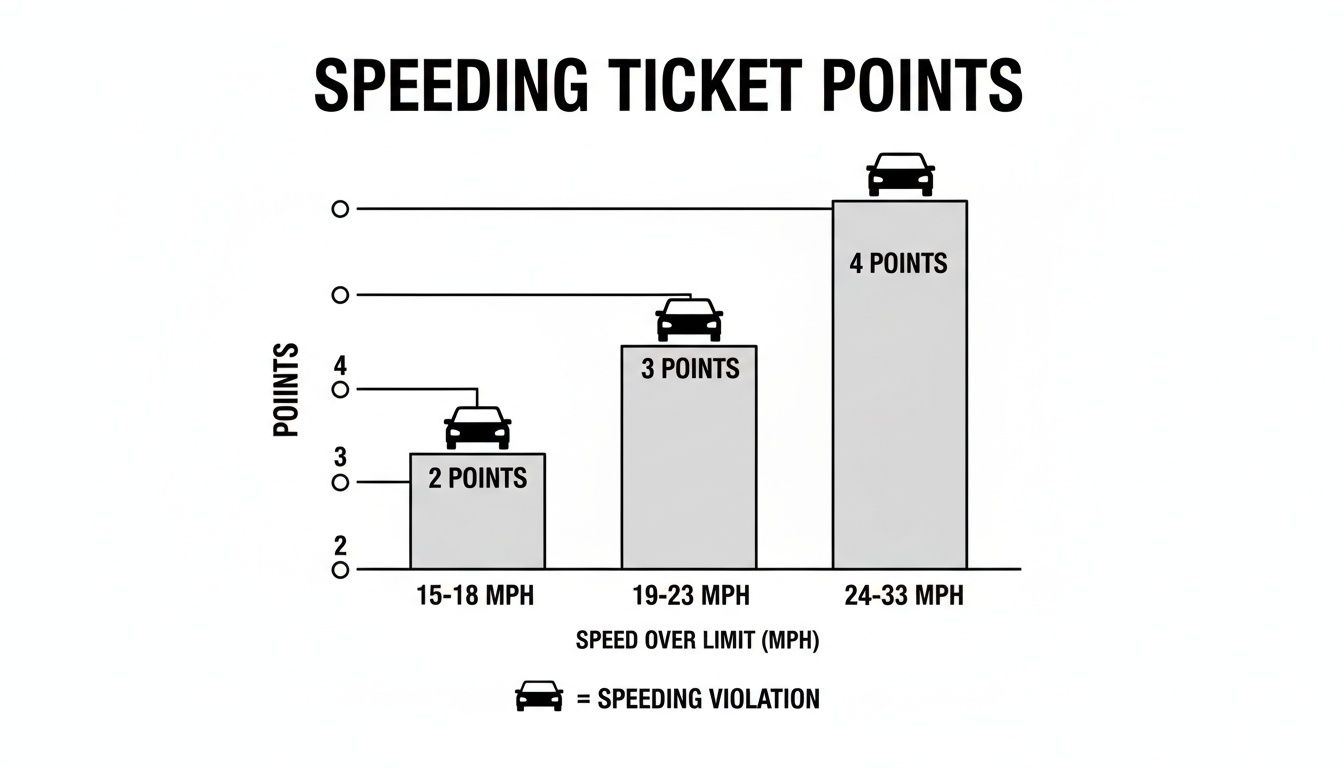
As you can see, the jump from a minor infraction to a serious one happens fast. This is why paying close attention to your speedometer is so critical.
Here’s a more detailed breakdown of how those points are calculated:
Georgia Speeding Ticket Points by Speed Over Limit
This table lays out the specific point penalties for each speeding range. It’s the official guide the DDS uses to assess points against your license after a conviction.
| Miles Per Hour (MPH) Over Speed Limit | Points Added to License |
|---|---|
| 15-18 MPH | 2 Points |
| 19-23 MPH | 3 Points |
| 24-33 MPH | 4 Points |
| 34+ MPH | 6 Points |
Remember, any speeding violation of 14 MPH or less over the limit will not result in any points being added to your license. However, the offense will still appear on your driving record unless you are eligible for a plea reduction to a non-reporting offense.
The Broader Impact of Speeding Violations
You’re not alone in this. Speeding is incredibly common. Across the United States, police issue about 41 million speeding tickets every single year, making it one of the most frequent traffic violations. That number shows just how easy it is to get caught, especially on the busy roads we see every day in Johns Creek, Milton, and Roswell.
The real problem isn't the fine—it's the points. Rack up too many, and you’re looking at a suspended license, mandatory defensive driving classes, and car insurance premiums that can go through the roof.
For a lot of drivers, one ticket doesn’t feel like an emergency. But what matters is the cumulative effect. Each ticket pushes you closer to a threshold you don't want to cross. Navigating the rules for speeding citations in Forsyth County, for example, means understanding that these aren't just numbers. They’re warnings that can eventually disrupt your work, your family life, and your finances.
Getting a speeding ticket is bad enough, but many people don't realize that the points that come with it aren't automatic. So, how exactly do those pesky points end up on your driving record? It’s a process, and understanding it is the key to protecting your license.
In Georgia, points only hit your record after a traffic violation results in a conviction. This is a hugely important detail. Just because an officer hands you a piece of paper doesn't mean the points are already there. You’re only “convicted” when you do one of two things: pay the fine (which is the same as pleading guilty) or are actually found guilty by a judge in court.
Once that conviction is official, the court alerts the Georgia Department of Driver Services (DDS), and they add the points to your license. Think of it as a running tab. Every conviction adds to your total, pushing you closer to serious consequences. That's why it's so critical for drivers in our local areas—like Johns Creek, Milton, and Alpharetta—to take every single citation seriously. They add up.
The Timeline: From Court to Your Record
After you're convicted, the court where your case was finalized sends that information over to the DDS. But don't be surprised if the points don't show up right away. The timeline for them to appear on your official driving history, known as your Motor Vehicle Report (MVR), can really vary. Sometimes it takes just a few days; other times, it could be several weeks before the system is updated.
This delay can give drivers a false sense of security, making them think they got away with it. The points almost always show up eventually. It’s a good idea to check your MVR from time to time to know exactly where you stand.
Here's the bottom line: points follow a conviction. This means there is a window of opportunity between getting the ticket and the case being closed to contest the charge and potentially avoid the points altogether.
How Georgia's System Stacks Up Globally
While we're focused on Georgia, it's helpful to see that our point system is part of a much bigger global effort to keep roads safe. Most places that use a penalty point system assign somewhere between 2-6 points for a speeding violation, depending on how fast you were going.
Take Norway, for example. They give experienced drivers two or three points for speeding, but new drivers get double that. A license suspension kicks in at just eight points. You can dig into more of these international approaches on pubmed.ncbi.nlm.nih.gov.
Looking at it this way reminds you that a speeding ticket isn't just about a one-time fine. It’s a mark against your permanent record that tells a story about your driving habits, and a story that both the state and your insurance company are paying close attention to.
The Real Consequences of Too Many Points
Those points the Georgia DDS adds to your license after a traffic ticket are more than just a number—they're a countdown. For anyone who relies on their car, especially commuters in places like Roswell, Marietta, or Forsyth County, racking up points can quickly lead to some serious, life-disrupting penalties.
The biggest threat? A full-blown license suspension. This isn't some far-off possibility; it's a real consequence for drivers who don't take these tickets seriously. Knowing where that line is drawn is the first step to staying on the right side of it.

License Suspension in Georgia
In Georgia, the number you absolutely have to remember is 15. If you hit 15 or more points on your license within any 24-month period, the Georgia Department of Driver Services (DDS) is going to suspend your driving privileges. That's not just a slap on the wrist; it means you are legally barred from getting behind the wheel.
Getting your license back isn't as simple as just waiting it out, either. The process is a real headache and usually involves:
- Paying steep reinstatement fees, which can easily run into the hundreds of dollars.
- Completing a mandatory defensive driving course, which you'll have to pay for yourself.
- Surviving the suspension period, which can make getting to work, picking up kids, and just living your life incredibly difficult.
Losing your license can put your job on the line, complicate simple errands, and take away your freedom of movement. The state makes the reinstatement process a financial and logistical pain for a reason—to drive home the seriousness of the violations.
The Financial Fallout Beyond Fines
Even if you manage to avoid a suspension, the points on your record will hit you where it hurts: your wallet. Insurance companies see points as a giant red flag that you're a risky driver. The more points you have, the higher the chance they think you'll get into an accident, and they will hike your premiums to match that risk.
And this isn't a one-and-done price increase. A single high-point speeding ticket can cause your insurance rates to jump and stay there for three to five years. Over that time, you could end up paying thousands more than you otherwise would have. If you want to dig deeper, you can learn more about how long traffic tickets stay on your record. Often, this long-term financial hit is far more costly than the initial fine for the ticket itself.
Stricter Rules for Younger Drivers and Professionals
For certain drivers, the state’s rules are even tougher. Georgia holds young drivers and those with commercial licenses to a much higher standard, and the consequences for them are far more severe.
- Drivers Under 21: If you're under 21, your license will be suspended for a single traffic offense worth 4 or more points. That includes a speeding ticket for going just 24 MPH over the limit. One bad ticket, and you're off the road.
- CDL Holders: For anyone driving for a living, a serious traffic violation can be a career-ender. A conviction for excessive speeding can lead to the disqualification of their Commercial Driver's License (CDL), making it impossible for them to work.
Think about a parent in Marietta who gets two 4-point tickets in a year, or a young professional in Roswell caught going 25 MPH over the limit. In both cases, the points add up in a hurry, triggering consequences that go way beyond just paying a fine.
So You Got a Ticket. What Happens Next?
Getting pulled over and handed a speeding ticket can make you feel like your hands are tied, but you have more control over the outcome than you might realize. For drivers in East Cobb, Roswell, Marietta, and throughout Cobb County, knowing your options is the first step to protecting your driving record. What you do right after getting that ticket directly impacts how many points, if any, end up on your license.
The moment that citation is in your hand, a clock starts ticking. Your next move will decide whether you're facing points on your license, a spike in your insurance premiums, or other long-term headaches. Let's walk through the paths you can take.
The Easy Way Out: Just Paying the Fine
The most common reaction is to just pay the fine and be done with it. It seems simple—go online, enter your credit card, and move on. But this seemingly easy option has a serious hidden cost: paying the fine is the same as an admission of guilt.
Once you pay, you've been convicted of the offense. The Georgia Department of Driver Services (DDS) will then automatically tack the corresponding points onto your license. It’s the path of least resistance, but it guarantees you’ll get the points and all the problems that come with them.
Fighting Back: Contesting the Ticket in Court
Your second option is to contest the ticket. This means you plead "not guilty" and set a court date. When you show up, you're challenging the state's evidence against you. Was the officer's radar gun properly calibrated? Did they have a clear line of sight? Were there procedural errors? These are the kinds of questions that can be raised.
Choosing to contest your ticket is a fundamental right. It puts the burden of proof back where it belongs—on the prosecutor. This single decision opens up the possibility of having the charge reduced or even dismissed entirely.
Finding a Middle Ground: Exploring Plea Options
In most Georgia courts, it’s not always an all-or-nothing battle. There are often opportunities to negotiate with the prosecutor for a better outcome than what's printed on the ticket. This usually means pleading to a lesser offense that carries fewer points or, ideally, no points at all.
One unique tool in Georgia is the nolo contendere plea, which is Latin for "no contest." Here's how it works:
- What It Is: A nolo plea isn't an admission of guilt, but it is an acceptance of the conviction and the fine. You're essentially agreeing not to fight the charge.
- The Big Benefit: Its main advantage is that a nolo plea can stop points from being added to your driver's license for a moving violation.
- The Catch: You can only use a nolo plea once every five years in Georgia. It’s a valuable tool, but it should be used strategically.
The Educational Route: Traffic School or Defensive Driving
Sometimes, a judge is willing to offer an alternative to fines and points. If your driving record is relatively clean, the court might allow you to complete a defensive driving course. Successfully finishing a state-approved class can lead to a reduced fine or, more importantly, prevent any points from hitting your license.
This isn't an option in every case; it often depends on the specific court, the judge, and the severity of your ticket. Think of it as an opportunity to prove you're a responsible driver and keep your record clean.
When to Consider Professional Guidance for a Ticket
That sinking feeling when you see flashing blue lights in your rearview mirror is just the beginning. The real stress starts when you have to navigate the court system, a process that can feel confusing and overwhelming for anyone.
While you might be tempted to just pay a minor ticket and move on, handling it alone can backfire. You could end up with unexpected points on your license and a surprise spike in your insurance premiums. Deciding whether you need professional help is a critical first step, especially when your driving record is on the line.
An experienced traffic attorney who knows the local courts in places like Forsyth County, Cobb County, Cumming, and Johns Creek brings a huge advantage to the table. They understand the specific procedures, the prosecutors, and the judges—insider knowledge that can make a real difference in how your case turns out.

Why Experience Matters in Traffic Court
The question of "do I need a lawyer for traffic court?" is one we hear all the time. The short answer is that a seasoned professional sees your case from angles you’d never think of. They immediately start looking for procedural errors or questioning the evidence, like pulling the calibration and maintenance records for the radar gun used. From there, they build a strategy tailored to the facts of your situation.
Their primary goal is almost always to negotiate with the prosecutor for a better deal. This could mean:
- Getting the charge reduced to a non-reporting violation to avoid points completely.
- Negotiating a much lower fine.
- Arranging for you to take a defensive driving course to keep your record clean.
An attorney with a background as a former prosecutor brings an especially unique perspective. They know exactly how cases are built from the other side and which arguments are most likely to succeed. This experience is key to finding weaknesses in the prosecution's case and protecting your license.
The system is complex. Even a simple speeding ticket is governed by rules and procedures that can either help you or hurt you. Having someone on your side who knows the playbook inside and out ensures your rights are protected every step of the way.
Protecting Your Rights and Ensuring Fairness
Having a professional advocate is even more critical when you consider the potential for bias in traffic enforcement. It's an unfortunate reality that not all drivers are treated the same on the road.
A groundbreaking 2023 study published on Science.org revealed significant racial disparities, finding that minority drivers were 24-33% more likely to get a ticket for driving the same speed as their white counterparts.
An experienced attorney works to ensure your case is judged on its merits, free from any external factors or biases. They are there to demand fair treatment and hold the system accountable. When you’re facing a ticket, having a professional in your corner isn't just about fighting a citation—it's about making sure you get a just and equitable outcome.
Common Questions About Georgia Speeding Tickets
After laying out the point system and its consequences, you probably still have some specific questions about your own ticket. It’s natural. Every situation feels unique. Here are some straightforward answers to the questions we hear most often.
Think of this as a starting point to help you get your bearings.
Can a Speeding Ticket Be Removed From My Record?
Once a speeding ticket conviction hits your official Georgia driving record, it’s generally there to stay. The real goal isn't removing a conviction—it's preventing it from happening in the first place.
The most effective strategy is often to seek a reduction to a non-reporting offense before you're found guilty. That's how you keep your record clean.
How Long Do Points Stay on My Georgia License?
The points from a speeding ticket will stick to your Georgia driver's license for exactly two years from the conviction date. After 24 months, they expire.
But here’s a critical distinction many people miss: even after the points disappear, the violation itself does not. Insurance companies can see that ticket on your driving history for years, and they absolutely will use it to justify higher premiums.
Do Out of State Tickets Affect My Georgia License?
Yes, they almost always do. Georgia is part of the Driver License Compact, which is basically an agreement between states to share information on traffic violations.
So, if you get a ticket in another member state, they’ll report it back to Georgia. The Georgia DDS will then treat it as if it happened here, adding the appropriate points to your license. There's no escaping it just by crossing a state line.
Is It Worth Contesting a Minor Ticket?
Even a "minor" two-point ticket is worth taking seriously. Those two points might not seem like much now, but they can be the tipping point for a license suspension if you get another ticket within the next two years.
Plus, any moving violation on your record is a red flag for your insurance company. Contesting a ticket to get it reduced or dismissed can save you a surprising amount of money and protect your driving privileges down the road.
If you're dealing with a speeding ticket in Cumming, Johns Creek, Milton, or anywhere else in Forsyth and Cobb County, you don’t have to figure this out on your own. Contact Brian Hansford Law to talk through your case and understand what your best options are. You can get started by visiting us at https://challengemycharge.com.
