
A background check comes back on a Tuesday afternoon. The job offer in Alpharetta goes quiet, the apartment application in Marietta stalls, or a licensing board asks for records from a case you thought was finished years ago. That is usually the moment people stop asking general questions and start asking what it will really cost to clear a record in Georgia.
In North Atlanta, the price is not just the filing side of the case. The actual cost includes time, missed opportunities, and the risk of filing the wrong request in the wrong court or under the wrong Georgia rule. In Forsyth, Cobb, and Fulton County, those mistakes can mean delays, repeat filings, and more attorney time later to fix a problem that could have been handled correctly at the start.
Georgia also uses its own terminology. What many people call expungement is often record restriction, and that distinction affects strategy, eligibility, and cost. If you are trying to figure out how to get a criminal record expunged in Georgia, the answer depends on the charge, the outcome, the agency holding the record, and the court history tied to the case.
Old DUI-related entries create a separate layer of concern because they continue to appear in ways that matter long after the court date. If that is part of your history, this guide on clearing a DUI from Georgia criminal history explains why the record keeps causing trouble.
Clients in Alpharetta, Cumming, Roswell, and Marietta usually want one clear answer: what will this cost me if I do it right the first time? That is the right question. A cheap do-it-yourself attempt can become the expensive option if it fails, delays relief, or leaves the public record problem untouched.
Your Past Record Does Not Define Your Future
A lot of people reach this point after they've already done everything the court asked of them. They completed classes, paid probation fees, kept a job, rebuilt family trust, and moved on. Then one old case keeps blocking the next step.
In Georgia, what many people call expungement is usually record restriction. The name matters because the process, the court handling, and the cost analysis are Georgia-specific. If you're dealing with a past DUI, dismissed charge, misdemeanor arrest, or another criminal case in Alpharetta or surrounding courts, you need to evaluate the record under Georgia rules, not a generic national checklist.
What clients are usually trying to fix
The common pattern is practical, not theoretical:
- Employment trouble: A background check turns up an old arrest or charge.
- Housing delay: A landlord asks follow-up questions about a case you thought was over.
- Professional risk: A licensing board or employer sees a criminal history entry and pauses the process.
- Peace of mind: You don't want a mistake from years ago controlling every application.
For people dealing specifically with prior impaired driving allegations, this resource on clearing a DUI from Georgia criminal history helps explain why old DUI-related entries still matter long after the court date is over.
A clean slate isn't automatic. It takes paperwork, eligibility analysis, agency coordination, and the right filing strategy. That's why people often start by asking whether they can get their criminal record expunged in Georgia, then quickly realize the better question is what the whole process will really require.
Practical rule: The cheapest filing is the one you only have to do once.
Why the cost question matters so much
The cost of record clearing isn't only the filing fee. It's also the risk of getting denied, the time spent gathering records, and the lost opportunities while the record stays visible.
A simple matter may be relatively manageable. A more involved file, especially one with multiple arrests, multiple agencies, or objections from the prosecutor, gets expensive fast. That's where people in Forsyth and Cobb County often underestimate the total price. They budget for the clerk. They forget the rest of the process.
The Core Components of Expungement Costs
Record clearing costs money in four different places, and clients in Alpharetta often focus on only one of them. They ask about the filing fee and miss the hours spent pulling records, fixing errors, and dealing with agencies that do not move on your timetable.
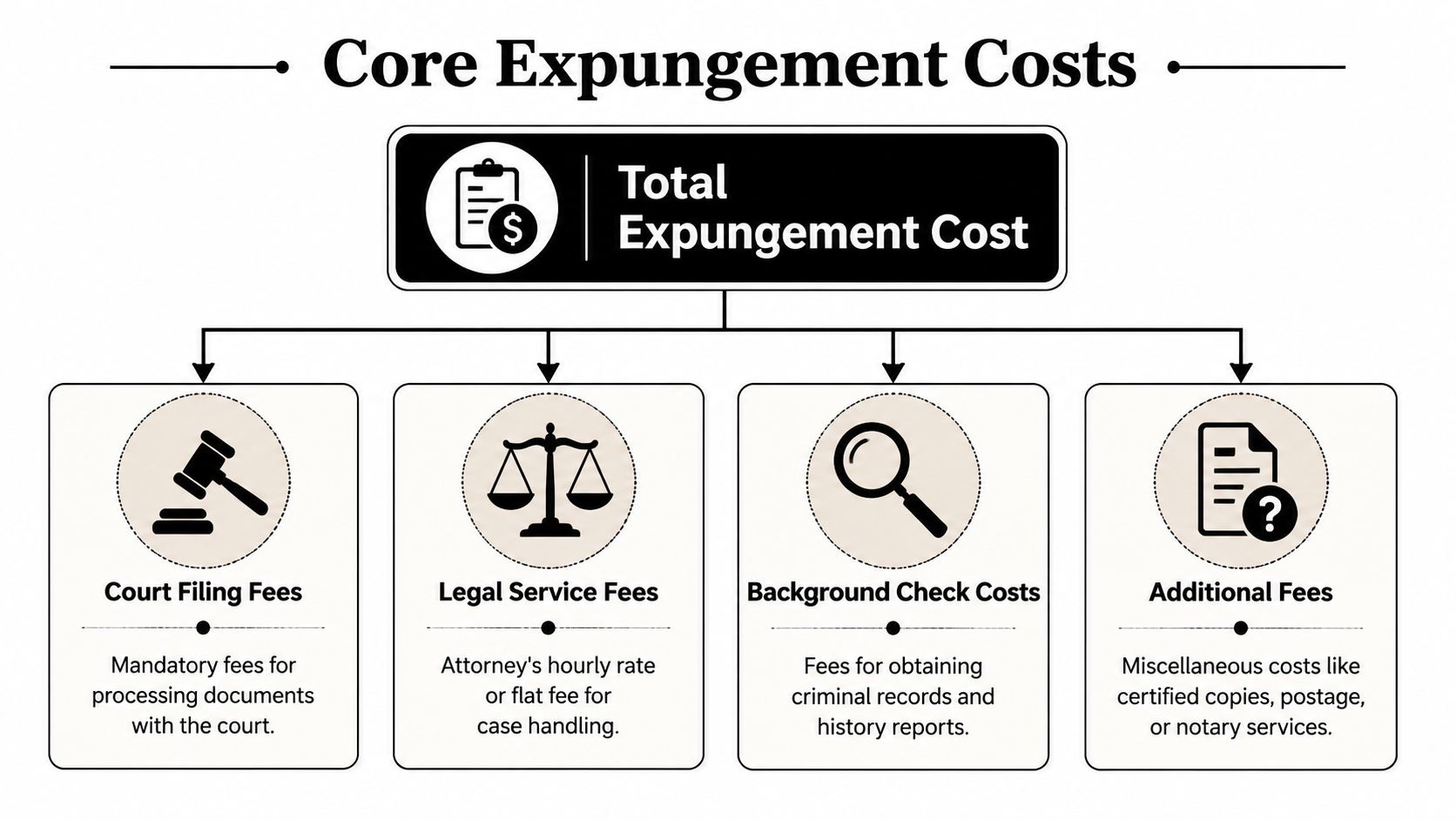
Court filing and government fees
Government charges are the visible part of the bill. They can include filing fees, certified copies, criminal history reports, and service or delivery costs required to get the right paperwork in front of the right office.
In Georgia, those charges are rarely the whole story. A person with one clean, eligible case may keep this part relatively modest. A person with old arrests in multiple courts, or records that do not match cleanly across agencies, usually spends more before the petition is even ready to file.
Background checks and fingerprinting
This category looks minor until something goes wrong.
A bad case number, an incomplete criminal history, or a fingerprint submission that does not match the agency's record can stop the process cold. In practice, this is one of the first places DIY cases lose time and money, because the fix often means ordering more records, making another trip, or reworking forms that were based on incomplete information.
Administrative expenses people forget
The smaller costs are predictable. They still add up.
- Certified copies: Courts may require certified dispositions or other file-stamped records.
- Mailing and service: Some matters require certified mail, formal service, or tracked delivery to prove notice.
- Notary and copying: Affidavits, IDs, and supporting documents often need to be signed, copied, and organized correctly.
- Multiple courts or agencies: A Forsyth County file plus a Cobb or Fulton record is not one errand. It is several.
For people comparing billing options before they hire counsel, Choosing the right law firm fee structure is a useful starting point. Record restriction work is often billed as a flat fee, but some lawyers use hourly or hybrid pricing, which changes the total cost if complications show up mid-process.
If you are still sizing up the process itself, review how attorneys handle sealing criminal records in Georgia. That gives a better sense of what you are paying for beyond forms, especially when court records, prosecutor review, and agency follow-up all have to line up.
Attorney fees
Attorney fees usually drive the largest price difference from one case to the next. The actual variable is not just the charge on paper. It is the amount of legal judgment required to decide whether relief is available, what has to be gathered first, which agency needs to act, and how much resistance to expect in that court.
In North Atlanta courts, that distinction matters. A straightforward record restriction issue in one county takes less work than a file involving several arrests, older dispositions, or a case history spread across Forsyth, Cobb, and Fulton. The cheaper quote is not always the lower total cost of ownership if it leaves out record collection, prosecutor contact, corrected filings, or follow-up after submission.
The best price is the one that gets the record cleared correctly the first time, without paying twice to repair an avoidable mistake.
Why Expungement Prices Vary So Much
Two people can both ask how much does an expungement cost and get very different answers. That's normal. The record, the county, and the procedural posture drive the number.

Offense severity changes the workload
A single, straightforward misdemeanor matter is one thing. A felony-related file, a DUI-connected history issue, or a case involving multiple court events is another.
The practical difference is the amount of review and coordination required. More serious charges tend to bring more paperwork, more chances for objections, and more need to verify that every condition has been satisfied before filing.
The number of cases matters
One charge in one court is usually manageable. Multiple charges spread across different dates, agencies, or counties create a much heavier administrative burden.
That problem is common in North Atlanta. Someone may have an older case in Fulton County, a later traffic-related arrest in Cobb County, and another matter tied to Forsyth County. Even when relief is available, the work doesn't happen in one neat packet.
Jurisdiction affects price even when the work looks similar
Jurisdiction isn't just a clerical detail. It can be the reason one matter is inexpensive and another becomes hard to justify without careful budgeting.
A strong example comes from Tennessee, where the state set its felony expungement fee at $450, significantly above the national norm, as part of a revenue approach. When lawmakers passed the law in 2012, the state projected $7 million annually, but the law reportedly generated only about $130,000 each year, which shows how high fees can create a real access problem rather than cover administrative work (The Marshall Project).
That same principle applies more broadly. Filing costs don't always reflect actual complexity. Sometimes they reflect local policy choices, court structure, or the number of agencies that must be involved.
For readers comparing legal costs across different parts of the justice system, this guide for Colorado bail bond costs shows another example of how location and procedure can change the final number even before attorney time enters the picture.
Georgia Record Restriction A North Atlanta Cost Breakdown
A North Atlanta resident may start with one goal, clear the record and move on, then find out the total bill is split across filing fees, certified records, service costs, background checks, and attorney time spent fixing old case paperwork. In Alpharetta-area matters, the total cost often turns on where the case was filed, how clean the record is, and whether anyone catches an eligibility problem before money is spent in the wrong court.
Georgia record restriction is controlled in part by O.C.G.A. § 35-3-37. For budgeting, the practical question is simple. What will it cost to clear this specific record in Fulton, Forsyth, or Cobb, and what will a failed first attempt cost if it has to be redone?
What clients usually pay for in Georgia
The starting expenses are usually straightforward. Court filing fees, service costs, certified copies, and record pulls can all appear before any hearing is set. Then the file itself starts driving cost.
A clean, single-county matter is one budget. A case with an arrest in one county, a transfer to another court, and missing disposition paperwork is a different budget entirely.
In North Atlanta, the expense usually comes from four places:
- Court filing costs: These vary by court and case type.
- Service and records costs: Sheriffs, clerks, and agencies may each require separate payments.
- Background and file verification: Clients often need accurate GCIC, clerk, or agency records before filing.
- Attorney time: Legal fees rise when counsel has to confirm eligibility, correct file defects, deal with prosecutor objections, or coordinate across counties.
People comparing legal fees often get better context by reviewing the average cost of a criminal lawyer. Record restriction work is post-case representation with real procedural risk, not simple form filling.
Estimated filing-side costs in North Atlanta
| County | Typical filing-side costs to expect |
|---|---|
| Fulton County | Court filing fees, service costs, certified copies, and record retrieval expenses |
| Forsyth County | Court filing fees, service costs, certified copies, record retrieval expenses, and possible local add-on costs depending on the case |
| Cobb County | Court filing fees, service costs, certified copies, record retrieval expenses, and possible local add-on costs depending on the case |
These are not full-case totals. They are the out-of-pocket costs clients usually need to budget before contested issues, multi-county coordination, or hearing preparation are added.
Where North Atlanta cases get expensive
Forsyth, Cobb, and Fulton do not always create the same workload even when two cases look similar from the outside. That difference matters. A dismissal with complete records may move efficiently. An older case with incomplete docket entries, a charge reduction, or conflicting agency records can require hours of work before a lawyer is ready to file anything.
I see the same mistake repeatedly. Someone budgets for one filing fee, then learns the case needs certified dispositions, agency follow-up, and a legal review to confirm that the record qualifies for restriction at all.
That is why the total cost of ownership matters more than a generic fee chart.
What Alpharetta-area clients should budget for beyond the obvious
Three cost drivers show up often in North Atlanta record clearing matters:
- More than one jurisdiction: A person may live in Alpharetta but need records from Fulton, Forsyth, or Cobb, and each office has its own process.
- Old or incomplete paperwork: Missing dispositions and inconsistent case numbers create delays and extra attorney time.
- Eligibility mistakes: A dismissed case may still require careful review before money is spent on filing and service.
In these cases, the expensive part is often not the filing itself. It is correcting the record, choosing the proper procedure, and avoiding a failed attempt that has to be rebuilt from scratch.
People looking for help after an old arrest is blocking a job, license, housing application, or professional opportunity usually need more than a fee estimate. They need a realistic budget for getting the matter done correctly in the court that holds the record.
The Hidden Cost of DIY vs The Value of an Attorney
A Forsyth County resident gets denied for a job because an old arrest still appears on a background check. He finds the court forms online, assumes the filing fee is the primary expense, and submits the paperwork himself. Two months later, the petition stalls over a record mismatch and a prosecutor objection he did not see coming. Now he is paying twice. Once in filing-related costs, and again in lost time, delayed employment, and the attorney work needed to fix a preventable mistake.

What goes wrong in self-filed cases
Self-filed record clearing matters usually break down at predictable points. The problem is rarely effort. The problem is procedure, timing, and local practice.
Common failures include:
- Wrong eligibility decision: The person assumes a dismissal or old arrest automatically qualifies, then files a petition the court or prosecutor will not support.
- Incomplete court and agency records: The case number, disposition, arrest record, and clerk file do not match, which stops the matter before the judge even reaches the merits.
- Poor response to objections: The filer gets pushback from the prosecutor and has no clear way to answer it with the right documents or legal basis.
- Service or filing mistakes: A technical error can delay the case, trigger a rejection, or force the person to start over.
If you are weighing legal fees against handling it yourself, it helps to compare the average cost of a criminal lawyer with the actual cost of a failed filing. In record restriction work, the cheaper option on day one is not always the lower-cost option by the time the case is finished.
What clients are really buying when they hire counsel
In Alpharetta-area cases, attorney value is rarely about filling in blanks on a form. It is about getting the case into a condition where it can succeed in the first place.
An experienced lawyer reviews eligibility before money is spent. The lawyer tracks down missing dispositions, checks whether agency records match the court file, and prepares the petition for the county that will make the final decision. That matters in Forsyth, Cobb, and Fulton, where filing habits, clerk expectations, and prosecutor responses are not always identical.
I have seen clients spend modest amounts trying to do this themselves, then face a much larger bill later because the first attempt created delay, confusion in the record, or a denial that had to be cleaned up carefully.
The total cost of ownership matters more than the first invoice
The comparison is not filing fee versus attorney fee. The comparison is total cost of ownership.
That includes:
- Money spent on records, copies, certifications, and refiling
- Time away from work dealing with clerks, agencies, and rejected paperwork
- Lost income or missed opportunities while the record remains visible
- Higher legal fees later if counsel has to repair a bad filing instead of starting clean
- The risk that a preventable mistake delays relief for months
A good lawyer reduces those risks. In many cases, that is where the savings are.
What an experienced local lawyer prevents
Good representation does four practical things:
- Stops ineligible filings early so money is not wasted on a case that should not be filed yet, or should be handled through a different procedure.
- Fixes record problems before filing so the court, prosecutor, and agency file are working from the same information.
- Handles county-specific practice in courts serving North Atlanta, including matters touching Forsyth, Cobb, and Fulton County records.
- Answers objections efficiently with the right documents and legal framing, rather than letting the case stall.
Paying less up front can cost much more if the filing fails and the record keeps interfering with work, housing, licensing, or school applications.
That is the practical value of counsel in record restriction cases. A seasoned local attorney does not just file paperwork. The attorney lowers the risk of paying twice.
The Record Restriction Process and Timeline in Georgia
A client in Alpharetta gets denied for an apartment, assumes record restriction is a quick filing, and then loses another month waiting on missing court paperwork from two counties. That is a common start. In Georgia, the timeline turns on preparation, record accuracy, and the practices of the court and prosecutor handling the case.
The process usually takes longer than people expect because several offices may touch the file. A mistake at the front end often costs more time than the filing itself.
The usual sequence
A Georgia record restriction matter often moves through these steps:
Eligibility review Start with the legal question that matters most. Is the arrest, charge, or case outcome eligible for restriction under Georgia law?
Record gathering
Obtain the court disposition, charging documents, arrest information, and any other records needed to confirm that every agency is reporting the same event the same way.Petition preparation and filing
The filing has to match the case history. Wrong dates, incomplete dispositions, or mismatched agency information can slow the case down or trigger an objection.Prosecutor review
In many counties, the prosecutor's response affects timing in a very practical way. A clean, well-supported filing is easier to process than one that raises basic record questions.Court action and agency follow-through
After approval, the order still has to make its way through the system so the record is handled correctly by the relevant agencies.
Where delays usually happen
The slowdowns are rarely dramatic. They are clerical and procedural.
A missing disposition from a municipal court. An arrest date that does not match the GCIC entry. A case that started in one court and ended in another. In Forsyth, Cobb, and Fulton matters, those details matter because one unresolved inconsistency can hold up the entire request while everyone waits for corrected paperwork.
That is why experienced counsel often shortens the timeline. A lawyer who regularly handles these files can spot eligibility problems early, identify which documents the clerk will require, and address predictable objections before the case stalls. In real terms, that can mean fewer rejected filings, fewer return trips to the courthouse, and fewer weeks with the record still showing up in background checks.
What to expect in practice
Some cases move cleanly once the paperwork is assembled. Others take longer because an older charge has to be traced, a final disposition was never entered properly, or multiple courts have pieces of the same record.
The practical answer for North Atlanta clients is simple. Build the timeline around investigation first, filing second. That approach usually costs less than rushing a petition, getting it kicked back, and paying again in time, filing expense, and lost opportunities while the record stays public.
Take the First Step to a Clean Slate Today
The right way to look at record restriction isn't as a nuisance expense. It's a strategic legal decision with long-term financial consequences.
A few hundred dollars may cover a simple self-managed attempt. A more realistic attorney-led budget in North Atlanta often sits in the $1,000 to $2,500 range for many Georgia matters, and more involved cases can cost more. What matters is whether the process gets done correctly and whether the result removes the obstacle that's costing you jobs, housing options, and peace of mind.
What usually works best
People get the best outcome when they treat record clearing the same way they treat any other serious criminal defense issue:
- Move early: Waiting doesn't make the record less visible.
- Check eligibility first: A bad filing wastes money and time.
- Budget for the full process: Include records, filing, service, and legal work.
- Use local knowledge: Forsyth, Cobb, and Fulton practice details matter.
If you're in Alpharetta, Roswell, Johns Creek, Milton, Cumming, Sandy Springs, Marietta, or anywhere in North Atlanta, the practical answer to how much does an expungement cost is this: enough that you should plan carefully, but not so much that it's worth leaving a fixable record untouched.
The more expensive option is often inaction. A record that keeps triggering employer concern, licensing trouble, or housing denials keeps charging you over and over.
If you want a case-specific estimate and a clear answer on whether your Georgia record can be restricted, contact Brian Hansford Law for a free, confidential consultation. The firm helps clients across Alpharetta, Roswell, Johns Creek, Milton, Cumming, Marietta, Forsyth County, Cobb County, and North Atlanta evaluate eligibility, avoid costly filing mistakes, and take the next step toward a clean slate.
