
If you need to postpone a court date, you'll have to formally ask for a continuance. This isn't just a casual phone call; it's a specific procedural request, usually done by filing a written motion. In that motion, a valid reason for the delay is typically laid out, like needing more time to hire the right attorney or to dig into new evidence the prosecutor just handed over. The key is to file this request as early as possible—it shows respect for the court's schedule and can boost the chances of it being approved.
Understanding Your Court Date and What a Continuance Means

Walking into court for the first time, especially for an arraignment, can be incredibly intimidating. Whether your case is in Forsyth County, Cobb County, or a local municipal court like Alpharetta or Milton, the process can feel like a blur. This is exactly where a continuance becomes one of the most important tools available.
A continuance is simply a formal postponement of your court date. It's not about dodging responsibility. Instead, it can be thought of as hitting the pause button to make sure a person has everything they need to properly handle their case before things move forward.
The Purpose of a Postponement
At its core, a continuance is about ensuring fairness. The court system, from Marietta to Roswell, understands that life happens and things come up that can prevent a case from moving ahead on its scheduled date. A well-timed continuance can provide the breathing room needed to build a smart, thoughtful response to the charges.
So, what can be done with this extra time? It's invaluable for several critical tasks:
- Securing Representation: Finding and hiring the right lawyer who truly understands your situation isn't something to rush.
- Reviewing Evidence: Both you and your attorney need enough time to go through every piece of evidence—police reports, witness statements, body cam footage, you name it.
- Investigating the Case: A strong defense often requires its own investigation. This could mean tracking down new witnesses or bringing in an expert to review the state's evidence.
- Negotiating Resolutions: Sometimes, a delay opens the door for productive talks between an attorney and the prosecutor, which can often lead to a much better outcome than going straight to trial.
A continuance is a powerful strategic tool. It transforms a rushed, high-pressure court date into a deliberate process, giving you the time you need to prepare, weigh your options, and protect your rights.
Courts are often willing to grant a continuance if a person can show "good cause." This just means there is a legitimate, acceptable reason for needing more time. Below is a table outlining some of the most common reasons that courts in Georgia typically accept.
Common Reasons for Requesting a Court Continuance
| Reason Category | Specific Examples | Impact on Your Case |
|---|---|---|
| Legal Representation | You've just hired an attorney who needs time to get up to speed. You're still in the process of interviewing and retaining counsel. | This is one of the strongest and most frequently granted reasons, especially at an arraignment. |
| Evidence & Discovery | The prosecution has provided new evidence (discovery) that needs to be reviewed. You need time to gather your own evidence or witness statements. | Essential for a fair trial. A continuance ensures you aren't blindsided by new information. |
| Witness Availability | A key witness for your defense is unavailable due to illness, travel, or another unavoidable conflict. | A judge will often grant this to ensure all relevant testimony can be heard. |
| Personal or Medical | You or your attorney have a serious illness, a family emergency, or a pre-scheduled medical procedure. | Courts are generally understanding of legitimate health and family crises. |
| Negotiations | You and the prosecutor are actively discussing a potential plea agreement and need more time to finalize it. | Judges often prefer cases to resolve without trial and will allow time for these discussions. |
Remember, the reason provided needs to be specific and genuine. Simply wanting to delay the case without a solid reason won't be enough.
Navigating the Initial Court Appearance
The very first court appearance is the arraignment, and it's a critical moment. This is where the court formally reads the charges and asks for a plea. It’s vital to understand what happens at an arraignment hearing, because this is often the first—and best—chance to ask for a continuance.
In busy courts like those in Johns Creek and Cumming, judges are managing a packed docket every single day. Showing up unprepared puts a person at an immediate disadvantage. Requesting a continuance right at the start is extremely common, especially if a lawyer hasn't been hired yet. It sends a clear signal to the judge that the charges are being taken seriously and a defense is being prepared. Most judges will grant this initial request because it helps the whole process run more smoothly later on, ensuring a person is properly prepared for the next step.
What Are Good Reasons to Ask for a Continuance in Georgia?
When a person steps into a courtroom in places like Cobb or Forsyth County and asks for a continuance, a solid, legitimate reason is needed. The judge has heard it all. Simply saying more time is needed won't cut it. One must show what the law calls "good cause"—a real, justifiable reason why pushing the court date is necessary.
A vague excuse like, "I'm just not ready," is a fast track to getting denied. A judge's decision comes down to the specifics. The request needs to be credible and show that a delay is essential for a fair outcome.
You Need Time to Hire a Lawyer
This is probably one of the strongest and most respected reasons for a continuance, especially at a first court date or arraignment. The right to have an attorney is a fundamental part of our justice system, and judges from Roswell to Marietta understand that choosing the right one is a serious decision that shouldn't be rushed.
Explaining that you're in the process of interviewing lawyers but haven't found the right fit yet is completely different from just showing up empty-handed. It shows you're taking the charges seriously.
For instance, someone facing a complex charge in Johns Creek might need an attorney who specializes in that specific type of case. Telling the judge this demonstrates diligence and makes the request for more time seem perfectly reasonable.
A Key Witness Can't Be There
Another powerful reason is when a critical witness is unavailable. This can't be just anyone. It has to be someone whose testimony is absolutely central to the defense. Maybe the alibi witness booked a non-refundable international trip months ago, or a key witness is suddenly in the hospital.
If this is the situation, be ready to tell the judge:
- Who the witness is and why their testimony is so important.
- The specific reason they can't make it to court.
- What has been done to try and get them there.
- Exactly when they will be available.
Providing these details shows the court you're not just trying to stall. It proves the delay is a genuine necessity to present one's side of the story.
A continuance isn’t a get-out-of-jail-free card. It’s a tool meant to ensure fairness. A judge in Milton or East Cobb is far more likely to grant a request if you can show the delay actually helps the pursuit of justice, rather than hindering it.
You're Waiting on Crucial Evidence
Sometimes, a case simply can't move forward because a party is waiting on essential evidence to be collected, produced, or analyzed. This happens all the time, particularly in cases with technical elements like a DUI charge in Alpharetta or Cumming.
Think about a scenario where an attorney wants to independently review the maintenance and calibration logs for the breathalyzer used in an arrest. The police department might not hand those records over right away. Requesting a continuance to get those documents and have an expert look at them is a textbook example of good cause.
Other common evidence-related delays include:
- Waiting on a hospital to release medical records.
- Needing more time for a private investigator to finish their work.
- Allowing a forensic expert to analyze evidence turned over by the prosecutor.
In the fast-paced world of criminal defense, getting a continuance can be a game-changer, especially in busy jurisdictions like Alpharetta and Forsyth County. Federal judicial statistics show filings in regional courts of appeals climbed 3 percent to 40,612, mostly due to criminal cases. That caseload pressure is exactly why a well-timed continuance is so important—a rushed case is rarely a good one. In Cobb County and East Cobb, where 93,649 total cases have been activated in federal pretrial services, the numbers alone make a compelling argument for slowing down and getting it right. You can read more about these caseload trends and their impact on the justice system.
At the end of the day, whether in Marietta or Roswell, the success of the request depends on the strength of the reason. A specific, well-documented, and honest justification shows respect for the court and makes it clear you're committed to resolving the case fairly.
The Process for Filing a Motion to Continue
Knowing why a continuance is needed is only half the battle; understanding how to ask for one is just as critical. The process isn't just a formality—following the correct steps shows the court you respect its time and rules. Depending on how close the court date is, the request can be made verbally in the courtroom or, more formally, through a written motion.
There are two main ways to make the request. The first is an oral motion made directly to the judge during a hearing. The second, and more common method, is a written Motion to Continue, which is filed with the court clerk ahead of time. While an oral request can work in a pinch, a written motion is almost always better because it creates a formal record and gives everyone fair warning.
Oral Requests vs. Written Motions
Making an oral request is straightforward and usually reserved for emergencies or a very first court appearance. For instance, if you show up for an arraignment in Milton Municipal Court and realize you need time to hire an attorney, you can simply state that to the judge when your case is called. This is a common and almost always accepted reason for a first continuance.
But for any request after that initial hearing, a written motion becomes the standard expectation. It gives the judge and prosecutor a detailed, documented explanation they can review before you even get to court. This is especially true in busy courts like those in Marietta or Cobb County, where judges are managing heavy caseloads and appreciate well-prepared, formal filings.
Crafting a Formal Motion to Continue
A written motion doesn't have to be complicated legal jargon, but it absolutely must contain specific information. Think of it as a formal letter to the judge explaining exactly why more time is needed.
Every motion must clearly state:
- Case Information: Your full name, the case number, and the specific court.
- The Request: A clear, direct statement that you are requesting a continuance.
- The Reason: This is the most important part. A detailed explanation of your "good cause" for the delay.
- Proposed New Date: If possible, suggest a new date or a general timeframe. It shows you're thinking ahead.
- Prosecutor Notification: A sentence confirming you have sent a copy of the motion to the prosecutor.
Here are some of the most common and valid reasons that form the core of a good motion.
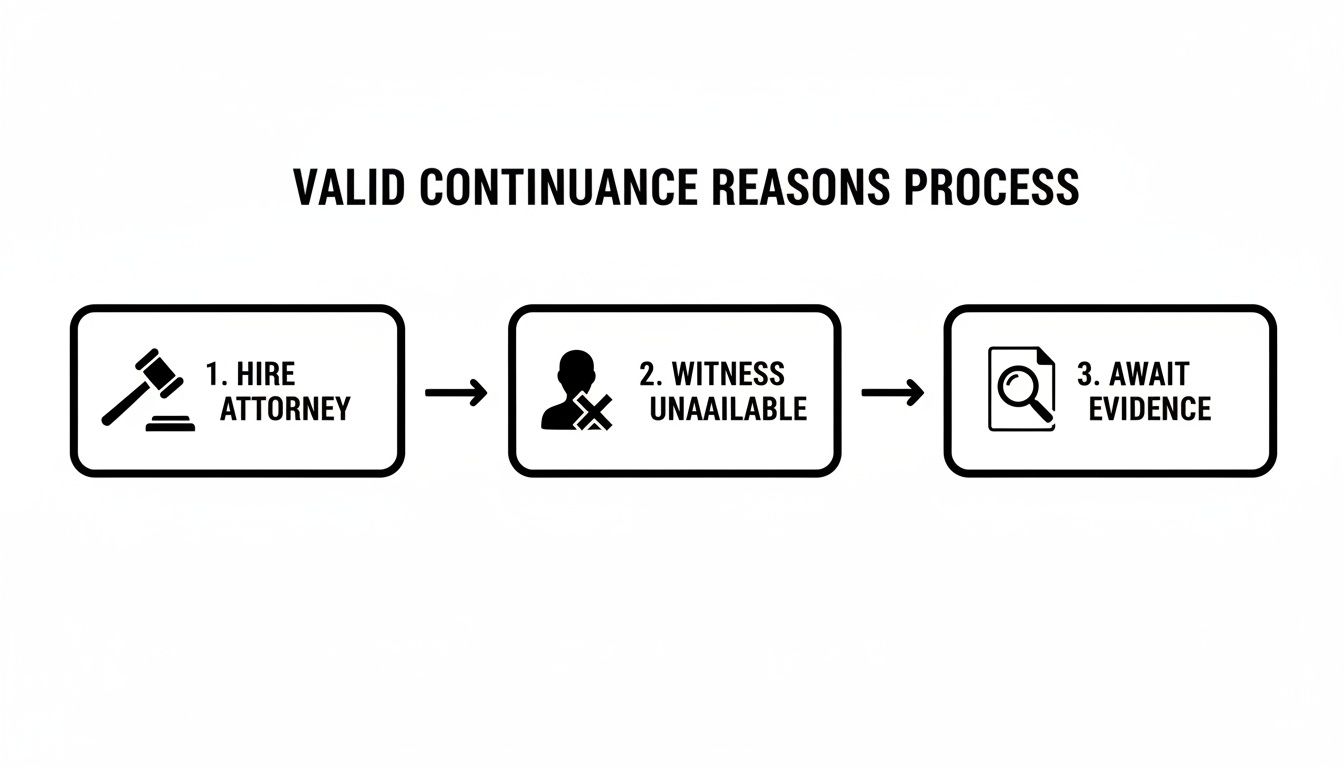
This flowchart shows that whether you're bringing an attorney on board, dealing with an unavailable witness, or waiting on key evidence, each serves as a solid foundation for your request.
The language in the motion can be simple and direct. For example: "Comes now the Defendant, [Your Name], and respectfully moves this Court to continue the hearing currently scheduled for [Date], due to the recent retention of counsel who requires adequate time to review discovery and prepare." That’s it. Clear, direct, and to the point.
Timeliness is everything. Filing your motion as early as you possibly can is non-negotiable. A last-minute request is far more likely to get denied because it messes up the court's schedule and inconveniences everyone involved.
Filing and Notifying the Right People
Once the motion is written, it has to be filed. The original document is filed with the Clerk of Court for the specific court handling the case (e.g., Cobb County State Court or Roswell Municipal Court). Always ask for a time-stamped copy for your own records. This is your proof of filing.
At the same time, you must provide a copy to the prosecutor’s office. This is called service, and it’s a critical step. Failing to notify the prosecutor can get your motion denied on the spot. It’s also a good idea to call the clerk’s and prosecutor’s offices a day or two later just to confirm they received everything.
Properly preparing for a court appearance is a multi-step process, and getting more familiar with how to prepare for your court hearing can give you a better grasp of all the pieces that need to come together.
Remember, local court rules can and do vary. A procedure that works perfectly in Forsyth County might be slightly different in Johns Creek. Always double-check the specific filing requirements for your court. Getting these little procedural details right goes a long way in showing the court a person is taking their case seriously.
Presenting Your Continuance Request in the Courtroom
The moment the court calls your name and you step up to face the judge is pivotal. All the prep work comes down to this. This isn't the time to just read a motion out loud—it’s about conveying the need for more time with clarity and respect. How a person handles themselves can make all the difference.
Courtroom etiquette isn't optional. Always, and without exception, address the judge as "Your Honor." A person should stand when they speak, make their points clearly without mumbling, and never interrupt the judge or the prosecutor. A calm, professional demeanor signals to the court that you're taking this seriously, which can make a judge far more willing to listen.
Be ready for questions. The judge will want to know why this continuance is needed. A direct, honest answer should be ready, whether it's because a lawyer was just hired who needs to get up to speed or a key piece of evidence is pending. Ambiguity will get you nowhere.
Handling Objections from the Prosecutor
Don't be surprised if the prosecutor stands up to object. It happens all the time. From their point of view, any delay can feel like a setback—witnesses get frustrated, evidence can go stale, and it just drags the process out.
You can usually anticipate what they're going to say:
- "This is just a delay tactic." They might argue you’re just trying to push things off, hindering a swift resolution.
- "We have witnesses here." This is a big one. They'll claim that postponing the date is a major inconvenience for witnesses who took time off to be in court.
- "This isn't the first request." If a continuance has been asked for before, they will absolutely bring it up to paint a picture of someone trying to stall.
When the prosecutor objects, stay quiet and calm. Listen to everything they have to say without interrupting. Once they're finished, you'll have a chance to briefly respond, reaffirming the valid reason for the request and stressing that the delay is crucial for a fair outcome.
The judge’s job is a balancing act: they have to weigh the interests of both sides while keeping the court calendar moving. Your task is to show that granting your request serves the cause of fairness more than it disrupts the schedule.
What the Judge Considers Before Deciding
At the end of the day, the decision is up to the judge. In a matter of moments, they'll weigh several factors. A judge in a busy Cobb County or Forsyth County courtroom makes these calls all day long, so your credibility and clarity are paramount.
Navigating court continuances in criminal defense demands precision, as statistics reveal how delays impact outcomes in high-stakes cases across major markets like Marietta and Cobb County. Federally, management stats profile 94 district courts, noting heavy criminal loads that strain timely resolutions. With 9,069 new prosecutions logged in a single month, courts grant continuances judiciously. Short-term delays of 1-4 weeks are common for minor issues, but after 2-3 requests, judges in criminal matters—tied to Sixth Amendment speedy trial protections—often deny, pushing cases forward. For young adults facing juvenile offenses in Roswell or families in Johns Creek, this means a first request backed by compelling evidence has the highest chance of success. Discover more insights about how courts manage continuance requests.
Here’s what’s running through a judge’s mind:
- The Legitimacy of Your Reason: Is this a solid reason, like hiring an attorney, or does it sound like an excuse?
- Timeliness of the Request: Did you ask for this well ahead of time, or did you spring it on the court at the last second?
- History of Prior Requests: Is this your first time asking? A second or third request is always a much harder sell.
- Impact on the Case: Will granting this delay cause real harm to the prosecution’s case?
Nothing is ever guaranteed, but a well-reasoned, respectfully presented request has the best shot. The first request for a continuance is almost always the easiest one to get, so it's important to make it count.
Strategic Reasons to Consider a Continuance
Knowing how to ask for a continuance is one thing; understanding when and why it's a smart strategic move is something else entirely. A continuance is much more than just pushing back a court date. When used thoughtfully, it can completely change the direction of a case, creating opportunities that simply wouldn't exist on a rushed timeline.
The core benefit is simple: time. But it’s what is done with that time that really matters. A strategic delay can provide the breathing room to poke holes in the prosecution's evidence, thoroughly investigate their claims, or open the door for meaningful negotiations outside the pressure of the courtroom.
Gaining Time for Investigation and Discovery
One of the most powerful reasons to seek a continuance is to give a defense team the runway it needs to do a deep dive into the facts. The evidence the prosecutor hands over—called "discovery"—is rarely the full story. A delay gives the defense a chance to:
- Interview Witnesses: A defense team can track down and talk to people the police might have overlooked or who could offer a completely different version of events.
- Analyze Evidence: This is critical. Experts can be hired to review things like breathalyzer calibration records in a DUI case or pull forensic data from a computer.
- File Additional Motions: The extra time allows for drafting and filing other crucial legal motions, like a motion to suppress evidence that was gathered improperly.
This investigative phase often uncovers weaknesses in the state's case that weren't obvious at first glance. A continuance essentially buys the chance to build a defense narrative instead of just reacting to the prosecutor's.
Creating an Opportunity for Negotiation
Courtrooms are tense environments. Making life-altering decisions under that kind of pressure is never ideal. A continuance pushes back the clock, lets emotions cool down, and creates a much better atmosphere for negotiating with the prosecutor.
With a little more time, an attorney can engage in real discussions aimed at a better outcome. This could mean getting charges reduced or exploring alternative sentencing options. Prosecutors are managing huge caseloads, and a well-prepared defense that signals its readiness to fight can make them far more open to a reasonable deal.
A continuance isn't about avoiding the inevitable; it's about shaping it. The pause it creates can be the most productive period in a case, opening doors to resolutions that a hurried process would have slammed shut.
Understanding the Potential Downsides
But asking for a continuance isn't always the right play. It's a calculated risk, and delaying a case can sometimes have negative consequences that have to be considered.
The most obvious downside is that it just prolongs the stress and uncertainty of having a criminal case hanging over a person's head. In some situations, it can also give the prosecution more time to find new witnesses or evidence to strengthen their own case.
It helps to know how judges in places like Milton and East Cobb view these requests. There’s no hard limit, but judges often get skeptical after two or three continuances, especially with speedy trial clocks ticking. The federal Speedy Trial Act, for example, sets a 70-day limit. Short continuances of 1-4 weeks are common for preparation, but longer delays are rare without a compelling reason. In Georgia's superior courts, having a solid reason like a medical issue or needing an expert witness dramatically improves the odds, which is a huge factor in DUI or juvenile cases. You can learn more about how federal caseloads impact court timelines from the U.S. Courts' statistical reports.
Ultimately, deciding whether to ask for a continuance is a strategic call. The benefits of more prep time have to be weighed against the drawbacks of a longer case. This is where experienced guidance can be invaluable. If you're weighing your options, learning how to find a good criminal lawyer who can assess your specific situation is a critical step.
A Few Common Questions About Court Continuances in Georgia
When facing the court system in places like Alpharetta or Forsyth County, a lot of questions pop up. Just understanding the basics of asking for a continuance can help a person know what to expect and make the whole process feel less confusing. Let's walk through some of the things people ask most often.
Keep in mind, this is a general overview of how things usually work. It is not a substitute for guidance from a qualified attorney about a specific case.
How Many Continuances Can I Get?
There's no magic number or hard limit on how many continuances can be requested in Georgia. But that doesn't mean a person can ask for endless delays. A judge's patience can wear thinner with each new request.
A first request, especially if it's at an arraignment to hire a lawyer, is almost always granted. The second time, a much stronger reason will be needed. By the third time, a judge in Cobb County or Johns Creek is going to be extremely skeptical and will likely say no unless there is an extraordinary, well-documented reason.
Will a Continuance Make Me Look Guilty?
Absolutely not. Requesting a continuance won't make a person look guilty in the slightest. It's a standard, incredibly common part of the legal process.
In fact, when it's done for the right reasons—like needing time to hire the right lawyer or to actually review the evidence—it shows the judge the case is being taken seriously. Judges in busy courts from Marietta to Cumming get it; preparing a proper defense takes time. A good, justified request is seen as a sign of diligence, not an admission of guilt.
A continuance is a procedural tool designed to ensure fairness for both sides. Using it strategically is a sign of a thoughtful defense, not an admission of wrongdoing.
How Long Will a Continuance Delay My Case?
There’s no one-size-fits-all answer here. The length of a delay can vary a lot, depending on why the request is made and what the court's calendar looks like.
- Short Delays (1-4 weeks): This is the most common scenario. These are usually granted for straightforward things like finalizing hiring an attorney, a minor scheduling conflict, or just getting a chance to review the initial police reports.
- Medium Delays (1-3 months): These are less frequent and require a more serious justification. This kind of time might be needed when waiting on critical evidence from a third party, like medical records, or trying to line up an expert witness's schedule.
- Long Delays (3+ months): These are pretty rare in criminal cases, mostly because of the right to a speedy trial. A judge would only grant such a long pause for very serious and unavoidable circumstances.
Does the Prosecutor Have to Agree to My Request?
No, the prosecutor doesn't have to agree. It's actually pretty common for the prosecution to object, especially if they think a person is just trying to stall or if a delay will be a major inconvenience for their witnesses.
But here's the key: the final decision is 100% up to the judge. Even if the prosecutor stands up and objects, the judge can still grant the continuance if a compelling and valid reason is provided. It certainly helps to have the prosecutor on board, but their approval isn't required.
Navigating the complexities of the court system requires experience and a deep understanding of local procedures. At Brian Hansford Law, we have spent over 25 years defending clients across North Georgia. If you are facing criminal charges in Alpharetta, Roswell, or the surrounding counties, we can provide the knowledgeable defense you need. Contact us today for a consultation at https://challengemycharge.com.
