
Getting hit with a DUI charge can feel like the world is ending, but an arrest is not the same thing as a conviction. The first moves you make are absolutely critical. Knowing how to beat DUI charges starts right now, and a proactive approach can open up defense opportunities you didn't even know existed.
Your First Steps After a DUI Arrest

The hours and days right after a DUI arrest are a crucial window. It's totally natural to feel stressed and overwhelmed, but the single most important thing is to shift from feeling powerless to being proactive. A strong defense is built on the tiny details remembered and the procedures challenged from the get-go.
Think of the arrest as the start of a process, not the final word. Many cases have clear paths to challenge the evidence, often leading to reduced charges or a complete dismissal. Finding those paths means picking apart every single moment of the encounter.
Document Everything Immediately
Your memory is your best weapon in the hours after an arrest. Details get fuzzy fast, so it is important to write down everything you can remember about the incident as soon as you can. Don't try to decide what's important. Just get it all down on paper.
This personal record is invaluable for spotting procedural mistakes or contradictions in the officer's official report later. Focus on these key points:
- Before the Stop: What were you doing right before you were pulled over? Where were you coming from? What were the road conditions like? Was it raining? Foggy?
- The Traffic Stop: What reason did the officer give for pulling you over? Try to recall their exact words. Was anyone else in the car with you?
- Your Interaction: What questions did they ask you? How did you respond? Were you polite?
- Field Sobriety Tests: Where did they make you do the tests? Was it on a sloped shoulder, in the dark, or on uneven ground? Do you have any injuries or medical conditions that could have made those tests difficult?
A detailed, personal account of the arrest can be incredibly powerful. It provides a counter-narrative to the police report and can highlight facts or circumstances the official record might overlook or misrepresent.
Understanding the Core Concepts
Successfully fighting a DUI charge comes down to questioning two main things: the evidence the prosecution has and the procedures the police followed. Every single piece of evidence, from what the officer claims they saw to the breathalyzer result, can be scrutinized for weaknesses.
At the same time, law enforcement has to follow a very strict set of rules during a DUI investigation. Any misstep can be grounds for a defense. For example, if the officer didn't have a valid reason to pull you over in the first place, all the evidence they collected after that might get thrown out.
Digging into these angles requires a deep knowledge of DUI law and police procedure. This is why learning how to find a good criminal lawyer is one of the most important things you can do early on. The right attorney will take your detailed account, compare it against the police report, and find those critical opportunities for your defense.
Questioning the Initial Traffic Stop
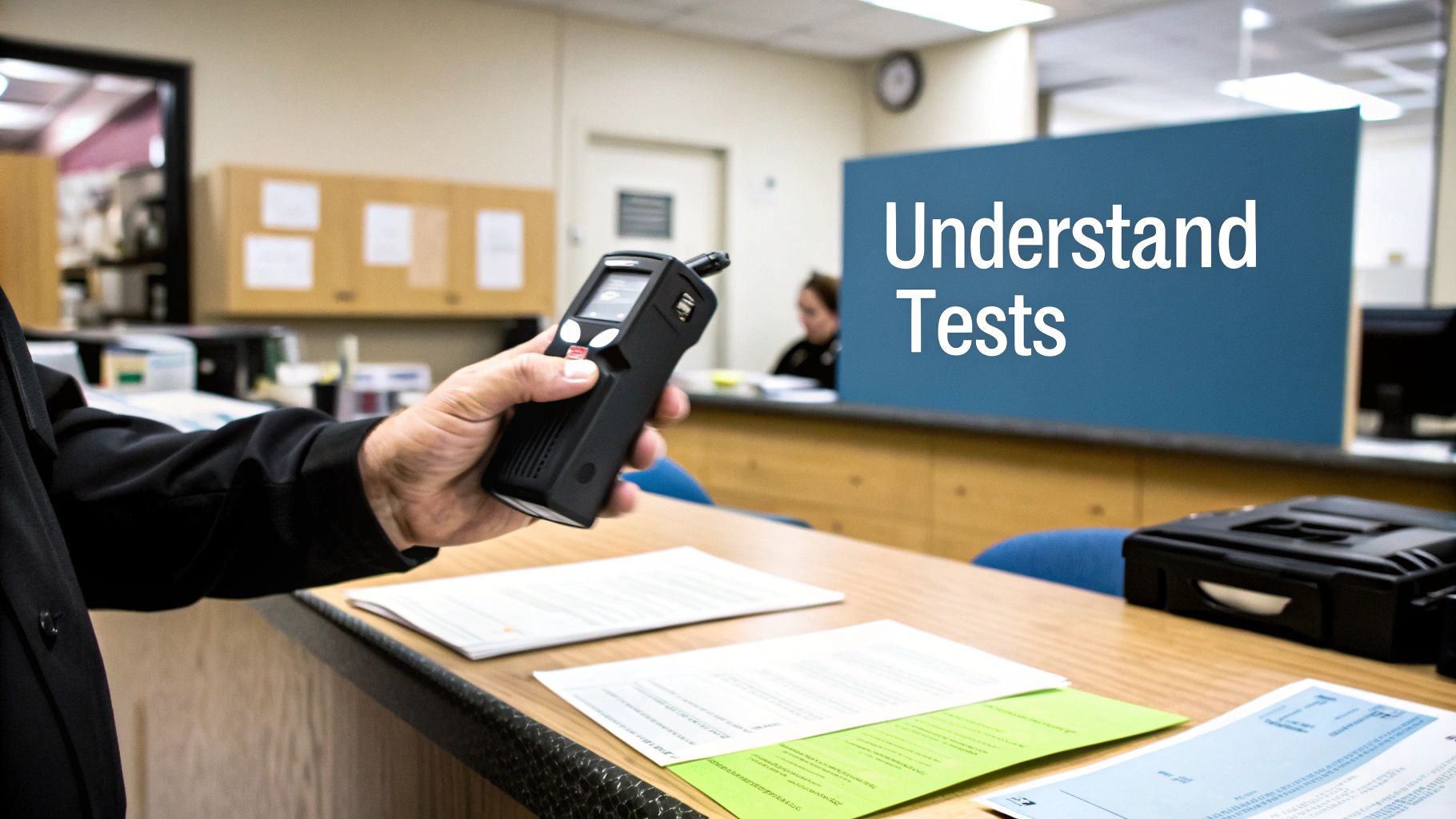
Every single DUI case starts with one thing: the traffic stop. The legality of that first interaction is the absolute foundation of the prosecution's entire case. If an officer didn’t have a constitutionally sound reason to pull you over in the first place, any evidence they collected afterward—from what they saw to your test results—could potentially get thrown out of court.
Figuring out how to beat DUI charges often starts with a hard look at this critical moment. It's a fundamental check on the government's power, and any mistake the officer makes here can cause the state's case against you to fall apart.
Reasonable Suspicion: The Legal Bar for a Traffic Stop
An officer can't just pull you over based on a gut feeling or a random hunch. They must have what the law calls "reasonable suspicion" that a crime or traffic violation has occurred. While this is a lower bar than "probable cause," it still requires them to point to specific, observable facts.
A clear-cut traffic violation like speeding or blowing through a red light easily meets this standard. But many DUI stops are built on much more subjective observations.
- Weaving Within a Lane: A single, minor drift inside your lane probably isn't enough. But consistent, significant weaving that crosses over the lines might be.
- Driving Too Slowly: Going way under the speed limit for no apparent reason (like heavy rain or fog) can sometimes trigger suspicion.
- Anonymous Tips: A 911 call about a drunk driver can be enough for a stop, but only if the tip seems reliable and the officer can independently verify some of the details before pulling you over.
The key is to pick apart the officer’s stated reason for the stop. A vague justification like "suspicious driving" won’t cut it; they need to articulate concrete actions that led them to initiate the stop.
The entire case hinges on the lawfulness of the initial stop. If the stop is deemed illegal, it can create a 'fruit of the poisonous tree' situation, where all subsequent evidence is considered tainted and may be suppressed.
From Suspicion to Probable Cause for an Arrest
Once you're on the side of the road, the officer’s investigation begins. To escalate the situation from a simple traffic stop to a full-blown DUI arrest, they need to establish "probable cause." This is a higher legal standard that requires enough evidence to believe a crime has likely been committed.
An officer builds probable cause by accumulating observations during the stop. These observations are frequently subjective and can be swayed by any number of external factors. Challenging them is a core part of a strong defense. An officer is trained to look for specific signs of impairment, such as:
- Physical Appearance: They'll note things like bloodshot eyes, fumbling movements, or a flushed face.
- Your Statements: Any admission to drinking, even just "a couple of beers with dinner," will be used against you.
- Field Sobriety Tests: Your performance on standardized exercises like the Walk-and-Turn or the One-Leg Stand.
Unpacking the Officer's Observations
Every piece of evidence an officer reports can be scrutinized for weaknesses. For example, "bloodshot eyes" can be caused by allergies, simple fatigue, or even contact lenses—not just alcohol. Likewise, fumbling for your license could easily be chalked up to nervousness instead of impairment.
Think about a real-world scenario: an officer stops someone late at night for briefly touching the fog line. The driver, exhausted after a 12-hour shift, has red eyes and seems a bit slow to respond. The officer lists these as signs of intoxication, but they could just as easily be signs of being tired. This is where context becomes everything in fighting the charges.
Focusing on these procedural details and evidence weaknesses is crucial. In fact, national statistics suggest that around 40% of initial DUI cases are either dismissed or result in reduced charges, often because of these very issues. A case can turn on identifying an illegal stop or improperly conducted sobriety tests. You can discover more about how these factors influence DUI case outcomes and see how a strong defense is built from the ground up.
Challenging Sobriety and Chemical Test Evidence
When it comes to DUI charges, the evidence from Field Sobriety Tests (FSTs) and chemical tests often feels like a slam dunk for the prosecution. Most people just assume a breathalyzer reading or a shaky performance on the roadside is the end of the story. It isn't.
Both types of evidence are surprisingly vulnerable. They rely on strict procedures, flawless equipment, and human interpretation—all of which can go wrong. A huge part of knowing how to beat DUI charges is learning to pick apart this so-called "scientific" proof.
Take the three standardized field sobriety tests—the Horizontal Gaze Nystagmus (the eye test), the Walk-and-Turn, and the One-Leg Stand. These aren't just simple pass/fail exercises you see on TV. They're physical performance evaluations that police must administer according to very specific guidelines from the National Highway Traffic Safety Administration (NHTSA).
Even the slightest deviation from these protocols can throw the results into question. If the officer gives the wrong instructions, makes you perform the test on a sloped or poorly lit shoulder, or doesn't consider your physical health, the validity of that test is compromised.
The infographic below really drives home why having a professional comb through your case files is so critical for finding these kinds of procedural mistakes.

As you can see, a deep-dive into the evidence is where the key weaknesses in the state's case are often found.
Deconstructing Field Sobriety Test Performance
It’s a massive misconception that only alcohol can cause someone to "fail" an FST. The truth is, dozens of factors can make a completely sober person look impaired. These alternative explanations are the bedrock of a solid defense.
Consider these possibilities from real cases:
- Medical Conditions: Things like inner ear problems, vertigo, or old leg and back injuries can make balancing on one foot next to impossible for anyone.
- Age and Weight: Even the NHTSA’s own research admits that people over 65 or more than 50 pounds overweight are likely to struggle with these tests, sober or not.
- Nervousness and Fatigue: Let's be honest, getting pulled over is stressful. That anxiety, combined with being tired after a long day, can easily cause mistakes that an officer might wrongly label as signs of impairment.
- Environmental Factors: Were you standing on uneven ground? Was it dark? Were headlights from passing cars blinding you? These are hardly lab-controlled conditions for a standardized test.
When any of these factors are in play, the officer's conclusion about your performance becomes purely subjective. And an officer's opinion is not objective proof.
Scrutinizing Chemical Test Results
Breathalyzers and blood tests seem much more scientific, but they are also full of potential holes. The machines need constant, precise calibration. The samples must be handled perfectly. The person running the test needs proper training.
The accuracy of any chemical test is only as good as the procedures used to obtain it. A single broken link in the chain of custody for a blood sample or a missed maintenance check on a breathalyzer can be enough to have the results suppressed.
Breathalyzer results, for example, can be skewed by things that have nothing to do with how much you drank. The "mouth alcohol" defense is a classic for a reason—it’s based on real science. Residual alcohol in the mouth can contaminate the sample and give a falsely high reading.
This can be caused by:
- Recent Use of Mouthwash: Many popular brands contain a high percentage of alcohol.
- Acid Reflux or GERD: Burping can bring alcohol vapors from the stomach into the mouth, artificially inflating the reading.
- Dental Work: Food particles trapped in braces or dentures can ferment over time and produce their own alcohol.
For blood tests, a common focus is on the chain of custody. This is the official paper trail documenting every single person who handled your blood sample, from the moment it was drawn to the time it was tested. Any gap or inconsistency in that chain immediately raises questions about contamination or tampering, making the results unreliable in court.
All of these potential errors become even more critical as jurisdictions adopt stricter Blood Alcohol Concentration (BAC) limits, typically between 0.02 and 0.08. A small machine error or procedural slip-up can mean the difference between being under or over the legal limit. As detailed in this report on BAC limits, these global standards demand precision, opening up more avenues for challenging results that are right on the edge.
To give you a clearer idea, here are some common ways the evidence presented in DUI cases can be challenged.
Common Challenges to DUI Evidence
| Type of Evidence | Common Weakness | Potential Defense Strategy |
|---|---|---|
| Field Sobriety Tests (FSTs) | Improper administration; environmental factors; officer's subjective opinion; client's physical limitations. | File a motion to suppress based on non-compliance with NHTSA standards. Use dashcam/bodycam footage to show improper procedure. |
| Breathalyzer Results | Machine malfunction or improper calibration; "mouth alcohol" contamination; operator error. | Subpoena maintenance logs for the breathalyzer. Argue acid reflux or recent use of mouthwash skewed the results. |
| Blood Test Results | Broken chain of custody; improper storage of the sample; contamination during the draw or testing process. | Scrutinize the chain of custody documents for gaps or errors. Challenge the qualifications of the phlebotomist. |
| Officer Testimony | Inconsistent statements; memory lapses; subjective observations contradicted by video evidence. | Cross-examine the officer on inconsistencies between their report, testimony, and video evidence. |
Each piece of evidence has a potential flaw. The key is knowing where to look and how to expose it. Never assume the state's evidence is airtight—it rarely is.
Finding Procedural Errors and Rights Violations
Beyond just the physical evidence, a really powerful DUI defense strategy involves scrutinizing the process itself. From the moment the blue lights flash to the final steps of booking, everything law enforcement does is governed by strict rules. When an officer makes a mistake, it can blow a hole in the prosecution's case.
These aren't arguments about whether a person was impaired; they're about whether the government played by its own rules. A seemingly small procedural slip-up can have huge consequences.
Miranda Rights and Custodial Interrogation
We’ve all heard police on TV rattle off the Miranda warning. In the real world, though, its application is very specific. An officer only has to read you your Miranda rights—including the right to remain silent—after you are in custody and before they start a custodial interrogation.
So, what does that mean in a DUI stop? Custody basically means you aren't free to leave, which is typically after you've been formally arrested. Interrogation means they are asking you questions designed to get an incriminating answer.
- Before Arrest: Anything you say during the initial traffic stop—like admitting you had a few drinks—is usually fair game for the prosecution. At that point, you're not technically in custody.
- After Arrest: Now, if you're arrested, put in the patrol car, and taken to the station, and an officer starts grilling you about your night without reading you your rights, those answers could be suppressed.
A Miranda violation doesn't automatically get the case thrown out. What it does mean is that any statements you made during that improper questioning can't be used against you in court.
Suppressing key statements can seriously weaken the state's case. It's a critical turning point, especially if the prosecutor was leaning heavily on your own words to prove you were impaired.
Georgia's Implied Consent Law
Another area full of potential procedural mistakes is Georgia's "implied consent" law. The moment you drive on a Georgia road, you’ve implicitly agreed to take a chemical test (breath, blood, or urine) if an officer has probable cause to arrest you for DUI. But the law has rules for the officer, too.
The officer is required to read you the Georgia Implied Consent Notice—accurately and completely. This notice spells out the consequences for taking the test versus refusing it, including the potential one-year license suspension for a refusal.
Any error here is a point that can be challenged.
- Did the officer read the right notice for your age? The warning for a driver under 21 is different from the one for someone 21 or over.
- Did they read it at the correct time? It must be read after the arrest but before you're asked to take the official state test.
- Did they add their own spin or commentary that confused the official warning?
If an officer mumbles through the notice or misstates the law, an argument can be made that your decision to refuse the test wasn't fully informed. That can sometimes stop the prosecutor from using your refusal as evidence of guilt at trial.
Other Critical Procedural Mistakes
Beyond Miranda and implied consent, there's a whole checklist of administrative and procedural rules that police have to follow. A deep dive into the paperwork, timelines, and video footage can uncover mistakes that become valuable leverage for your defense.
Think of it as a complete audit of the arrest. Everything can be scrutinized.
- Paperwork and Filing Errors: Was the police report filed correctly and on time? Do the written statements contradict what the bodycam or dashcam shows?
- Evidence Handling: As mentioned before, the chain of custody for a blood sample has to be flawless. Any gap or mistake can compromise the integrity of the evidence.
- Speedy Trial Rights: The Constitution guarantees you a right to a speedy trial. If the prosecution causes unreasonable delays, it can sometimes lead to a full dismissal of the charges.
Catching these errors requires a sharp eye and a deep knowledge of DUI procedures. Each mistake that is found chips away at the state's case, creating opportunities for a better plea offer or giving solid grounds to fight the charges in court.
Understanding Plea Negotiations and Trial Options
While a complete dismissal is always the primary goal, the reality is that many DUI cases are resolved long before they ever see the inside of a courtroom. This is where plea negotiations come in, and it's a critical strategic phase. All the weaknesses uncovered in the prosecution's case can now be used as leverage for a better outcome.
When the state's case has some real holes—maybe the sobriety test was administered incorrectly or the officer's reason for pulling you over was flimsy—it creates significant bargaining power. Suddenly, the prosecutor might be a lot more willing to offer a plea bargain to avoid the risk of losing the entire case at trial.
This is the opening to push for a reduction of the DUI charge to a less serious offense, like reckless driving.
What a Reduced Charge Really Means
Getting a DUI reduced to a lesser charge is a huge win. A DUI conviction in Georgia carries a heavy stigma and some pretty severe penalties. This can include potential jail time (which becomes mandatory on subsequent offenses), license suspension, and a permanent criminal record that follows you everywhere.
A lesser charge like reckless driving, while still a serious traffic offense, brings much more manageable consequences:
- No DUI on Your Record: This is the biggest benefit. It protects your reputation and keeps a DUI from showing up on background checks for jobs.
- Lighter Penalties: Fines are usually lower, and the odds of serving any jail time are significantly reduced or even eliminated.
- Less Impact on Your License: A reckless driving conviction will still add points to your license, but it sidesteps the automatic suspension periods that are mandatory with a DUI.
Deciding whether to accept a plea deal is a tough call. It always comes down to a careful, honest analysis of the strengths and weaknesses of your specific case. To help you think through this, we've put together a detailed guide on the pros and cons of a plea bargain that breaks down the strategic considerations.
Preparing for a Potential Trial
If a favorable plea agreement cannot be reached with the prosecutor, the next step is trial. This doesn't mean the fight is over; it just means the battleground shifts to the courtroom, in front of a judge or jury. Preparing for trial is an intensive process with several key stages.
It all starts with jury selection, where both sides question potential jurors to find an impartial panel. After that, the process moves to opening statements, where each side lays out the roadmap for their case and tells the jury what they intend to prove.
The decision to go to trial is a serious one. It involves risk, but it's also the only path to a "not guilty" verdict and completely clearing your name when the evidence is on your side.
Next, the prosecution presents its case. They'll call witnesses, like the arresting officer, and introduce their evidence, such as breathalyzer results or dashcam footage. The defense gets to cross-examine every single witness, challenging their testimony and pointing out any inconsistencies.
Once the prosecution rests, the defense can present its own case, which might involve calling its own witnesses or bringing in an expert to dismantle the state's evidence. Finally, both sides deliver closing arguments, summarizing their positions before the judge or jury begins deliberating to reach a verdict.
It's also crucial to understand the broader context. DUI enforcement isn't the same everywhere; it can vary dramatically from state to state. While the United States sees roughly 1 million DUI arrests annually, how those cases play out depends heavily on local laws and even the specific court you're in. Some states have much higher arrest rates and stricter penalties than others. Knowing this regional context is vital for building a defense strategy that will actually work in your specific jurisdiction.
Whether negotiating a plea or heading to trial, the objective is always the same: to secure the best possible resolution by strategically dismantling the case against you.
Common Questions About Fighting a DUI Charge
When you're facing a DUI charge, questions start piling up fast. It's a confusing and stressful time, and you're probably wondering what your real options are. Let's walk through some of the most common questions to clear things up and give you a better sense of how a strong DUI defense works.
These aren't just textbook answers. They explain how what seems like rock-solid evidence can be challenged and clarify the different ways a case can be resolved in your favor.
Can a DUI Be Beaten if I Failed a Breathalyzer?
Absolutely. A high breathalyzer reading feels like a final verdict, but in reality, it's far from the end of the story. So many people assume a failed test means the case is a lost cause, but that’s simply not true. A huge part of knowing how to beat DUI charges is knowing how to attack the reliability of that number.
A solid defense can be built by looking at a few key areas:
- Machine Maintenance: Those breathalyzer machines have to be calibrated and maintained with precision. Service logs for the specific device used can be pulled to see if it has a history of malfunctions or if its last calibration was months overdue.
- Officer Training and Procedure: The officer who gives the test has to follow a very strict protocol. If they made any mistakes—like not observing you for the required 15-20 minute period before the test—the results can be compromised.
- Biological Factors: Things like "mouth alcohol" can throw off a reading. It's a real issue that can be caused by acid reflux (GERD), certain types of dental work, or even just burping before you blow. These factors introduce contaminants that have zero to do with the actual alcohol content in your blood.
A breathalyzer result is just one piece of evidence. If the initial traffic stop was unlawful, everything that followed—including the breath test—could be suppressed and thrown out of court, regardless of the reading.
What Is the Difference Between a DUI Dismissal and a Reduced Charge?
This is a critical distinction because they are two very different—but both very positive—outcomes.
A dismissal is the home run. It means the prosecutor has dropped the charges against you completely. The case is over. This usually happens when a fatal flaw is found in the state's case, like an illegal traffic stop or when key evidence gets suppressed.
A reduced charge, on the other hand, is typically the outcome of a successful plea negotiation. The DUI charge might be replaced with a lesser offense, often reckless driving. While it’s not a full dismissal, getting the charge reduced is still a major win. A reckless driving conviction has much lighter penalties, helps you avoid the mandatory license suspension that comes with a DUI, and—most importantly—it keeps a DUI conviction off your permanent record.
The decision to push for one over the other often comes down to the strength of the evidence and the specific facts of a given case.
Is Hiring Specialized Help Necessary for a First Time DUI?
DUI cases are much more complex than they seem on the surface. They aren't just traffic tickets; they are a unique mix of criminal law, administrative license procedures, and scientific evidence. Even for a first-time offense, the consequences are serious and can follow you for years.
A lawyer who focuses on this area of law brings an indispensable skill set to a defense. They know the ins and outs of field sobriety testing protocols and the science behind blood and breath tests. They also have established relationships with the local prosecutors and judges, which can be invaluable when it's time to negotiate.
This specialized knowledge makes it possible to spot defense opportunities that a general practitioner would almost certainly overlook. They can handle both the criminal case and the separate administrative license suspension hearing, making sure every deadline is met and every possible angle is explored.
For a deeper dive, check out our extensive collection of answers to DUI FAQs. Trying to handle a charge like this alone means going up against a complicated system without the benefit of experience.
At Brian Hansford Law, we understand the stress and uncertainty that come with a DUI charge. With over 25 years of experience, including time as a former prosecutor, Brian Hansford is dedicated to meticulously preparing your defense and fighting to protect your rights and your future. If you are facing a charge in Georgia, contact us for a consultation at https://challengemycharge.com.
