
The quickest way to figure out if your license is suspended is usually to go straight to the source: your state's Department of Motor Vehicles (DMV) website. Most states have an online portal where you can punch in your license number and a few personal details to get an instant answer on your driving status.
Why Would My License Be Suspended, Anyway?
Before you even start digging into your status, it helps to understand why a license gets suspended in the first place. A lot of people think it only happens after some major driving screw-up, but the truth is often much more complicated. Knowing the potential reasons can give you some much-needed context for what you might find on your record.

The list of reasons for a suspension is surprisingly long, covering everything from on-the-road offenses to financial issues that seem totally unrelated to driving. This is precisely where so many people get blindsided, finding out their driving privileges were pulled for something they never would have connected to their license.
The Obvious Culprits: Driving-Related Offenses
Let's start with the most common causes—the ones that happen behind the wheel. These are typically actions that directly threaten road safety.
- Getting too many points on your record from a string of traffic tickets.
- Committing serious moving violations, like reckless driving or street racing.
- Driving Under the Influence (DUI) of alcohol or drugs.
- Causing an accident when you don't have valid car insurance.
The Sneakier Reasons: Non-Driving Issues
This is where things can get confusing. Many states have laws that tie your right to drive to other civic and financial duties. This can lead to a suspension for problems that have nothing to do with being on the road.
It's a tough spot to be in. A huge number of license suspensions come from non-driving issues. This often traps people in a cycle: they can't drive to work to earn the money to pay the very fines that caused the suspension.
For instance, a revealing study in New Jersey showed that a jaw-dropping 91% of license suspensions were for reasons completely unrelated to driving. The primary cause was failing to pay fines or fees, a penalty that hits lower-income communities the hardest. You can dig into the data and social impact by checking out the full study on driver's license suspensions.
Some other common non-driving triggers include:
- Failing to pay court-ordered child support.
- Not paying other court fines or surcharges.
- Skipping a scheduled court date.
Getting a handle on these possibilities is a useful first step to figuring out what’s going on with your own license.
How to Check Your License Status with Official Sources
When you suspect your license might be suspended, you need a straight answer, and fast. The only place to get that is directly from the source. While plenty of third-party websites claim they can look up your status, their information is often outdated or just plain wrong.
The definitive record of your driving privileges is held by your state’s official motor vehicle agency—you probably know it as the DMV, MVD, or BMV. Going through them is the only guaranteed way to get the correct information.
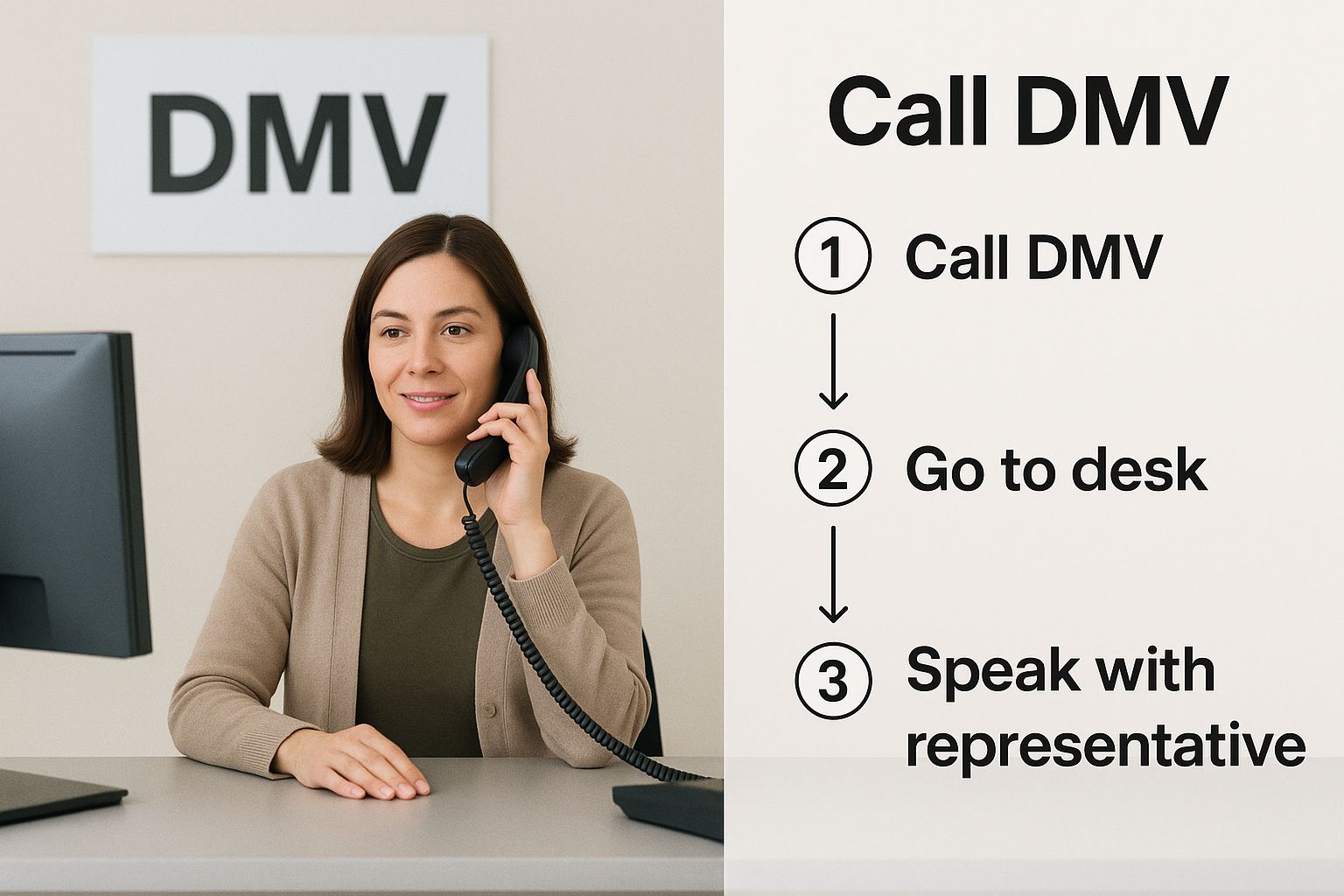
As you can see, the name changes depending on where you live, but their role as the keeper of your driving record is the same everywhere.
Using Your State’s Online Portal
These days, the quickest way to verify your status is online. Almost every state has a portal where you can check your driving privileges in just a few minutes. To do it, you'll need to prove you are who you say you are.
Have these details handy before you start:
- Your full driver's license number
- Your date of birth
- The last four digits of your Social Security number
Once you punch that in, the system should tell you whether your license is valid, suspended, or revoked. Keep in mind, some states might charge a small fee, usually between $5 and $20, if you want a full, official copy of your driving record. A simple status check, however, is often free.
Watch out for sketchy websites that demand payment upfront before sending you to the real state portal. The safest bet is to search Google for "[Your State] DMV" or "[Your State] driving record" to land on the official government site.
Other Official Ways to Check
What if you can't get online or just prefer not to? No problem. You have other official, reliable options, even if they take a bit more time.
Sometimes, the best way to get an answer is to talk to an actual person. A quick phone call to your local DMV office can often clear things up. A representative can look up your record while you're on the line and tell you what’s going on.
You can also handle it in person by visiting a DMV branch or by mailing in a formal request. For an in-person visit, you'll have to bring identifying documents (like your six points of ID) and proof of address. Mailing in a form is usually the slowest method, so don't count on it if you're in a hurry.
To make it easier, here's a quick rundown of your options.
Official Methods for Checking Your License Status
| Method | Typical Speed | Potential Cost | Information Needed |
|---|---|---|---|
| Online Portal | Instant | $0 – $20 | License number, DOB, last 4 of SSN |
| Phone Call | A few minutes (plus hold time) | Usually free | License number, DOB, other personal details |
| In-Person Visit | Same day (plus travel/wait time) | Varies by state | License, 6 points of ID, proof of address |
| Mail-In Request | 1-3 weeks | Varies by state | Completed form, copy of ID, payment |
No matter which path you choose, using one of these official channels is the only way to be 100% certain about where you stand.
Making Sense of Your Driving Record
Once you get your hands on your official driving record, it can look like a mess of confusing codes and jargon. But figuring out what it all means is the first real step toward understanding why your license was suspended and what you need to do to fix it. This document tells the entire story of your driving history, good and bad.
Think of it as a report card for your time on the road. It lists every official interaction, from a simple speeding ticket to more serious violations. Your job is to find the specific entries that led to your current suspension.
Decoding Common Codes and Terms
Driving records are notorious for using abbreviations to cram a lot of information into a small space. While the exact codes can differ from one state to another, some are pretty universal. Learning them will help you quickly find the problem areas on your report.
Here are a few you’re likely to run into:
- FTA (Failure to Appear): This is a big one. It means a court date for a ticket or another violation was missed.
- FTP (Failure to Pay): This code pops up when fines for a traffic ticket or court judgment have not been paid.
- DUI / DWI: These stand for Driving Under the Influence or Driving While Intoxicated and point to an alcohol or drug-related offense.
- Points: Many states use a point system to track violations. Your record will show exactly how many points were added for each offense.
Your driving record is more than just a list of tickets; it’s an official document that outlines the specific reasons and dates for any suspension. Look for a section often labeled "Withdrawals" or "Suspensions" to find the most critical information, including start dates and reinstatement conditions.
A Real-World Scenario
Let's look at a common situation. Imagine a driver, we'll call him Alex, checks his record and sees an entry marked FTA right next to a speeding ticket from six months ago. The record also shows his suspension started just a short time after that missed court date.
In this case, the suspension wasn't triggered by the speeding ticket itself—it was because Alex never dealt with it in court. The driving record gives him the exact clue he needs: the FTA is the culprit. Alex now knows his first step toward getting his license back is to contact the court that issued the original ticket and clear up the failure to appear. This is why knowing how to read your own record is so crucial for moving forward.
Surprising Reasons Your License Can Be Suspended
Most people think you only get your license suspended for really bad driving, like a DUI or a string of speeding tickets. The truth is, your driving privileges are often tied to responsibilities that have nothing to do with being behind the wheel. This is a huge blind spot for many folks, and it’s why they’re often shocked to find out their license is suspended for something they never saw coming.
For example, falling behind on court-ordered child support is a very common reason for license suspension in Georgia and many other states. The same goes for unpaid court fines, even if they aren't from traffic violations. The state's logic is that driving is a privilege, and keeping up with your financial and civic duties is part of the deal.
Beyond the Driver's Seat
The list of non-driving reasons for a suspension is surprisingly long and can catch even the most cautious drivers off guard. Getting a handle on these potential triggers is the first step to figuring out what might be going on with your own license.
Some of the most common non-driving offenses we see include:
- Failure to Pay Child Support: States have systems in place to automatically suspend the licenses of parents who are delinquent on their payments.
- Unpaid Court Fines: This isn't just about traffic tickets. Any court-ordered fine that goes unpaid can put your license on the chopping block.
- Drug Offenses: Even a drug conviction that had nothing to do with a vehicle can lead to an automatic license suspension in some states.
This link between your license and non-driving offenses is a big deal. Research shows that over 190,000 driver's licenses are suspended every year for drug offenses where a vehicle wasn’t even involved. As you can imagine, this creates huge problems for people just trying to get to work and support their families. You can dig into the data on this issue by exploring the research from the Prison Policy Initiative.
A suspension can even happen from a DUI-related stop where you weren't actually convicted of a crime. Under implied consent laws, if you refuse a chemical test like a breathalyzer, you can face an automatic administrative license suspension.
This is a civil penalty, completely separate from any criminal case, and it’s one of the most unexpected ways drivers lose their right to be on the road. You can learn more about the consequences of a refusal in our guide on Georgia's implied consent law.
What to Do If Your License Is Suspended
Finding out your license is suspended can be a shock, but it is a solvable problem. The process of getting driving privileges back is called reinstatement, and the first step is always understanding exactly why it was suspended. Every situation is different, and your state's DMV will have a specific checklist waiting for you.
Generally, the original issue that caused the suspension will need to be addressed. This might mean paying off old court fines, finishing up a court matter, or completing a state-mandated program. The exact requirements hinge entirely on the specific case and the rules in your state.
Common Reinstatement Hurdles
While the path to getting your license back will be unique to you, most reinstatement plans include a few common steps. Knowing what to expect can make the whole process feel much more manageable.
- Paying All Fines and Fees: This isn't just the original ticket. You’ll likely have to cover any late fees plus a separate license restoration fee, which typically runs around $100.
- Completing Required Courses: Depending on what happened, you may be ordered to complete a defensive driving course or an alcohol and drug education program before the state will even consider reinstatement.
- Filing an SR-22 Form: For more serious violations, like a DUI, the state will require your insurance company to file an SR-22 form on your behalf. This is simply a document that proves to the state that you’re carrying the minimum required car insurance.
The most important thing you can do is get the official list of reinstatement requirements directly from your state's motor vehicle agency. Treat that list as your roadmap—follow it to the letter so you don't miss a single step.
If your suspension is related to a DUI, the requirements can be far more involved and complex. For anyone in that situation, understanding every possible option is important, and you can learn more about how to beat DUI charges in our guide.
Common Questions About License Suspensions
When you're trying to figure out your driving record, a lot of questions pop up. We've put together some straightforward answers to the most common ones. This should help you get a clearer picture of what you're dealing with.
How Long Does a Suspension Stay on Your Record?
This is a big question, and honestly, it depends on your state. A suspension will show up on your official driving record for a specific length of time, usually somewhere between three and ten years.
Even after you've jumped through all the hoops to get reinstated, the suspension itself is still visible to insurance companies and law enforcement for that entire period.
For more serious offenses like a DUI, that mark can stick around a lot longer—sometimes forever. That’s why tackling the original issue is so critical. If a DUI is what caused your suspension, you might be wondering what to do next. Our guide on getting a DUI off your record offers a much deeper dive into that specific process.
Can a Suspension in Another State Affect Me?
Yes, it can. Nearly all states are part of the Driver License Compact, which is basically a national database for sharing driver information.
If you get your license suspended in one state, your home state will find out and almost always enforce that same suspension. You can't just cross state lines and hope a ticket or violation disappears. It will follow you home.
Driving on a suspended license is a serious charge, no matter where you are. The International Roadcheck, a huge enforcement effort across the U.S., Canada, and Mexico, recently found that 5.1% of all driver violations were for driving with a suspended license. You can dig into the road safety enforcement findings yourself.
This just goes to show how seriously law enforcement takes your license status, even during routine stops. It's a huge reason to get any suspension issues cleared up as quickly as possible.
If you're caught in the complexities of a suspended license, especially one tied to criminal charges, understanding your options is the first move. For more information and resources in Georgia, reach out through https://challengemycharge.com.
