
A lot of people start looking up how to clean your driving record after the stressful part seems over.
The stop happened on GA-400, or on a side street in Alpharetta, Roswell, Johns Creek, or Cumming. You signed the citation. Maybe you posted bond. Maybe you already walked out of court thinking the fine was the whole problem.
It usually isn't.
In Georgia, the full damage often shows up later. Your license status changes. Your insurance renews at a much worse rate. A background check sees more than you expected. A case that looked minor turns into a problem with work, school, a commercial license, or a professional application.
The good news is that many records can be improved, challenged, reduced, restricted, or managed if you act quickly and choose the right path. The wrong move is treating every ticket or charge the same. A speeding ticket in one North Atlanta court may call for a very different strategy than a reckless driving charge in another, and a DUI is in its own category entirely.
The Stakes of a Georgia Traffic Violation
That flashing blue light behind you in Milton or Sandy Springs feels like a short event. Legally, it often starts a much longer chain.

A traffic case can affect three separate things at once:
- Your court case. This is the citation or criminal charge itself.
- Your driving record. Georgia DDS tracks convictions and points.
- Your insurance and background visibility. Those consequences often last longer than people expect.
A driver in Roswell might think, "I'll just pay it online and move on." That can be a mistake. Paying a ticket is usually the same as entering a conviction. Once that conviction hits your record, you may have fewer options.
What turns a small ticket into a bigger problem
The risk isn't limited to the fine.
A simple moving violation can start a pattern. Then a later stop in Alpharetta, Cumming, or Marietta lands on top of the first one. A driver who was manageable on paper now looks risky to DDS, to an insurer, and sometimes to an employer.
In practice, I see people underestimate these cases for one reason. They focus on the roadside stop and ignore the paperwork trail that follows.
Practical rule: The sooner you review the charge, the court, and your existing record, the more options you usually have.
Why local court differences matter
North Atlanta courts don't all feel the same.
Municipal courts in places like Alpharetta, Roswell, and Sandy Springs often handle city-issued traffic cases with their own calendars, procedures, and negotiation culture. State courts in counties like Forsyth or Cobb can feel more formal and may involve different prosecutors, scheduling practices, and expectations for contested hearings.
That matters because the best answer isn't always "fight everything" and it isn't always "take the class and pay it." Sometimes the smartest move is contesting the basis for the stop. Sometimes it's negotiating for a non-reporting resolution. Sometimes it's protecting your ability to use a limited one-time remedy later.
If your goal is to clean your record, you need to think beyond today's court date. You need to think about what this charge will look like six months from now when insurance renews, or when a suspension notice shows up, or when a background screening pulls the case.
Accessing and Understanding Your Georgia Driving Record
A Roswell ticket that seemed minor two years ago can become the reason DDS flags your license today. Then a new stop in Alpharetta or Cumming turns into a much bigger problem because the court is looking at a record you have not reviewed carefully.
Start with the record. Not your memory. Not the version you think the clerk explained at the window.
Pull the right Georgia DDS record first
Order your Georgia Motor Vehicle Report through DDS before you make any decision about paying a ticket, using a plea, or signing up for a class. If you want a plain-English walkthrough before you pull the report, this guide on how to check your driving record can help you understand what you are requesting and what it may show.
If your concern is bigger than points, check your license status too. A pending suspension, hold, or reinstatement issue changes the strategy immediately, especially if you drive through multiple North Atlanta courts and one unresolved case is affecting the rest. This resource on checking for a suspended license is a useful place to start.
Read the record like a lawyer would
Once you have the MVR, slow down and read each line. The details matter.
Look for these items:
- Identity information. Your name, date of birth, and license number must match exactly.
- Court and case entries. Confirm where the case came from and how it was reported.
- Convictions. The key question is whether the case ended in a conviction that DDS recognizes.
- Point-related offenses. Some tickets create more risk than drivers realize.
- Suspensions or withdrawals. These entries often explain why a license problem is still active.
- Out-of-state matters. A Georgia driver can still run into restoration trouble because of an older hold from another state.
Court origin matters more than many drivers expect. A city court matter out of Alpharetta or Roswell may appear on the record in a way that is easy to misunderstand, especially if the offense description is abbreviated. A Forsyth County case tied to Cumming can read differently again. The wording may look technical, but the essential questions stay the same: was it reported as a conviction, were points assessed, and is the entry accurate?
Use Georgia's official rules, not rumor
Georgia DDS publishes the point system and suspension rules, and that is the standard to use. According to the Georgia DDS points schedule, certain traffic convictions add points to your license, and DDS can suspend a license when a driver reaches the statutory threshold within the applicable period.
DDS also explains that an approved defensive driving course may reduce points in some situations, but that option has limits and timing rules. I tell clients to be careful with that remedy. Using it too early can leave you with fewer options later if another ticket comes out of Roswell Municipal Court, Alpharetta Municipal Court, or Forsyth County.
That is the trade-off. A course can help. It does not erase the underlying case, and it does not fix every record problem.
Mistakes that cause trouble later
Drivers reviewing their own MVRs often miss the same issues:
| Mistake | Why it causes problems |
|---|---|
| Assuming a dismissal means nothing will appear anywhere | Court outcome and DDS reporting are related, but they are not identical questions |
| Looking only at points | Some entries hurt you even before a formal point problem develops |
| Ignoring which court handled the case | Alpharetta, Roswell, and Cumming-area cases can require different follow-up steps |
| Forgetting a prior nolo plea or course use | Past choices can limit what is still available now |
| Missing clerical errors | A wrong code, date, or disposition can affect insurance, licensing, and future court strategy |
Sort the record before you take action
After you review the MVR, separate each entry into one of four categories:
- Possible reporting error. Wrong disposition, duplicate entry, incorrect identifying information, or a case that needs clerk review.
- Minor traffic matter. Often a strategy issue involving the original court, the plea used, or whether DDS reporting can still be addressed.
- Serious driving offense. DUI, reckless driving, hit and run, or another charge with criminal consequences beyond points.
- License restoration issue. Active suspension, hold, failure to appear, or an interstate problem.
This step sounds simple, but it shapes the entire plan. A Roswell speeding case and a Forsyth suspension issue do not get fixed the same way, even if both appear on the same DDS printout. A clean-up strategy works only when you know which court created the problem, how DDS recorded it, and what can still be corrected now.
Strategies for Minor Traffic Tickets in North Atlanta Courts
Those asking how to clean your driving record in Georgia generally aren't starting with a felony. They're starting with a speeding ticket, a lane-change citation, a light violation, or a failure-to-yield case.
Those cases still matter. The question is what to do before the ticket hardens into a conviction.

Option one is paying the ticket
This is the fastest option. It's usually the worst one if your record matters.
Paying closes the court file, but it often means you accepted the offense. For a driver in Alpharetta, Roswell, or Marietta, that can be fine if the issue is isolated and your record is otherwise clean. It can be a bad move if you're close to a point problem, if you drive for work, or if insurance is already a concern.
Use this option only after you've reviewed the record and the likely consequences.
Option two is asking about nolo contendere
A nolo contendere plea can help in the right case because it may prevent points from being assessed in Georgia for an eligible traffic matter. But people misuse it.
The problem is simple. It isn't a universal eraser. It has limits, and using it casually can waste a valuable remedy on the wrong citation. If you later face a more damaging ticket, you may wish you had saved it.
Option three is fighting the ticket
A lot of record-cleaning work often begins here.
Fighting a ticket doesn't always mean a dramatic trial. Sometimes it means negotiating before the hearing. Sometimes it means pointing out a proof issue. Sometimes it means getting the charge amended to something that protects your record better.
A traffic ticket attorney in Cumming or a speeding ticket lawyer in Marietta looks at questions like these:
- Was the stop lawful
- Can the officer prove the specific offense charged
- Is the witness available
- Can the charge be reduced to a non-point offense
- Will the court consider a driving course or other condition
How strategy changes by court
A city court in Sandy Springs may handle calendar calls and negotiation differently than a county-level case in Cobb or Forsyth. That doesn't mean one court is easier. It means local practice matters.
In some municipal courts, preparation and presentation make a major difference. In others, the best result comes from resolving the case before a contested hearing date. A Roswell ticket may call for a different tone and timing than a Cumming Municipal Court matter.
That local variation is exactly why generic internet advice fails. "Just ask for traffic school" isn't a strategy. It's a question. Whether that question helps depends on your record, the judge, the prosecutor, and the charge.
If your ticket is in a North Atlanta court, don't copy what worked for your cousin in another county. Local practice drives outcomes.
A practical comparison of your choices
| Path | Best use | Main risk |
|---|---|---|
| Pay it | Isolated issue with low record impact | You lock in the conviction |
| Nolo plea | Select eligible case where avoiding points matters | You may waste a limited remedy |
| Contest or negotiate | When record protection matters more than speed | Requires preparation and court work |
When a class makes sense
A driver improvement or defensive driving course can be smart, but only when it fits the larger plan.
It may help persuade a court to resolve a minor ticket more favorably. It may also help with point reduction at the DDS level in the proper situation. But taking the class after you've already made the wrong plea often doesn't solve the problem you created.
Consider the class when:
- Your record is still salvageable. The course works best as part of a timely strategy.
- The court is open to a negotiated resolution. Some courts view proactive steps favorably.
- You understand the long-term cost. Don't burn a limited tool on a case that could be handled another way.
What to bring if you're appearing in court
For a hearing in Alpharetta, Roswell, Sandy Springs, or Marietta, bring structure, not excuses.
Take:
- Your citation.
- A copy of your driving record.
- Any proof of completed classwork.
- Proof of insurance if relevant.
- Notes on what happened, written while the details are fresh.
A lot of minor ticket cases are won or improved because the driver prepared early enough to give the court a workable solution.
Tackling Serious Offenses Like DUI and Reckless Driving
A DUI or reckless driving charge isn't just a worse ticket. It's a different kind of case.
Now you're dealing with criminal exposure, license consequences, court reporting requirements, and a record problem that can follow you long after the case closes in Alpharetta, Johns Creek, Marietta, or elsewhere in North Atlanta.

Why DUI changes the analysis
With a serious charge, the first objective isn't "How do I clean this later?" It's "How do I stop this from becoming a permanent problem now?"
That means looking hard at the stop, the arrest, the officer's observations, the testing process, and the charging decision. A DUI lawyer in Alpharetta or Johns Creek should be evaluating whether the evidence supports the charge as filed, whether the case can be reduced, and whether your license is facing a separate administrative threat.
A reckless driving lawyer in Marietta or a misdemeanor defense attorney in Roswell should be doing the same kind of front-end work. The best record-cleaning strategy is often a strong defense before conviction.
What a serious case can lead to
Serious traffic-related criminal charges can create problems in several lanes at once:
- Court exposure. Misdemeanor or felony consequences depending on the case.
- License risk. Suspension and restoration issues.
- Background check visibility. Employers and landlords may see more than a traffic citation.
- Insurance fallout. The financial penalty can last long after court.
According to verified data summarized at thezebra.com, a first-offense DUI conviction in Georgia can be restricted from public view after completing probation and meeting other criteria, and a single DUI can raise insurance rates by an average of 80% for 3-5 years. The same verified data notes that attorneys often use the First Offender Act under O.C.G.A. § 42-8-60 for eligible non-DUI charges to pursue record restriction.
That tells you two things. First, the conviction itself is expensive far beyond the courtroom. Second, relief may exist, but only after the case is handled correctly.
DUI reduced to reckless driving is not automatic
People ask for this all the time. It can happen. It is never guaranteed.
A reduction usually depends on the evidence problems, the person's history, the court, and the prosecutor's view of the case. In some Fulton County and Cobb County courts, the path to a reduced disposition may involve treatment steps, clean compliance, and targeted legal arguments. In other cases, the better route is a direct attack on admissibility or proof.
What doesn't work is walking into court and saying, "I need this off my record."
Courts respond better to legal reasons, mitigation that is documented, and a defense position that gives the prosecutor a reason to move.
A serious charge needs a case theory, not a plea for mercy.
Reckless driving and drug-related charges
Reckless driving can look deceptively simple on paper. In practice, it can affect employment, professional licensing, and future charging decisions. A reckless driving attorney in Cobb County or Forsyth County should treat it as a record case from day one.
The same is true for related drug possession allegations arising from a vehicle stop. A drug possession lawyer in North Atlanta often has to challenge both the search and the substantive charge. If that challenge succeeds, the record problem changes dramatically. If it fails, the cleanup process becomes narrower and more technical.
What actually helps after arrest
If you've been arrested for DUI, reckless driving, or a related offense, the most useful moves are immediate and specific:
- Preserve documents. Citation, bond paperwork, notice forms, and court date information.
- Write down the facts. Stop location, timing, what the officer said, what tests were requested.
- Check your license status early. Don't assume court and DDS are in sync.
- Avoid self-inflicted damage. Casual admissions in calls, texts, or social posts can become evidence.
- Build the record for reduction or restriction now. That includes compliance, treatment if appropriate, and smart court positioning.
The record issue after conviction
Even when a conviction happens, not every door closes.
For some first-offense DUI cases, restriction may later be possible if the legal criteria are satisfied. For eligible non-DUI criminal charges, First Offender treatment can be the difference between a publicly visible conviction and a path toward restriction.
But timing matters. Plea language matters. Disposition language matters. The court where the case is resolved matters. A person trying to clean a driving record after a bad plea often learns the hard way that the cleanup options were shaped months earlier.
The Georgia Record Restriction and Expungement Process
In Georgia, people often use the word "expungement" loosely. The more important term in many cases is record restriction.
That distinction matters because the goal is usually not to rewrite history. The goal is to limit public visibility of an eligible case so it stops damaging work, housing, and reputation.
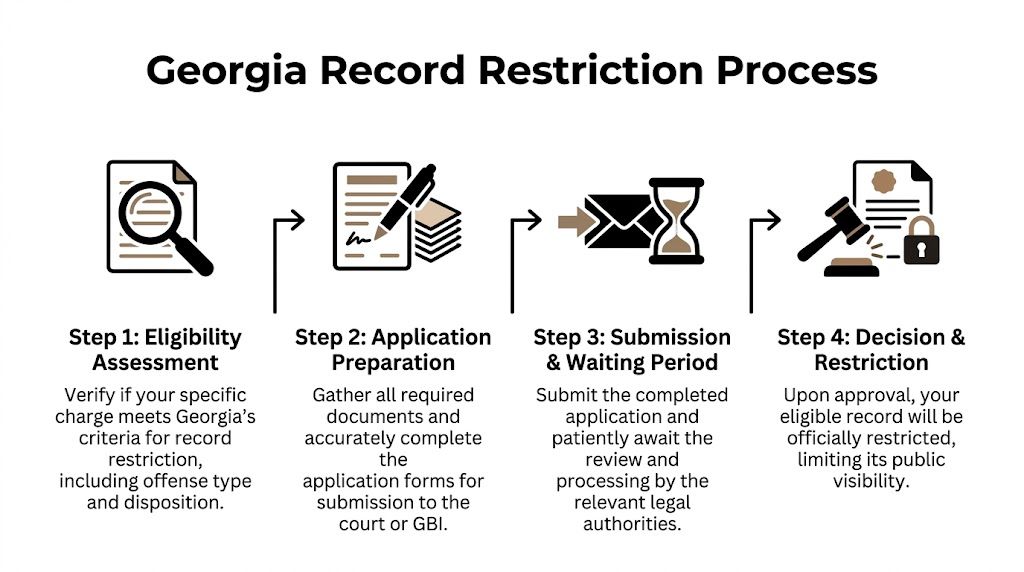
Step one is figuring out whether the case qualifies
Eligibility always comes first.
A dismissed charge is different from a conviction. A first offender disposition is different from a straight guilty plea. A DUI is treated differently from many non-DUI charges. The court where the case was resolved in Forsyth County, Gwinnett County, Cobb County, or Fulton County also matters because the filing path can differ in practice.
This is the point where many do-it-yourself petitions fail. People assume that because a case feels old, it qualifies. Age alone doesn't control the answer.
Step two is pulling the exact case documents
You need the paper trail before you ask a court or agency for relief.
That usually includes:
- Final disposition paperwork
- Accusation or accusation number
- Sentencing terms
- Proof probation or conditions were completed
- Any prior orders affecting first offender or dismissal status
If a charge came out of a vehicle stop, you also need to separate the criminal case from the DDS issue. Cleaning the public criminal record doesn't automatically change every driving-history consequence.
Step three is filing the right request in the right place
Georgia record restriction practice is technical. A request may involve the arresting agency, prosecutor, court, or state record systems depending on the type of case and disposition.
A common mistake is filing a document in the court that handled the ticket calendar when the controlling criminal disposition sits elsewhere in the record chain. Another is serving the wrong office or failing to include the paperwork showing eligibility.
If your concern goes beyond court files and includes broader online visibility, this guide on remove your name from public records online gives a useful overview of how court relief and online data cleanup are related, but not identical.
For a Georgia-focused explanation of legal relief options, this resource on getting records expunged is a practical companion because it helps distinguish what people call expungement from the restriction remedies that may apply.
Restricting a record is a legal process, not a website fix. If the underlying case isn't handled correctly, online cleanup won't solve the real problem.
Step four is waiting, responding, and preparing for review
Some requests are straightforward. Others draw objections or require a hearing.
A solid petition usually explains:
| Part of the request | Why it matters |
|---|---|
| Accurate case identification | Prevents delay and misfiling |
| Legal basis for restriction | Shows the court or agency why relief is allowed |
| Proof of completed conditions | Answers the most common objection early |
| Clear proposed relief | Helps the reviewing authority understand exactly what you want |
If a hearing is set, the focus should stay narrow. Eligibility. Disposition. Compliance. Why the law allows restriction.
What people get wrong about the process
Three myths cause the most trouble.
- "If I paid everything, it disappears." Payment closes obligations. It doesn't create restriction.
- "If the case was old, no filing is needed." Many records stay visible until someone acts.
- "Driving record cleanup and criminal record cleanup are the same." They overlap, but they aren't identical systems.
For anyone trying to clean a driving record after a North Atlanta case, that last point is critical. You may need to solve the court record, the DDS consequences, and the background-check visibility separately.
Why You Need an Experienced Attorney to Clear Your Record
People often wait too long to hire counsel because they think the issue is administrative.
It rarely is.
A record problem usually sits at the intersection of criminal law, local court procedure, DDS practice, and timing rules. That's why a DUI attorney in Alpharetta, a reckless driving lawyer in Marietta, or a license suspension lawyer in Cumming brings value that generic advice can't.
Local court knowledge changes outcomes
North Atlanta isn't one courthouse.
Alpharetta, Roswell, Johns Creek, Sandy Springs, Cumming, and Marietta all have their own patterns. Prosecutors differ. Calendars differ. Some courts are more negotiation-driven. Others require a tighter evidentiary approach. A lawyer who works in these venues knows what documents matter, when to raise a point, and what resolutions are realistic.
That local familiarity helps in ordinary ticket cases and becomes even more important in DUI, misdemeanor, and felony matters.
DIY record cleanup has predictable failure points
People representing themselves usually run into one of these problems:
- They plead too early. Then they ask how to undo a result that could have been avoided.
- They miss the record split. They fix the court issue but ignore DDS, or the reverse.
- They file the wrong petition. Technical errors waste time and credibility.
- They use a limited remedy poorly. A nolo plea or course election gets burned on the wrong case.
- They underestimate serious charges. Reckless driving, DUI, and related drug charges are treated like simple tickets until it's too late.
What an experienced attorney actually does
Good representation isn't just showing up in court.
It means investigating the stop, identifying pressure points in the evidence, negotiating with a realistic goal, preserving eligibility for later restriction, and protecting your license while the case is pending. It also means knowing when a client should contest the charge and when a clean negotiated outcome is the smarter move.
If your concern includes public background visibility after the case, this explanation of how to clear a criminal background is a useful starting point because it frames the problem the right way. The issue usually isn't one document. It's the whole legal footprint.
Hiring the right lawyer isn't about making a ticket disappear by magic. It's about avoiding preventable damage and using every lawful option the right way.
When to call right away
Don't wait if any of these apply:
- You have a DUI or reckless driving court date coming up
- You think your license may be suspended
- You already paid a ticket and now regret it
- You have multiple cases in different North Atlanta courts
- An employer or insurer has already flagged your record
- You need same-day legal help before a deadline
When the stakes involve points, suspension, insurance, or a public criminal record, delay usually costs options.
Frequently Asked Questions About Cleaning a Driving Record
A driver in Roswell pays a ticket online on Tuesday, applies for a new job on Friday, and finds out the plea put points on the license and limited what can be fixed later. That happens often in North Atlanta because different courts handle traffic cases differently, and the right move in Alpharetta is not always the right move in Cumming or Roswell.
Can I really clean my driving record in Georgia
Sometimes, yes. The answer depends on whether you are dealing with a pending ticket, a conviction already reported to DDS, a criminal traffic charge, or bad information on the record.
In Alpharetta Municipal Court, the best result is often getting in front of the case before a plea is entered. In Roswell, the strategy may focus on amending the charge to protect your record and insurance position. In Cumming or Forsyth County State Court, serious driving cases usually require a more formal defense plan because the long-term consequences can reach beyond points and into public criminal history. The key is identifying which court has the case and what stage the case is in before taking any action.
How long does the process take
There is no single timeline.
A simple ticket issue in a municipal court can sometimes be addressed quickly if the case is still open and the court calendar allows it. A record restriction matter usually takes longer because the outcome depends on the final disposition, the arresting agency, the prosecutor's position, and whether the paperwork was done correctly the first time.
Fast answers are not always good answers. I tell people to start with the actual DDS record and the court disposition because those two documents usually show whether the problem can still be fixed or only contained.
What about an out-of-state hold blocking my Georgia license
These cases are frustrating, and waiting usually makes them worse.
If Georgia DDS says another state still shows a hold, Georgia generally will not clear the license until that other state reports compliance or release. The practical fix is to clear the issue in the originating state, get written proof, and then make sure DDS receives and processes the right documentation. Out-of-state holds do not usually disappear because time passed.
The Georgia Department of Driver Services license reinstatement information is a good starting point for understanding how reinstatement blocks work. In practice, the hard part is not reading the rule. The hard part is matching the old case, the other state's requirements, and DDS's processing rules without missing a step.
Can a DUI ever be removed from public view
Sometimes, but only in limited circumstances and only if the case ended in a way that qualifies under Georgia law.
A first DUI does not automatically vanish after probation. If the case ended with a conviction, the public record problem and the license problem are separate issues. If the charge was reduced, dismissed, or otherwise resolved without a disqualifying conviction, record restriction may be possible later. The exact court disposition controls the answer.
That is why I review the accusation, sentencing paperwork, and final disposition together. One wrong assumption about how the case was closed can waste months.
How much does a DUI lawyer cost in Alpharetta or nearby
The fee depends on the court, the charge, whether a license suspension hearing is involved, whether testing is disputed, and whether the case is likely to resolve by negotiation or trial.
A DUI in Alpharetta Municipal Court may involve a different workload than a reckless driving or DUI-related case in Roswell or a more heavily contested matter in Cumming. Anyone giving a flat answer without reviewing the citation, bond paperwork, prior history, and DDS status is guessing.
Is paying the ticket ever the right choice
Yes, sometimes.
It can be the sensible option for a minor matter when the record is otherwise clean and the plea will not trigger a suspension, a major insurance increase, or a problem with a commercial license. But that decision should come after checking what is already on the DDS record and what the local court will report.
In North Atlanta courts, one paid ticket can affect the strategy for the next case. That is especially true for drivers with multiple citations spread across Alpharetta, Roswell, and Cumming. A quick payment can close the file, but it can also close off better options.
