
If a past mistake is a barrier to a job, a home, or just peace of mind, you’ve probably heard a few terms used to describe clearing a record. The two big ones are expungement and record sealing. They sound similar, but knowing the difference is the first real step in understanding the process.
Understanding Your Path to a Clean Slate
When you start digging into how to clear a criminal record, it’s easy to get lost in confusing language that changes from state to state. The goal here isn’t to provide specific guidance for any individual case but to lay out the landscape of what is involved.
Think of it this way: expunging a record is often described as having it physically destroyed or erased from public view. Sealing a record is more like putting it in a locked vault—it still exists, but access is highly restricted.
Expungement Unpacked
When people talk about getting a record cleared, expungement is usually what they have in mind. It’s often the most complete option available. An expunged record is typically removed from public databases, and in some cases, the physical files are actually destroyed.
What does that mean for an individual? It means a potential employer running a standard background check would likely see a clean slate for that particular incident.
But “erased” can be a tricky word. Even after an expungement, certain government and law enforcement agencies can often still access the record. It’s not a complete wipe from existence, but it’s a powerful way to remove it from the public eye.
A key takeaway is that expungement significantly limits who can see a past offense, opening doors that were previously closed. It’s often viewed as the gold standard for record clearing.
How Record Sealing Works
Record sealing is another path, but it works differently. Instead of being destroyed, the record is made confidential. This effectively hides it from the general public.
So, landlords, private employers, and the general public won’t see the sealed offense on a typical background check.
Just like with expungement, law enforcement and the court system can almost always still see a sealed record. It might also surface in very specific situations, like an application for a government security clearance or certain professional licenses.
- Public Access: The main point is to block the public from ever seeing the record.
- Official Access: Law enforcement and other approved agencies almost always keep their access.
- Future Impact: Sealing a record makes it much easier to pass most background checks for jobs and housing.
Figuring out if a record is eligible for sealing or expungement is a critical first step. To get a better handle on the specifics, individuals can learn more about what it means to have a criminal record expunged and what the process usually involves. The rules depend entirely on local laws, the type of offense, and how much time has passed.
Expungement vs Record Sealing What’s the Difference
To break it down even further, here’s a quick side-by-side look at how these two processes generally stack up.
| Feature | Expungement | Record Sealing |
|---|---|---|
| Primary Goal | To destroy or permanently remove the public record of an offense. | To make the record confidential and hide it from public view. |
| Public Access | The record is generally not accessible to the public, including most employers. | The record is not accessible to the public or for standard background checks. |
| Law Enforcement Access | Agencies may still have access for official purposes. | Agencies almost always retain access for official investigations. |
| Common Outcome | The individual can often state they were not convicted of that crime. | The conviction is hidden but technically still exists in secure databases. |
At the end of the day, both options are designed to reduce the long-term damage of a criminal record. Taking the time to research the specific laws in your area is the foundation for this complex, but potentially life-changing, journey.
Determining if Your Record Can Be Cleared
Before anyone touches a single form or thinks about filing with the court, the very first question to answer is whether a record is even eligible to be cleared. This is the starting line, and honestly, it’s where a lot of people get tripped up because there isn’t a simple, one-size-fits-all answer.
The rules for clearing a record are made at the state and local levels. That means the requirements in Alpharetta, Georgia, could look completely different from the laws in another state—or even another county. Think of it like trying to get a loan from a bank. Each one has its own specific criteria. In the same way, each court system has its own checklist for deciding who gets a second chance.
Common Factors That Determine Eligibility
Most courts look at a combination of three big things: the nature of the offense, how much time has passed, and what has happened since the incident. Let’s break down what that really means.
The type of offense is usually the first hurdle. Jurisdictions draw a hard line between different kinds of crimes. Minor offenses, like a petty theft charge or a single misdemeanor possession from years back, are often eligible. On the other hand, serious violent felonies or certain crimes against vulnerable people are almost always excluded from any kind of record clearing.
For example, a shoplifting charge in Cobb County from when someone was young has a much better shot at being restricted than a recent felony conviction. The severity of the crime is the first filter.
Next up is the waiting period. It is not possible to just turn around and apply to clear a record right after a conviction. States require a set waiting period to prove that an individual has stayed on the right side of the law.
This waiting period can be as short as a year or two for minor infractions or stretch past a decade for more serious, but still eligible, offenses. That clock doesn’t usually start ticking until every part of the sentence is completed—that means probation, parole, and paying off all fines.
Finally, an individual’s subsequent history is a huge piece of the puzzle. To erase a criminal record, it is often necessary to show the court that the past offense was a one-time thing, not a pattern. If there are other convictions since the one an individual wants to clear, eligibility drops significantly. The whole point of these laws is to help people who have truly turned their lives around.
The core idea behind eligibility is demonstrating that an individual has paid their debt to society and has become a productive, law-abiding citizen. The combination of offense type, time, and subsequent good conduct paints this picture for the court.
How Different Scenarios Play Out
To see how these factors really work, let’s look at two different situations.
Imagine someone in Roswell who was convicted of a non-violent misdemeanor eight years ago. They finished their probation, paid every fine, and haven’t had so much as a speeding ticket since. They are an excellent candidate for having their record cleared because they check all three boxes.
Now, think about another person in Forsyth County with a more serious felony conviction from four years ago who just picked up a DUI charge. Their path is going to be much tougher. The felony itself might not be eligible, the waiting period probably hasn’t been met, and the new charge shows a pattern that works against them.
This infographic does a great job visualizing the two main routes for clearing a record—expungement and sealing—and how they differ.
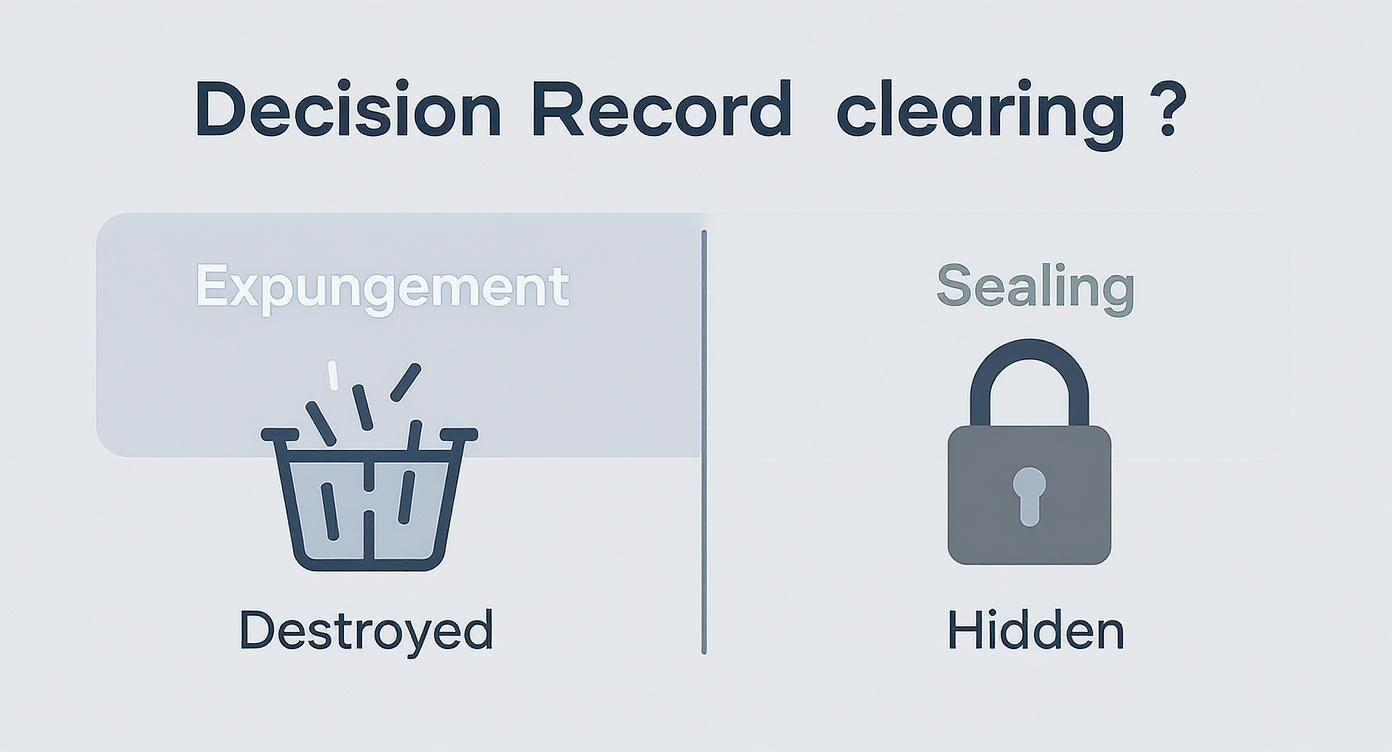
As you can see, both options get the record out of the public eye, but one path leads to the record being “destroyed,” while the other just “hides” it from public view.
Finding the Rules for Your Area
Since every state has its own unique laws, the only way to know for sure if someone qualifies is to look up the specific statutes in the jurisdiction where they were convicted. This can get complicated pretty quickly, sending a person down a rabbit hole of state legislative websites and court resources filled with technical jargon.
Because the process is so specific and unforgiving about details, many people look for help from resources that focus on this exact area of law. A much deeper explanation of the steps and requirements can be found in this guide on how to seal criminal records.
Figuring out the exact rules that apply to a specific case is the foundation for everything that comes next. Without confirming eligibility first, any effort to erase a criminal record is just a shot in the dark.
For a long time, trying to clear a criminal record was a difficult process. It meant navigating a maze of complicated paperwork, often with a hefty price tag, and the whole process was just plain frustrating.
But things are finally starting to change. A huge shift is happening across the country as more states adopt “Clean Slate” laws. These new laws are designed to automatically clear eligible records, meaning an individual does not have to lift a finger.

This modern approach is a real game-changer. It gets rid of the biggest hurdles that used to stop people from getting a second chance—the cost, the confusion, and simply not knowing it was even possible. Now, governments can use technology to identify and wipe records on a massive scale.
How Does Automatic Clearing Work?
Instead of making people file petitions and jump through hoops, automatic record clearing flips the script. The government agencies now take the lead. They set up systems that scan digital court and law enforcement databases, find records that fit the legal criteria for clearing, and then automatically process them.
This is all thanks to new legislation that lays out clear eligibility rules. Generally, these laws focus on non-violent offenses, older convictions, and arrests that never even led to a conviction. The process happens entirely behind the scenes, providing relief to countless people who might have never known they had an option.
The idea behind automatic clearing is simple but powerful: if you’re eligible for relief, it can happen without having to fight a bureaucratic system. This is a crucial change, considering that historically, less than 10% of eligible individuals ever succeed in clearing their records through the old petition-based process.
The Impact of Clean Slate Laws
The real-world effect of these laws is massive, touching lives in communities from Cumming to Marietta and everywhere in between. When a record is cleared automatically, it helps people get back into the workforce, find stable housing in places like Johns Creek and Milton, and go after educational opportunities without an old mistake holding them back.
It’s a systemic fix that strengthens entire communities by allowing more people to become productive, tax-paying citizens.
To see just how big this change is, look at the states that have gone all-in. One of the most ambitious examples is California, which recently put its automatic expungement law into full effect.
Under Assembly Bill 1076, which kicked off on July 1, 2022, the state started a huge effort to clear records. In just the first six months, the California Department of Justice automatically and permanently wiped over 11 million old arrest and conviction records. This historic initiative was powered by major investments in technology and targeted records where people were never convicted or had already finished their sentences for non-prison convictions. You can read more about this groundbreaking law and its early results.
Who Benefits from This New Approach?
Automatic clearing is mainly for people with minor, non-violent offenses who have stayed out of trouble for a certain amount of time. The exact rules vary from state to state, but the goal is generally the same.
- Arrests Without Conviction: If someone was arrested but never charged, or if they were found not guilty, that arrest can still haunt their record. Clean Slate laws are incredibly effective at getting rid of these.
- Low-Level Misdemeanors: Old offenses like petty theft or minor drug possession from years ago are perfect candidates for automatic clearing once the waiting period has passed.
- Decriminalized Offenses: When a state decriminalizes something, like cannabis possession, automatic clearing can retroactively remove old convictions for that same offense.
This move toward automation shows a fundamental change in how our justice system thinks about second chances. By removing barriers and using technology, states are making it possible for millions of people in communities like Forsyth County and Alpharetta to finally move on from their past and build a better future.
Navigating the Petition-Based Process
So, what happens when a record isn’t eligible for automatic clearing? This is where the traditional, petition-based process comes into play. It’s a more hands-on route, requiring an individual to formally ask the court to clear their record. This is the standard procedure in many jurisdictions, including Cobb County and Forsyth County.

Think of this process as building a case. It’s on the individual to gather the right documents, fill out the specific forms, and file everything correctly with the court. It’s less about waiting for a system to work for you and more about taking deliberate, methodical action.
The First Step: Gathering Your Documentation
Before even touching a petition, it is necessary to get the paperwork in order. This is the foundation of the entire request, and any misstep here can cause serious delays. An individual needs the official records that spell out exactly what happened with their case, from the moment of arrest to the final outcome.
It’s a bit like preparing taxes—one wouldn’t start filling out the 1040 without W-2s and receipts, right? Same idea.
Here are the key documents that are almost certainly needed:
- A copy of the criminal history report: This gives the full picture of the record.
- Official court records for the specific case: These are the most critical pieces. They detail the charges, court proceedings, and the final disposition (how the case ended).
- Proof the sentence was completed: This could be paperwork showing probation was finished, every last fine was paid, or a required class or program was completed.
Hunting down these records can be a job in itself. It will likely be necessary to contact the clerk of the court in the county where the conviction happened—say, in Roswell or Marietta—and formally request copies. Be prepared for this to take time and cost a little money for administrative fees.
Preparing and Filing the Petition
With all documents in hand, the next step is to tackle the petition. This is the official document where a formal request is made to the court to expunge or seal a record. Every jurisdiction uses its own specific forms, and grabbing the wrong one is a non-starter.
Let’s walk through a quick scenario. Imagine someone in Alpharetta wants to clear a misdemeanor from five years back. They’ve already secured their court disposition and a receipt showing all fines were paid. Their next job is to find the exact “Petition for Record Restriction” form that their county requires.
Filling out these forms demands absolute precision. Every detail—case number, arrest date, charges, and the outcome—must be entered exactly as it appears on the official records. A single typo, like a transposed number in a case file or a misspelled name, could get a petition kicked back, forcing the individual to start all over again.
The petition-based process is unforgiving when it comes to details. Every piece of information must be accurate and verifiable, as the court will use official records to confirm the facts presented.
Once the paperwork is perfect, the next move is filing it with the right agency, which is almost always the clerk of the court where the conviction occurred. There’s usually a filing fee involved, which can run from under $100 to several hundred dollars, depending on the court. In some cases, a copy of the petition also has to be “served” to the prosecutor’s office that originally handled the case.
What Happens After You File
Once a petition is submitted, the waiting game begins. The court and the prosecutor’s office will review everything to confirm eligibility and that all the paperwork was filed correctly. Don’t expect a quick turnaround; this review can easily take several weeks or, more commonly, a few months.
If the prosecutor doesn’t object and the judge signs off, the court issues an order to clear the record. That order is then sent to various state agencies so they can update their databases. However, if the prosecutor objects or the judge has questions, a hearing might be scheduled. An individual may have to appear in court and make their case for why the petition should be granted.
The complexity here is why many people decide they need professional help. While this guide lays out the road map, the twists and turns of the system can be tough to handle alone. Knowing when to look for resources is key, and our article on how to find a good criminal lawyer offers practical information for anyone considering that step. Ultimately, the petition-based path is a journey of precision, patience, and persistence.
Why So Few People Succeed in Clearing Their Record
The idea of clearing a criminal record sounds like a powerful second chance, and it absolutely is. But the reality is that most people who are eligible to get their record cleared never actually cross that finish line.
It’s a frustrating disconnect often called the “uptake gap.” This isn’t about personal failure; it’s a systemic problem driven by some very real, very common obstacles.

Knowing what trips people up is the first step toward avoiding those same pitfalls. By understanding the hurdles, an individual can prepare for them and navigate the path to erasing a criminal record much more effectively.
The Major Roadblocks to a Clean Slate
One of the biggest issues is a simple lack of awareness. Many people with records that could be sealed or expunged just don’t know it’s an option. They assume a past mistake is a permanent stain, never realizing that laws in places like Cobb County or Forsyth County might offer a way out.
Then there’s the sheer complexity of the process itself. Navigating the court system is rarely intuitive.
- Confusing Paperwork: The petitions are often loaded with jargon and demand absolute precision. One small mistake can derail the whole thing.
- Procedural Hurdles: Petitions can be thrown out for simple errors—missing a deadline, filing in the wrong courthouse, or not notifying the right agencies.
- Finding Information: Just tracking down old court records from years ago can feel like a full-time job.
Finally, the cost is a real barrier. Between filing fees, the price of obtaining official records, and assistance, the expenses can add up fast. It creates a financial wall that stops many people before they can even get started.
The “uptake gap” isn’t just a theory; it’s a well-documented problem. Many who could get a fresh start are blocked by a combination of confusing procedures, high costs, and a simple lack of information.
The Data Behind the Uptake Gap
This isn’t just based on experience; research backs it up. A major study out of Michigan, for instance, uncovered a startling gap. It found that only 6.5% of people eligible for expungement actually got it done within five years.
When researchers asked why, the answers were always the same: they didn’t know they could, the process was too confusing, or they couldn’t get help. You can read more about the findings on expungement uptake and its benefits to see just how big the problem is.
The study also showed something incredibly positive: those who did succeed had remarkably low rates of reoffending—even lower than the general population. This tells us that when people can get past the barriers, the system works. It offers a genuine path back to a stable, productive life. For anyone in areas like Alpharetta or Roswell, understanding these challenges is key to setting realistic expectations and preparing for the process ahead.
A Global View on Second Chance Laws
The idea of giving someone a second chance isn’t a new concept, and it certainly isn’t confined to one country. It’s a principle you can find recognized in systems all over the world. But how that second chance is actually achieved—the real-world process of sealing or erasing a criminal record—changes dramatically the moment you cross a border.
The end goal is almost always the same: helping someone move past an old mistake and fully rejoin society. Yet, there is no universal playbook for how to get there. Each nation has built its own system, shaped by its unique traditions and cultural values. This means the rules on who is eligible, how long someone must wait, and which offenses even qualify can be worlds apart.
Contrasting International Approaches
This global patchwork of laws really drives home just how different the journey to a clean slate can be. Many countries have created pathways for relief, but the mechanics are rarely identical. Just look at the ‘spent convictions’ schemes you find in places like the United Kingdom and Australia.
In those systems, certain convictions are considered “spent” after a set rehabilitation period. Once a conviction is spent, an individual generally doesn’t have to disclose it for most things, like a typical job application. However, the waiting periods are strict, and the list of eligible offenses is very specific. This is quite different from other countries where an individual might have to file a direct petition with a court, putting the entire burden of proof on them to show they deserve it.
The key takeaway here is simple: while many systems agree on the need for second chances, how they deliver them is incredibly different. The only way to know the true options is to understand the specific rules in your local jurisdiction.
Expungement laws truly vary across the globe, with the eligibility, process, and overall impact differing from one country to the next.
- In the United Kingdom, people can apply to have certain convictions or cautions removed, but not all crimes are eligible.
- Australia’s ‘spent convictions’ system also allows minor offenses to be cleared from public records, but serious crimes are almost always excluded.
- Meanwhile, Japan has a mandatory waiting period before an individual can even petition a court, and getting approval hinges on their ability to prove they’ve been rehabilitated.
You can learn more by exploring a global comparison of expungement laws to see just how these different systems stack up.
This worldwide overview makes one thing clear: there’s no one-size-fits-all solution for erasing a criminal record. Each country’s approach is a direct reflection of its history and social priorities, making localized research the essential first step for anyone looking for this kind of relief.
Common Questions About Clearing a Criminal Record
When trying to move on from a past mistake, navigating the system can bring up a lot of questions. People often have the same concerns, so let’s walk through some of the most common topics to give you a clearer picture.
This information is meant to explain general concepts, not to serve as specific guidance for any individual situation.
Does Expungement Mean My Record is Gone Forever?
Not exactly. The idea that a record is completely “erased” or “deleted” is a common misunderstanding. When a record is expunged, it’s typically removed from public access. This is a huge win, as it means most employers, landlords, and anyone running a standard background check won’t see it.
However, the record usually isn’t destroyed. It often still exists in secure government and law enforcement databases. Access is highly restricted, but it may be visible for things like federal security clearances or certain government job applications. The rules on who can see what vary a lot from state to state.
How Long Does it Take to Clear a Record?
There’s no simple answer here, and a lot depends on location, the type of offense, and how busy the courts are. The entire process, from the day a petition is filed to getting a final decision from a judge, can take anywhere from a few months to more than a year.
Some states are moving toward automatic clearing systems for certain offenses, which are designed to be much faster. But for most people, it’s a petition-based process. That involves filing the right paperwork, waiting for the prosecutor’s office to review it, and possibly attending a court hearing.
It’s easy to think clearing a record is a quick fix. In reality, the petition-based systems require patience. You’re dealing with multiple agencies, each with its own timeline and procedures.
Can Any Criminal Record Be Cleared?
Unfortunately, no. Every jurisdiction has strict limits on which offenses are eligible. As a general rule, minor, non-violent offenses and first-time convictions have the best chance of qualifying for expungement or sealing.
On the other hand, serious violent felonies, sex offenses, and crimes involving children or other vulnerable people are almost always ineligible. The laws are incredibly specific to each state, so it’s critical to research the eligibility criteria for the exact offense in the jurisdiction where the conviction occurred.
Understanding the nuances of the justice system can be difficult. If you are researching these topics, the team at Brian Hansford Law is dedicated to providing clarity and information. Learn more at https://challengemycharge.com.
