
Having a misdemeanor on your record can feel like a heavy weight, showing up on background checks and making it harder to get a job, find housing, or move on with your life. In Georgia, the process for clearing a record is officially called record restriction, not expungement. It's a key distinction for anyone seeking a fresh start.
The Path to a Clearer Future with Record Restriction

While many people use the term "expungement," what actually happens in Georgia is that the record gets restricted. It’s not completely erased, but it is hidden from public view. This means most employers, landlords, and schools conducting a standard background check won't see it.
This process is more than just a name game. Understanding what record restriction actually does is crucial to setting the right expectations. For individuals in places like Alpharetta, Cumming, and across Forsyth County, getting a record restricted can open doors that were previously closed by a past mistake.
Understanding Record Restriction vs. Sealing
It’s easy to get the terms confused, but record restriction and record sealing are two very different things under Georgia law. Knowing the difference helps in understanding what's possible for a particular case.
- Record Restriction: This is the most common path for clearing eligible misdemeanors and even some felonies. The charge is removed from an individual's official public-facing criminal history. However, law enforcement and prosecutors can still access it for criminal justice purposes.
- Record Sealing: This is a much stronger, and far less common, level of protection. A sealed record is hidden from everyone, including law enforcement, unless a judge issues a specific court order to unseal it. This is typically reserved for unique situations, like certain cases involving youthful offenders.
The bottom line is that for most adults trying to clear a misdemeanor, record restriction is the relevant process. It delivers the practical benefit needed: cleaning up what shows up on a background check.
To help see the real-world differences at a glance, here’s a breakdown of what each action means.
Record Restriction vs. Record Sealing: What It Means for You
This table clarifies the practical differences between Georgia's record restriction and sealing processes, helping to understand the real-world outcomes.
| Action | Record Restriction (Standard) | Record Sealing (Less Common) |
|---|---|---|
| Visibility to Public | Hidden. Employers, landlords, and the general public cannot see it on a standard background check. | Hidden. The record is completely unavailable to the public. |
| Visibility to Law Enforcement | Visible. Police, prosecutors, and courts can still see the charge for official purposes. | Hidden. Law enforcement cannot see the record without a specific court order. |
| Common Use Cases | Most eligible misdemeanors and some non-violent felonies for adults. | Primarily for youthful offender cases or other specific statutory exceptions. |
| Primary Goal | To remove barriers to employment, housing, and educational opportunities. | To provide the highest level of confidentiality, almost as if the event never occurred. |
As you can see, restriction is designed for practical, everyday relief, while sealing offers a near-total erasure reserved for special circumstances.
A High-Level View of the Journey
Navigating the record restriction process has several key steps, but it's not a one-size-fits-all journey. The specific forms and filing procedures can change depending on where the case was handled. For instance, filing in Marietta's municipal court will have its own quirks compared to filing in Forsyth County Superior Court.
The path, however, generally starts the same way. First, one must determine if a misdemeanor is even eligible for restriction, which often depends on how the case ended—was it dismissed, was the person acquitted, or did they finish a diversion program?
Once eligibility is confirmed, the next phase is all about paperwork. The right documents must be gathered, the application filled out, and filed with the correct agencies, which usually includes the arresting police department and the prosecutor's office that handled the case.
This guide will break down each of these stages, providing a clear roadmap from start to finish. We'll get into the details of eligibility, the forms needed, and how to handle common bumps in the road, all to get on the path toward a cleaner record.
Before even thinking about downloading forms or calling the court clerk, the very first step is figuring out if a misdemeanor charge can even be restricted in Georgia. This is a critical point. The outcome of the original case is the single most important factor, and knowing where one stands from the get-go can save a ton of time and frustration down the road.
Not every misdemeanor gets a green light for restriction. The path to eligibility has a few different lanes, and for most people, the clearest route is when a case ended without a conviction.
Pathways to Eligibility
The most straightforward qualifications are for cases that didn't end with a guilty verdict. If the justice system didn't find a person guilty in the end, the record of that arrest shouldn't have to follow them forever.
Here are the common scenarios that open the door for restriction:
- The case was dismissed. This means the prosecutor decided to drop the charges. It could be for any number of reasons—not enough evidence, a witness who didn't show up, etc.
- The person was found not guilty. If the case went to trial and a judge or jury acquitted the person, that arrest record is eligible for restriction.
- The grand jury didn't indict. For certain misdemeanors that go before a grand jury, if they decide there isn't enough evidence to move forward (what's called a "no bill"), the charge qualifies.
- A diversion or conditional discharge program was completed. These programs are a common option for first-time offenders. The individual completes certain tasks—like community service or counseling—and the charge gets dismissed. A successful completion makes the record eligible.
For example, if someone in Roswell was arrested for misdemeanor shoplifting and they entered a pre-trial diversion program, paid a fine, and avoided trouble for six months, the charge would be dismissed. That dismissal is what makes their arrest record eligible for restriction.
When a Conviction Complicates Things
What happens if there was a conviction? This is where it gets a lot trickier.
Under Georgia's "Second Chance" law, it's possible to petition to restrict up to two misdemeanor convictions, but the rules are strict and require patience.
A person must wait a full four years from the day their sentence was completed—and that includes any probation—before they can apply. During that four-year window, they can't get convicted of any new crime, and can't have any charges pending against them. It's also critical to understand the differences between expunged and sealed records, because the specifics really matter for one's future.
It's also worth noting that Georgia's system is just one of many. The landscape for clearing records changes dramatically from state to state. While Georgia has specific rules, other states do things completely differently. Across the U.S., waiting periods for misdemeanors typically range from one to five years after a sentence is complete. Roughly 38 states offer some form of misdemeanor expungement, but around 25 states have no automatic policies, even for non-convictions. It's a real patchwork of laws out there.
Offenses That Are Typically Ineligible
Unfortunately, not all misdemeanors are treated equally. Georgia law specifically carves out certain offenses, making them ineligible for restriction, no matter what the outcome of the case was.
These usually include:
- Family Violence Offenses: Charges involving domestic disputes often fall under special rules that make them incredibly difficult, if not impossible, to restrict.
- Sex-Related Offenses: Many misdemeanors of a sexual nature are off-limits, especially if they require registration as a sex offender.
- Serious Traffic Offenses: This does not refer to a simple speeding ticket. Convictions for things like DUI, Reckless Driving, and Fleeing or Attempting to Elude are generally not eligible for restriction in Georgia.
Let's look at a real-world situation. Say someone is arrested for DUI in Johns Creek. The charge is ultimately reduced to Reckless Driving, and they're convicted of that. Because Reckless Driving is on the list of ineligible offenses, that conviction can never be restricted from their record.
But here's the twist: if that same DUI charge had been dismissed entirely by the prosecutor, the original arrest record would be eligible. The final disposition is everything.
Navigating the Georgia Record Restriction Process
Once it's determined that a misdemeanor is eligible for restriction, that's the first major hurdle. Now, it's time to get down to the business of actually making it happen. This is where attention to detail becomes critical. Many applications get returned because of small, avoidable mistakes in the paperwork. It's best to think of it less like filling out a form and more like building a case—every piece has to be perfect.
The process kicks off with gathering the core documents. These aren't just suggestions; they are non-negotiable items required by the courts and state agencies. Without them, a request is dead in the water.
Your Document Gathering Checklist
Before even looking at the application form itself, it is necessary to get a couple of key pieces of paper. This is the foundation for everything that follows.
- Final Disposition of Your Case: This is the single most important document needed. It’s the official court record that spells out exactly how the case concluded—whether it was dismissed, the person was found not guilty, or they finished a diversion program. A certified copy can be obtained from the clerk's office in the courthouse where the case was handled. It's a good idea to get two copies.
- Official Criminal History Report: It will be necessary to pull a GCIC (Georgia Crime Information Center) criminal history. This is the state's official version of the record. Most local sheriff’s offices or police departments can provide this. Be prepared to show ID and pay a small fee.
Having these two documents ready will make the next steps infinitely smoother. They contain all the specific case numbers, dates, and charge information needed to fill out the restriction application accurately.
This decision tree gives you a quick visual of the main pathways to getting a misdemeanor restricted in Georgia.
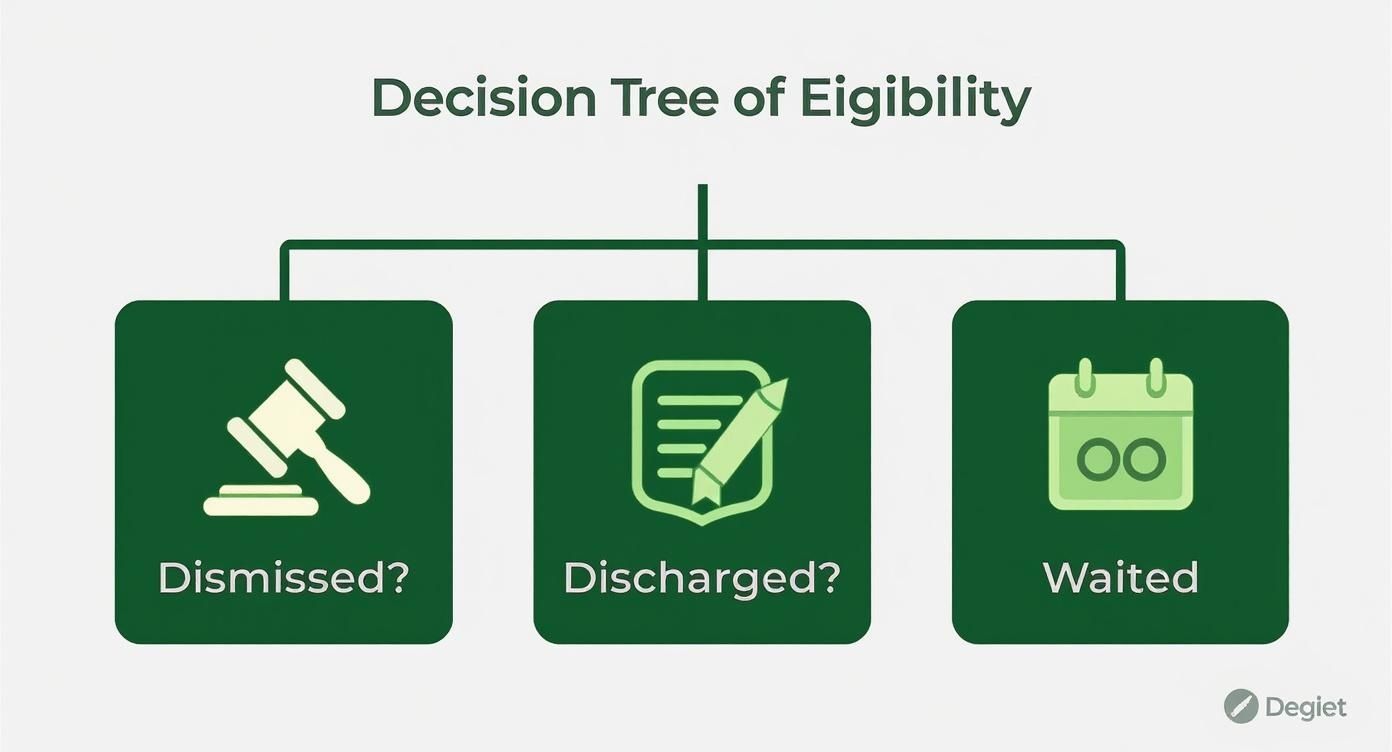
As you can see, the cleanest routes are for cases that were dismissed outright, resulted in a discharge, or where the required time since the conviction has passed.
Correctly Completing the Forms
With the necessary documents in hand, you're ready to tackle the official form, usually called the "Request to Restrict Arrest Record." It looks simple enough, but this is precisely where many people trip up.
Common mistakes often include:
- Using the wrong case numbers or arrest dates.
- Forgetting to list the specific statute number for the charge.
- Leaving sections blank or providing vague information.
Take your time. Double-check every single entry against your official disposition and criminal history. A simple typo can get your application sent right back, forcing you to start all over again. Accuracy is everything here.
For instance, if someone was arrested by the Roswell Police Department, but their case was heard in Fulton County State Court, both agencies must be listed correctly. These details matter because the paperwork gets passed around to multiple agencies for their sign-off. For a deeper dive, you can learn more in our article about how to seal criminal records, which covers similar ground.
Filing with the Right Agencies
Once the application is filled out perfectly, it has to be filed. This isn't a one-stop-shop. Copies must be submitted to the right agencies, and the process can be slightly different from one county to the next.
Generally, filing will happen at two main places:
- The Arresting Law Enforcement Agency: This is the police department or sheriff's office that made the arrest—whether it was the Alpharetta Police Department or the Cobb County Sheriff's Office, they are the first stop. They have to review their records and complete their section of the form.
- The Prosecutor’s Office: After the arresting agency gives its approval, the application moves on to the prosecutor who handled the case (for a misdemeanor, that might be the Forsyth County Solicitor-General's Office, for example). They review the case file and decide whether to approve or object to the restriction.
It's absolutely crucial to know the local procedure. In a place like Marietta, you might file with the police department, and they'll forward it to the prosecutor for you. In other jurisdictions, you might have to hand-deliver it to each agency yourself. A quick phone call to the court clerk or the law enforcement agency can clear up their specific protocol and save a ton of wasted time and frustration.
After successfully filing the application with both agencies, the waiting game begins. If both approve it, the information is sent to the GCIC to officially restrict the record from public view.
Dealing With Pushback and Navigating Local Court Procedures
Even with a perfectly filled-out application, getting a misdemeanor record restricted isn’t always a straight shot. Hiccups happen. Local court procedures can add some unexpected twists and turns, and knowing what they are ahead of time is the best way to keep a case from getting stuck.
One of the most frequent snags is an objection from the prosecutor. Just because all the legal requirements for restriction are met doesn’t mean the prosecutor has to agree. They have the right to look at the request and, if they think the record should stay public, they can object.
An objection isn't a dead end. It just means the process gets a bit more formal. When the prosecutor objects, the court will typically schedule a hearing where a judge will have the final say.
What to Expect at a Record Restriction Hearing
Receiving a notice for a court hearing can feel daunting, but it’s a standard part of the process. It’s designed to give both the applicant and the prosecutor a chance to be heard. The judge’s job is to weigh the public’s interest in keeping the record accessible against the real-world harm the person is facing because it’s still public.
In court, the prosecutor will lay out their reasons for objecting. Then, the applicant or their attorney will have the chance to make the case for why the restriction is justified.
A common situation is someone who has completely turned their life around since a minor mistake years ago. At a hearing, it may be helpful to present proof of a steady job, volunteer work, or a college degree to show that the old charge doesn't define who they are today and is actively holding them back from better opportunities.
To make a persuasive argument, it is necessary to show the judge how that old record is a real barrier to getting a better job, finding housing, or securing a professional license. The judge will hear both sides and then make a ruling.
Understanding the Quirks of Local Courts
Beyond a formal objection, the simple day-to-day differences between local courts can cause major delays. A process that’s straightforward in Forsyth County might hit a roadblock in Marietta or East Cobb because of some unwritten rule or a clerk’s preference.
For example:
- Checking on a Case: In places like Roswell or Johns Creek, it might be possible to check an application's status online or with a quick phone call.
- Finding the Right Person: In bigger jurisdictions like Cobb County, it may be necessary to track down a specific person in the prosecutor’s or solicitor's office for an update. The main clerk’s office often won’t have that information.
- Filing Nuances: Some courts require everything to be filed in person. Others are fine with mail-in submissions. Knowing these little details can keep paperwork from getting lost in the shuffle for weeks.
These local differences highlight how important it is to do research. Before filing anything, it's always a smart move to call the specific clerk of court and the arresting police agency to confirm exactly how they handle these requests. Taking that one proactive step can save a ton of frustration and keep things moving.
Successfully clearing a record means knowing more than just the state law; it means understanding the on-the-ground reality of the court system involved. Being ready for an objection and knowing the local procedural quirks are critical to getting that old misdemeanor off your back for good.
The Real-World Impact of Clearing Your Record

Knowing the steps to restrict a misdemeanor is one thing, but understanding why it matters is what helps people get through the process. The effort put into clearing a record isn't just about paperwork; it's a direct investment in the future. It’s about reclaiming the opportunities a past mistake may have put just out of reach.
For most people, the biggest and most immediate impact is on their career. A misdemeanor conviction, no matter how small it seems, can be a major red flag for employers. It often leads to getting automatically filtered out by online job applications or forces an awkward, defensive conversation in an interview. It can effectively shut the door on a good job before you ever get a chance to prove what you can do.
Unlocking Better Employment and Financial Stability
Once a record is restricted, that wall comes down for most jobs. All of a sudden, an individual is competing on a level playing field, where their skills and experience matter more than a single event from their past. This opens the door not just to more job offers, but to better-paying ones with real stability and a future.
The data backs this up. One study found that people who had their records expunged saw their wages jump by over 22% within just one year. That's a life-changing difference, all from removing an obstacle that had nothing to do with their current abilities. You can discover more about these economic findings and see the powerful data for yourself.
The positive effects aren't just about money. The same research showed that recidivism rates among those who received an expungement were remarkably low—even lower than those of the general population. This strongly suggests that clearing a record aids in rehabilitation and successful reentry into the workforce.
Ultimately, the process of having a criminal record expunged is about restoring the ability to fully participate in the community and the economy.
Expanding Your Housing and Educational Horizons
The benefits don't stop with a better paycheck. A clean background check creates a ripple effect, building a foundation for long-term stability and personal growth in other critical parts of your life.
- Better Housing Options: Landlords and property managers almost always run background checks. A misdemeanor can mean an instant denial, pushing a person into less desirable or less safe housing. With a restricted record, they stand a much better chance of getting approved for the apartment or home they actually want.
- Access to Education: Many colleges and technical programs, especially those that lead to professional licenses in fields like nursing or teaching, require a clean criminal history. Restricting a record can be the key that unlocks eligibility for these programs and entirely new career paths.
- Professional Licensing: From real estate agents to cosmetologists, many professions require a state license. A criminal record can be grounds for denial. Clearing that record is often the most critical first step toward getting licensed and launching a career or even starting a business.
Navigating the expungement process is about much more than filing forms. It’s a powerful step that can be taken to rewrite a story and build a future that isn't defined by the past.
Common Questions About Georgia's Record Restriction Process
When you start digging into Georgia's record restriction laws, a lot of specific questions pop up. Even after you get the main idea, you’re often left wondering about the real-world stuff—how long it actually takes, what happens with certain pleas, and what the options are if things don't go your way. Let’s clear up some of the most common questions.
The goal here is to provide straight answers to these tricky points, so you have a complete picture of what's involved. Knowing these details can make all the difference in feeling prepared for the road ahead.
How Long Does the Entire Record Restriction Process Take?
Everyone wants to know the timeline. From the day the paperwork is filed to the moment the record is officially updated, the process is anything but instant.
Realistically, the entire process can be expected to take somewhere between 90 and 150 days. This window gives each agency the time it needs to do its job.
- First, the arresting agency has to review and process the application.
- Then, it goes to the prosecutor’s office for their review and signature.
- Finally, once it's approved, the paperwork is sent to the Georgia Crime Information Center (GCIC) to update the official criminal history.
The biggest variable here is delays. If the paperwork isn't perfect, an agency has a backlog, or the prosecutor objects, that timeline can stretch out. Patience is key, but so is filing everything correctly the first time.
Can My Record Be Restricted for a Nolo or First Offender Plea?
How a case was resolved is everything when it comes to eligibility. Two common outcomes that cause a lot of confusion are "nolo contendere" pleas and cases resolved under the First Offender Act.
If a first offender sentence for a misdemeanor was successfully completed, that charge is discharged without a conviction. That’s great news because it means the charge is eligible for restriction. As long as all court orders were fulfilled, the path is clear.
A "nolo contendere" (no contest) plea is a completely different animal. For the purposes of a criminal record, a nolo plea is treated as a conviction. Because of this, a nolo plea is generally not eligible for restriction unless it falls under a very narrow and rare legal exception.
What Happens If a Request for Record Restriction Is Denied?
Getting a denial from the prosecutor isn't the end of the road, but it does mean things are about to get more formal. There is a legal right to contest that decision.
If a prosecutor denies the request, the next move is to file a motion with the court that handled the original criminal case. This forces the court to schedule a hearing to review the prosecutor’s denial.
At that hearing, a judge will listen to both sides. The prosecutor will have to explain their reasons for objecting, and the applicant will get the chance to argue why the restriction should be granted. This is an opportunity to show how the public record is harming one's ability to find a job, secure housing, or move on with life.
Is an Attorney Needed for the Record Restriction Process?
Legally, an attorney is not required. But trying to handle it alone can be tough. The process is filled with procedural landmines where one small mistake can lead to major delays or an outright denial.
Having a lawyer can be especially helpful in a few key situations:
- Complex Cases: If a record has multiple charges or the case outcomes are confusing.
- Prosecutor Objections: If a request is denied and a court hearing becomes necessary.
- Local Nuances: Knowing the specific quirks of local courts—from Cumming and Alpharetta to Marietta and East Cobb—can make a huge difference in how smoothly things go.
An experienced attorney can make sure paperwork is filed correctly from the start, handle the back-and-forth with the prosecutor's office, and represent you in court if a hearing is needed.
Navigating the complexities of Georgia's record restriction laws can be challenging. If you are in Alpharetta, Marietta, or the surrounding counties and need assistance, the team at Brian Hansford Law has the experience to guide you. We are dedicated to helping you clear your record and move forward with your life. Find out how we can help by visiting us at https://challengemycharge.com.
