
The first few hours after a domestic violence arrest in Alpharetta are a blur of confusion and high stress. What you do—and what you don't do—in the next 24 to 48 hours can dramatically shape the outcome of your case in the Fulton County court system. The single most important piece of advice I can give is this: stay calm, say absolutely nothing to the police, and call an experienced Alpharetta criminal defense attorney immediately. Your first court date is not far away, and you must be prepared.
Do not speak to police without representation. Deadlines in Fulton County move quickly. Call now for a confidential case review and protect your record.
Your First 48 Hours After a Domestic Violence Arrest in Alpharetta
Once the Alpharetta Police Department or another local agency in North Fulton puts you in handcuffs, you’re thrown into a legal system that moves incredibly fast. It's completely natural to want to explain your side of the story, thinking you can clear things up right away. I've seen it time and time again—it's a mistake that almost always does more harm than good.
Prosecutors in Fulton County are aggressive. They will take any statement you make, no matter how innocent it seems, and twist it to build their case against you. Remember, your silence is not an admission of guilt. It's your constitutional right and your strongest defense at this stage.
To keep it simple, here are the immediate dos and don'ts I tell every client facing this situation in North Fulton.
Immediate Actions vs Critical Mistakes After an Alpharetta Arrest
| What You Must Do | What You Must Avoid |
|---|---|
| Invoke your right to remain silent. State clearly, "I am invoking my right to remain silent and I want an attorney." | Talking to the police. Don't try to explain, apologize, or negotiate. Anything you say can be used against you by North Fulton prosecutors. |
| Comply with all no-contact orders. This means absolutely zero contact with the alleged victim—no calls, texts, or third-party messages. | Violating the no-contact order. Even if the other person contacts you first, responding can lead to a new charge and complicate your case in Fulton County. |
| Hire an experienced local attorney before your first court date in Alpharetta. This is not the time for a wait-and-see approach. | Going to your first hearing alone. An attorney can argue for a reasonable bond and start building your defense immediately in the Alpharetta Municipal Court or Fulton County State Court. |
| Start documenting everything. Write down your recollection of the events while they are still fresh in your mind. | Returning to your shared home. Even if it's just to get your clothes, this violates the order and will lead to another arrest. |
Following these guidelines is the first step in protecting yourself. Making the wrong move, however, can create new legal problems before your original case even gets started.
The No-Contact Order and Its Consequences
After a domestic violence arrest in Georgia, the judge will almost certainly issue a Temporary Protective Order (TPO) or a "no-contact" condition as part of your bond. This isn't a suggestion; it is a direct court order.
This means you are legally barred from having any contact with the alleged victim. This includes:
- No phone calls, text messages, or emails.
- No direct messages or comments on social media.
- No asking friends or family in Johns Creek or Milton to pass along a message.
- No going back to a shared home, even for a moment.
Breaking this order is a separate crime. If you respond to a text or a call, you can be charged with Aggravated Stalking or Violation of a TPO. These new charges will only complicate your original case and make it much harder to achieve a good result in the Fulton County court system.
This flowchart breaks down the three most vital steps to take right after an arrest.
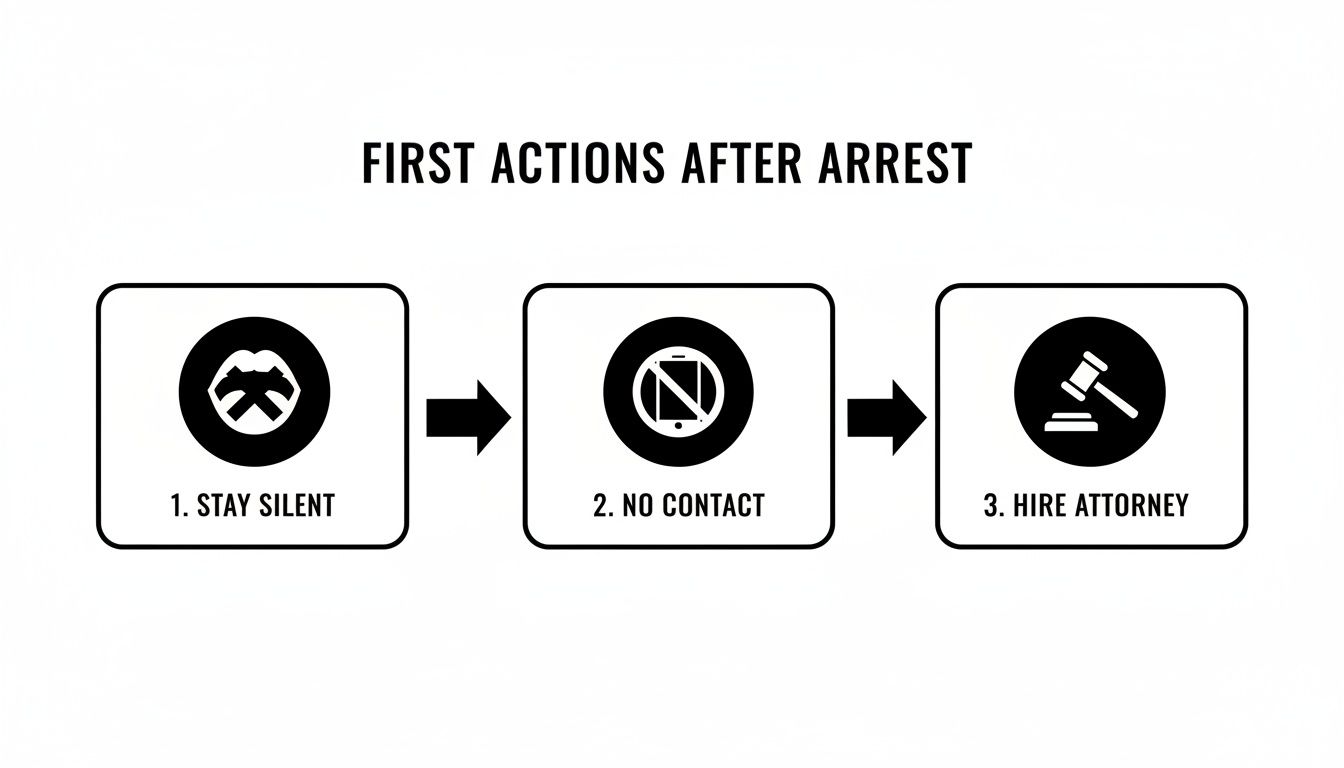
Your immediate priorities are simple but non-negotiable: exercise your right to silence, obey the no-contact order strictly, and get a lawyer on your side.
Securing Legal Representation Before Your First Hearing
Your first court appearance, which could be a bond hearing in Fulton County or an arraignment in Alpharetta Municipal Court, happens quickly. Walking in without a criminal defense attorney near me puts you at a huge disadvantage. An attorney can start working for you right away, fighting for reasonable bond conditions and beginning the critical process of gathering evidence.
You have to understand that once the state files charges, the alleged victim can't just "drop" them. The decision to prosecute belongs solely to the State of Georgia and the Fulton County District Attorney's office.
This is exactly why you need a strategic advocate from the very beginning. An attorney who knows the local courts in North Fulton—from Roswell and Johns Creek to Milton—can start building your defense from day one. You can learn more about these initial steps by reading our guide on what happens when someone is arrested, which offers more detail on these crucial early stages. Protecting your rights and your future starts now.
Why This Matters in Alpharetta
When you're reeling from an arrest, the legal paperwork can feel like another language. The first and most critical step in defending yourself is to cut through the jargon and understand exactly what you're up against in the Fulton County court system.
In Georgia, these cases almost always fall under the Family Violence Act (FVA). This isn't just a label; it’s a designation that changes everything. It's why the Alpharetta Police Department has a mandatory arrest policy and why your right to own a firearm can vanish overnight.
Prosecutors across Fulton County, from Roswell to Sandy Springs and Milton, approach FVA cases with extreme seriousness. You need to know precisely what type of charge you're facing, because a conviction brings consequences that ripple through your life long after any fines are paid or jail time is served.
Charge Breakdown: Understanding What You Face in Fulton County
Not all family violence charges are created equal. The penalties and long-term fallout hinge on whether you're charged with a misdemeanor or a felony. North Fulton prosecutors look closely at the specific allegations before deciding which path to take.
Misdemeanor Family Violence Charges:
The most frequent charge we see is Simple Battery (Family Violence). This can stem from physical contact that is considered merely "insulting or provoking," even if no one was hurt. A conviction still means up to 12 months in jail, a $1,000 fine, and a mandatory Family Violence Intervention Program.
Another common one is Simple Assault (Family Violence). For this, no physical contact has to occur. The charge is based on an act that puts someone in reasonable fear of being physically injured.
Felony Family Violence Charges:
This is where the stakes get dangerously high. An Aggravated Assault (Family Violence) charge can be filed if a weapon was allegedly involved, if there was strangulation, or if prosecutors believe there was an intent to rob or murder. A conviction for this carries a prison sentence of one to 20 years.
Aggravated Battery (Family Violence) is another serious felony, charged when the alleged act leads to serious disfigurement or the loss of a body part. This comes with a mandatory minimum prison sentence. For professionals living in Johns Creek, Cumming, or Dunwoody, a felony conviction doesn't just damage your reputation—it can end your career.
What the "Family Violence" Designation Means for You
The "Family Violence Act" tag carries immense legal weight in the Fulton County court system. It’s not just a procedural detail.
Under Georgia law, if a police officer has probable cause to believe an act of family violence happened, they must make an arrest. They have no discretion. This is how a simple argument can turn into a night in jail and a criminal case you can't ignore.
This FVA designation triggers other immediate problems:
No-Contact Orders: At your very first court appearance, whether it's in Alpharetta Municipal Court or Fulton County State Court, a judge will almost certainly issue a no-contact order.
Firearm Rights: A conviction for any misdemeanor crime of family violence leads to a lifetime federal ban on possessing firearms.
Public Record: The charge appears on your criminal history with the "Family Violence" label, creating a powerful stigma for future employers and landlords.
Understanding these differences is the foundation of a real defense. A one-size-fits-all strategy won't work here. Knowing whether you're fighting a misdemeanor or a felony, and what that FVA label truly means, is how we start preparing to protect your record and freedom in North Fulton.
Facing charges in Alpharetta? Speak with an attorney today to understand your options and start building your defense.
Defense Strategy: How We Fight Domestic Violence Charges in Alpharetta

Winning a domestic violence case in an Alpharetta court isn't about luck. It's about building a solid, fact-based defense strategy. From the moment charges are filed, the prosecution has one mission: to get a conviction. Our job is to systematically take their case apart by exposing every weakness, challenging their evidence, and telling your side of the story.
No two cases are the same, but strong defenses often fit into a few key categories. Whether it's questioning the accuser's credibility or establishing that you acted in self-defense, there are always avenues to explore in the Fulton County court system.
Challenging False Allegations in Fulton County
Domestic violence is a very real problem, but so are false accusations. Tempers flare, and unfortunately, allegations are sometimes used as a weapon out of anger, jealousy, or to get an edge in a divorce or custody case.
When we suspect a false allegation, our strategy is to put the accuser’s story under a microscope. We dig into:
- Inconsistencies: Does the story change? We compare what they first told the Alpharetta Police Department to what they say in court.
- Motive to Fabricate: Is a bitter divorce or child custody battle going on in a Fulton County court? We look for any outside pressures that could motivate a false report.
- Lack of Corroboration: Many of these cases are just "he said, she said." Without physical evidence, credible witnesses, or medical records, the prosecution’s case is built on shaky ground.
A good defense attorney knows how to shine a spotlight on these weaknesses to create the reasonable doubt needed to win.
Asserting Self-Defense in a Georgia Court
Sometimes, an incident did happen, but your actions were justified under the law. Georgia law permits you to use reasonable force to defend yourself or someone else from immediate harm. To win on a self-defense claim, we have to prove that you genuinely believed that force was necessary to stop a threat.
This means painting a clear picture for the judge and jury. We gather evidence like:
- Photographs of your own injuries, even if they seem minor.
- A documented history of threats or violence from the accuser.
- Testimony from anyone who saw the accuser acting aggressively.
Proving self-defense is a technical legal argument, especially in a domestic situation. You can't just claim it—we have to build a compelling case showing your actions were a necessary and proportionate response.
Attacking the State's Evidence and Procedures
Even when the state thinks it has a strong case, the evidence might not be admissible in court. The Constitution protects you from illegal searches and improper police questioning. We scrutinize every single step law enforcement took, from the moment they showed up at your home in Milton or Johns Creek.
An arrest is not the end of the story; it is the beginning of our investigation. We examine police reports, body camera footage, and witness interviews for procedural errors that can get evidence thrown out.
We use pre-trial motions to suppress evidence that was gathered illegally. For instance, if the police pressured you into a confession without reading your Miranda rights, that statement could be excluded. If they conducted an illegal search of your Roswell or Sandy Springs home, anything they found might get thrown out.
Successfully challenging the state's evidence can cripple their case before you ever see a courtroom. Sometimes, a technical legal victory is the one that matters most. For more on this, check out our guide on how you may be able to drop domestic violence charges. A complete defense looks at every possible angle.
Court Process in Fulton County: What to Expect

When you're facing a domestic violence charge, the legal system can feel overwhelming. After an arrest in North Fulton, you're suddenly dropped into a complicated process with strict deadlines and rules that don't forgive mistakes. The first step to getting back some control is understanding exactly how your case will wind its way through the local courts.
An arrest by the Alpharetta Police Department might land you in the Alpharetta Municipal Court for your first appearance. But make no mistake—more serious charges, or any case that proceeds, will almost always be transferred to the Fulton County State Court or Superior Court. This is why you need an attorney who is in these specific courts every single day.
The Initial Appearance and Bond Hearing in Fulton County
Your first time in front of a judge will be for your initial appearance or bond hearing. This usually happens within 48-72 hours of your arrest. This isn't your trial. The only goals here are for the judge to tell you what you’re charged with and to set the conditions for your release, which is called a bond.
A critical mistake is attending this hearing without legal representation. An attorney can argue for a reasonable bond amount and, more importantly, challenge overly restrictive conditions like a complete ban on returning home, even to retrieve personal items.
During this hearing, the judge will almost certainly issue a "no-contact" order as a condition of your bond. This means absolutely zero communication with the alleged victim. No calls, no texts, and no messages passed through friends or family. If you violate this order, you’ll be arrested again and face new charges.
Your Arraignment Hearing in Alpharetta
After the bond hearing, the next formal court date is the arraignment. This is where the court formally reads the charges against you and you are required to enter a plea of "guilty" or "not guilty." Depending on the details of your case, this might happen back in the Alpharetta Municipal Court or directly in a Fulton County court.
It is absolutely crucial to plead "not guilty" at this stage. A guilty plea slams the door shut on your case—you’ll be sentenced right then and there, with no chance to review the evidence or build a defense. A "not guilty" plea keeps all your rights intact and gives your attorney the time needed to actually fight the charges. For a deeper look into this hearing, you can explore our detailed article about what to expect at an arraignment hearing.
The Discovery and Motion Phase
Once we enter a "not guilty" plea, the case moves into the discovery and pre-trial motion phase. This is where the real work begins. During discovery, the prosecutor is legally required to turn over all the evidence they have against you.
This includes everything from:
- Police reports from agencies in Alpharetta, Milton, or Roswell
- Body camera and dashboard camera footage
- All witness statements
- Photographs and any medical records
- 911 call recordings
My job as your attorney is to comb through every single piece of this evidence, searching for weaknesses. We look for inconsistencies in the accuser's story, procedural mistakes by the police, and any violation of your constitutional rights. This is also the time when we file pre-trial motions, like a motion to suppress illegally obtained evidence, which can sometimes gut the prosecution's case before it ever gets to a jury.
Plea Negotiations and Exploring Alternatives in Alpharetta
While my team and I prepare every case as if it’s going to trial, the reality is that many domestic violence cases in Fulton County are resolved through negotiation. My background as a former prosecutor gives me a unique advantage here. I know their playbook, which allows me to anticipate their strategies and negotiate from a position of strength.
Sometimes, what the police report calls an assault was actually an act of self-defense. In Georgia, a successful self-defense argument requires showing you had a reasonable belief you were in imminent danger and only used the force necessary to protect yourself.
For first-time offenders, there are often alternatives to a conviction that we can pursue. These aren't just handed out; they have to be strategically negotiated.
- Pre-Trial Diversion Programs: Fulton County offers programs that can lead to a full dismissal of your charges after you complete certain requirements, like anger management classes.
- The Georgia First Offender Act: This powerful law allows a person to avoid having a conviction on their record if they successfully complete their sentence.
Securing these kinds of favorable outcomes requires an experienced Alpharetta defense attorney who knows the local prosecutors and judges. That personal knowledge and experience can make all the difference.
Why Choose Brian Hansford in Alpharetta
When you’re facing a domestic violence charge in North Fulton, the attorney you hire is the single most important decision you will make. Your freedom, your reputation, and your future are all on the line. You don't just need a lawyer—you need a calm, strategic guide who knows the Alpharetta legal system inside and out.
Brian Hansford brings a crucial advantage to your corner: years of experience as a former prosecutor. This isn’t just a line on a resume. It’s a fundamental difference in how your case is handled. He understands exactly how the other side thinks, how they build a case, and where the weak points are. He anticipates their moves before they happen, giving you a defensive edge that other attorneys simply can't offer.
A Local Attorney for a Local Fight
Brian is in the Alpharetta Municipal Court, Fulton County State Court, and Fulton County Superior Court almost daily. This isn't generic advice from someone who drives up to Alpharetta once a month. This is a localized defense built on firsthand knowledge of the specific judges, North Fulton prosecutors, and courtroom procedures that will shape your case.
We understand what’s at stake for professionals and families in communities like Roswell, Milton, and Johns Creek. A charge here impacts your career, your standing, and your future. Our focus is on protecting it all.
Our entire approach is built around giving you direct, confident counsel to get you through this incredibly stressful time. We are committed to protecting your record and fighting for the best possible outcome for you and your family.
FAQ: Alpharetta Domestic Violence Charges
An arrest for domestic violence throws your life into chaos. The questions come fast and furious. Based on years of defending clients in Alpharetta, Fulton County, and across North Georgia, I've compiled answers to the most urgent concerns people have right after an arrest. This isn't a substitute for legal advice on your specific case, but it will give you a clear picture of what you're up against.
Q: What happens if the alleged victim wants to drop the charges in Alpharetta?
A: Once an arrest is made in Alpharetta, the case belongs to the State of Georgia, not the victim. The Fulton County prosecutor has the sole authority to drop charges, and they often pursue cases even if the accuser recants. A victim's wishes are considered but are not the deciding factor.
Q: How long will a domestic violence case take in Fulton County?
A: A domestic violence case in the Fulton County court system can take anywhere from a few months to over a year. The timeline depends on the charge's severity, whether the case stays in Alpharetta Municipal Court or moves to State or Superior Court, and if it is resolved through negotiation or proceeds to trial.
Q: Can I go back home after a domestic violence arrest in Georgia?
A: Almost certainly not, at least not immediately. A judge in Fulton County will issue a no-contact order as a condition of your bond. This legally forbids you from returning to a shared home with the accuser. Violating this order is a separate crime that will lead to another arrest.
Q: What is a Pre-Trial Diversion Program in Fulton County?
A: For some first-time offenders, Fulton County offers pre-trial diversion as an alternative to prosecution. If you are accepted, you must complete requirements like counseling and community service. Upon successful completion, the charges against you are dismissed, protecting your record. Negotiating entry into this program requires an experienced attorney.
Q: Will a domestic violence charge affect my job in Roswell or Milton?
A: Yes, it absolutely can. A conviction can threaten professional licenses, security clearances, and job opportunities, a major concern for professionals in Roswell, Milton, and Johns Creek. Even a pending charge on a background check can create serious issues, making a strong, proactive defense essential to protect your career.
Q: Do I have to complete a Family Violence Intervention Program (FVIP)?
A: If convicted of a family violence offense in Georgia, yes. The law mandates completion of a 24-week, state-certified Family Violence Intervention Program (FVIP). An effective defense attorney will work to negotiate a plea to a non-family violence charge to avoid this mandatory program and its stigma.
Q: What is the Georgia First Offender Act?
A: The Georgia First Offender Act allows individuals with no prior felony convictions to avoid a formal conviction on their record. If you are granted First Offender status and complete your sentence successfully, the case is discharged without an adjudication of guilt. It's a critical tool for protecting your future.
Q: Should I talk to the police to explain my side of the story?
A: No. Never speak to the Alpharetta Police or any law enforcement officer about your case without your attorney present. As a former prosecutor, I can confirm anything you say can be used against you. Politely state, "I am invoking my right to remain silent, and I want to speak with an attorney."
The stakes are simply too high to face this alone. If you're dealing with domestic violence charges in Alpharetta, Roswell, Sandy Springs, or anywhere in North Fulton, you need immediate and strategic legal help. I know how prosecutors build these cases, which means I know how to find the weaknesses and protect your future.
Call Brian Hansford Law now to request a confidential review of your case.
