
Trying to find an arrest record in Georgia can feel like a maze. With information spread across different government agencies and online portals, it’s easy to get lost. The real trick is knowing exactly where to look first, which saves a ton of time and frustration. Your starting point really depends on what you need to find—a recent booking, the details of an old case, or a full criminal history.
The most reliable information will always come from official government sources. Each one has a specific job, and understanding who does what is key. For example, to learn about a very recent arrest in a place like Roswell or Marietta, the local sheriff’s department website is a practical first stop.
Differentiating State and Local Resources
The biggest distinction to understand is between statewide and local, county-level resources. The Georgia Bureau of Investigation (GBI) is the main hub for statewide information. They run a centralized database called the Georgia Crime Information Center (GCIC), which is the official source for a comprehensive criminal history report covering arrests across different counties.
However, if you’re looking for something more immediate or specific to one area, county resources are often faster and have more detail. This is especially true in metro Atlanta jurisdictions like Forsyth County, Cobb County, and Fulton County, which handle a high volume of cases from cities like Cumming, East Cobb, and Alpharetta.
A common mistake people make is looking in the wrong place. A sheriff’s office is for recent jail bookings, while the clerk of court’s office holds the official case files and dispositions. Knowing this difference saves time and frustration.
Sheriff’s Office vs. Clerk of Court
Knowing the roles of these local agencies is crucial for a successful search. Here’s a simple way to think about it:
- Sheriff’s Office: This is the law enforcement arm that runs the county jail. Their online portals are perfect for finding recent arrest information, booking photos (mugshots), and a list of who is currently in jail. If someone was just arrested in Milton or Johns Creek, the Fulton County Sheriff’s Office website is where you’d want to check first.
- Clerk of Court: This office is the official record-keeper for all court documents, both criminal and civil. Their records give you a much deeper look into a case, showing the specific charges filed, court dates, motions, and the final outcome—whether it was a conviction, dismissal, or something else.
So, while a search on the Cobb County Sheriff’s Office website might show that a person was arrested last night, the Cobb County Clerk of Superior Court’s portal will eventually have the official charges and let you track the case as it moves through the court system. To get a better handle on the documents that often kick off an arrest, you can learn more about how arrest warrants work in GA and what they mean.
Quick Guide to Georgia Arrest Record Sources
This table breaks down the best official sources to use depending on what you’re looking for.
| Information Source | Best For Finding | Typical Access Method | Key Locations Served |
|---|---|---|---|
| Georgia Bureau of Investigation (GBI) | Official, statewide criminal history reports | Online request (fee required) | All Georgia counties |
| County Sheriff’s Office | Recent arrests, jail bookings, inmate rosters, mugshots | Free online portals, in-person requests | Forsyth, Cobb, Fulton, etc. |
| County Clerk of Court | Detailed court case files, charges, dispositions, sentences | Free online search portals, in-person requests | Forsyth, Cobb, Fulton, etc. |
| Municipal Courts | Records for traffic violations or city ordinance offenses | Online portals, phone or in-person requests | Cumming, Alpharetta, Roswell, etc. |
Ultimately, choosing the right starting point—whether it’s the GBI for a broad overview or a local sheriff’s office for immediate booking details—makes the entire process much more manageable.
Using Official State and County Resources
When you need to find arrest records in Georgia, the most reliable path is always through official state and county sources. These government channels give you direct access to the most accurate, up-to-date information right from the agencies that create and manage the records. A great place to begin is often at the statewide level.
The Georgia Bureau of Investigation (GBI) is the central hub for criminal history information across all 159 counties. Its Georgia Crime Information Center (GCIC) is where all arrest data is ultimately funneled. Requesting an official criminal history from the GBI provides a complete picture of someone’s record, which is especially helpful if you’re not sure which county an arrest happened in.
This isn’t an instant search like a local jail roster. It’s a formal process that requires submitting a request with specific personal details and paying a fee, but it’s the definitive source for an official statewide background check.
This flow chart gives you a good visual of how a search typically works, starting from the broad state databases and narrowing down to specific county and online resources.
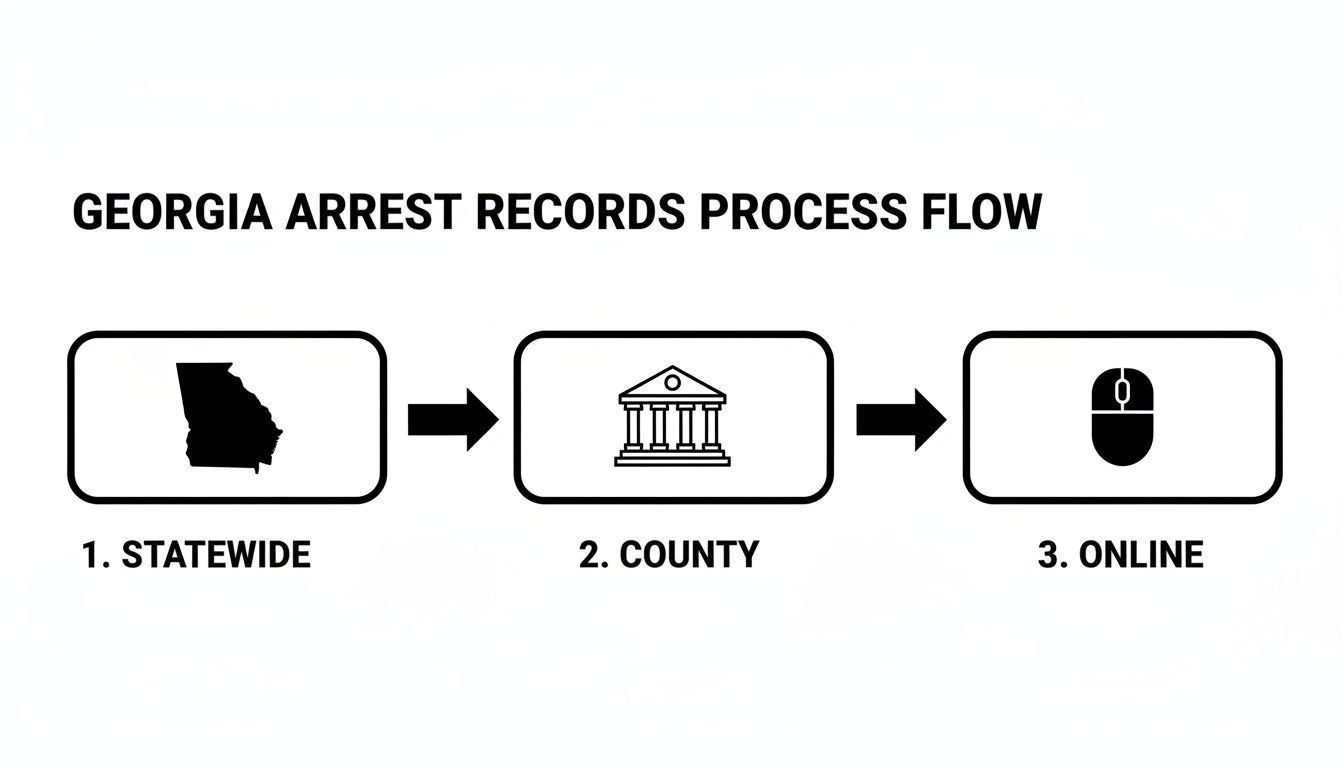
As you can see, you can start with a wide net at the state level or dive right into local searches, depending on what you’re trying to find.
Diving Into County-Level Searches
While the GBI is great for a full overview, sometimes you need information that’s more recent or localized. That’s when county-level resources are your best bet.
For instance, if you’re looking for an arrest that just occurred in Marietta or East Cobb, the Cobb County Sheriff’s Office website is the place to go. Most sheriff’s offices in Georgia have online inmate search tools that show who is currently in jail.
These portals are invaluable for getting immediate information and typically provide:
- A booking photo (mugshot)
- The date and time of the arrest
- The initial charges
- Bond information, if it has been set
Likewise, for an arrest in Cumming, the Forsyth County Sheriff’s Office offers a similar public lookup tool. These are the go-to resources in the immediate aftermath of an arrest.
It’s critical to understand the difference between what a sheriff’s office provides and what the Clerk of Court holds. The sheriff’s site gives you a snapshot of the arrest itself, but the Clerk’s records tell the full story of the court case that follows.
Finding Court Records with the Clerk of Court
Once an arrest is made, the case enters the judicial system, and the county’s Clerk of Court becomes the official record-keeper. If you need to find out what happened with a case in Alpharetta or Roswell, you’d search the Fulton County Clerk of Superior Court’s online portal.
These court databases let you track a case from its initial filing to its final disposition. You can find detailed information like the official charges filed by the prosecutor, court dates, motions, and the final verdict or sentence. This is how you confirm whether an arrest resulted in a conviction, a dismissal, or some other outcome. You can learn more in our guide on whether background checks show arrests.
The Scale of Georgia’s Justice System
Accessing arrest records is a crucial first step for anyone in Alpharetta, Cumming, or Forsyth County who is facing criminal charges. Recent statistics show just how massive Georgia’s jail system is. As of September, county jails across the state housed 33,748 inmates.
That number was down from August’s total of 38,206, showing how much detention populations can fluctuate and why checking records promptly is so important. What’s truly telling is that 70.6% of those inmates—or 23,825 individuals—were awaiting trial. This highlights that the vast majority of people in custody have not yet been convicted of a crime, making access to their records an important step in the process.
So, you’ve managed to pull an arrest record from one of Georgia’s state or county portals. Now what? Looking at the document for the first time can feel like trying to decipher a secret code, packed with unfamiliar jargon, strange abbreviations, and dates that don’t immediately make sense.
Let’s break down what you’re actually looking at.
First, you’ll see the basics—the person’s name, date of birth, and physical description. You’ll also find administrative details like a booking number and the exact date and time of the arrest. A booking photo, or mugshot, taken when the individual was processed into the facility, is usually front and center.
Decoding the Charges and Codes
This is the most important part of the record. The charges aren’t just simple descriptions of what happened; they’re directly tied to specific Georgia laws.
Every charge comes with an Official Code of Georgia Annotated (OCGA) code. This is the formal statute the person is accused of violating. For instance, a DUI charge will be listed as OCGA § 40-6-391. A theft charge out of a place like East Cobb would be tied to OCGA § 16-8-2. These codes are the language of the system, telling you precisely what the allegation is.
Right next to the charges, you should see the arresting agency. This clarifies which department made the arrest, whether it was the Forsyth County Sheriff’s Office, the Milton Police Department, or even the Georgia State Patrol.
A common point of confusion is the difference between an arrest and a conviction. An arrest record only proves that someone was taken into custody on suspicion of a crime. It does not mean they were found guilty.
Understanding Bond, Case Status, and Key Dates
Moving down the document, you’ll find details about whether the person is in custody or has been released. The bond amount is a huge piece of this puzzle. It’s the money a judge requires to be paid for the person to get out of jail while their case is pending.
The case status is another critical detail that tells you where things stand. You’ll see terms like:
- Pending: The case is still active and making its way through the court system.
- Dismissed: The prosecutor has decided to drop the charges entirely.
- Closed: The case has a final resolution, like a conviction, an acquittal, or a plea deal.
You’ll also see a timeline of key dates: the arrest date, the date charges were formally filed (the accusation or indictment date), and any upcoming court appearances. Putting all these pieces together helps paint a clear picture of the situation.
Georgia’s criminal justice system is complex, and knowing how to read these documents is a crucial first step. According to UGA’s Carl Vinson Institute, common offenses leading to arrests in areas like Alpharetta and Marietta include theft (16,000 cases, or 31.16% of top offenses), drug-related crimes (10,227 cases), and burglary (12,520 cases). This data, especially for the 37.57% of inmates aged 30-39 who may be new to the system, shows why interpreting an arrest record correctly—from OCGA codes to case status—is so important. You can dig deeper into the numbers in the Georgia Criminal Justice Data Landscape Report.
From Arrest to Potential Outcomes
Let’s use a real-world example. Say a young person is arrested for shoplifting in Roswell. The Fulton County arrest record would show their name, identify the Roswell Police Department as the arresting agency, and list the charge with its corresponding OCGA code. The judge might set a $1,500 bond, and the case status would start as ‘pending.’
As the case moves forward, that record gets updated. If the prosecutor decides not to pursue the case, the status could change to ‘dismissed.’ If it goes to court and ends in a not-guilty verdict, that becomes the final disposition. On the other hand, if there’s a guilty plea or a conviction at trial, that will also be reflected in the court records.
Even after everything is resolved, the original arrest often stays on their public record unless it’s formally restricted. To learn more about that process, check out our guide explaining the difference between expunged and sealed records.
When You Can’t Find a Record
So you’ve searched the usual spots for an arrest record in Georgia and come up empty-handed. It’s frustrating, especially when you feel certain an arrest took place. But this doesn’t mean your search failed or you did something wrong.
More often than not, it means the record is intentionally kept out of the public eye. Understanding why this happens is just as important as knowing where to look in the first place. Public access has its limits, and Georgia law is designed to shield certain records to protect privacy or give people a genuine second chance.
The Impact of Record Restriction
In Georgia, when we talk about clearing an arrest from public view, the correct term is record restriction. You’ll hear people use the word “expungement,” but restriction is how it’s done here. Once a record is restricted, it’s sealed from public access. That means it won’t pop up on the standard background checks or online court portals you’ve been searching.
This isn’t an automatic process. It requires a formal petition to the court, and eligibility usually hinges on the final outcome of the case.
Generally, a record might be eligible for restriction if:
- The prosecutor dismissed the charges.
- A jury or judge found the person not guilty at trial.
- The person successfully finished a pretrial diversion or similar program.
Think about a real-world scenario. Someone gets arrested for shoplifting in Alpharetta, but the Fulton County prosecutor decides to drop the case. A petition can then be filed to restrict that arrest record. Once a judge signs off, a search on the Fulton County Clerk of Court’s website will no longer show that case ever existed.
A restricted record is a powerful way for someone to move on with their life. It’s also the main reason a straightforward search can hit a dead end. The system is working as intended—hiding certain outcomes from public view.
The Confidentiality of Juvenile Records
Another major reason a record might be invisible is that the case involved a minor. In Georgia, juvenile records are almost always confidential. This isn’t a loophole; it’s a core principle of the juvenile justice system, which is built around rehabilitation, not just punishment.
The idea is to prevent a mistake made as a teenager from becoming a lifelong roadblock to getting into college or finding a good job. Because of this, the arrest and court records for anyone under 17 (or 18 for certain offenses) are sealed. They simply aren’t available through the public portals you’d use for an adult. This is a crucial point for families in communities like Milton, Johns Creek, or Cumming who are trying to navigate a minor’s case.
You won’t find a juvenile’s arrest record by searching the Forsyth County or Cobb County sheriff’s databases. Access is tightly controlled and limited to the juvenile, their parents, their lawyer, and a few specific government agencies.
Why Some Adult Records Remain Hidden
While restriction and juvenile confidentiality are the most common reasons a record seems to have vanished, other situations can come into play. On rare occasions, law enforcement might temporarily limit access to details of a case if an investigation is still active. This is done to protect the integrity of the case but is far less common than a formal restriction.
Understanding why someone would want a record restricted becomes clear when you look at the long-term consequences of an arrest. The Georgia Department of Corrections tracks the state prison population, and the numbers show just how high the stakes are. As of October, there were 4,901 inmates serving life sentences—all of which started with a county-level arrest. Fulton County, which covers parts of Roswell and is close to East Cobb, held 911 of those individuals, making up 12.01% of the state’s total. For people in nearby communities like Milton or Cumming, these statistics are a stark reminder of how an initial arrest record can lead to a lifetime of consequences.
You can see the full data for yourself in the Georgia Department of Corrections inmate profiles.
Understanding Your Next Steps
So you’ve found an arrest record. For many people, seeing that document is the end of a long, stressful search. But often, it’s really just the beginning of a new, more important journey.
Think of an arrest record as a snapshot. It’s one single moment, frozen in time, that tells you very little about what actually happened before, during, or after the incident. This is especially true for families in places like Cumming, Alpharetta, or Marietta who are seeing this kind of thing for the first time. The document is just data—charges, dates, and unfamiliar codes.
The key now is to figure out what that data actually means and build a plan. Remember, an arrest is not a conviction, and nothing about the future is set in stone.

It’s time to shift your mindset from simply finding information to understanding the situation. It’s important to look past the initial shock and focus on the road ahead.
Moving from Information to Action
That arrest record in your hands opens the door to some critical questions. What are the real-world consequences of these charges? How does the court process in Forsyth County or Cobb County actually work? Most importantly, what can be done to protect this person’s future? Answering these questions goes far beyond just reading the report.
This is exactly where professional guidance can become critical. A skilled criminal defense attorney does more than just show up in court. They can help make sense of the arrest record, explain the real meaning behind the charges, and lay out all the possible outcomes—good and bad.
At this stage, an attorney’s role usually involves:
- Translating the Charges: Explaining what those specific OCGA codes mean in plain English and what a prosecutor has to prove to get a conviction.
- Investigating the Arrest: Scrutinizing the details of the arrest itself. Were proper procedures followed? Were rights violated?
- Building a Defense Strategy: Creating a game plan tailored to the unique facts of the case, whether it’s a DUI in Roswell or a shoplifting charge in Milton.
Finding an arrest record is the diagnostic phase; what comes next is creating a plan. The goal is to move from a reactive state of worry to a proactive position of strength, armed with a clear understanding of the options available.
Protecting a Future Beyond the Arrest Record
One of the biggest concerns anyone has after an arrest is the long-term damage. A public arrest record can create huge roadblocks to getting a job, renting an apartment, or even applying to college. That’s why any forward-thinking plan must include exploring ways to limit that record’s public visibility.
In Georgia, there is a process for this called record restriction. If a case ends with a favorable outcome—like a dismissal of charges or a not-guilty verdict—it might be possible to get that arrest record sealed from public view. This is an incredibly powerful tool for making sure one mistake doesn’t shadow a person for the rest of their life. An experienced attorney can determine if someone is eligible for restriction and handle the complex petitioning process for them.
The Value of Early Professional Guidance
The time immediately following an arrest is absolutely critical. Decisions made in those first few days can impact the entire case, from the bond hearing all the way to the final verdict. Once you find that arrest record, an important next step is to speak with a knowledgeable professional who can help you see the whole picture.
Let’s look at a real-world scenario. A young adult is arrested in Cumming, and their family finds the record online. They see a serious-sounding charge and, understandably, they panic. But a defense attorney might look at that same record and see that the evidence is weak, or recognize that the person is a perfect candidate for a pretrial diversion program that could get the charges dismissed entirely.
Without that professional insight, the family wouldn’t even know those options exist. They might go through the initial court appearances alone, missing key opportunities to steer the case toward a much better outcome.
Ultimately, finding an arrest record in Georgia is just the first chapter. The chapters that follow—building a defense, navigating the courts, and working to protect a clean future—are where the real work begins. Moving from the uncertainty of finding a record to the clarity of a well-defined plan is an important step to take.
Common Questions About Finding Georgia Arrest Records
When you start digging into Georgia arrest records, it’s easy to run into confusing situations. Even once you know where to look, a lot of misconceptions and nuances can trip you up. Here are some clear, straightforward answers to the questions we hear most often.
How Long Does An Arrest Stay On Your Record In Georgia?
This is a big one, and the answer surprises most people: an arrest in Georgia can stay on your record forever. It doesn’t just fall off after a few years, even if the charges were dropped. The assumption that a dismissed case means a clean record is a common and costly mistake.
The good news is that Georgia law provides a way to seal off public access to certain arrest records. This process is called record restriction (what many people think of as expungement). Whether you’re eligible depends entirely on the offense and how the case ended. For example, if the prosecutor dismissed your charges or you were found not guilty at trial, you likely have a strong case for restriction.
Are Arrest Records And Criminal Records The Same Thing?
No, and this is probably the most critical distinction to understand. Knowing the difference is key to interpreting what you find.
- An arrest record gets created the second a person is taken into custody. It’s the initial paperwork: booking info, mugshot, and the charges the police think apply. Think of it as a record of an accusation.
- A criminal record is the full story. It shows what happened after the arrest—whether it led to a conviction, a dismissal, a guilty plea, or an acquittal.
It’s entirely possible for someone to have an arrest record but no criminal convictions if the charges were never proven in court.
The simplest way to put it is this: an arrest record shows you were suspected of a crime, while a criminal record shows you were found guilty of one. That difference is everything when it comes to background checks for jobs and housing.
Can I Find Out If Someone Has A Warrant In Georgia?
You can often check for active warrants, but how you do it changes from county to county. Most local sheriff’s offices, like those in Forsyth County and Cobb County, have online databases where you can search for active warrants. Usually, all you need is a full name and maybe a date of birth.
If you’re looking for someone in a city like Johns Creek or Milton, you’d need to check with the Fulton County Sheriff’s Office. If an online search comes up empty, your next stop should be the Clerk of Court’s office in that county. They’re the ones who manage all the official documents that authorize warrants.
Are Online Background Check Websites Accurate For Georgia?
Those third-party background check sites can give you a quick snapshot, but it’s wise to take what you find with a grain of salt. Their accuracy is often questionable. These companies scrape data from tons of public sources, and that information can easily be outdated, incomplete, or just plain wrong.
For example, a site might show an arrest that happened in Marietta but completely miss the fact that the case was thrown out in Cobb County Superior Court a month later. For official, reliable information, always go straight to the source. That means getting a statewide report from the Georgia Bureau of Investigation (GBI) or pulling records directly from the specific county sheriff and court where the event took place.
Understanding the complexities of the Georgia justice system is the first step toward protecting your future. If you or a loved one needs guidance after an arrest in Cumming, Alpharetta, or the surrounding areas, the experienced team at Brian Hansford Law is here to help. For a detailed review of your case and to explore your defense options, visit us at challengemycharge.com.
