
Most people think that once someone is charged with a crime, a big, dramatic trial is inevitable. That's what is often seen on TV, right? But the reality of the legal system can be very different. Getting a case dismissed before it ever sees the inside of a courtroom isn't just possible; it's a core part of many defense strategies.
It all boils down to a few key approaches: showing a fatal flaw in the prosecution's evidence, winning a critical pretrial motion, or negotiating a resolution directly with the prosecutor. This is about being proactive and dismantling the state's case piece by piece, long before a jury is ever called.
Understanding How Cases Get Dismissed Before Trial

When an individual faces charges, the stress of a potential trial can feel crushing. The good news is that many cases never get that far. A significant number are resolved much earlier through a dismissal, which is a legal term for the termination of the case against a defendant.
Learning how to get a case dismissed before trial means understanding that these dismissals don't just happen by luck. They're the direct result of a skilled defense attorney digging into the evidence, challenging the state's actions, and sometimes, having a frank conversation with the prosecutor. This guide will break down exactly how that works.
This guide lays out the primary strategies used to seek a dismissal of the charges before a case ever gets to trial. Each one targets a different potential weakness in the prosecution's case.
Common Strategies for Pretrial Case Dismissal
| Strategy Type | Primary Goal | Common Scenario |
|---|---|---|
| Discovery Review | Uncover weaknesses in the prosecution's evidence. | Finding conflicting witness statements or a lack of physical evidence. |
| Pretrial Motions | Legally challenge the validity of the state's case or evidence. | Filing a Motion to Suppress evidence obtained during an illegal traffic stop. |
| Negotiations | Persuade the prosecutor to drop or reduce charges. | Presenting mitigating circumstances or proof of innocence directly to the DA. |
| Alternative Resolutions | Resolve the case without a conviction through diversion or other programs. | A first-time offender completing a program to have their charges dismissed. |
As these methods are explored in more detail, you'll see how a proactive defense can create opportunities for a positive outcome well before any trial date is set.
Why Pretrial Dismissals Happen
The time between an arrest and a trial is a critical battlefield. This is where every single move the government has made is scrutinized. A case can be thrown out for all sorts of reasons, and the job of a defense attorney is to find them.
Was the evidence against the defendant gathered illegally? It can be challenged. Is there simply not enough credible evidence to prove the charge beyond a reasonable doubt? That argument can be made forcefully. This is why details in police reports, body cam footage, and witness interviews are so important—the key to a dismissal is often hiding in plain sight.
The Statistical Reality of Court Cases
Contrary to popular belief, most criminal cases don't end in a jury trial. The data backs this up. A 2018 study from the Pew Research Center revealed that about 8% of federal criminal defendants had their cases dismissed. While that might not sound like a huge number, it proves that getting a case tossed out before trial is a very real possibility.
A dismissal means the case is over. It’s not a plea deal or a reduced sentence—it’s a complete termination of the legal proceedings, stopping the prosecution cold on the current charges.
This early stage of a case is where there is the most leverage to protect a person's record and future. The strategies deployed now can make all the difference, and that's exactly what this guide is about.
2. A Deep Dive Into The Evidence (Discovery)

Any solid attempt to get a case thrown out before it ever sees a jury begins with discovery. This is the formal legal process where the prosecution is required to turn over every piece of evidence they’ve collected against a defendant. It's the first real look at what the defense is up against.
This isn't just a quick skim. A legal team meticulously combs through everything—police reports, witness statements, lab results, photos, bodycam footage, 911 calls, and more. This is where one can start poking holes in the State's case and where the first threads of a dismissal strategy almost always appear. It's a critical part of the role of a modern document review attorney to find the details others might miss.
Finding The Cracks in the State's Case
The entire goal during evidence review is to find problems that make it harder, if not impossible, for a prosecutor to prove guilt beyond a reasonable doubt. These issues usually fall into a few common buckets.
Attorneys hunt for contradictions. Does a witness's statement clash with what the arresting officer wrote in his report? Did the bodycam footage from an officer capture something important that was conveniently left out of the written summary? These kinds of discrepancies can be pure gold for a defense.
Procedural mistakes are another major target. Law enforcement has to play by the rules. If they conduct an illegal search, bungle the Miranda warning, or mishandle the chain of custody for a key piece of evidence, it can open the door to getting that evidence thrown right out of court.
Exculpatory vs. Impeachment Evidence
During discovery, defense attorneys are specifically on the lookout for two types of evidence that can turn a case on its head. It’s crucial to know the difference, because both are incredibly valuable.
- Exculpatory Evidence: This is the stuff that directly points to innocence. The classic example is a time-stamped gas station receipt or surveillance video showing the defendant was miles away when the alleged crime happened.
- Impeachment Evidence: This type of evidence might not prove innocence, but it shreds the credibility of the prosecution's case. For example, finding out a key witness has a prior conviction for perjury can be used to impeach—or challenge the truthfulness of—their testimony.
Prosecutors have a constitutional duty to provide the defense with any exculpatory evidence they uncover. This is known as the Brady rule. When they fail to do so, it's a massive violation that can absolutely lead to a dismissal.
The discovery process isn't just about seeing what the prosecution has; it's about finding what they don't have. A lack of physical evidence—no fingerprints, no DNA, no corroborating witnesses—can be just as powerful as finding a flaw in the evidence they've actually presented.
How Flawed Evidence Can Turn Into a Dismissal
When significant flaws are found, they become the ammunition for pretrial motions.
Let's say evidence was gathered during an unlawful search of a car. A defense attorney would immediately file a Motion to Suppress that evidence. If the judge agrees the search was illegal under the Fourth Amendment, that evidence is excluded.
For many drug or weapon possession charges, this is the silver bullet. Without their key evidence, the prosecutor’s case often falls apart, leaving them with no choice but to dismiss the charges. A person can learn more about how the powerful exclusionary rule works and its direct impact on a case.
Bottom line: a painstaking review of the evidence is the engine that drives a successful pretrial defense. It gives attorneys the facts and legal arguments they need to dismantle the State's narrative and show the court why the case should go no further.
Using Pretrial Motions to Challenge the Prosecution

Once all the evidence has been combed through, it’s time to take formal action. This is where pretrial motions come in. They aren’t just paperwork for the sake of it; these are powerful legal arguments filed with the court to request a specific ruling, and they are absolutely central to any strategy aimed at getting a case dismissed.
A pretrial motion is essentially a focused, legal attack on the prosecution's case. It's how a defense attorney takes the weaknesses found in the discovery process and uses them to challenge the very foundation of the charges. Filing the right motion at the right time can completely change the trajectory of a case, often leading directly to a dismissal.
The Motion to Dismiss for Lack of Evidence
One of the most straightforward approaches is filing a Motion to Dismiss. This motion makes a simple but powerful argument: even if the judge believes every single thing the prosecutor alleges, there still isn't enough legally sufficient evidence to prove the case beyond a reasonable doubt. It’s a bold move that asks the judge to end the case before it ever really gets going.
For instance, imagine a theft case where the only evidence is a vague description from one witness that could easily match hundreds of people. A Motion to Dismiss would argue that this is far too thin to proceed to trial. The goal is to show the judge that the state's case is built on speculation, not solid facts.
These motions put the pressure on the prosecutor to lay their cards on the table early. If they can't show the judge they have at least a basic level of proof, the case can be thrown out right then and there.
The Motion to Suppress Illegally Obtained Evidence
Now, for what is often the most effective tool in a defense attorney's arsenal: the Motion to Suppress. This motion isn't about arguing innocence. Instead, it argues that the government violated the defendant's constitutional rights while gathering its evidence. If the judge agrees, that illegally obtained evidence gets excluded, or "suppressed," from the case.
Think about a common scenario where a police officer pulls a driver over without a legitimate reason. During that stop, they conduct a search and find something. A defense attorney would immediately file a Motion to Suppress, arguing that the initial traffic stop was illegal from the jump.
If the stop itself was unlawful, then everything found as a result of that stop—what is called the "fruit of the poisonous tree"—is inadmissible in court. This can completely gut the prosecution's case.
When their key evidence is thrown out, especially in drug or DUI cases, prosecutors are often left with nothing. They frequently have no choice but to dismiss the charges. A successful suppression motion is a very common path to victory.
Targeting Procedural and Constitutional Violations
Beyond challenging the evidence itself, pretrial motions can also target procedural mistakes made by the state. These motions are all about upholding the fundamental rights that guarantee a fair process for every single person accused of a crime.
Common procedural motions include:
- Motion to Dismiss for Violation of Speedy Trial Rights: The Constitution guarantees a right to a speedy trial. If the prosecution drags its feet and causes unreasonable delays, a motion can be filed to dismiss the case entirely.
- Motion to Dismiss for Prosecutorial Misconduct: This is filed when a prosecutor engages in improper conduct. That could mean hiding evidence that helps the defense (a Brady violation) or making inappropriate statements.
The odds of a case being resolved before trial can vary. For example, in England and Wales, the Crown Court's conviction rate was 80.0% in 2017–2018, which suggests roughly one-fifth of cases ended in dismissals or acquittals. This shows how different legal systems handle pretrial resolutions. One can explore more about these conviction rate statistics and see how they compare.
Each type of motion has a specific job, but they all work toward the same goal: dismantling the prosecutor's case on legal grounds before a jury ever hears it.
The Role of Negotiation in Securing a Dismissal
While courtroom motions are powerful tools, many dismissals aren't won with a gavel but through quiet, strategic negotiation. It’s surprising how many cases get resolved through direct communication with the prosecutor, long before a trial is even on the horizon.
This behind-the-scenes advocacy is often where an experienced defense attorney makes the biggest impact. It’s about opening a dialogue and laying out a compelling argument for why taking the case to trial simply isn't in the interest of justice.
Understanding Prosecutorial Discretion
At the core of any negotiation is a legal principle called prosecutorial discretion. This gives prosecutors the authority to decide whether to file charges, what to charge, and when to drop a case altogether. They aren't required to push every case to trial, and a lot of factors influence their decisions. One can get a much deeper explanation of the power behind prosecutorial discretion and how it shapes criminal cases.
A good defense lawyer understands the pressures and priorities of the local prosecutor's office. By framing the argument in a way that aligns with those realities, it is possible to influence their decision-making process.
A prosecutor's main goal is to secure a conviction. If a defense attorney can show them that a conviction at trial is a long shot, the prosecutor has a very strong reason to consider a dismissal instead of wasting time and taxpayer money on a weak case.
This is exactly why that initial evidence review is so critical. Every weakness, every inconsistency, and every constitutional issue uncovered becomes leverage in these crucial conversations.
What Persuades a Prosecutor to Dismiss a Case?
Prosecutors in busy jurisdictions are juggling massive caseloads. They have to prioritize the cases that are strong, serious, and have a high chance of winning at trial. That reality creates real opportunities for negotiation.
So, what actually convinces a prosecutor to drop the charges?
- Weak or Inadmissible Evidence: If there is clear proof that key evidence was obtained illegally or that a witness’s story doesn't hold water, the prosecutor's confidence in their case can crumble quickly.
- The Defendant's Background: A clean criminal record, a steady job, and strong community ties are powerful mitigating factors. This is especially true for more minor, non-violent offenses.
- Cooperation or Restitution: In certain situations, agreeing to help with another investigation or making things right with the alleged victim (restitution) can be traded for a dismissal.
- Witness Availability: The prosecution's case might completely fall apart if their main witness is uncooperative, has moved out of state, or is otherwise unavailable to testify.
Presenting a strong, organized argument is key. Think of it like a civil case, where lawyers are crafting an effective personal injury demand letter to secure a settlement. The same principle applies here; a clear, well-reasoned defense argument can be incredibly persuasive.
Negotiation for Conditional Dismissals
Sometimes, a prosecutor won't agree to an outright dismissal but will offer a conditional one. This is pretty common for first-time offenders or in less severe cases. It gives the defendant a chance to earn a dismissal by showing good conduct.
These conditions might require the completion of certain tasks, such as:
- Attending anger management or substance abuse counseling.
- Performing a set number of community service hours.
- Paying restitution to the alleged victim.
- Simply staying out of trouble for a specific period of time.
Once all the conditions have been met, the prosecutor formally dismisses the case. This is a fantastic outcome because it protects a person's record from a conviction and provides a clear path forward. Securing these kinds of alternative resolutions all comes down to skilled negotiation.
How Diversion Programs Can Lead to Dismissed Charges
Sometimes, the smartest path to getting a case dismissed doesn't involve a big courtroom fight. Instead, it’s a structured, alternative route called a pretrial diversion program. Think of it as a practical agreement between the defendant and the prosecution, offering a clean slate without ever getting a conviction.
For many defendants, especially first-time offenders or those facing less serious charges, diversion is a fantastic outcome. It provides a chance to take responsibility and actively work toward a dismissal, sidestepping the stress and uncertainty of a trial.
The concept is straightforward: the prosecutor agrees to press pause on the case. In exchange, the defendant agrees to complete a specific set of requirements. It's like a probationary period before any conviction ever happens.
What Do Diversion Programs Actually Involve?
The conditions of a diversion program aren’t one-size-fits-all. They’re tailored to the specifics of the alleged offense and are meant to be constructive, not just punitive. The goal is to address the root issue so it doesn't happen again. While the details can change by jurisdiction, one can usually expect some combination of the following.
- Educational Classes: For a minor drug possession charge, this could mean an alcohol and drug awareness course. For a traffic offense, it might be a defensive driving class.
- Counseling or Treatment: In cases that touch on issues like anger management or substance abuse, the court will likely require participation in therapy or a treatment program.
- Community Service: It's very common to be asked to complete a set number of hours working for a local non-profit or community organization.
- Paying Restitution: If someone suffered a financial loss, like in a minor shoplifting case, paying that money back is almost always a non-negotiable part of the deal.
- Staying Out of Trouble: The defendant will be required to avoid any new arrests for the entire duration of the program, which is typically between six months and a year.
The defendant's end of the bargain is to successfully check all these boxes. Once every single condition is met and verified, the prosecutor makes good on their promise and formally files to have the charges dismissed.
The real win with a diversion program is walking away without a criminal conviction. While the arrest might still be on a person's record for a time, the case itself is officially closed with a dismissal—not a guilty plea.
Diversion vs. Other Common Resolutions
It’s crucial to understand how diversion differs from other outcomes that might sound similar but have very different legal baggage. People often get pretrial diversion mixed up with deferred adjudication or a first-offender plea, but the distinction is critical.
Let’s put them side-by-side to clear things up.
| Resolution Type | How It Works | Final Outcome |
|---|---|---|
| Pretrial Diversion | The defendant completes conditions before entering any plea. The case is effectively paused. | Charges are dismissed upon successful completion. A plea is never entered. |
| Deferred Adjudication | The defendant pleads guilty or no contest, but the judge defers finding them guilty while they complete probation. | The case is dismissed after probation, but the initial plea can still have other consequences. |
| First-Offender Plea | The defendant pleads guilty, is sentenced, and completes probation. | After probation, the conviction is discharged, but it's not a true dismissal from the start. |
As you can see, pretrial diversion is in a class of its own because it stops the entire process before a plea is ever entered. That's a huge advantage. It prevents any admission of guilt from ever hitting the record, giving the defendant the cleanest possible outcome and protecting their future. Exploring this option is a fundamental part of any strategy for getting a case dismissed before trial.
A Roadmap for Navigating the Pretrial Phase
Trying to understand what happens before a case ever gets near a trial can feel overwhelming. Having a basic roadmap of the typical stages makes the whole situation a lot more manageable. Think of this as a bird's-eye view, consolidating the strategies discussed into a clearer timeline of what to expect from the first day in court to the deadlines that can make or break a case.
It all starts with the arraignment. This is the first formal appearance, where the court officially reads the charges. Right after that, the discovery period begins. This is when the defense team gets all of the prosecution's evidence—police reports, witness statements, and more—and starts picking it apart. This stage is absolutely foundational; every strategic decision made from this point on is built on what is found during discovery.
Key Stages and What They Mean
Every step in the pretrial phase has a purpose. It's not just a waiting game; each stage moves the case along and, more importantly, provides opportunities to challenge the prosecution's narrative. Knowing these stages helps one understand the rhythm of the process and be a more active participant in their own defense.
For many felony cases, one of the first and most critical steps is the preliminary hearing. It’s essentially a mini-trial where a judge has to decide if there’s enough probable cause to even let the case move forward. To get a better handle on this crucial step, you can read more about what happens at a preliminary hearing and see how it fits into the bigger picture.
After those initial court dates, the focus shifts to legal filings and negotiations.
- Discovery and Investigation: This is where the real work begins. The defense is not just reading what the prosecution gives them; they are actively looking for holes, inconsistencies, and weaknesses in the case.
- Motion Deadlines: The court will set very strict deadlines for filing pretrial motions, like a Motion to Suppress evidence or a Motion to Dismiss the charges entirely. If these dates are missed, the opportunity is lost. It’s that simple.
- Negotiation Windows: Throughout this whole period, the defense is in communication with the prosecutor. They use the weaknesses they find to argue for a dismissal or, if appropriate, a much more favorable plea offer.
Being proactive is everything. The pretrial phase is an active battlefield where a strong defense is built, shaky evidence is thrown out, and good outcomes are secured long before a jury is ever called.
Once this general sequence of events is understood, a person is in a much better position to understand why things are happening the way they are. It takes the mystery out of the legal jargon and turns a confusing journey into a series of clear, understandable steps. It really underscores why preparation and strategic action from day one are so critical.
Answering Your Questions About Case Dismissals
If you're trying to get a case dismissed before it ever sees a trial, you're bound to have questions. It’s a confusing part of the legal process, and a lot of the terms get thrown around interchangeably. Let's clear up some of the most common things people ask.
The path from an arrest to a potential dismissal isn't a straight line. It's a series of phases, and each one presents a new opportunity to challenge the prosecution's case.
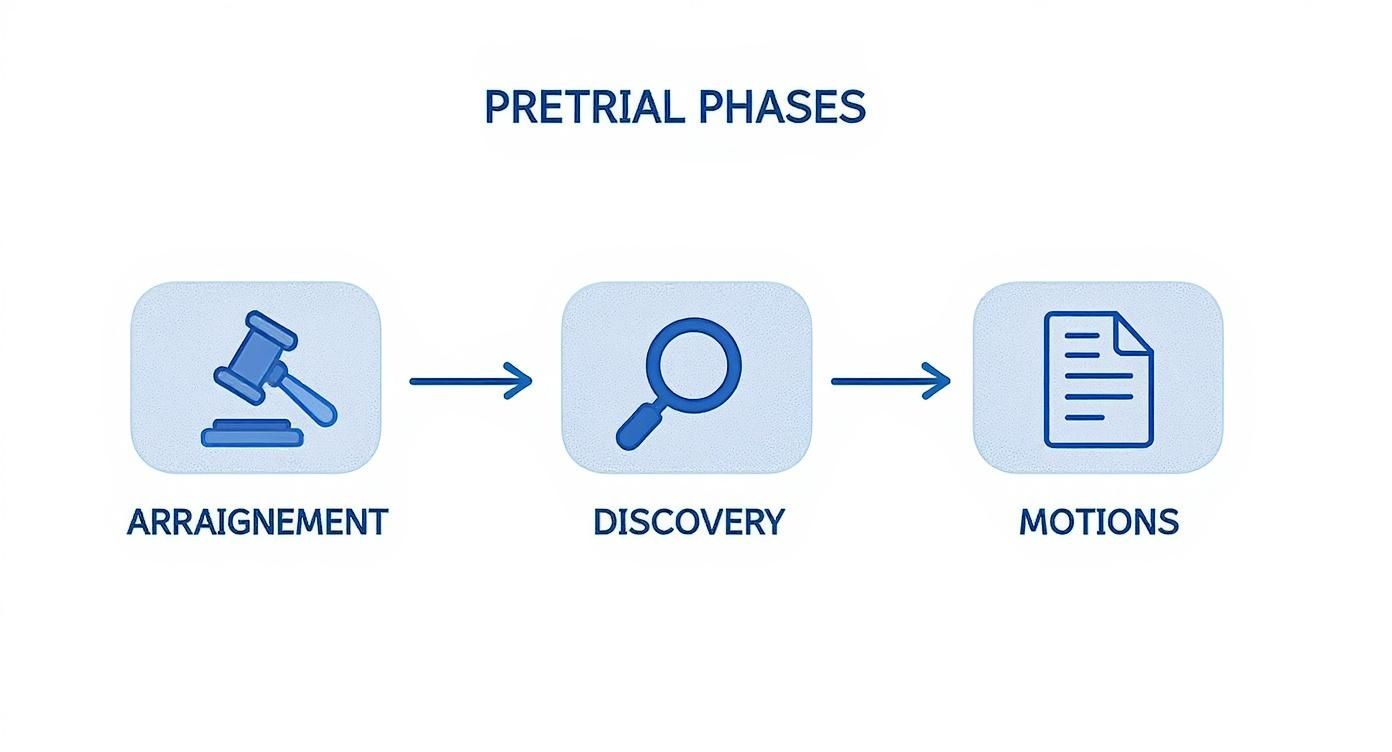
As you can see, the process builds on itself. What happens at the Arraignment affects the strategy in Discovery, and the evidence uncovered there becomes the foundation for powerful Motions to dismiss.
How Long Does It Take to Get a Case Dismissed?
This is the million-dollar question, and the honest answer is: it depends entirely on the case.
Sometimes, a fatal flaw can be spotted in the state's evidence right out of the gate, and a case might get tossed within a few weeks or months. Other times, getting a dismissal requires filing complex pretrial motions, which means hearings, arguments in front of a judge, and waiting for a formal ruling. That process can easily stretch out over several months.
Is There a Difference Between Dropped Charges and a Dismissal?
Yes, there's a crucial legal difference, even though people often use the terms to mean the same thing.
When charges are "dropped," it’s usually the prosecutor's decision to stop pursuing the case. This often happens early on, maybe because they realize they have a weak witness or insufficient evidence.
A "dismissal," on the other hand, is an official order from the court that formally ends the case. A judge can issue a dismissal based on a prosecutor's request or, more importantly, after a defense attorney has successfully argued a motion to dismiss.
The distinction really matters. A dismissal by a judge, especially one "with prejudice," is a much more powerful and permanent victory than a prosecutor just deciding not to proceed for now.
Can a Dismissed Case Be Refiled?
This is where the fine print becomes critical. Whether the prosecution can try again depends entirely on how the judge dismissed the case.
- Dismissal Without Prejudice: Think of this as a temporary win. It shuts down the current case, but it leaves the door open for the prosecutor to refile the same charges later if they find new evidence.
- Dismissal With Prejudice: This is the best possible outcome. It's a final, permanent end to the matter. The prosecution is legally forbidden from ever bringing those charges against the defendant again.
If you or a family member is facing criminal charges in Alpharetta, Forsyth County, or anywhere in the North Georgia area, you can't afford to go it alone. At Brian Hansford Law, we've spent over two decades fighting for our clients, armed with the invaluable perspective gained from my time as a prosecutor. We know how to build a defense that works. Contact us today to start protecting your rights and your future. Find out more at challengemycharge.com.
