
Getting an assault charge dropped isn't a single event; it's a process. It usually boils down to finding the weak spots in the prosecutor's case, building a powerful defense strategy, or striking a deal for a different outcome. To do that, the process often starts with preserving evidence, knowing your rights, and looking into every option, including things like pre-trial diversion programs.
Your First Steps After an Assault Accusation

The minutes and hours right after an accusation or arrest for assault can be a blur. It's confusing, and what happens next is absolutely critical. Knowing what's happening can provide some much-needed clarity and get you ready for what’s coming. The whole thing usually kicks off with booking, which is just the official process of recording personal information and taking fingerprints.
After that, the immediate goal is getting out of jail. This is where a bail or bond hearing comes in. A judge looks at the situation and decides if a person can be released and what conditions they'll have to follow. The amount for bail can be all over the map, depending on how serious the charge is and the individual's background. Getting through this step is crucial because it’s a lot easier to assist in one's own defense when not behind bars. If you want a deeper dive into this part of the process, you can learn more about how bail works in Georgia and see what factors a judge considers.
Knowing Your Rights and Preserving Evidence
From the very first interaction with law enforcement, individual rights are everything. The big one? The right to remain silent. It is absolutely essential that you don't discuss the incident with anyone—especially police—until you've spoken with a lawyer.
At the same time, it's important to start gathering and protecting any evidence that helps your side of the story. This is one of the most proactive things that can be done, and it can make a huge difference down the road.
- Save Communications: Keep every text message, email, voicemail, or social media message that has anything to do with the incident or the people involved. It is often recommended not to delete anything.
- Identify Witnesses: Make a list (mental or on paper) of anyone who saw or heard what went down. It doesn't matter if you think they're on "your side" or not; their story might have details that are helpful.
- Document Your Recollection: As soon as possible, write down everything remembered. Details get fuzzy fast, and an account written right after the event is the most credible.
- Take Photographs: If there are any injuries, like bruises or scratches that back up a self-defense claim, take pictures of them immediately. Make sure they're timestamped.
The first few hours after an accusation aren’t just about going through the motions. This is the first and best chance to lay the groundwork for a defense. What is said—and more importantly, what is not said—and the evidence saved can completely change the direction of a case.
The First Court Appearance
The first time in front of a judge is usually called an arraignment. This is where they'll formally state what the charges are. The accused will also be asked to enter a plea—usually "guilty," "not guilty," or "no contest." While it feels mostly procedural, this hearing really sets the stage for everything that comes next.
Understanding these first moves—from booking and bail to saving evidence and showing up for an arraignment—pulls back the curtain on the whole process. It turns a chaotic, scary experience into a series of steps that can actually be managed, allowing a person to focus on what really matters: getting ready for the tough decisions and conversations ahead.
Understanding Common Defense Strategies in Assault Cases
When facing an assault charge, the effort often begins by looking at the situation from every conceivable angle. It's on the prosecutor to prove their case beyond a reasonable doubt, and there are several well-established ways to challenge their narrative. These aren't just loopholes; they're solid arguments that poke holes in a key part of the accusation—whether it’s who was involved, what their intent was, or the bigger picture of what really happened.
Getting a handle on these strategies is the first step toward understanding how an assault charge can be addressed. Each one, however, relies entirely on the specific facts and evidence available.
Arguing Self-Defense
Claiming self-defense is probably the most well-known defense out there. This strategy doesn't deny that an action took place, but it frames that action as a necessary response to a threat being faced. For a self-defense argument to hold up in Georgia, the force used must have been proportional to the threat.
For example, if someone shoves a person hard during an argument, shoving back might be seen as a reasonable response. But if a weapon is pulled out in response to a shove, that's almost certainly going to be viewed as excessive force. The entire argument comes down to showing that there was a reasonable belief of being in immediate danger and acting only to protect oneself or someone else. There are detailed articles that get into the nitty-gritty of the specifics of what self-defense law covers, which can be a great resource.
A successful self-defense claim hinges on reasonableness and proportionality. It’s about convincing a judge or jury that the actions were a justifiable reaction to a legitimate and immediate threat, not an act of aggression.
Evidence is everything here. Things to look for include:
- Witness Testimony: People who saw the other person start the fight or act aggressively.
- Physical Evidence: Any injuries sustained, like bruises or scratches, that indicate an attack happened first.
- Communication Records: Threatening text messages, voicemails, or social media posts from the other person.
Mistaken Identity and Alibi
Another way to directly attack an assault charge is to argue mistaken identity. The police simply got the wrong person. This happens more often than one might think, especially in chaotic scenes with bad lighting, or when an encounter was over in a matter of seconds.
The best friend of a mistaken identity defense is a rock-solid alibi. If it can be proven that the accused was somewhere else entirely when the incident went down, the charge has no legs to stand on.
- Real-World Scenario: Let's say a person is accused of being in a bar fight in Roswell at 10 PM on a Friday. But they have a time-stamped receipt from a gas station in Marietta from 9:55 PM and a friend who can testify they were with them. That creates a powerful alibi that makes their involvement physically impossible.
A digital footprint—GPS data from a phone, security footage from a nearby store, credit card transactions—can be incredibly powerful in proving where someone was and backing up their claim.
Challenging the Accusation Itself
Sometimes, the best defense is to attack the credibility of the accusation head-on. False allegations are a real, if complicated, part of the justice system. While most assault claims are legitimate, a small but significant number are not. For instance, international studies on sexual assault reports have found that false allegation figures can range from 4% to 9%, with some analyses putting the number as low as 2% when strict definitions are used.
Even the way police classify reports as "unfounded" can stop a case in its tracks, which shows that the credibility of an allegation is a major hurdle from the very beginning.
Lack of Intent and Mutual Combat
For an assault charge to stick, the prosecutor has to prove there was an intent to cause harm or make someone fear for their safety. If the actions were purely accidental, that negates the criminal intent required for a conviction. Bumping into someone in a crowded Milton restaurant and causing them to fall isn't assault because there was zero intent to hurt them.
In other cases, the idea of consent or mutual combat can come into play. This is for situations where two people willingly agree to a physical fight. It's a limited defense and won't fly if someone gets seriously hurt, but in minor scuffles, it can be a valid point to argue that both parties were willing participants. By digging into these angles—self-defense, mistaken identity, lack of intent, or the truthfulness of the claim itself—it becomes possible to start building a counter-narrative that dismantles the prosecution's case.
The Role of Pre-Trial Motions and Negotiations
Long before a case ever sees the inside of a courtroom, a lot of the real work happens behind the scenes. This pre-trial phase is often where the groundwork is laid to get assault charges dropped. It comes down to filing strategic motions and entering into careful, pointed negotiations with the prosecutor. Both of these actions can completely change the direction of a case.
Understanding these tools is critical. This isn't about courtroom drama; it's about challenging the very foundation of the prosecutor's case on procedural grounds. A successful motion can dismantle their evidence, while effective negotiation can lead to a resolution without the risk and stress of a full-blown trial.
Filing Pre-Trial Motions to Challenge the Case
Pre-trial motions are formal requests made to a judge, asking them to rule on a specific issue before the trial even starts. Think of them as a critical filter, designed to make sure that only sound charges and properly obtained evidence can move forward.
Two of the most powerful motions in an assault case are motions to dismiss and motions to suppress evidence.
A motion to dismiss argues that the entire case should be thrown out. This could be for any number of reasons—maybe there's not enough evidence to support the charge in the first place, or perhaps the defendant's constitutional rights, like the right to a speedy trial, were violated. If a judge grants this motion, the case is over.
A motion to suppress evidence is another vital tool. This motion argues that certain evidence was obtained illegally and, therefore, should be excluded from the case. For example, if police conducted an unlawful search of a home or car and found something, that evidence could be suppressed.
Here’s a quick visual breakdown of common defenses that often form the basis for these kinds of pre-trial challenges.
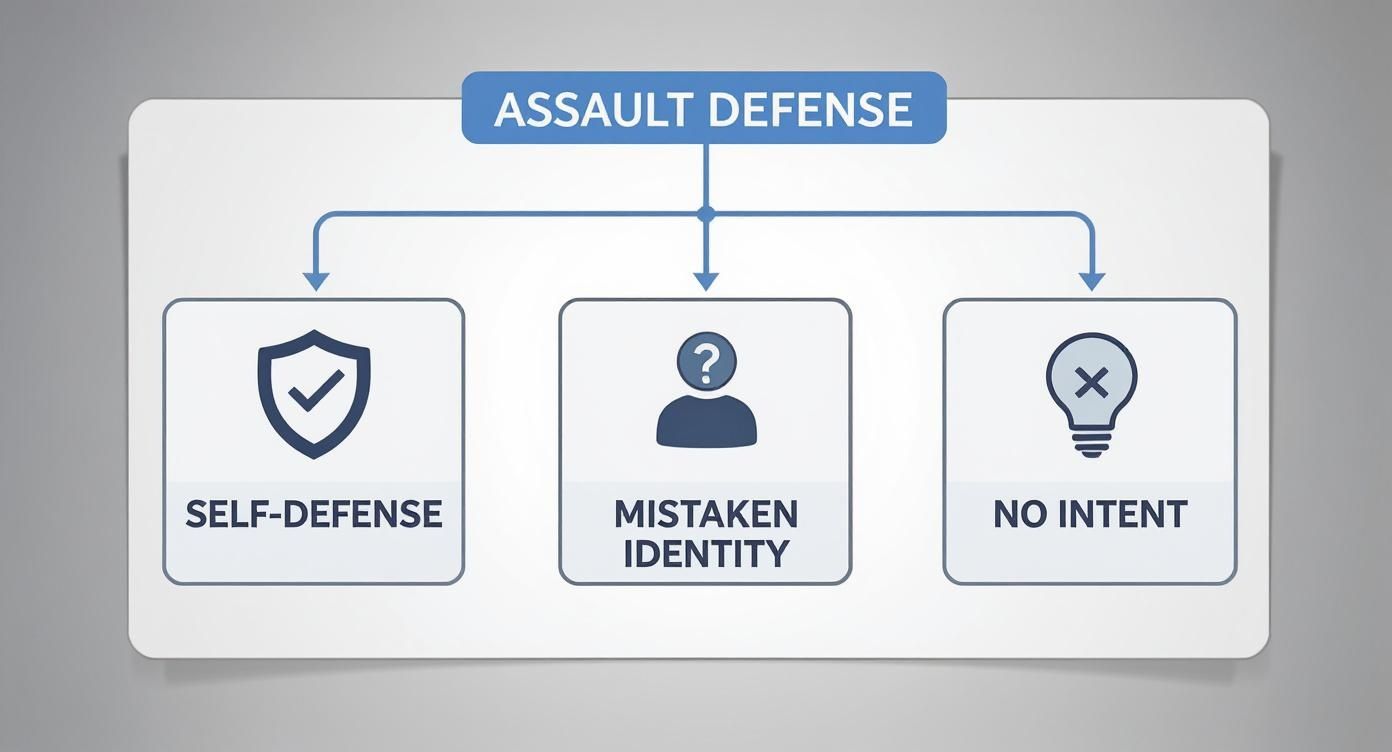
As you can see, core defenses like self-defense, mistaken identity, or a simple lack of intent are central to how an assault accusation can be challenged from the very beginning.
The Art of Negotiation with the Prosecution
While motions are fought out in front of a judge, negotiations happen directly with the prosecutor. The prosecutor, representing the state, holds a surprising amount of power. It's called prosecutorial discretion, and it means they get to decide how to proceed with a case. They can reduce the charges, offer an alternative path, or even drop the case completely.
So, what makes a prosecutor willing to negotiate a better outcome? It usually comes down to a few key factors:
- Weak Evidence: If the evidence is shaky—maybe their main witness isn't credible or the physical evidence is lacking—a prosecutor will think twice about risking a loss at trial.
- Witness Issues: Sometimes the alleged victim no longer wants to cooperate or has a background that undermines their credibility in court.
- First-Time Offender: If a person has a clean record, prosecutors are often much more open to giving them a second chance through a diversion program or a reduced charge.
- A Compelling Defense: When a strong, well-supported defense strategy is presented, like a convincing self-defense claim, it can persuade a prosecutor that getting a conviction is far from a sure thing.
The real art of negotiation is showing the prosecutor that their case has significant weaknesses. The goal is to make a dismissal or a favorable plea deal the most logical—and just—outcome for everyone involved.
The bigger picture of how assault cases are handled systemically also plays a role. For instance, data shows that for every 1,000 sexual assaults, only about 31% are even reported to the police. From there, only 28 cases eventually lead to a felony conviction. Prosecutors know this reality well. They understand that many cases fall apart due to fear of retaliation, a belief that police won't help, or simple evidentiary gaps. This awareness can heavily influence their evaluation of a case's strength.
By methodically highlighting these weaknesses and presenting strong mitigating factors, a positive result can often be secured long before a trial is ever necessary.
Not every assault charge has to end with a trial, a plea, or a conviction. Many people don't realize that in places like Forsyth and Cobb County, there are other ways to resolve a case—paths that can lead to a much better result, sometimes even getting the charges dropped completely. These options exist outside the high-stakes drama of a courtroom battle and tend to focus on fixing the problem rather than just punishing the person involved.
For a lot of first-time offenders or cases where the incident wasn't that severe, pre-trial diversion programs are a fantastic option. It can be thought of as a conditional second chance. The prosecutor agrees to hit the pause button on the case, and instead of moving forward, the individual is given a specific set of tasks to complete.
So, What Do Diversion Programs Actually Involve?
The requirements for a diversion program aren't just random hoops to jump through. They're designed to get at the root of what might have led to the incident in the first place. The specifics will depend on your case, but they almost always include a mix of the following:
- Anger Management Classes: These courses are all about learning better ways to handle conflict and frustration.
- Community Service: The person will be asked to complete a certain number of volunteer hours, giving back to the local community.
- Counseling or Therapy: Sometimes, the court wants an individual to address underlying issues like stress or substance abuse.
- Restitution: If someone's property was damaged, paying to fix it is almost always part of the deal.
If all the boxes are checked and everything is completed within the given timeframe, the prosecutor will dismiss the charges. That’s the best possible outcome—no criminal conviction hanging over a person's head.
Other Ways to Settle a Case
Formal diversion isn't the only game in town. There are other negotiated outcomes that can keep a record clean. One common alternative is called deferred adjudication. It's a bit like diversion, but with a slightly different structure. In this scenario, a plea might be entered, but the judge doesn't formally find the person guilty.
Instead, the individual is placed on a type of probation with a list of conditions to follow. As long as they stay out of trouble and do everything they're supposed to, the case gets dismissed at the end of the probationary period. Again, it's a far better result than a conviction.
Getting access to these kinds of deals often comes down to the prosecutor's judgment, the specific facts of a case, and an individual's personal history. The goal is always to demonstrate that what happened was an isolated event and that the person is not a danger to anyone.
It's also worth remembering that things happening outside the courtroom can completely change the direction of a case. For instance, the alleged victim's actions and feelings play a huge role. Studies have shown that a significant number of accusers end up withdrawing their complaints because they feel intimidated by the process or lose faith that justice will be served. This complicated mix of institutional pressures and personal dynamics is part of the reality of the system, and it's one of the many reasons charges sometimes get dropped long before a trial is even considered. You can find more details about these systemic influences in reports on why assault cases are dropped.
Below is a table comparing some of the most common outcomes one might encounter when facing an assault charge. It helps clarify what each path looks like and what the end result can be.
Comparing Potential Case Outcomes
| Resolution Path | Typical Requirements | Final Outcome |
|---|---|---|
| Pre-Trial Diversion | Anger management, community service, restitution, no new arrests. | Charges are dismissed upon successful completion. No conviction. |
| Deferred Adjudication | Plea entered but held; probation with conditions (similar to diversion). | Case is dismissed after the probationary period. No final conviction. |
| Plea Bargain | Plead guilty to a lesser charge (e.g., Disorderly Conduct instead of Battery). | Conviction for the reduced charge, often with a lighter sentence like probation. |
| Trial Acquittal | Vigorously fighting the charges in court before a judge or jury. | Found "Not Guilty." The case is closed with no conviction or penalties. |
| Trial Conviction | The prosecutor proves the case beyond a reasonable doubt at trial. | Found "Guilty." Results in a criminal conviction and sentencing. |
Ultimately, knowing about these alternative routes is a critical part of understanding the system. They offer a constructive way forward that can protect a person's future from the lifelong burden of a criminal record.
How Local North Georgia Courts Handle Assault Cases
When a person is facing an assault charge in North Georgia, it’s critical to understand that not all courtrooms are created equal. The outcome of a case isn't just about the letter of the law; it's heavily influenced by the local culture. The way a prosecutor approaches a case can change dramatically from one county to the next, even if the charges look identical on paper.
For instance, the solicitor’s office in one county might have a standard, almost automatic, procedure for offering pre-trial diversion to first-time offenders in simple battery cases. But right next door, a neighboring county’s prosecutor's office might treat those same charges far more aggressively, rarely even considering such programs. This is where having boots-on-the-ground, local knowledge becomes a game-changer.
These differences aren't written down in any law book. They're the unwritten rules and tendencies that shape how prosecutors and judges in places like Forsyth County, Cobb County, or cities like Alpharetta and Roswell handle their dockets. Knowing these local nuances is a huge part of understanding how strategies that actually work are built.
The Power of Prosecutorial Discretion and Local Policies
Every prosecutor's office operates with what’s known as prosecutorial discretion. This is a powerful tool that gives them the authority to decide whether to file charges, what charges to file, and whether to offer a plea deal or dismiss a case altogether. That discretion is shaped by local policies, community pressures, and even the personal philosophies of the elected District Attorney or Solicitor-General.
In some jurisdictions, there might be intense political pressure to take a hardline stance on anything labeled a "violent offense," which makes negotiating much tougher. In others, you'll find a greater emphasis on rehabilitation and alternative resolutions, especially for younger defendants or those with a clean record.
Understanding the specific "personality" of a courthouse—from how willing prosecutors are to negotiate to the kinds of sentences certain judges prefer—provides a massive strategic advantage. It allows for the formation of a realistic game plan and a defense tailored to actually resonate with the people making the decisions.
How Different Jurisdictions Might View the Same Case
Let's imagine a common scenario: a simple assault charge from a verbal argument that gets a little physical in a parking lot. No serious injuries, just a minor scuffle.
- In Cumming (Forsyth County): The prosecutor's office here might be more open to a diversion program if the accused has a clean record. They often prioritize clearing their dockets of minor offenses to focus on more serious crimes.
- In Marietta (Cobb County): The approach could be totally different. With a high volume of cases, the solicitor’s office might have a more structured, less flexible policy. They might demand an anger management course before they’ll even think about reducing the charge to something like disorderly conduct.
- In Roswell or Johns Creek (Fulton County): The local courts here often place a heavy emphasis on the alleged victim’s wishes. If the accuser is insistent on prosecuting, the state is going to be far less willing to dismiss the case, no matter what the defendant's history looks like.
This isn't about one area being "better" or "worse" than another. It's simply a reality that geography plays a major role in a case. The very same set of facts can lead to wildly different initial offers from the prosecution depending on where the incident happened.
Knowing if a local prosecutor is receptive to mutual combat arguments or is especially skeptical of self-defense claims can make or break a case. Ultimately, this kind of local insight is absolutely critical for navigating the system and fighting for a positive outcome.
Clearing Your Record After a Case Dismissal

Getting assault charges dropped feels like the end of the road, but it’s not the final step. It's a massive relief, for sure. But here's something many people don't realize: even with a dismissal, the arrest record sticks around. It remains publicly accessible, just waiting to be found by anyone running a background check for a job, an apartment, or a loan.
That lingering digital footprint can pop up at the worst times, creating barriers long after the case was thought to be over. To truly move on, the next move is seeking a record restriction—what most people think of as expungement. This is the official process in Georgia for sealing an arrest record from public view.
The Georgia Record Restriction Process
The path to restricting a record is specific and requires getting the procedure just right. Once a case is dismissed or resolved without a conviction, an individual is generally eligible to have the arrest record restricted. This is what stops private background check companies and the general public from seeing the incident.
The process usually breaks down like this:
- Filing a Petition: A formal request will need to be submitted to the court that handled the case and to the agency that made the arrest.
- Providing Documentation: This means gathering the official paperwork showing the case was dismissed, nolle prossed (meaning the prosecutor dropped it), or resolved through a program like pretrial diversion.
- Agency Review: The arresting law enforcement agency and the prosecutor’s office both review the petition to confirm eligibility.
Once everyone signs off, the Georgia Crime Information Center (GCIC) updates its database. That’s the final step that effectively seals the record from prying eyes.
The whole point of record restriction is to make sure a past accusation doesn't unfairly define a person's future. It’s about getting a clean slate back and removing obstacles to personal and professional life.
Why Is a Clean Record So Important?
Let's be blunt: an arrest record, even without a conviction, carries a stigma. A potential employer might see the assault charge and move on to the next applicant without giving a chance for explanation. A landlord might deny a rental application. It can even affect educational opportunities.
Successfully restricting a record is about long-term protection. It means that when someone applies for a job in Alpharetta, a loan in Marietta, or an apartment in Cumming, the arrest for that dismissed assault charge won’t show up on standard background checks. This final action safeguards the future, making sure a resolved issue stays in the past where it belongs.
Common Questions About Assault Charges
What if the Person Who Accused Me Changes Their Mind and Wants to Drop the Charges?
This is a really common question, and the answer surprises a lot of people. Once charges are filed, the decision to drop them isn't up to the accuser anymore—it's up to the prosecutor.
The case is officially "The State of Georgia vs. [Defendant's Name]," not the accuser versus the defendant. While the prosecutor will definitely take the accuser's wishes into account, they have the final say. They'll look at all the evidence, the seriousness of the situation, and public safety concerns before deciding whether to dismiss the case.
How Long Will My Assault Case Take to Get Resolved?
The timeline for an assault case can vary dramatically. There's no one-size-fits-all answer.
If it's a straightforward situation that gets resolved through something like a pretrial diversion program, it might only take a few months. But for more complicated cases that require a lot of motions or are headed toward trial, it could be a year or even longer before it's all over.
What’s the Difference Between Simple Assault and Aggravated Assault?
The distinction here is crucial, as it dramatically affects how a case is handled and what options are on the table.
In Georgia, simple assault generally means an act that puts someone in reasonable fear of getting hurt, while simple battery is the actual unwanted physical contact. These are typically misdemeanors.
Aggravated assault, on the other hand, is a serious felony. A charge gets elevated to "aggravated" if it involves things like:
- A deadly weapon
- An intent to commit another serious crime (like robbery or rape)
- An act that causes serious bodily injury
This difference is a key factor in how prosecutors will approach a case and what kinds of resolutions might be possible when looking at a strategy for getting assault charges dropped.
Navigating the complexities of the system isn't something that should be done alone. Brian Hansford Law brings over two decades of experience to the table, including critical time spent as a prosecutor. That background provides a deep, practical understanding of how to challenge criminal charges in North Georgia. Visit us at challengemycharge.com to learn more.
