
A background check can turn an old arrest into a current problem in seconds. You apply for a job in Alpharetta, an apartment in Roswell, or a professional opportunity in Johns Creek, and a case you thought was behind you shows up again.
That’s usually when people search how to get my criminal record expunged.
In Georgia, that search term points you in the right direction, but the legal answer is more specific. The process often referred to as “expungement” is usually record restriction, and that distinction matters in Fulton County, Forsyth County, Cobb County, Cherokee County, and Gwinnett County. The rules are different from what you’ll see in Florida-heavy search results, and the wrong assumption can waste months.
The process is also harder than expected. Only 6.5% of legally eligible individuals get their record cleared within five years, according to the expungement research summarized by the North Carolina State Bureau of Investigation expungement resource. That number matters because it shows the underlying problem. Eligibility alone doesn’t get the job done. Procedure does.
Your Past Record Doesn't Have to Define Your Future
A dismissed charge can still interfere with hiring. A resolved misdemeanor can still trigger questions. Even a case that never led to a conviction can follow you longer than it should.
That’s why people in Cumming, Milton, Marietta, Sandy Springs, and Duluth keep searching for relief under the word expungement. They want a practical answer, not legal jargon. They want to know whether a court can stop the public from seeing a case that keeps getting pulled into routine screenings.
In Georgia, that answer depends on the type of case, how it ended, and whether the law allows the record to be restricted from public access. It also depends on filing the right request in the right place, with the right supporting record.
Practical rule: The best time to address record restriction is before a new employer, licensing board, or landlord finds the case first.
People often assume that if they qualify, approval is automatic. It usually isn’t that simple. A missing disposition, an incorrect case number, an incomplete filing, or a misunderstanding about whether a DUI, drug case, traffic offense, or felony qualifies can stop the process before a judge ever reaches the merits.
That’s especially true in North Atlanta courts, where local practice matters. A person dealing with a prior arrest in Alpharetta Municipal Court, a prosecution in Fulton County Superior Court, or a charge out of Forsyth County needs advice tied to Georgia procedure, not generic online content built around another state’s system.
The Truth About Expungement vs Record Restriction in Georgia
Georgia clients use the word expungement because that’s the term everyone knows. In actual Georgia practice, the term you need to understand is record restriction.

What Georgia usually means by record restriction
Record restriction generally means the record is limited from public access rather than erased from existence. That’s a major legal difference. Many employers, landlords, and members of the general public may no longer see the case the same way, but that doesn’t mean the government acts as if the case never happened.
If you’ve been reading national articles, confusion on the topic often begins. A lot of online content discusses the difference between records being hidden and records being destroyed. If you want a plain-language comparison, this explanation of the difference between expunged and sealed records gives useful context. In Georgia, most adults are dealing with restriction, not true destruction of the record.
Why Florida search results mislead Georgia residents
A common mistake in North Georgia is following Florida instructions. That happens because Florida content dominates search results for terms like “clear my record” and “expunge arrest.”
But Georgia law works differently. As noted in this discussion of Florida sealing and expungement procedures, Florida uses a mandatory Certificate of Eligibility process. Georgia law under O.C.G.A. § 35-3-37 has no such requirement, and that difference is critical for people in Cumming, Johns Creek, Alpharetta, and Roswell who are trying to file in the correct court.
Following another state’s checklist is one of the fastest ways to delay a Georgia case.
What record restriction can and cannot do
For many people, the practical goal is simple. They want an old public record to stop appearing in ordinary searches and routine background screening. When record restriction is available, that can make a real difference in employment and housing conversations.
Still, there are trade-offs. Georgia’s process is narrower than many people think.
| Issue | What to know in Georgia |
|---|---|
| Public visibility | Restriction is aimed at limiting public access to eligible records |
| Complete destruction | That’s usually not the right expectation for adult Georgia cases |
| Convictions | Some convictions remain very difficult or impossible to restrict |
| Non-convictions | Dismissals and acquittals are often the strongest candidates |
| DUI cases | DUI convictions are a common source of confusion and usually a poor fit for restriction requests |
The legal label matters in North Atlanta courts
This isn’t just terminology. It affects the paperwork you file, the expectations you should have, and the way you answer the court’s questions.
If someone says, “I need my record expunged,” the primary legal analysis starts with questions like these:
- How did the case end. Dismissal, acquittal, guilty plea, nolo plea, diversion, or First Offender disposition all lead to different outcomes.
- Which court handled the matter. Municipal, State, Superior, or Recorder’s Court can affect how records are stored and how relief is pursued.
- What charge is involved. A marijuana possession dismissal in Marietta is not analyzed the same way as a DUI conviction in Sandy Springs.
- What else is on the record. Pending charges, probation status, unpaid obligations, and later convictions can all complicate the request.
In practice, the people who do best are the ones who stop using the generic word as their legal strategy and start analyzing the actual Georgia remedy available in their specific case.
Are You Eligible for Record Restriction in North Atlanta
Eligibility determines whether individuals receive confirmation of their status or discouraging information. Georgia lacks a uniform solution for all past offenses. The ability to restrict a record in Alpharetta, Milton, Cumming, Marietta, or Johns Creek relies upon the specific case results and the relevant legal statutes.

Non-conviction cases are usually the best candidates
If you were arrested but the case was later dismissed, dead docketed, no-billed, or you were acquitted, that’s often the strongest starting point. These are the cases where people have the best chance of getting meaningful relief because the record exists even though the prosecution didn’t end in a conviction.
That matters for people charged with offenses like simple battery, shoplifting, misdemeanor marijuana possession, or other low-level accusations that never resulted in a guilty finding. A dismissed drug possession case in Marietta or a not guilty verdict on a misdemeanor in Fulton County often deserves a close review for restriction.
In a lot of these cases, the problem isn’t the law. It’s the paperwork trail. The disposition may be incomplete, the case number may be inconsistent across agencies, or the arresting agency’s version of events may not line up neatly with the court record.
Some youthful and first-offender situations need closer analysis
A lot of North Atlanta clients come in assuming an old youthful mistake should automatically disappear. Sometimes there is a path forward. Sometimes there isn’t.
That’s especially true when the case involved a First Offender sentence, conditional discharge, or another disposition that people casually describe as “kept off my record.” Those phrases can hide important legal details.
Here are the questions that usually matter first:
- Was there a conviction or not. Many people use the word conviction loosely. The legal answer controls eligibility.
- Did the person successfully complete the sentence. Completion status often changes the analysis.
- Was the case in juvenile court or adult court. Juvenile records raise a different set of issues than adult criminal records.
- Was the charge a traffic offense, DUI, or something tied to license consequences. Those cases often create false hope because they carry criminal and driving consequences but don’t fit cleanly into record-restriction relief.
For a more focused discussion of lower-level cases, this guide on how to expunge a misdemeanor in Georgia can help you compare your facts to common misdemeanor scenarios.
A case that feels minor to you may still be legally significant to the court record system. Eligibility turns on the disposition, not your memory of how serious the charge seemed.
Felony convictions usually have limited options
Many online articles often become misleading. They speak broadly about “clearing your record” without making clear that Georgia adults with felony convictions usually face a much narrower path.
If the case ended in a felony conviction, record restriction may not be available in the way you expect. Some people may have relief tied to how the sentence was imposed, whether First Offender treatment applied, or whether another specific statute creates a route to protection. But many felony convictions don’t fit the standard public understanding of expungement.
That’s why a person with an old felony theft, drug, or assault case in Cobb County should not assume the answer will be the same as a person whose charge was dismissed. Those are different legal categories.
DUI and traffic-related records often cause confusion
A lot of high-intent searches come from people dealing with old DUI arrests, reckless driving charges, suspended license matters, speeding tickets, and related traffic cases. Those people are usually asking one of two questions:
- Can this be restricted now?
- If not, is there another way to reduce the damage from the record?
For a DUI arrest that was dismissed, there may be a restriction analysis worth doing. For a DUI conviction, the answer is usually much tougher. Georgia treats these cases differently than many people hope, and it’s one reason generic “expungement near me” content often leads readers in the wrong direction.
A quick way to self-screen your case
Before you spend time gathering records, ask yourself these practical questions:
| Question | Why it matters |
|---|---|
| Did the case end without a conviction | Non-convictions are often the strongest candidates |
| Do you know the exact final disposition | You need the court’s wording, not your recollection |
| Are there other pending criminal matters | Open cases can complicate requests |
| Was this a DUI or serious felony conviction | Those usually face the hardest restrictions |
| Do multiple agencies hold the record | Court, police, and state repositories may all need to be addressed |
If you can’t answer those questions confidently, don’t guess. Get the record first. Many denials begin with a client filing based on what they think happened instead of what the official record says.
Filing Your Petition A Step-by-Step Guide for Georgia Courts
A lot of people think filing is mostly form work. It isn’t. It’s a document-accuracy project with legal consequences, and small errors can undo an otherwise valid case.
Practitioner benchmarks in comparable expungement systems show that 70-80% of eligible applicants can succeed, but success rates drop below 50% for self-filers due to documentation errors like incomplete forms or mismatched case numbers, according to this step-by-step expungement process discussion. That warning translates well to Georgia practice because the same kinds of mistakes show up here.
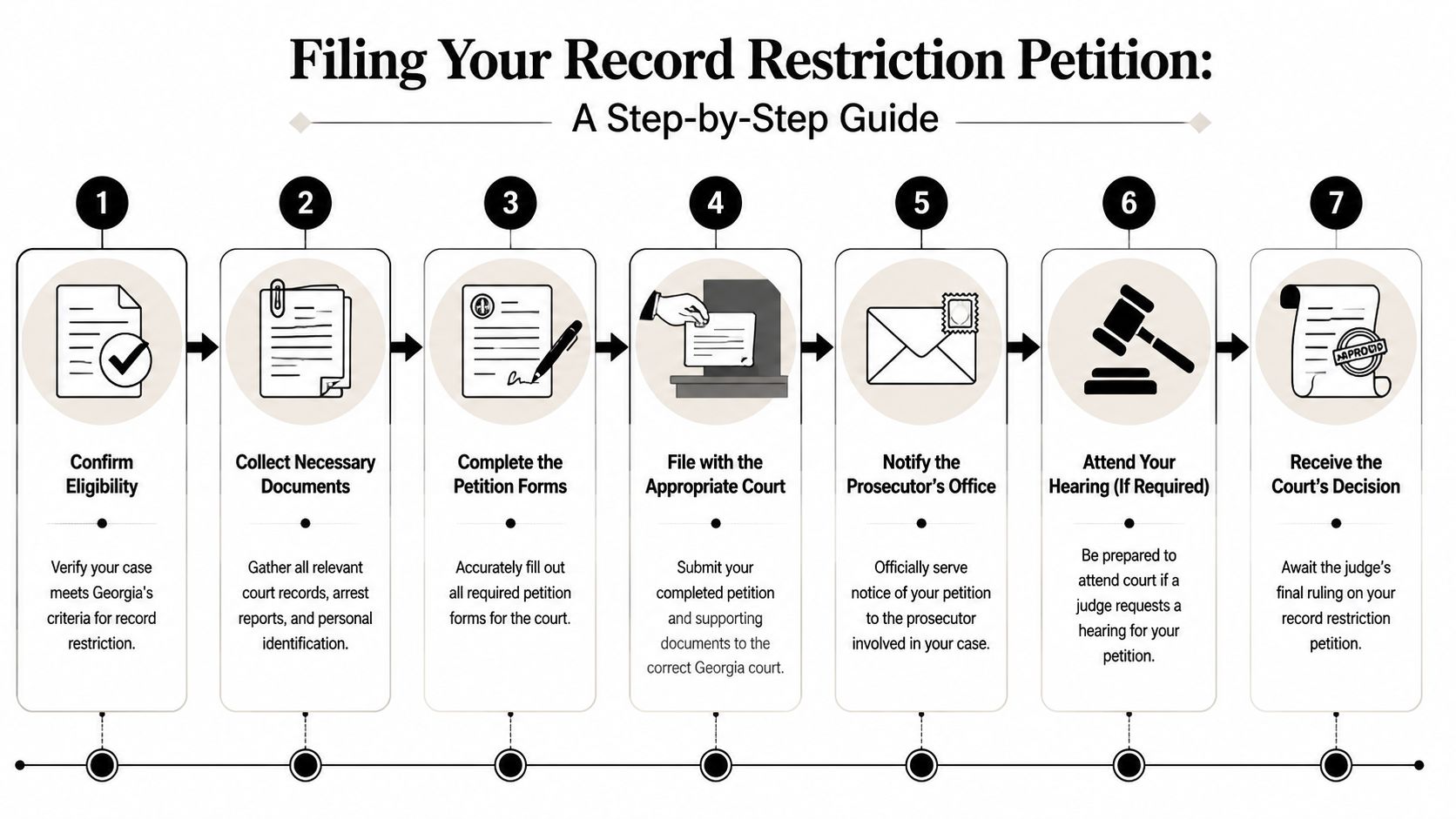
If your case involves an arrest record rather than a conviction issue, this resource on how to get your arrest record expunged is a useful companion because arrest-based cases are often where people first encounter the restriction process.
Start with the full record, not memory
The first step is getting the exact court and arrest information. That usually means collecting certified or reliable copies of:
- The accusation, citation, indictment, or warrant
- The final disposition
- Any sentencing order or probation termination paperwork
- Agency identifying information, including arrest date and case number
- Proof of dismissal, acquittal, or discharge, where applicable
People often bring in partial paperwork from years ago and assume that’s enough. It usually isn’t. Courts and prosecutors need to be able to match the requested relief to the exact case history.
A single wrong digit in a case number can create a rejection problem that has nothing to do with eligibility.
File in the right court and serve the right office
Georgia procedure depends heavily on where the case started and where the official record sits. A municipal case can create one filing path. A State Court misdemeanor can create another. A Superior Court felony matter may require a different analysis entirely.
That’s why local court familiarity matters in places like:
- Fulton County
- Forsyth County
- Cobb County
- Cherokee County
- Gwinnett County
The practical filing work often includes identifying the clerk’s office, confirming the prosecutor’s role in review, and making sure the filing package includes every document needed for the court to act without sending it back.
Courts don’t fix your paperwork for you. If the filing is incomplete, the case usually stalls until you correct it.
Expect procedural friction, especially in mixed-charge cases
A common North Atlanta fact pattern is a case with multiple charges arising from one stop or arrest. For example, a person may have been arrested in Roswell for DUI, reckless driving, and an open container allegation, but only one count was dismissed while another ended in a plea.
That kind of mixed outcome creates real complexity. You may be dealing with:
| Scenario | Practical issue |
|---|---|
| One count dismissed, one count pled | The public record may reflect both outcomes |
| Arresting agency and court records don’t match | The judge may need clearer documentation |
| Old case from a closed or changed court system | Record retrieval may take extra work |
| Out-of-county arrest with local consequences | Venue and record location may not be obvious |
These are the cases where self-filers often get tripped up. They assume the dismissed part of the case can be isolated easily, but the way the record was created may make the request more technical than it looks.
Hearings aren’t always the problem, preparation is
Some cases can be resolved on the papers. Others may require a hearing or at least a formal response from the prosecutor. The hearing itself is rarely the biggest obstacle. The larger issue is whether the petition package gives the judge a clean legal basis to grant relief.
That means your filing should answer questions before the court asks them:
- Why is this charge eligible
- How did the case end
- What authority permits the requested restriction
- Are there any disqualifying facts missing from the petition
- Does the supporting record match the relief requested
When the file is sloppy, the court has reasons to hesitate. When the file is clean, the court can focus on the law.
What works and what usually does not
Some filing habits help. Others create avoidable delay.
What tends to work
- Ordering complete records early so the petition reflects the full case history
- Reconciling every case number and date before filing
- Checking the final disposition language instead of relying on a docket summary alone
- Anticipating prosecutor objections in charges with public-safety overtones
- Using counsel familiar with local practice, including firms such as Brian Hansford Law that handle Georgia criminal defense and record-restriction matters in North Atlanta courts
What usually doesn’t work
- Filing based on online snippets from a county portal
- Assuming a case was “dropped” without obtaining the actual dismissal record
- Treating DUI like a standard misdemeanor for restriction purposes
- Copying another state’s expungement forms or instructions
- Waiting until a job offer is on the line before starting document collection
The fastest way through the process is usually a careful start. Most delay comes from correction work after filing.
Common Roadblocks DUIs Felonies and Filing Without a Lawyer
The hardest cases tend to fall into three categories. DUI convictions, felony convictions, and self-filed petitions with procedural problems.

Why DUI convictions are such a common dead end
People regularly ask whether an old DUI can be expunged in Georgia. In most cases involving a DUI conviction, the answer is no or close to no under the relief people usually have in mind.
That surprises people because DUI is often charged alongside traffic offenses, and many assume traffic-type cases are easier to clean up later. They usually aren’t. A dismissed DUI arrest may present one kind of analysis. A DUI conviction presents another, and it’s far more restrictive.
That distinction matters if you’re searching for a DUI lawyer in Alpharetta, a DUI attorney in Roswell, or help after a prior case in Cumming or Sandy Springs. The best time to protect your record in a DUI case is before conviction, not years later.
Felony history narrows the path
A felony record changes the conversation immediately. For many adult convictions, record restriction is not the broad remedy people expect when they search how to get my criminal record expunged.
Some people may still have arguments tied to how the case resolved, whether First Offender treatment was involved, or whether a non-conviction count within a larger indictment can be addressed separately. But if the overall expectation is “I’ll file a form and the felony disappears,” that expectation usually doesn’t survive a close legal review.
The more serious the charge, the less forgiving the process becomes. Old assumptions don’t help. Exact court records do.
Filing without a lawyer is where many cases go off track
Legal aid benchmarks from high-demand jurisdictions show that 40-60% of applications filed without an attorney fail due to procedural mistakes, while filings with experienced counsel have a success rate of over 95%, according to this expungement pitfalls analysis. The article also notes Georgia-specific issues such as a 4-year wait post-probation in relevant contexts. Those numbers come from outside Georgia, but the lesson fits local practice exactly: procedure defeats a lot of otherwise viable petitions.
The usual pro se mistakes aren’t dramatic. They’re basic.
- Wrong case identifier
- Missing disposition
- Filing in the wrong court
- Asking for the wrong kind of relief
- Ignoring disqualifying facts
- Failing to address all agencies holding the record
People facing old criminal records in Milton, Marietta, East Cobb, or Duluth often try to save money by filing on their own. That can make sense for some simple administrative problems. It usually makes less sense when the issue is a public criminal record affecting work, housing, professional licensing, or a pending background check.
Hard cases often need strategy, not optimism
If your record includes a DUI, a drug possession case, a felony count, or a mixed-result prosecution, the legal work isn’t just filing paper. It’s deciding what relief is available, what argument fits the statute, and whether the better path is restriction, record correction, or a defense strategy in a current pending case so the future record problem never gets worse.
That’s where experienced court representation matters. The value isn’t just “having a lawyer.” It’s having someone who knows which cases in North Atlanta are realistically fixable and which ones require a different plan.
Secure Your Second Chance with Brian Hansford Law
A successful record restriction can change ordinary parts of life that people take for granted. Job applications become less stressful. Rental screenings become more manageable. Background checks stop reopening a case that should no longer dominate your future.
But the process only helps if the case is analyzed correctly at the start.
For many people in Alpharetta, Johns Creek, Roswell, Cumming, Milton, Marietta, and the broader North Atlanta area, the actual need isn’t more internet research. It’s a case-specific answer to questions like these:
- Is this charge eligible in Georgia
- Was my case a conviction, a discharge, or a non-conviction
- Do I need to file with the court, the agency, or both
- Will this affect employment, housing, or a professional license
- If my case can’t be restricted, what’s the next best legal strategy
Brian Hansford Law focuses on Georgia criminal defense, including the kinds of cases that create these record problems in the first place. That matters because record restriction is tied directly to how a case ended. A former prosecutor with more than 25 years of legal experience brings a different perspective to that review. He knows how charging decisions, plea structures, dismissals, and court records are built, and that background helps when sorting out whether relief is available in Fulton, Forsyth, Cobb, Cherokee, or Gwinnett County.
If you’re dealing with an old arrest, a dismissed drug case, a prior misdemeanor, or questions about a DUI or felony record, the most useful next step is a confidential review of the actual documents. Guessing based on memory usually creates delay. A record-based legal review creates options.
Frequently Asked Questions About Record Restriction
How much does it cost to restrict a record in Georgia
The total cost depends on the court, the type of case, the records you need to obtain, and whether you hire counsel. There may be court-related filing costs and separate attorney’s fees. The only reliable way to estimate cost is to review the exact case and the records required.
How long does the process take
Timelines vary by court, by the quality of the records, and by whether the prosecutor objects or the court wants a hearing. Some cases move on paperwork alone. Others take longer because records have to be tracked down or corrected before the court can act.
Can I say I don’t have a criminal record after restriction
That depends on the type of record, the setting, and who is asking. Public-facing background check issues may improve significantly after a successful restriction, but some government, licensing, or law-enforcement contexts may still require disclosure. You should get legal advice before answering broadly on an application.
Can a DUI be expunged in Georgia
A dismissed DUI charge may deserve review. A DUI conviction is generally not something people can expunge or restrict in the ordinary sense they mean when they search that phrase.
Should I file on my own
If the case is simple, some people try. If the case involves a DUI, felony history, mixed dispositions, or urgent employment concerns, self-filing creates more risk. The biggest problems usually come from basic procedural mistakes, not from dramatic legal fights.
If you want a clear answer about whether your Georgia record can be restricted, contact Brian Hansford Law for a free, confidential consultation. If you’re in Alpharetta, Roswell, Johns Creek, Milton, Cumming, Marietta, Sandy Springs, Duluth, or the surrounding North Atlanta counties, you can get a case-specific review focused on what your record shows, what relief may be available, and what to do next before another background check puts your future on hold.
