
If you're searching for how to get off the sex offender registry, you're probably not looking for abstract legal theory. You're trying to figure out whether there is a real path out, whether you've waited long enough, and whether one mistake in paperwork could set you back again.
For people living in Alpharetta, Roswell, Johns Creek, Milton, Cumming, Marietta, and across North Atlanta, registry status affects ordinary life in ways outsiders often miss. Housing gets harder. Work becomes complicated. Family routines get shaped around reporting rules and public exposure. Even when the sentence is over, the registry can feel like it never is.
Georgia law does create a path for some people to seek removal. But the process is technical, county-specific, and unforgiving of shortcuts. In North Atlanta, that means the right answer often turns on details tied to the original conviction, the county of conviction, and the quality of the evidence presented to the court.
Your Path Forward From the Georgia Sex Offender Registry
A lot of people wait too long to ask the first question that matters. Am I legally eligible to file at all? They assume that years of compliance should be enough. Sometimes it is. Sometimes it isn't.
That difference usually comes down to classification, timing, and where the case was originally handled. A person living a stable life in Johns Creek may still need to file in another county because the conviction happened there. A resident of Milton may believe ten years have passed, only to learn the clock is measured from the start of registration, not merely from the date of conviction.
The practical reality is this: registry removal cases reward precision. They don't reward hope alone, and they definitely don't reward guesswork.
Practical rule: Before anyone drafts a petition, they should confirm the exact conviction record, the registration start date, and the county where the petition must be filed.
People often approach this issue the same way they first approach a DUI or felony case. They search for urgent answers, local court guidance, and a lawyer who knows how judges and prosecutors handle these matters in North Atlanta. That instinct is right. The registry process isn't just about statutes on paper. It's about how those statutes are applied in real superior courts serving Fulton County, Forsyth County, and Cobb County.
There is a path forward for some registrants in Georgia. The hard part is identifying the correct one early, then building a case that survives scrutiny.
Determining Your Eligibility for Removal Under Georgia Law
Eligibility under Georgia registry law is usually won or lost on the paperwork before a petition is ever filed.

In North Atlanta, I regularly see people from Alpharetta, Cumming, Roswell, and Marietta assume they qualify because they have stayed out of trouble for years. Sometimes they do. Sometimes Georgia law bars relief because of the offense category, a victim-related factor, or the way the conviction was entered. Good conduct helps, but it does not create eligibility where the statute does not allow it.
The starting point is O.C.G.A. § 42-1-19, which governs petitions for release from registration in Georgia. The court looks first at the legal status of the conviction and whether the person fits into a category the statute allows to petition. That review is technical. In Forsyth, Cobb, and Fulton County cases, small record details often control the result.
What Georgia courts look at first
A judge does not begin with character letters or employment history. The court begins with the underlying case file and the statute.
That review usually includes:
- The exact offense of conviction. The common name for an offense is often less important than the code section listed in the final disposition.
- Whether the case involved a minor, force, or another disqualifying factor. Those facts can change whether removal is available at all.
- The date registration first began. The waiting period analysis depends on the statute and the registration timeline, not just the arrest or plea date.
- Whether the person has any registry violations or later convictions. Even a case that appears eligible on paper can weaken quickly if the compliance history is poor.
- Whether the conviction was handled in Georgia or elsewhere. Out-of-state cases create an extra layer of analysis because Georgia registration rules may not line up neatly with the original offense label.
This part is less intuitive than people expect. A person may have completed probation years ago and still be outside the filing window. Another person may focus on rehabilitation when the actual problem is that the offense category itself makes the petition harder or impossible.
Common eligibility mistakes in North Atlanta cases
The mistakes are predictable.
People rely on memory. They use old plea papers that are incomplete. They assume the sheriff's office classification answer settles the question. It often does not. The superior court will want the actual record.
Another common problem is confusing registry removal with record restriction. They are separate forms of relief under Georgia law. If you need a plain-language overview of how Georgia treats older criminal records in other contexts, this article on how misdemeanor expungement and record restriction work gives useful background, but it is not a substitute for a registry eligibility review.
Documents to pull before you file anything
Before a lawyer can give a reliable opinion, the file needs to be built from the right records, not assumptions.
Start with:
- The final disposition and sentencing documents from the criminal case.
- Certified copies of the accusation or indictment if the facts alleged may affect eligibility.
- Any registration notice, risk-level paperwork, or GBI-related classification records you received.
- Proof showing when registration started and whether it has been continuous.
- Records of compliance, including proof that reporting requirements were met.
- Treatment completion, counseling, restitution, and probation discharge records, where applicable.
In practice, many self-filed cases often go off course. The person filing may be sincere and may even have a strong personal story, but the court still needs a clean statutory argument supported by records.
A practical eligibility screen
| Issue | Why it matters |
|---|---|
| Offense code section | Controls whether Georgia law allows a petition |
| Victim age and case facts | Can limit or bar relief |
| Registration start date | Affects whether the waiting period has run |
| Compliance history | Violations can damage the petition |
| State and county of conviction | Changes the legal analysis and where the case belongs |
I tell clients to treat this review with the same seriousness they would give a civil filing deadline or service problem. Missing a legal requirement at the front end creates expensive delay. Resources like Essential steps for lawsuit notices show the same basic lesson in another context. Early procedural mistakes are often the hardest to fix later.
The right question is not whether removal feels deserved. The right question is whether Georgia law permits the court to grant it on the record you can prove.
The Petition Process in Forsyth Cobb and Fulton County Courts
A North Atlanta resident can do everything right for years and still lose time if the petition is filed in the wrong court or submitted without the records a Superior Court judge expects. In registry removal cases, procedure often decides whether the court reaches the merits.
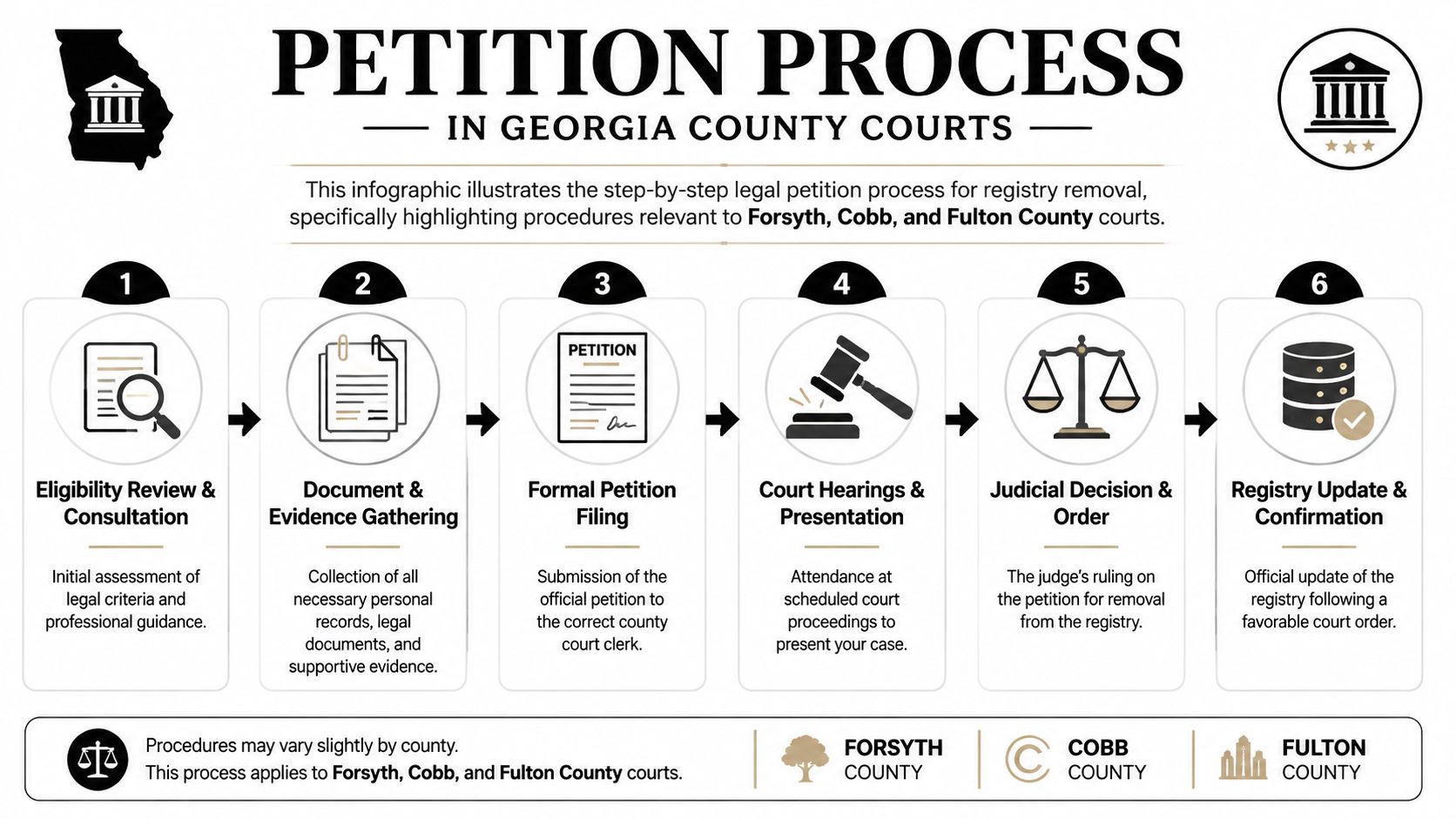
In Georgia, the filing usually goes to the Superior Court in the county tied to the conviction, not solely the county where the person lives now. That distinction matters in North Atlanta. A person living in Alpharetta may still need to file in Fulton County Superior Court. Someone now living in East Cobb may need to proceed in Cobb if that is where the case originated. For a Cumming resident with a Forsyth conviction, Forsyth County Superior Court is usually the starting point.
Local practice shapes the case more than many people expect. The statute sets the legal standard, but clerks, calendars, notice requirements, and hearing preferences differ from county to county. Fulton often requires more patience because of volume. Forsyth and Cobb may move faster, but speed does not help if the packet is incomplete or the agency notice is mishandled.
What the filing path usually looks like
A strong petition is built in order, with each step supported by records.
- Prepare the petition and supporting exhibits. The filing should match the statute, identify the qualifying basis for removal, and attach the documents the court will rely on.
- File in the correct Superior Court. Venue errors create delay and can force a refiling.
- Serve or provide notice to the required parties. Depending on the case, that can include the District Attorney, the sheriff, and agencies that maintain registry information.
- Address any response from the State. Some offices consent in appropriate cases. Others object, ask for more information, or want a hearing.
- Appear for a hearing if the judge sets one. Some judges decide on the papers. Others want testimony, clarification, or argument on the statutory requirements.
- Submit a proposed order if requested. Even after a favorable ruling, the order has to be specific enough for agencies to act on it.
Anyone filing in these courts should review Georgia Superior Court rules and filing expectations. The statewide rules do not answer every local question, but they help frame how pleadings, service, and hearings are handled.
How Forsyth, Cobb, and Fulton can differ in practice
Forsyth County cases often benefit from clean, organized filings. Judges and staff want to see the legal basis quickly, with certified records and a clear timeline. If the petition leaves gaps about dates, compliance, or the underlying disposition, the court may slow the case down until those gaps are fixed.
Cobb County practice often turns on preparation. If there is likely to be opposition, the petition should be filed with enough documentation to answer the obvious questions before the hearing is set. Treatment records, discharge paperwork, and proof of completed obligations matter more than broad character letters standing alone.
Fulton County requires extra attention to logistics. The volume is heavier, scheduling can take longer, and paperwork mistakes are more expensive because they can add weeks or months. In Fulton, I want the filing to be complete the first time, with service handled correctly and a record that does not invite avoidable continuances.
Common filing mistakes
The same errors show up again and again:
- Filing in the county of current residence instead of the county tied to the conviction
- Using a bare petition with little or no supporting documentation
- Assuming the clerk will explain notice requirements
- Waiting until the filing deadline mindset kicks in, then rushing a petition that needed weeks of preparation
- Treating the case like an administrative request instead of a contested court matter
Procedure matters in every kind of case. The same lesson appears in Essential steps for lawsuit notices. Court systems expect deadlines, service, and filing rules to be followed precisely, even when the person filing has a strong underlying position.
A petition for removal should read like a case prepared for a judge, not a letter asking for a break. In Forsyth, Cobb, and Fulton, that difference often decides whether the case moves cleanly toward a signed order or stalls in objections, reset hearings, and avoidable delay.
Building a Persuasive Case for Rehabilitation and Removal
A man in Alpharetta can be legally eligible to petition for removal and still lose because the file does not answer the judge's real question. The court wants proof that daily life now reflects stability, compliance, and reduced risk, not just a request for another chance.

In Forsyth, Cobb, and Fulton, I treat these petitions like evidence-driven court matters. A judge may never meet the petitioner outside a short hearing, so the written record has to do heavy lifting. If the packet is thin, inconsistent, or vague, the court is left with the old offense and very little else.
What a persuasive record looks like in a Georgia removal case
The strongest petitions usually show a clear pattern over time, not a last-minute collection of favorable statements. Useful proof often includes:
- Treatment completion records, discharge summaries, and letters from providers who can speak to attendance, progress, and ongoing compliance
- Employment records that show steady work, promotions, professional licenses, or consistent income
- Housing history that reflects lawful, stable residence and a structured living environment
- Proof that all financial obligations were satisfied, including restitution if it applied in the case
- Registry compliance records showing no reporting violations or lapses
- Detailed support letters from employers, pastors, counselors, mentors, or family members with firsthand knowledge of daily conduct
The difference is specificity. "He is a good person" carries little weight. "I have supervised him at work for four years, he is punctual, trusted with customer contact, and has had no disciplinary issues" gives the court something concrete to evaluate.
Judges look for consistency, not slogans
A persuasive case ties rehabilitation to documents, dates, and verifiable facts. That is especially true in North Atlanta courts, where judges and prosecutors have seen plenty of petitions built around general claims of personal growth. General claims rarely carry a close case.
I want the record to show how the person has lived since conviction: treatment completed, rules followed, work maintained, obligations paid, support systems established. If there was counseling after formal treatment ended, that can help. If the person changed jobs several times but remained steadily employed, that can still be presented well if the timeline is organized and honest.
Strong proof and weak proof are not the same
| Weak presentation | Strong presentation |
|---|---|
| “I have changed.” | A dated timeline supported by treatment, work, and compliance records |
| Generic character letters | Letters with concrete examples from people who know the petitioner well |
| Gaps in employment or residence with no explanation | A complete history with supporting documents and a direct explanation of gaps |
| Verbal claim that restitution was paid | Receipts, court records, or payment confirmations |
| One favorable fact highlighted repeatedly | Multiple records showing sustained stability over time |
Support letters deserve careful handling. In Fulton County, polished but generic letters often do less than one direct letter from a supervisor, therapist, or pastor who can explain specific observations. In Forsyth and Cobb, judges also tend to respond better to credible detail than volume. Ten letters that repeat the same broad praise are weaker than three that explain real contact and long-term observations.
Build the evidence file before the petition is filed
Good cases are built months before filing. Sometimes longer.
Keep every treatment document. Save employment records, tax documents, certificates, and proof of stable housing. Put payment confirmations in one folder. If a provider is willing to write a letter, ask early, because treatment professionals and employers often need time and may want to review the petition before signing anything.
That preparation matters because local practice matters. A petitioner in Cumming or Roswell may have strong facts, but if the documents are scattered or the timeline is unclear, the court sees disorder instead of rehabilitation. A clean file tells a better story and makes objections easier to answer.
For younger clients and families, record issues can overlap with juvenile court history, confidentiality concerns, and what remains visible years later. Anyone sorting through that part of the background should understand how juvenile records may be sealed in Georgia before deciding what material to include or address directly.
One final point. Do not hide bad facts that the court or prosecutor will find anyway. Explain them, document them where possible, and show what changed afterward. Credibility is part of rehabilitation, and in a registry removal case, credibility can decide the outcome.
Special Considerations for Juvenile Adjudications
When the underlying conduct happened in juvenile court, the analysis changes. Families in Milton, Johns Creek, and nearby communities often assume the adult rules apply automatically. They usually don't.
A juvenile adjudication raises different questions about confidentiality, long-term record access, and how rehabilitation should be framed. The court isn't just looking backward at the offense. It is also looking at age, maturity, development, family support, school history, treatment response, and the difference between adolescent conduct and adult risk.
Adult cases and juvenile cases are not the same
Here is the practical comparison:
| Adult conviction issues | Juvenile adjudication issues |
|---|---|
| Focus on statutory conviction language | Focus often includes delinquency findings and juvenile court history |
| Employment and housing stability can dominate | School record, family structure, and developmental progress may matter more |
| Court expects adult accountability record | Court may weigh age at offense and later maturation differently |
That difference matters when building the presentation. In an adult case, a petition often leans heavily on work history and long-term compliance. In a juvenile-related matter, the record may need to show how the person matured, responded to treatment, and moved beyond the conduct of adolescence.
What families should pay attention to
Several issues come up repeatedly in juvenile-related registry questions:
- Record access and sealing. Families often don't know what juvenile records remain available and what can still be used in later proceedings.
- Language from the original case. Juvenile dispositions are easy to misread if you're only relying on memory.
- Current age and life stage. A young adult who has since completed school, treatment, and other obligations may need a different evidentiary presentation than an older adult petitioner.
- Privacy concerns. Juvenile matters involve understandable concern about long-term stigma and future opportunities.
For broader background on juvenile confidentiality, this discussion of whether juvenile records are sealed in Georgia helps families understand the difference between sealed records and complete relief.
In juvenile-related cases, the most persuasive story is usually a documented growth story, not a purely legal argument.
Parents also tend to ask whether the same waiting periods apply in the same way they do in adult cases. The answer depends on the actual legal posture of the case, the registration basis, and the statutes tied to that disposition. That is why juvenile cases should be reviewed from the original court papers up, not from assumptions based on adult registry advice online.
The biggest mistake families make is waiting because they believe nothing can be done until much later. Sometimes waiting is necessary. Sometimes early legal review uncovers a more realistic path than the family expected.
Exploring Record Restriction and Future Legal Relief in 2026
A man in Alpharetta gets off the Georgia sex offender registry after years of compliance. He expects the practical fallout to end there. Then a job application, a rental screening, or a professional licensing review brings the old case back into view because registry removal and record relief are different parts of Georgia law.

That distinction causes real confusion in North Atlanta courts and clerk offices. In Forsyth, Cobb, and Fulton County, I regularly see people use "expungement," "record restriction," "pardon," and "de-listing" interchangeably. Georgia does not treat them interchangeably, and a mistake at the planning stage can waste time or create false expectations.
Registry removal addresses whether a person must continue registering. Record restriction addresses whether parts of a record remain publicly accessible when Georgia law permits restriction. "Expungement" is still common everyday language, but in Georgia, record restriction is usually the more accurate term. A pardon or other post-conviction remedy may help with some collateral consequences, yet it does not automatically end a registry obligation or erase the underlying record.
Those differences matter in ordinary ways. An employer may care about one database. A landlord may see another. A licensing board may ask broader questions than a background screening company. Relief in one area can help substantially without fixing every problem tied to the case.
The better approach for 2026 is to evaluate the case in layers. If registry removal is available, that may be the first filing. After that, the next question is whether any form of record restriction, pardon, or other post-conviction relief is realistically available under Georgia law and the facts of the case. Older misdemeanor cases, cases tied to youthful conduct, and cases with unusual sentencing histories often require that kind of step-by-step review.
Here is the practical framework I use with clients in Cumming, Marietta, Roswell, Johns Creek, and surrounding North Atlanta communities:
| Legal objective | Question to ask |
|---|---|
| Get off the registry | Am I eligible to petition under the current Georgia statute and my specific conviction history? |
| Limit public access to the case record | Does Georgia law allow record restriction for this charge and disposition? |
| Improve future background check results | Is there any post-conviction relief that changes how this case appears or is evaluated? |
County practice also matters. The statute is statewide, but the paperwork, timing, and presentation issues can look different in Forsyth, Cobb, and Fulton courts. A filing that is technically possible may still fail if it ignores the local record, the original accusation language, the sentencing documents, or the way the county expects the petition to be supported.
Relief often works cumulatively. One successful order can improve employment, housing, and daily privacy concerns, then make the next legal decision clearer.
If you are planning beyond registry removal, ask a more complete question. Ask what can be done now, what must wait, what is not available under Georgia law, and which filing gives you the strongest practical benefit first. That is how post-conviction strategy should be built in North Atlanta. Not around labels, but around outcomes.
If you need direct guidance on registry removal, record restriction, DUI charges, felony accusations, misdemeanor defense, or urgent court deadlines in Alpharetta, Roswell, Johns Creek, Milton, Cumming, Marietta, and across North Atlanta, Brian Hansford Law can help you assess the facts, identify your legal options, and act quickly. The firm handles high-stakes criminal defense matters with local court knowledge, responsive communication, and practical strategy built around protecting your future.
