
Getting an old arrest record expunged is all about limiting public access, making it incredibly difficult for employers, landlords, and the general public to see. The process usually involves figuring out if you’re eligible under your state’s laws, filing a formal petition with the right court, and then waiting for a judge’s approval. When done right, this process can keep a past mistake from shadowing your future opportunities.
What Record Expungement Actually Means

When people discuss “expungement,” they often picture a magic eraser wiping a mistake from history. It’s a nice thought, but the reality is a bit more technical. Expungement is really about restricting public access to an arrest record, which effectively hides it from most standard background checks.
Think of it less like deleting a file and more like locking it away in a secure vault that almost no one has the key to. Once a record is expunged, it’s no longer visible to potential employers, landlords, or your nosy neighbor. For someone whose charges were dropped years ago but still has that arrest pop up on a background check, this process can be a genuine fresh start.
The Real-World Impact on Your Life
The biggest win from expungement is how it clears a path for your day-to-day life. An old arrest record—even for a minor issue or a dismissed charge—can throw up some serious roadblocks. It might be the reason someone didn’t get a job, was denied an apartment, or can’t even volunteer at their kid’s school.
By locking that record away, expungement helps make sure one past event doesn’t define an entire future. This is especially critical for non-conviction records—those arrests that never led to a guilty verdict but still linger in public databases. You can dive deeper into the specifics and learn how to seal criminal records in our detailed guide.
An expunged record isn’t about hiding the past; it’s about reclaiming your future. The goal is to prevent a single event from permanently limiting your access to housing, employment, and personal growth.
Understanding the Scope and Limitations
While the benefits are huge, the availability and effectiveness of expungement can vary wildly from state to state. The good news is that more than two-thirds of U.S. states now have some form of criminal record clearance.
As of 2024, most states offer ways to clear non-conviction records, and 46 states provide some kind of relief for many misdemeanors. Here’s the catch: the actual number of people taking advantage of this is shockingly low. One study found that less than 10% of Americans who qualify for expungement actually get their records cleared. This shows a massive gap between who is eligible and who actually gets relief, which is why it’s so important to understand the specific process right where you live.
Understanding Your Eligibility for Expungement
Figuring out if you even qualify for expungement is the first major hurdle. The rules can feel like they’re written in a different language from one state to the next, but the entire journey of getting your arrest record cleared starts right here.
Before diving into the deep end, it’s a good idea to get a handle on the common factors that influence eligibility. Think of this as learning the right questions to ask when you start looking into your state’s specific guidelines. This knowledge will put you in a much better position to understand where you stand.
Core Factors That Shape Eligibility
Most states look at a similar set of criteria when deciding who can clear their record. While the details will absolutely vary, the core principles usually come down to a few key areas. Getting familiar with these will make it much easier to interpret the specific rules in places like Forsyth County or Cobb County, Georgia.
These factors almost always include:
- The Type of Offense: There’s a world of difference between a misdemeanor and a felony. Less serious charges, like a minor shoplifting case, often have a much clearer path to expungement than more severe crimes.
- The Case Outcome: What happened in court is absolutely critical. Was your case dismissed? Were you acquitted? Or did you end up with a conviction? A record that didn’t result in a conviction is almost always easier to deal with.
- The Passage of Time: You can’t just file for expungement the day after your case closes. Most states impose a waiting period, which could be two, five, or even ten years, depending on the charge and the outcome.
To see how this plays out, just imagine two different people in Alpharetta. One person had a disorderly conduct charge dismissed five years ago. The other was convicted of a DUI two years ago. Their eligibility is going to be wildly different based on these three factors.
DUI cases, for example, have their own unique set of challenges. We break down some of those specifics in our guide on whether you can get a DUI off your record.
Understanding your eligibility isn’t about finding a loophole. It’s about seeing if the system has created a pathway for your specific situation. Every single detail—from the original charge to the final court decision—matters.
To give you a clearer picture, this table breaks down the key factors that states typically consider when evaluating an expungement request.
Common Factors Influencing Expungement Eligibility
This table outlines key factors that typically determine if an arrest or conviction record can be expunged, helping you understand what to look for in your state’s laws.
| Eligibility Factor | What It Means | Common Example |
|---|---|---|
| Nature of the Offense | States distinguish between violent/non-violent and felony/misdemeanor crimes. | A first-time, non-violent misdemeanor (like shoplifting) is more likely to be eligible than a violent felony. |
| Final Disposition | The outcome of your case is crucial. Was it dismissed, were you acquitted, or were you convicted? | An arrest that resulted in a dismissal or acquittal has a much higher chance of being expunged than a conviction. |
| Waiting Period | A mandatory period of time must pass after the case is closed before you can file. | Georgia might require a 4-year waiting period for certain misdemeanors, while another state could require 7 years. |
| Prior Criminal History | Having other convictions on your record can disqualify you, even if the current offense is eligible. | A single conviction might be expungeable, but a pattern of offenses often makes you ineligible. |
| Pending Charges | You typically cannot have any active criminal cases or be on probation when you apply. | If you have a pending DUI case, you likely cannot expunge an old, unrelated charge until the new case is resolved. |
Reviewing these factors will help you get a sense of what to look for as you begin researching the laws specific to your situation.
When Convictions Complicate Things
Getting a conviction expunged is a much higher bar to clear than an arrest that didn’t lead to one. States are very protective of conviction records.
Many jurisdictions have strict, non-negotiable rules about which convictions are eligible. Some violent felonies or offenses involving vulnerable people might be permanently excluded from ever being sealed or expunged.
For instance, a state might allow someone to expunge a single, non-violent misdemeanor conviction after a seven-year waiting period, but only if they’ve kept a completely clean record since. A second conviction, or any felony, could disqualify them entirely. This is why the original outcome of your case is so critical—a dismissed charge puts you in a much stronger starting position.
Navigating the Expungement Petition Process
Filing a petition to expunge an arrest record isn’t a single event—it’s more like navigating a complicated maze of administrative rules. The real work begins long before ever stepping foot in a courthouse. It starts with careful preparation and gathering all the necessary documents.
The first, and often trickiest, part of this journey is getting your hands on official, certified copies of your criminal record from the right agencies. Once those are tracked down, the next step is to find the correct, state-specific petition forms. Every jurisdiction has its own paperwork, and using an outdated or wrong form is a common mistake that can bring everything to a grinding halt.
From there, you’ll file the completed petition with the court where the original charge was handled.
To give you a better idea of how it works, this infographic breaks down the core elements that determine if you’re even eligible to file in the first place.
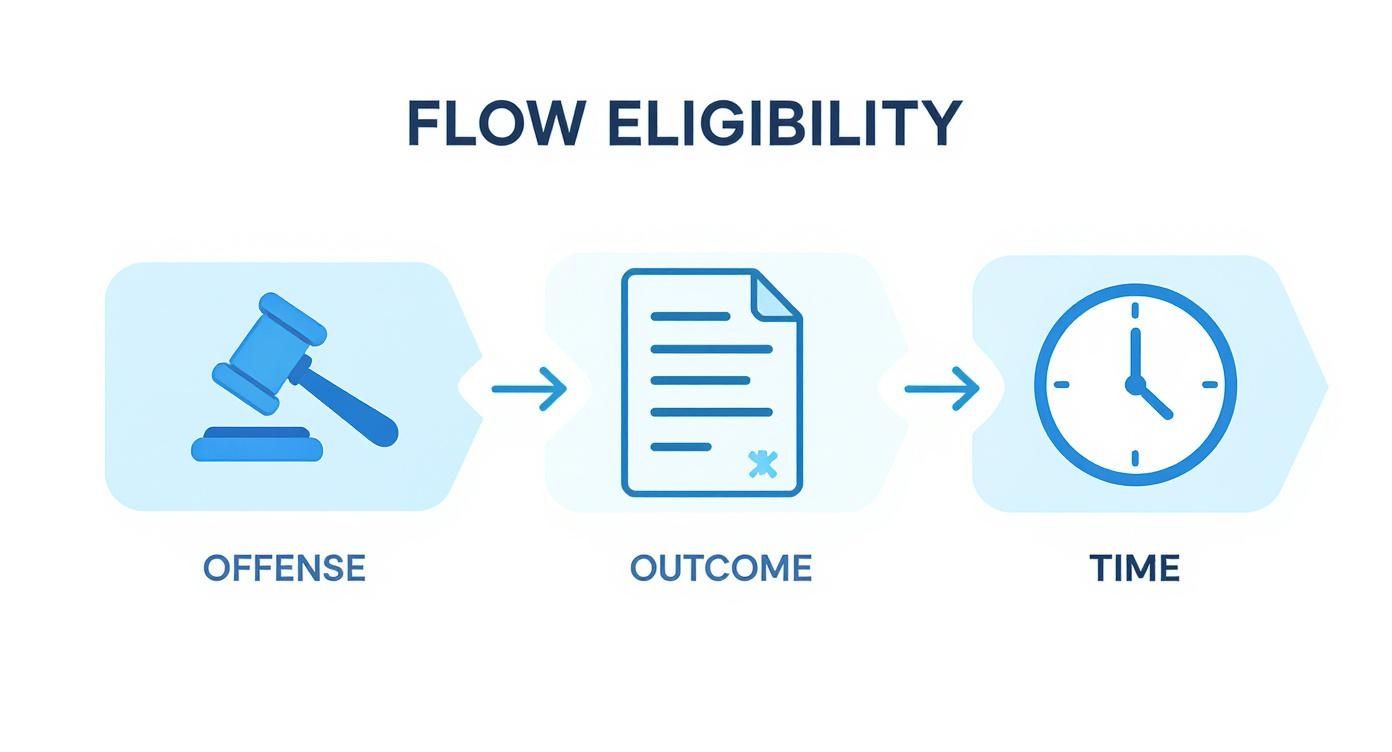
As you can see, the type of offense, the final outcome of your case, and how much time has passed are the three pillars of the entire petition process. It’s critical to understand where you stand on these three points before you even think about filling out any forms.
Common Roadblocks in the Petition Journey
Let’s walk through a real-world scenario. Imagine someone in Roswell, Georgia, wants to clear a decade-old misdemeanor arrest that was ultimately dismissed. Even in a case that seems straightforward, they are likely to hit a few snags.
- Filing Fees: Courts charge fees to process these petitions, and the cost can vary quite a bit from one jurisdiction to another.
- Serving Notice: They will also have to properly “serve” notice to the prosecutor’s office, which is a formal way of notifying them about the petition. If this isn’t done correctly, it can lead to an immediate denial.
The single most critical part of this process is an obsessive attention to detail. One missed signature, an incorrect case number, or a forgotten date can cause major delays or force you to start over from square one. Meticulous organization is your best friend.
Triple-checking every detail on every single form isn’t just a good idea—it’s essential. The system isn’t designed to forgive small errors. A simple mistake can be seen as an attempt to mislead the court, even if it was just an honest oversight.
The Importance of Proper Filing and Follow-Up
Once the petition is submitted, the work is not done. There will likely be a waiting period while the prosecutor’s office reviews the request and decides if they want to object. If they do file an objection, a court hearing might be scheduled where a judge will have the final say.
This whole multi-step procedure is exactly why so many people choose to get professional guidance. The forms, the deadlines, and all the procedural rules can feel overwhelming. For anyone who feels the process is just too complex to manage alone, understanding how to find a good criminal lawyer is a smart next step. An experienced attorney can make sure every single requirement is met, the first time.
Ultimately, getting through the expungement petition process successfully requires patience and precision. By understanding the flow, preparing for common obstacles, and ensuring every piece of paperwork is perfect, you give yourself the best shot at a successful outcome and taking that meaningful step toward a clear record.
How Clean Slate Laws Are Automating Relief
What if you could get your arrest record expunged without ever filing a single piece of paper? It sounds too good to be true, but that’s the groundbreaking idea behind “Clean Slate” laws.
This modern approach to record clearing is designed to automatically clear eligible records after a certain amount of time has passed. It completely removes the complex, often confusing, petition process for millions of people who just need a fresh start.
This automation is a huge shift from the traditional system, which puts the entire burden on the individual. The reality is, many people don’t even know they qualify for expungement. Others simply can’t find the time or money to navigate the administrative maze. Clean Slate initiatives are designed to bridge this massive “second chance gap.”
The Move Toward Automatic Expungement
Since 2018, a wave of these laws has swept through several states, aiming to fix the widespread underuse of record clearance.
States like California, Pennsylvania, Utah, and Virginia have passed laws to automatically clear a broad range of criminal records after a set period. This move gets rid of the burdensome petition process and dramatically increases the number of people who actually get the relief they are legally entitled to. You can dive deeper into how these policies are modernizing the justice system and learn about the impact of these changes on the national level.
This shift acknowledges a simple truth: when the process is difficult, most eligible people never see the benefits. By making relief automatic, states ensure that a past mistake doesn’t create a lifelong barrier to getting a good job or a safe place to live.
The goal of Clean Slate is simple: if someone is eligible for relief, they should receive it. Automation makes that goal a reality by removing the barriers of cost, time, and complexity that stop so many people from moving forward.
For people living in states with these laws, this means relief could already be on its way—without them having to do anything at all.
What This Means for You
If you live in a state with Clean Slate legislation, the process for clearing your record might already be happening behind the scenes. The specifics of these laws vary quite a bit from state to state, so it’s still important to understand what types of records are covered and the timelines involved where you live.
- Eligibility is Automatic: The system itself identifies records that meet the criteria for automatic expungement.
- No Petition Required: For covered offenses, you don’t have to initiate the process, pay filing fees, or show up for a hearing.
- Timelines Still Apply: There are still waiting periods, often several years, before a record is automatically cleared.
While Georgia has not yet adopted a comprehensive automatic expungement law like some other states, the national trend offers a hopeful look at the future of justice reform. It shows a growing understanding that helping people move past their records isn’t just good for them—it’s good for everyone.
What to Expect After Your Record Is Cleared

Holding a signed court order for your expungement is a huge win. It’s a moment of relief, but it’s crucial to understand that this is the beginning of the final phase, not the absolute end of the process. Your public record doesn’t just vanish overnight.
Think of that court order as a directive that now has to make its way through a bureaucratic maze. It gets sent out to be processed by various state and local agencies—from the clerk of court to the law enforcement department that made the arrest. This administrative legwork simply takes time.
The Digital Ghost of Your Record
One of the most common frustrations people experience is when an old charge still shows up online, sometimes weeks or even months after a successful expungement. This is what can be called the “digital ghost” of a criminal record.
Private background check companies and data brokers constantly scrape public records and store that information in their own massive databases. The problem is, they don’t get real-time updates from the courts. So, an officially expunged record can continue to haunt you in their outdated systems.
An expungement order legally clears your name at the government level. It does not, however, automatically scrub the internet of old information held by private companies. You may have to take proactive steps to make sure these third-party databases get the memo.
Taking Control of Your Online Footprint
If you run a background check on yourself and discover that it’s showing incorrect information, don’t panic. The good news is you now have the official documentation to fight back.
You can—and should—directly contact the company reporting the outdated data. Provide them with a copy of your expungement order, which serves as formal notice that their information is inaccurate and must be removed under the Fair Credit Reporting Act. Being persistent here is the key to finally clearing your name everywhere.
The Long-Term Positive Impact
Once you get past the administrative cleanup, the positive impact of a cleared record is life-changing. Doors to better job prospects, housing opportunities, and educational programs finally swing back open. This isn’t just wishful thinking; it’s backed by solid research.
A detailed study from Michigan shows just how powerful a second chance can be. The research found that the risk of reoffending among people who received an expungement was incredibly low. In fact, within five years, only 2.7% were rearrested for a felony, with even lower rates for minor offenses. You can read the full research about the power of a clean slate and see the data for yourself.
What this tells us is that once people are freed from the barriers of an old record, they are statistically less likely to reoffend than even the general adult population. Learning how to get your arrest record expunged is more than just a legal task; it’s a proven path toward stability and a genuinely fresh start.
Common Questions About Record Restriction
Even with a good grasp of the basics, specific questions always seem to come up during the record restriction process. The legal system has a lot of nuances, so it’s normal to feel a bit lost. Here are some of the most common questions people have when learning how to get an arrest off their record.
What’s the Difference Between Sealing and Expunging a Record?
People use these terms all the time, often interchangeably, but there’s a real legal distinction between them.
Expunging a record usually means the record is physically destroyed or completely erased from the system. On the other hand, sealing a record just hides it from public view. It still exists and can be accessed by certain government or law enforcement agencies.
For most day-to-day situations, like applying for a job in Milton or an apartment in Marietta, the outcome is pretty much the same. The important thing is that both sealing and expungement are designed to limit public access to your record, which is exactly what you need for a fresh start.
Will an Expunged Arrest Still Show Up on a Background Check?
Once the court has approved your petition and all the agencies have updated their files, an expunged record should not appear on a standard background check. This is the kind of check most employers and landlords run.
The frustrating part? There can be a delay. Private data companies and online databases don’t always update their systems right away. It’s also worth noting that very sensitive positions—think law enforcement or jobs requiring a high-level security clearance—involve much deeper background checks. In those rare cases, even sealed or expunged records might still be visible to specific government entities.
How Long Does the Expungement Process Take?
There’s no single answer to this one; the timeline can vary quite a bit. How long it takes depends heavily on a few factors:
- The State and County: Court dockets move at different speeds. Forsyth County might process things faster or slower than Cobb County.
- The Complexity of Your Case: A straightforward dismissal will almost always move quicker than a case with more complicated legal issues.
- Prosecutor Review: After you file, the prosecutor’s office has a period to review your petition and decide if they want to object.
From the day the first piece of paper is filed to the day that final court order is in hand, the whole process can take anywhere from a few months to over a year. It’s a journey with multiple administrative steps and agency processing times that are, frankly, out of your control.
Navigating the complexities of record restriction in Georgia requires careful attention to detail. If you are facing this challenge in Alpharetta, Roswell, or the surrounding areas, Brian Hansford Law is here to help. With over 25 years of experience, including time as a former prosecutor, Brian Hansford has the knowledge to guide you. Protect your future by visiting https://challengemycharge.com to schedule a consultation.
