
When you’re staring at negative search results linked to a DUI or criminal charge from somewhere in North Atlanta, it’s easy to feel powerless. The quickest path to getting that negative information off the internet is a multi-step approach: use legal avenues to seal records, make direct requests to websites and search engines, and build up positive content to push down anything that won’t budge.
This isn’t a one-and-done fix; it’s an ongoing campaign. But it’s a campaign you can win, and when your career and freedom are on the line, you need to act fast.
The Reality of Cleaning Up Your Digital Past
Seeing your own mugshot or an article detailing a past mistake can jeopardize everything—your career, your ability to rent a home, and even your personal relationships. Whether you were arrested for a DUI in Cumming, faced a misdemeanor drug charge in Roswell, or dealt with a reckless driving charge in Alpharetta, that digital footprint can feel like a life sentence.
This guide is our battle-tested playbook, designed specifically for North Atlanta residents who need to take back their online reputation when the stakes are high. If you need immediate help from a DUI lawyer in Alpharetta or a criminal defense attorney in Sandy Springs, this is your starting point.
We will break down three core strategies:
- Using Georgia's legal system to get criminal records restricted, or "sealed," from public view. This is crucial if you need to pass a background check.
- Executing technical takedowns by demanding websites and search engines de-index harmful content.
- Building a positive online presence through reputation-SEO to bury anything that can’t be removed entirely.
Setting Realistic Expectations for a Clean Slate
Before we get into the tactics, you have to understand that this is a process. The internet has a long memory. Removing a verifiably false statement is one thing; getting rid of a factually accurate (but damaging) news story about an old arrest is another battle entirely. If you're wondering how to get a DUI off your record, the answer starts with the court, not Google.
The problem is made worse by data brokers and "people-search" sites that constantly scrape and republish public records. A Consumer Reports study confirmed what we see in practice: services that promise to remove your data often fall short. They found that manually opting out is more effective, but the information almost always creeps back online. This requires constant vigilance, not a one-time scrub.
The best approach combines legal action with persistent technical follow-up. For example, an arrest for reckless driving in Forsyth County might be eligible for record restriction. That court order gives you the legal leverage you need to force a mugshot site to take down the content. Without it, your takedown requests are easy to ignore. A reckless driving lawyer can initiate this process.
To give you a clearer picture, this table outlines the three main strategies you'll use to manage what appears about you online.
Strategy Overview for Removing Negative Information
| Strategy | Primary Goal | Best For | General Timeline |
|---|---|---|---|
| Legal Remedies | Create a legal basis for removal by sealing or restricting the underlying public record. | DUI arrests, drug charges, misdemeanor & felony arrests eligible for Georgia's record restriction. Essential for clearing background checks. | 3-12 months, depending on the court and complexity. A local DUI attorney can navigate this faster. |
| Technical Takedowns | Directly remove content from websites, search engines, and data brokers. | Copyright violations (DMCA), policy violations (revenge porn, harassment), and content related to restricted records. | 1-6 weeks per request, but can be ongoing as new content appears. |
| Reputation-SEO | Suppress negative results by creating and promoting positive or neutral content. | Negative news articles, unflattering reviews, or any damaging content that cannot be legally removed. | 6+ months to see significant changes in search results; requires sustained effort. |
Each strategy serves a different purpose, but they work best when used together. Legal action often creates the foundation needed for successful technical removals. For urgent help, especially if facing a court date in Fulton County or Gwinnett County, contacting an attorney for a free consultation is the first step.
A Three-Part Battle Plan for Your Reputation
A successful campaign must be multi-faceted, hitting the legal, technical, and public-facing angles of your digital presence. This visual breaks down the core components of how we approach these cases.
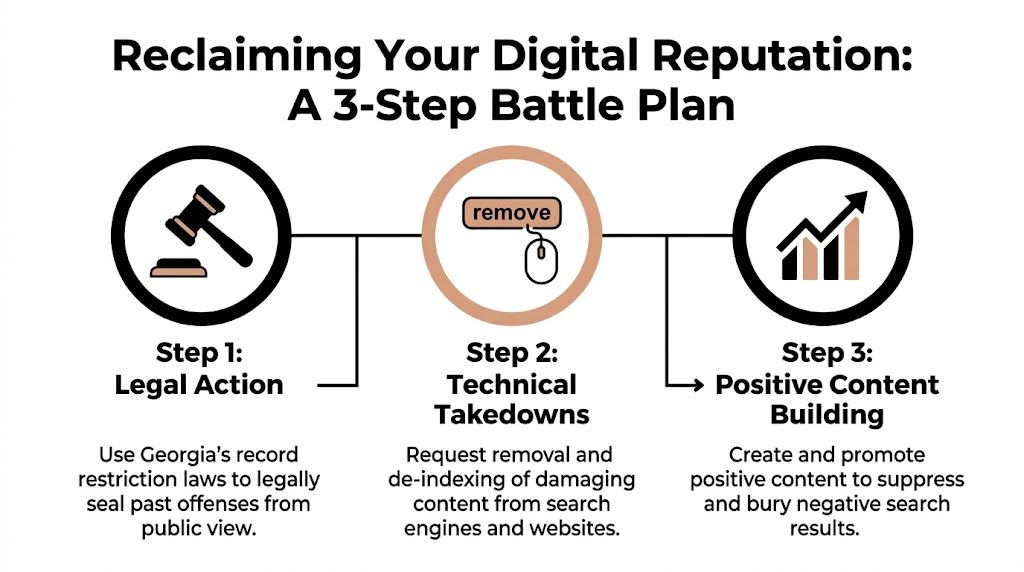
As the process shows, legal action is often the powerful first move that makes the other two possible. For a deeper dive into the specifics of building and maintaining a clean online profile, this complete online reputation management guide offers more detail on these strategies.
Whether you're up against a court deadline in Marietta or trying to keep a DUI from destroying your professional license, this guide will give you the actionable steps to fight back. We'll begin with your most powerful weapon: Georgia's record restriction laws.
Restricting Your Georgia Record: The First Step to a Clean Slate Online
When something from your past shows up online, the battle to get it removed usually starts in a courthouse, not with a computer. For those of us in North Atlanta, Georgia’s record restriction law (O.C.G.A. § 35-3-37) is the single most effective weapon we have to erase the legal source of that negative content. An experienced criminal defense attorney can determine if you're eligible.
This process, which many still call "expungement," seals your official criminal record from the public. It doesn’t disappear, but it becomes a non-public matter.
Think about a young professional in Roswell whose career is being held back by an old misdemeanor drug charge, even though the case was ultimately dismissed. Or a parent in Marietta who’s worried a past DUI arrest—later knocked down to reckless driving—will keep them from volunteering at their kid's school. This is a common concern for clients in Cobb County and Cherokee County.
For both, restricting the record is the essential first move. Once a record is officially restricted, you have the legal high ground. You can then demand that mugshot websites and old news articles take down the content because it no longer reflects a public record. A drug possession lawyer can manage this entire process for you.
Do I Qualify for Record Restriction in Georgia?
This is where things get tricky and where most people hit a wall. Whether you're eligible depends entirely on how your case was resolved. A misdemeanor defense attorney in Alpharetta can give you the specifics for your situation, but you're generally in a good position if your case ended in one of these ways:
- Case Dismissal or Nolle Prosequi: If the prosecutor dropped the charges, the arrest is almost always eligible for restriction. We see this a lot with everything from shoplifting to drug possession cases in Fulton and Gwinnett Counties.
- Completion of a Diversion Program: If you finished a pre-trial diversion or conditional discharge program for a first-time offense, your record should be eligible for restriction. This is a common outcome a DUI lawyer fights for.
- Acquittal at Trial: If a judge or jury found you "not guilty," you have a right to get that arrest record restricted.
- Conviction of Unrelated Charges: If you were arrested on a list of charges but only convicted of some of them, the charges you weren't convicted of can be restricted.
A scenario we handle all the time is a DUI arrest in Sandy Springs that, through negotiation, gets reduced to a reckless driving charge. While the reckless driving conviction will stay on your record, we can restrict the original DUI arrest. That’s a huge win for your online reputation and any background checks. This is a key strategy for any DUI attorney in Fulton County.
What About Restricting a Misdemeanor Conviction?
Thanks to Georgia's "Second Chance" law, you can now restrict up to two misdemeanor convictions, but the rules are strict. This has been a true game-changer for people haunted by mistakes they made years ago.
To qualify for this, you must:
- Wait four years after your sentence is fully completed (that includes probation).
- Have no new arrests or convictions during that four-year waiting period.
- Have no other convictions since the two misdemeanors you want to restrict.
Some serious misdemeanors, like those involving violence or sexual offenses, are not eligible. A speeding ticket lawyer in Roswell can tell you if a traffic offense qualifies, but this law was really designed to help with non-traffic misdemeanors that block people from getting jobs and housing.

Why You Need a Local Attorney for This
The law might sound simple, but the process is anything but. Every single courthouse, from Forsyth County in Cumming to Cobb County in Marietta, has its own filing procedures, specific forms, and unwritten rules. One small mistake on your petition can cause months of delays or even get it denied, leaving that damaging information online for that much longer.
An experienced criminal defense lawyer near me knows these local quirks. They know which forms the clerk actually wants, how to phrase the petition to get a judge's approval, and how to chase down the arresting agency to make sure the restriction is actually processed. A felony defense lawyer is especially vital if your case started with felony charges that were later dismissed or reduced.
If you’re wondering how to start, our guide on how to clear your criminal background in Georgia offers a more detailed breakdown. This is the foundation of your entire effort to clean up your name online. Without restricting the official record, asking websites to remove content is just a polite request. With a court order, it’s a demand they can't ignore.
Getting Your Past Off the Internet: Takedowns and De-Indexing
Once your Georgia criminal record is restricted, you might think the fight is over. But often, the court's decision is only the first step. The next challenge is the internet itself, where old news stories, embarrassing posts, and predatory mugshot websites can linger forever.
Even when a judge in Forsyth County seals your case, that doesn't automatically erase what’s online. To truly move forward, you have to go to the source—the websites and search engines—and get that damaging content removed or, at the very least, buried. This is a critical step in how to fight a DUI in Georgia long after the court case is over.
This process is often called de-indexing. While the information might technically still exist on some obscure webpage, de-indexing makes it invisible to a Google search. For most people, if it doesn't show up on Google, it doesn't exist.
Using Google’s Own Tools to Hide Negative Results
When a website owner won't cooperate, your best move is often to cut them out of the equation and go straight to the search engine. Google, Bing, and DuckDuckGo all have tools that allow you to request the removal of a webpage from their search results.
For Google, you can click the three little dots next to a search result and hit 'Remove result.' From there, you'll need to explain why it should be removed.
Google is most likely to approve your request if the content involves:
- Nonconsensual explicit images
- Exposed financial or medical records
- "Doxxing" content that shares your home address or phone number maliciously
- Content that a court has ordered removed
That last point is critical. Let's say a local news site published a story about your arrest in Johns Creek. Even after the charges were dismissed and restricted, the article is still the first thing people see when they search your name. By submitting a copy of the court's restriction order to Google, you provide undeniable proof that the matter is no longer public. This drastically improves your odds of getting the link de-indexed. A DUI lawyer in Johns Creek can provide this documentation.
Dealing With Mugshot Websites and Extortion Scams
Unfortunately, not every website operator plays by the rules. Predatory mugshot websites are notorious for this—they post your booking photo and then ignore takedown requests, hoping you'll get desperate enough to pay their outrageous "removal fees."
What they might not tell you is that this practice can be illegal in Georgia. Under O.C.G.A. § 16-9-93.1, it's a crime for someone to demand money to remove a mugshot from their website. If a site owner tries to extort you, the law is on your side.
In my experience, a strongly worded letter from a criminal defense lawyer who understands Georgia's specific laws is often all it takes. An attorney in Alpharetta or Marietta citing the exact statute sends a clear message: you know your rights and are ready to take legal action. This is infinitely more effective than an email from you or me.
DMCA Notices and Platform Policy Violations
Sometimes the problem isn't a mugshot but a personal photo or video being used to harass you. If you own the copyright to an image—which you almost always do if you're the one who took the picture—you can file a Digital Millennium Copyright Act (DMCA) takedown notice.
You can send a DMCA notice to the website's hosting provider or directly to a search engine like Google. This legal notice forces them to take down the infringing content or face potential liability. It's a powerful way to fight back against an ex-partner or anyone using your photos without permission.
For harassment or defamatory comments on platforms like Facebook or Twitter, your first move should be reporting the content for violating the platform's terms of service. Be meticulous. Take screenshots, save links, and document everything before submitting a detailed report. While it doesn't have the same legal weight as a court order, platforms are often quick to act when a violation is clear-cut.
Knowing which battles to fight yourself is key. If you're dealing with a simple policy violation, you can likely handle it. But if you’re up against a stubborn website demanding money or need to prove a public record is no longer public, you need a DUI attorney in Roswell or a misdemeanor defense lawyer in Milton on your side.
If you’re just starting this process and need help tracking down these records, our guide on how to find arrest records in Georgia is an excellent place to begin.
Building a Positive Online Reputation to Suppress Negatives
Sometimes the best defense isn’t getting something removed—it’s burying it. When legal or technical removals aren't an option, the long-term strategy is to take control of your own narrative online. This is often called reputation-SEO or suppression.
The goal is to create a portfolio of high-quality, professional content that you control. This new, authoritative content will eventually outrank and push negative information off the first page of Google, where over 90% of users never look. This is how you take back your story after a charge like a DUI or reckless driving in North Atlanta.
How to Build Your Positive Online Presence
Think of this process as building a digital firewall around your name. You need to own the top search results. The foundation rests on creating and optimizing professional platforms that showcase your character and expertise, not a past mistake.
I've seen this work for clients. For example, a real estate agent in Johns Creek who once faced a speeding ticket charge that kept popping up in searches. By consistently publishing articles on local housing trends in Forsyth County or their community work in Milton, they built a powerful portfolio of positive content. Over time, that new content pushed the old traffic ticket deep into the search results, making it practically invisible. A speeding ticket lawyer can help resolve the underlying ticket to prevent points and insurance hikes.
Your first steps should be:
- A Professional LinkedIn Profile: Maximize it. Use a professional headshot, write a detailed career summary, and actively connect with others in your field. LinkedIn profiles almost always rank high on Google for name searches.
- A Personal Website or Blog: This is your most powerful tool. A simple, professionally designed website with your name as the domain (e.g., JohnDoe.com) sends a direct signal to Google that this is the authoritative source for information about you.
- Secured Positive Mentions: Contribute guest articles to reputable local blogs, get quoted in industry publications, or have your professional achievements featured on your company’s website. Every mention on a trusted site builds your authority.
An important part of managing your online image is knowing how to respond to negative Google reviews and protect your reputation. While this guide is about creating proactive content, handling criticism is just as crucial.
The Power of Consistent, Positive Content
This isn't a one-and-done task. To successfully bury negative information, you have to consistently create and promote new content. This is where many people fall short—they create a profile and expect it to do all the work. Search engines reward fresh content and authority.
This proactive approach is proven. Suppression techniques can reduce the visibility of damaging content by up to 70-80% in search results within 6 to 12 months when combined with other removal efforts.

Think of a DUI lawyer in Marietta who starts a blog about changes in Georgia traffic law. By providing genuine value, they not only help potential clients but also create a library of content that solidifies their professional reputation. This makes any old, negative search result irrelevant.
This strategy is also critical for understanding what information might be visible about you in the first place. You can learn more about if background checks will show your arrest records in our detailed guide.
This process takes patience and commitment. However, it's the most reliable way to build a lasting, positive online reputation that can withstand the damage from a past arrest or charge. It puts you in the driver’s seat.
When You Need a North Atlanta Defense Attorney
Trying to handle things yourself with privacy settings or polite takedown requests is a decent first step, but those tactics often hit a wall. It's critical to know when to stop and bring in a professional. If you're tangled up in Georgia’s record restriction laws, getting shaken down by a mugshot website, or facing a tight court deadline in Marietta, the time for DIY is over.
When a past mistake is actively costing you your future, a lawyer isn't optional. This is when you're being denied jobs, rejected for housing in Alpharetta, or at risk of losing a professional license because of a background check. These are no longer just online reputation issues; they are legal and financial emergencies that need a real legal strategy from a DUI lawyer near me.
Navigating the Local Court Maze
Every courthouse in North Atlanta operates on its own set of unwritten rules. The clerks in Fulton County State Court have different filing preferences than those in Forsyth County Superior Court. A form that works perfectly in Roswell might get bounced for a small technicality in Cumming. This is exactly where local experience pays off.
An attorney who has spent years in these specific courtrooms brings a huge advantage. A DUI lawyer in Johns Creek who already knows the prosecutors or a reckless driving lawyer in Sandy Springs who understands how a particular judge thinks doesn't have to learn the system—they're already a part of it.
This insider knowledge is vital in high-stakes situations like these:
- Urgent Court Deadlines: If you miss a deadline to appeal a license suspension or file a record restriction petition, the consequences can be permanent. A license suspension lawyer makes sure every document is filed correctly and on time.
- Negotiating with Prosecutors: An attorney with established relationships can often negotiate far better outcomes, like getting a DUI charge reduced to a less serious offense that won't cause as much damage online. This is key to how to fight a traffic ticket or a more serious charge.
- Complex Legal Filings: Record restriction petitions are precise legal documents. One mistake, like checking the wrong box, can cause months of delays and leave negative information online even longer.
The Power of a Former Prosecutor's Perspective
Brian Hansford's background as both a former prosecutor and a veteran criminal defense attorney gives him a unique strategic edge. Because he’s been on the other side of the courtroom in North Atlanta, he knows exactly how the prosecution builds its cases, what evidence they focus on, and where their arguments are most vulnerable.
This dual perspective is more than just experience; it's a tactical advantage. It allows us to anticipate the prosecution's moves and build a defense designed not just to win in court, but to protect your future reputation from day one.
When a drug possession lawyer can predict the arguments coming your way, they can craft a defense that minimizes the public record from the very beginning. This isn't just about cleaning up the past—it's about stopping future online damage before it ever starts. A great defense attorney doesn't just react to charges; they proactively manage your public story.
When You Need Help Now
If you are facing a criminal charge, every single decision you make matters. A felony defense lawyer or a misdemeanor defense attorney does more than just represent you in court; they act as your shield against the long-term fallout of a public legal battle.
Whether you need a traffic ticket attorney in Milton to keep points off your license or an experienced DUI attorney in Gwinnett County to fight for your freedom, the right lawyer understands more than just the law. They know the local courts, they know the people involved, and they have a plan to protect your name both in the courthouse and online. Your reputation is far too important to leave to chance.
Frequently Asked Questions About Online Reputation Repair
When you're trying to clean up your online reputation, a lot of questions come up. We get it. Here are the answers to the ones we hear most often from our clients all across North Atlanta.
How Long Does It Take to Remove Negative Information From the Internet
Honestly, there's no single answer. The timeline can vary dramatically.
A simple, direct request to Google to de-index a single link might get processed in a few days or a couple of weeks. But if we're talking about a formal legal process, like getting a criminal record restricted here in Georgia, you need to be prepared for a journey of several months. The cost of a DUI lawyer often includes managing this lengthy process.
And then there's reputation suppression—the process of actively burying negative search results. This is a long-term project. You’ll typically need 6-12 months of consistent work to see a real shift in the rankings. There’s no magic button here. Success is built on a patient, multi-front strategy.
Can a Lawyer Force a Website to Remove My Mugshot in Georgia
In most cases, the direct answer is no. A mugshot from a lawful arrest is considered a public record, and publishing it is protected by the First Amendment. However, a lawyer becomes absolutely critical in two specific situations.
- If a site demands payment for removal, they could be breaking Georgia law (O.C.G.A. § 16-9-93.1). An experienced criminal defense attorney in Alpharetta can draft a cease and desist letter referencing this specific statute. That alone often gets the mugshot taken down immediately.
- Once your criminal record is officially restricted, the information is no longer public. This is the real game-changer. Your lawyer can then use that court order as legal leverage, demanding that websites remove the outdated content.
What Is the Difference Between Record Restriction and Google Removal
This is a critical distinction that many people miss. They are two completely different tools that, when used together, create a powerful solution.
Record restriction is a legal process that happens in a Georgia courtroom. It seals your official criminal record, preventing it from showing up on the vast majority of employment background checks. This is the most effective way to get a ticket dismissed or a charge sealed from public view.
Google removal, or de-indexing, is a technical request. It simply asks Google to hide a specific webpage from its search results. The page still exists on the original website; it's just much harder for anyone to find.
The most effective strategy always combines both. First, you work with a DUI lawyer in Cumming to legally restrict the arrest record. Then, you leverage that official court order as proof to compel Google and other sites to remove the associated news articles or mugshot pages for good.
Should I Try This Myself or Hire a Professional
For some very basic tasks, a DIY approach is fine. Updating your social media privacy settings or flagging a review that's clearly false are things you can certainly handle yourself.
But when the stakes are high, professional help isn't just a good idea—it's essential.
You absolutely need an experienced traffic ticket attorney in Marietta or a misdemeanor defense lawyer in Roswell when you are:
- Navigating the complex and often confusing legal process of record restriction.
- Facing a serious charge like a DUI or drug possession and need court representation.
- Dealing with stubborn website owners who are simply ignoring your removal requests.
- Trying to protect a professional license or secure a new job, especially if you need to avoid license suspension.
An attorney who understands the local procedures in Fulton, Cobb, and Forsyth Counties can defend your future in ways a self-help guide never can. For broader strategies, looking into modern AI-powered reputation management software platforms can also offer powerful tools for ongoing monitoring.
If you're up against a court deadline or an old charge is holding you back, don't wait. The team at Brian Hansford Law has years of experience as both prosecutors and defense attorneys, giving us the unique insight needed to protect your rights and your reputation. Contact us for a free, confidential consultation at https://challengemycharge.com and let's start cleaning up your past today.
