
Sealing a criminal record is a process that makes certain arrest or conviction records invisible to the public—think employers, landlords, and the general public. It’s all about clearing a path forward by limiting who can see past mistakes, which is a critical step for anyone needing a genuine fresh start.
Why Sealing a Criminal Record Matters

Understanding how to seal criminal records isn't just about paperwork; it's about reclaiming your future. A public criminal record can cast a long, frustrating shadow, creating roadblocks long after a mistake has been paid for. It can pop up unexpectedly during routine background checks, complicating efforts to secure a good job, find a decent place to live, or even go back to school.
For many people, this process is the key that finally unlocks doors that were slammed shut. Imagine being up for a promotion you've worked years to earn, only to have an old charge jeopardize your chances. Or think about the stress of apartment hunting when landlords keep denying your application because of something that happened years ago.
Sealing a record effectively removes these specific obstacles from your path.
The Real-World Impact on Your Life
The benefits of a sealed record trickle into almost every part of daily life. The biggest advantage, without a doubt, is the ability to pass the background checks that have become standard for almost everything.
Here are a few key areas where a sealed record makes a night-and-day difference:
- Employment Opportunities: Nearly every employer runs a background check. A sealed record means old offenses won't appear on most standard checks, opening up a much wider range of job prospects you were previously locked out of.
- Housing Applications: Landlords and property management companies almost always screen potential tenants. Sealing a record can prevent an old charge from leading to an automatic "no" on your rental application.
- Educational Pursuits: Some colleges and universities ask about criminal history during the admissions process. A sealed record helps ensure your application is judged on your academic and personal merits, not a past mistake.
- Professional Licensing: For careers that require a state license—like nursing, real estate, or cosmetology—a sealed record can be crucial for meeting the "good moral character" requirements.
In short, it allows your qualifications, your character, and your recent history to speak for themselves, rather than being defined by one incident from your past. To give you a clearer picture, let's compare what life looks like with an open record versus a sealed one.
Life With an Open Record vs a Sealed Record
Here's a breakdown of the practical differences you'll experience in key areas of your life once your record is sealed.
| Life Area | With an Open Criminal Record | With a Sealed Criminal Record |
|---|---|---|
| Employment | Job applications are often rejected due to background checks, limiting you to lower-paying jobs. | You can confidently apply for a wider range of jobs and pass most standard background checks. |
| Housing | Landlords and property managers frequently deny rental applications, making it difficult to find safe housing. | Your housing applications are judged on your financial stability and rental history, not a past offense. |
| Education | Admission to certain colleges or financial aid programs may be denied or complicated. | Your academic and personal merits are the focus of your application. |
| Loans & Credit | Obtaining personal loans or mortgages can be more difficult as lenders may view you as a higher risk. | Lenders focus on your credit score and financial history, not a past criminal charge. |
| Personal Life | You may face social stigma or feel the need to hide your past from new friends or partners. | You can move forward with confidence, knowing your past doesn't define your present relationships. |
The difference isn't just on paper; it's about reducing daily stress and opening up opportunities that are essential for building a stable, successful life.
Removing Barriers to Economic Stability
The economic fallout from an open criminal record is no secret. Research consistently shows that a criminal record heavily impacts employment and earning potential. People with conviction records face an unemployment rate of nearly 30%, a staggering figure compared to the 4.2% for the general population.
This statistic alone shows why sealing a record is such a vital tool for personal and community stability.
A sealed record isn't about erasing the past; it's about preventing the past from unfairly dictating your future. It's a formal recognition that you've moved on, creating a foundation for real personal and professional growth.
It's also important to understand the difference between a sealed and an expunged record. While people often use the terms interchangeably, their effects can differ depending on the state. You can learn more about what happens when a criminal record is expunged in our detailed guide.
In either case, the goal is the same: to limit public access and reduce the lifelong consequences of a criminal charge. This process allows individuals to contribute more fully to their communities without being constantly held back, turning a potential lifetime liability into a closed chapter.
Understanding Eligibility for Record Sealing
Before you can think about sealing a criminal record, you first have to figure out if you qualify. This is a big hurdle, and it’s where a lot of people get stuck. The rules aren't the same everywhere; they change from one state to the next, so what matters is the law where your case was handled.
Generally, eligibility boils down to a few key factors. The court will typically apply a three-part test to the situation:
- What kind of offense was it?
- How did the case end?
- Has enough time passed since it was all over?
You typically need to get a green light on all three before you can move forward with the actual paperwork.
This flowchart breaks down that exact process, showing how each stage builds on the last.
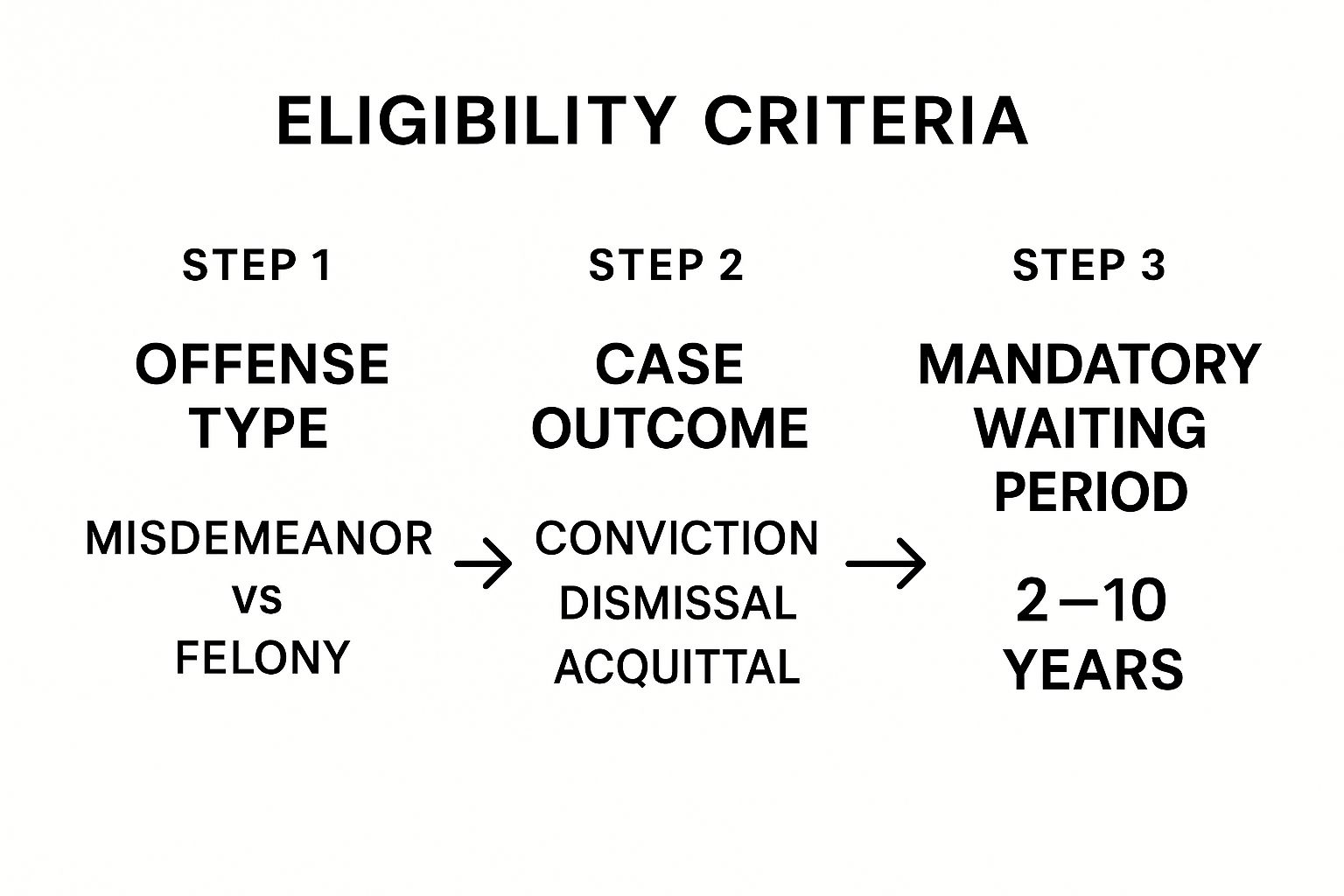
As you can see, it's a step-by-step evaluation. The offense, the outcome, and the waiting period all have to line up with what the law allows.
The Type of Offense Matters
The seriousness of the charge plays a huge role. As a rule of thumb, it's almost always easier to seal a misdemeanor than a felony.
For instance, someone with a single misdemeanor shoplifting charge from five years ago is in a much better position than someone with a felony burglary conviction from that same year. Most states have a list of serious crimes that can never be sealed—things like violent felonies, sexual offenses, or any crimes involving children.
But don't assume that a felony is an automatic dead end. Certain non-violent felonies, especially if they happened a long time ago, might still be eligible. A low-level felony drug possession charge from ten years back, for example, could qualify for sealing in some states, particularly if a person has kept their record clean since then.
How Your Case Was Resolved
The final outcome of your case is another critical piece of the puzzle. The path to sealing your record is a whole lot simpler—and faster—if you were never actually convicted of the crime.
Here’s how the courts tend to look at different results:
- Dismissals and Acquittals: If the prosecutor dropped the charges or you were found not guilty at trial, you're in the strongest possible position. In many jurisdictions, you can file to seal these kinds of records almost right away.
- Convictions: This is where it gets trickier. If you were convicted (meaning you pleaded guilty, no contest, or were found guilty), you’ll face a mandatory waiting period. You'll also have to prove you’ve completed your entire sentence, paid all your fines, and met any other conditions.
- Diversion Programs: If you completed a pre-trial diversion or deferred adjudication program, your charges were likely dismissed in the end. This is a great outcome and is usually treated just like any other dismissal.
The difference here is massive. Picture two people arrested for the exact same offense. One gets their case dismissed, while the other is convicted. The person with the dismissal might be able to start the sealing process immediately, but the convicted individual is stuck waiting for years.
Eligibility isn't just about what you were charged with; it’s about what happened in court. A dismissal or acquittal dramatically changes the timeline and complexity of sealing your record.
Understanding these details helps set realistic expectations. Some charges, like DUIs, are notoriously difficult to get off your record, but it really depends on state law. If you're dealing with that specific issue, you can learn more in our article about how to get a DUI off your record.
Mandatory Waiting Periods
This is where patience becomes essential, especially if you have a conviction. States require you to wait a certain amount of time to prove you’ve stayed out of trouble since your case closed.
And these aren't just suggestions; they are firm deadlines you can't get around.
- For misdemeanor convictions, the waiting period is typically 2 to 5 years after you've completed your sentence.
- For eligible felony convictions, you're looking at a much longer wait, often somewhere between 7 and 10 years.
Here's the key: the clock only starts ticking after you have finished every single part of your sentence. That includes probation, parole, and paying off every last dollar in court fines and restitution. If you were sentenced to three years of probation, your waiting period doesn't even begin until that probation is successfully terminated.
Gathering Your Documents for the Petition
Once you’ve got a good idea that you’re eligible, the next step is getting everything prepared. This is where the abstract concept of sealing your record turns into a real, tangible project. Think of it as gathering all your ingredients before you start cooking—having everything ready makes the whole process go a lot smoother. You'll be tracking down official records, finding the right forms, and getting all your information organized.
Attention to detail is everything here. Every court has its own specific way of doing things, so you have to be accurate. A small mistake on a form or a missing document can cause serious delays or even get your petition flat-out rejected. Taking the time to get your paperwork in order from the start is one of the most critical things you can do.

The goal is to build a complete and accurate file that clearly shows you meet all the requirements for sealing your record. This usually involves talking to different government agencies to make sure you have the official, certified copies they demand.
Starting With Your Official Criminal History
The foundation of your entire petition is your official criminal history report. This isn't just a summary you type up from memory; it must be a certified document from a state agency like the Georgia Bureau of Investigation (GBI). This report provides all the official details of the arrest or conviction you want sealed, like case numbers, dates, charges, and the final disposition.
To get this document, you'll need to go through the proper channels. The process usually involves:
- Submitting a formal request: You’ll have to fill out an application.
- Providing identification: This often means getting your fingerprints taken at an approved location.
- Paying a fee: There's almost always a cost to get these official records.
This step is non-negotiable. The court needs to see the official record to verify that the details of your case match your petition. Without it, your application is dead in the water.
Finding the Right Court and Forms
After you have your official criminal history in hand, the next job is to pinpoint the exact court where your original case was handled. This is the court that has jurisdiction over your record, and it’s where you have to file your petition. It could be a municipal court in a city like Roswell, a superior court in Forsyth County, or another local court.
Once you know the right court, you need to find their specific forms for petitioning to seal a record. You can often find these on the court clerk's website or by going to the courthouse in person. Be very careful to use the most current version of the forms, as they get updated from time to time.
The petition is your formal request to the judge. It’s where you lay out the facts of your case and explain why you are eligible and deserve to have your record sealed. Filling it out completely and accurately is essential.
This paperwork is what tells your story to the court system. It should clearly state the case details, confirm you've completed all parts of your sentence, and show that the required waiting period has passed.
The Role of Other Agencies
Filing your petition with the court is a huge step, but it’s not the last one. Once filed, your petition gets sent to other involved agencies for their review. This almost always includes the prosecutor’s office that originally handled your case and the law enforcement agency that arrested you.
These agencies have the right to look over your petition and decide whether or not to object.
- The Prosecutor's Office: They will review the case file and your petition to make sure you meet all the requirements. If they think you aren't eligible or believe there's a good reason your record should stay public, they can file an objection with the court.
- The Arresting Agency: The police department or sheriff’s office that arrested you also gets a copy. They object less often, but they still have the opportunity to do so.
If no one files an objection, the judge might just sign the order to seal your record without you ever having to go to court. But if an objection is raised, a court date will be set, and you'll need to go in and make your case to the judge. The complexity of these interactions is why many people decide to get professional help. If you're considering it, it’s useful to know how to find a good criminal lawyer who can handle this part of the process for you.
This administrative part of the journey can feel slow and bureaucratic, but it's a necessary checkpoint. Every piece of paper you gather and every form you fill out is one step closer to putting the past behind you.
So, What Happens After You File the Petition?
Once your petition is filed with the court, you've officially kicked off the final and most important phase. The paperwork is out of your hands and now sits with the court system, which means a period of waiting and watching begins. It can feel like nothing is happening, but this is when the key decisions are made behind the scenes.
The first move is purely procedural: the court clerk serves your petition to the prosecutor's office that originally handled your case. This is their formal heads-up. They typically have a window of 30 to 90 days, depending on the county, to look over your file and decide what to do. They can support it, ignore it, or fight it.
This review period is a huge hurdle. The prosecutor will be looking at everything—the original charge, your history since the case wrapped up, and whether you've ticked every single box required under state law.
The Prosecutor's Review and Why They Might Object
During their review, the prosecutor is really just asking one question: is there any compelling reason this record needs to stay public? For a lot of standard, non-violent offenses where the person has clearly done everything they were supposed to, the prosecutor might not even file a response. This is often a best-case scenario.
But they can, and sometimes do, object. An objection usually comes up for a few common reasons:
- Eligibility Disputes: The prosecutor might argue you haven't met the waiting period or that a more recent charge makes you ineligible.
- Public Safety Concerns: For more serious offenses, they could make the case that sealing the record isn't in the public's best interest.
- Victim's Rights: If your case involved a victim, the prosecutor might check with them before deciding whether to sign off.
If the prosecutor files a formal objection, your path forward changes. The judge won't just rubber-stamp your petition. Instead, the court will schedule a hearing, which means you'll have to show up and argue your case in person.
An unopposed petition is the smoothest path, no question. But an objection isn't the end of the road—it just means the court wants to take a closer look and hear from both sides before making a final call.
Knowing this might happen helps you mentally prepare for what could be a more involved process. A hearing requires a whole different level of readiness than just waiting for an order to show up in the mail.
The Court Hearing: What to Expect
If a hearing gets put on the calendar, this is your shot to make your case directly to the judge. These are formal proceedings where you and the prosecutor can present arguments and evidence. It’s your chance to show that you've been rehabilitated and that the good that comes from sealing your record outweighs any public interest in keeping it open.
So who's usually in the room?
| Participant | Role in the Hearing |
|---|---|
| You (the Petitioner) | To answer the judge's questions and explain why your record should be sealed. |
| The Judge | To listen to both sides, review the evidence, and make the final decision. |
| The Prosecutor | To present the state's argument for why the record should not be sealed. |
During the hearing, the judge is going to weigh everything. They’ll listen to the prosecutor's objections and then give you a chance to respond. Judges may ask about everything from life since the offense and employment history to community involvement. They're trying to get a complete picture of who you are today, not just who you were back then.
The Final Decision and the Court Order
At the end of the day, the decision is entirely up to the judge. After hearing from everyone, the judge will either grant or deny your petition.
If your petition is granted—either because there was no objection or because you won the hearing—the judge will sign a formal court order. This signed order is the piece of paper that makes it all real. It's a directive telling all the relevant agencies to restrict public access to your record.
But the process isn't over just yet. Once you have that signed order, you have one last step. You are responsible for getting certified copies of this order to every agency holding your records, like the Georgia Bureau of Investigation (GBI) and the police department that arrested you. This final step ensures every database gets updated, officially completing the process.
The Rise of Automatic Record Sealing

For a long time, clearing a criminal record was an uphill battle. You had to actively petition the court, a process that’s often confusing, expensive, and loaded with paperwork. It was a major roadblock for countless people trying to move on with their lives.
But things are starting to change. A growing number of states are flipping the script and adopting automated systems that clear records for eligible individuals. The best part? The person doesn't have to do a thing.
These programs, often called "Clean Slate" laws, use technology to do the heavy lifting. Instead of making you file motions and attend hearings, the state’s own computer systems are programmed to identify and seal qualifying cases automatically once the required time has passed. It's a fundamental shift designed to help the millions of people who qualify for relief but, for whatever reason, never make it through the traditional court process.
How Automated Sealing Works
At its core, the idea behind automatic record sealing is pretty simple. When a case is closed, all the key details—the charge, the final outcome, the date—get logged into state criminal databases. A Clean Slate system is built to scan those records on a regular basis, searching for cases that now meet the criteria for sealing.
Let's say a state law allows for a misdemeanor conviction to be sealed three years after the sentence is fully completed. The automated system will flag every case that hits that three-year anniversary. From there, it triggers the sealing process on its own, without the individual ever knowing it was happening. No forms, no court dates, no hassle.
This hands-off approach is a direct attack on the "second chance gap"—the huge difference between the number of people who are eligible to clear their records and the tiny percentage who actually succeed in doing it.
Of course, these systems aren't perfect. They work best with modern, fully digitized records. Older cases, especially those still stuck in paper files or with missing information, can sometimes get missed by the automated sweep.
Who Benefits and What Gets Cleared
The main goal here is to help people with non-violent offenses put the past behind them after they’ve stayed out of trouble for a set period. The types of records that most often get cleared automatically include:
- Dismissed Charges and Acquittals: Arrests that never resulted in a conviction are usually the first in line to be sealed.
- Low-Level Misdemeanors: Things like petty theft or disorderly conduct are commonly included after a waiting period, typically between 3 to 7 years.
- Certain Non-Violent Felonies: Some states are even expanding their programs to include specific non-violent felony convictions, though you’re looking at much longer waiting periods—often 10 years or more.
States like Pennsylvania and Utah are leading the way, showing how a well-designed policy can make a real difference. Utah, for example, has already sealed over 400,000 records through its automated system. While they’ve run into some challenges with older records that have incomplete data, the progress is undeniable.
If you want to dig deeper into how these policies work and the impact they're having, you can review the research on automated record clearance systems that breaks it all down.
Common Questions About Sealing Records
People trying to get their records sealed always have a lot of questions. It's a confusing process, and the terms, costs, and timelines can feel overwhelming. Getting clear, straightforward answers is the first step toward moving forward with confidence.
Here are a few of the most common questions.
What's the Difference Between Sealing and Expunging?
This is probably the biggest point of confusion. People often use "sealing" and "expunging" as if they mean the same thing, but in Georgia, they are very different. You need to know exactly what you're asking the court to do.
Here’s the breakdown:
- Sealing a record (often called "restriction" in Georgia) makes it private. It’s essentially locked away from the general public. While most employers, landlords, and nosy neighbors won't see it, law enforcement and some government agencies can still access it if they have a legitimate reason.
- Expunging a record used to mean the physical destruction of the file. The idea was to make it seem like the event never happened. While this term is still used, Georgia has moved away from true expungement to a system of record restriction and sealing.
The bottom line is that the specific Georgia statutes define what happens to your record. For most people today, the goal is getting the record restricted and then potentially sealed.
How Much Is This Going to Cost?
Cost is always a huge concern. Unfortunately, there’s no single price tag because it depends on your specific case. But you can count on a few typical expenses.
Every court has filing fees, which can run anywhere from less than a hundred to several hundred dollars. You'll also have smaller administrative costs for things like getting certified copies of your criminal history, fingerprinting, and mailing documents.
The biggest variable is attorney's fees if you decide to hire a lawyer. It’s also worth checking if the court offers fee waivers for financial hardship—it never hurts to ask.
Will I Ever Have to Disclose a Sealed Record?
For most everyday situations, the answer is no. Once a record is sealed, it won't show up on the standard background checks used for most jobs or apartment applications. This means you can honestly say you haven't been convicted of that crime.
However, there are some very important exceptions. You might still be required to disclose a sealed record if you’re applying for:
- A job in law enforcement or with a government agency.
- A professional license (like for nursing, teaching, or finance).
- Any position where you work with children, the elderly, or other vulnerable populations.
State law is very clear about when disclosure is still required, so you need to be aware of these limited situations.
How Long Does the Whole Process Take?
Be prepared to be patient. Getting a record sealed can take anywhere from a few months to over a year. The timeline really depends on the complexity of your case and how busy the local court system is.
A few factors can slow things down:
- Case Complexity: A simple petition for a dismissed charge will move a lot faster than sealing a felony conviction, which gives the prosecutor a chance to object.
- Court Backlog: Courthouses in busy areas like Cobb County or Forsyth County can have significant backlogs, which will delay how quickly a judge reviews your petition.
- Prosecutor Objections: If the prosecutor objects, a hearing has to be scheduled. That alone can add several weeks or months to your timeline.
From the day you start gathering paperwork to the day you have a signed order from the judge, it's a journey that requires careful attention to detail and realistic expectations.
Navigating the justice system in Alpharetta, Roswell, or anywhere in North Georgia is tough, but you don't have to do it alone. At Brian Hansford Law, we've helped countless clients protect their futures. If you need guidance on sealing your record or are facing criminal charges, contact us for a consultation. Learn more about how we can help at https://challengemycharge.com.
