
You might be wondering if a DUI is automatically a felony. The short answer is no. For most people facing a first-time DUI, the charge will be a misdemeanor.
But don't let that word fool you. Certain circumstances, what are often called "aggravating factors," can escalate that charge to a felony. A felony charge carries consequences that are far more severe and can last for years.
Understanding When a DUI Becomes a Felony
Think of a misdemeanor DUI as a serious warning shot from the legal system. A felony DUI, on the other hand, is a life-altering event. The line between them isn't arbitrary; it's drawn based on the specific facts of a case and prior history.
While the exact rules change from state to state, there are a few common triggers that consistently turn a standard DUI into a much more serious felony. Grasping what these triggers are is the first step in understanding just how serious a DUI arrest can be. The legal system escalates charges when it believes the offense was especially dangerous—either because other people were put at significant risk, or because a person has a pattern of similar offenses.
Key Escalating Factors
Across the country, a few scenarios almost always push a DUI into felony territory. These are the big ones:
- Repeat Offenses: This is the most common path to a felony DUI. If you have multiple prior DUI convictions within a certain time frame (often called a "lookback period"), prosecutors may seek a felony conviction.
- Causing Serious Injury or Death: If an impaired driving accident causes what the law calls "serious bodily injury" or results in a death, felony charges are practically guaranteed. This is often charged as Vehicular Homicide or Serious Injury by Vehicle.
- Child Endangerment: Driving under the influence with a child in the car is a major red flag for prosecutors and judges. In Georgia, having a passenger under the age of 14 in the car can lead to a separate felony charge, even if it's a first DUI offense.
- Extremely High BAC: While not as common in Georgia as a standalone felony trigger, some states will elevate a DUI to a felony if the driver’s Blood Alcohol Concentration (BAC) is exceptionally high, like double or triple the 0.08% legal limit.
It's a huge mistake to think all DUIs are the same. They aren't. The specific facts of an arrest are what truly matter. When prosecutors review a case, they are actively looking for these aggravating factors to decide whether to pursue a felony, a decision that completely changes the stakes.
To give you a clearer picture, let's break down the primary differences in a simple table.
Misdemeanor DUI vs Felony DUI At a Glance
This table offers a quick side-by-side comparison, summarizing the key distinctions between misdemeanor and felony DUI charges.
| Factor | Typical Misdemeanor DUI | Typical Felony DUI |
|---|---|---|
| Trigger | Usually a first or second offense with no aggravating factors. | Multiple prior DUIs, causing serious injury/death, or child endangerment. |
| Jail/Prison Time | Up to 12 months in a county jail. | A minimum of one year in state prison, often much longer. |
| Fines & Fees | Significant, but typically capped at a lower amount (e.g., up to $1,000 plus surcharges). | Substantially higher, often reaching many thousands of dollars. |
| License Suspension | A defined suspension period, usually from a few months to a year. | A long-term or even permanent revocation of driving privileges. |
| Criminal Record | A permanent misdemeanor record, with limited restriction/expungement options. | A permanent felony record, which cannot be expunged in Georgia. |
| Civil Rights | Generally retained. | Loss of rights, including the right to vote (while serving sentence) and own firearms. |
As you can see, the jump from misdemeanor to felony is a serious one, impacting everything from your freedom to your fundamental rights.
The Role of Prior Offenses
Nothing raises the stakes in a DUI case faster than prior convictions. The legal system sees repeat offenses not just as a mistake, but as a dangerous pattern of behavior. For example, in Georgia, a fourth DUI conviction within 10 years is automatically charged as a felony. This isn't just a local rule; it reflects a nationwide trend. You can discover more about drunk driving statistics and how repeat offenses are handled at ZealousAdvocate.com.
This strict focus on prior offenses shows that the system is designed to impose much harsher penalties on individuals who haven’t changed their behavior after a previous conviction. From the court's perspective, a repeat offense poses a much greater threat to public safety, and the punishment will reflect that.
The Factors That Escalate a DUI to a Felony
Not all DUI arrests carry the same weight. A first-time offense with no other complications is typically a misdemeanor, but certain circumstances can instantly elevate that charge to a felony. Prosecutors look closely at the details of an arrest for what they call “aggravating factors”—elements that show a heightened level of danger to the public.
It’s these tipping points that explain why two seemingly similar arrests can lead to vastly different legal consequences. Think of it as a series of switches. A standard DUI arrest flips the misdemeanor switch. But if other factors are involved, like a prior record or a car accident, more switches get flipped. Once a certain line is crossed, the felony alarm goes off, turning a serious mistake into a life-altering legal battle.
Prior Offenses and the Lookback Period
The most common path to a felony DUI is having a history of them. States use a "lookback period" to decide if a new DUI arrest should be treated more severely. It's like the state has a memory; it looks back over a set number of years to count your prior convictions. If you rack up too many DUIs within that window, the charge automatically escalates.
In Georgia, for example, a fourth DUI within a ten-year period is an automatic felony. The legal system doesn't see these as isolated incidents but as a pattern of dangerous behavior that demands much harsher penalties. It tells the court that earlier interventions, like fines and DUI school, just weren't enough.
High BAC and Extreme Impairment
Another major factor is just how intoxicated the driver was. While 0.08% is the standard blood alcohol concentration (BAC) limit, having a much higher BAC can trigger a felony charge in some states. A BAC of 0.15% or higher is almost always considered an aggravating factor.
A high BAC indicates a level of impairment so severe that it presents an extreme risk to everyone on the road. From a prosecutor's point of view, that level of intoxication shows a blatant disregard for public safety, which justifies the more serious charge.
The chart below shows the basic decision path that separates a misdemeanor DUI from a felony.
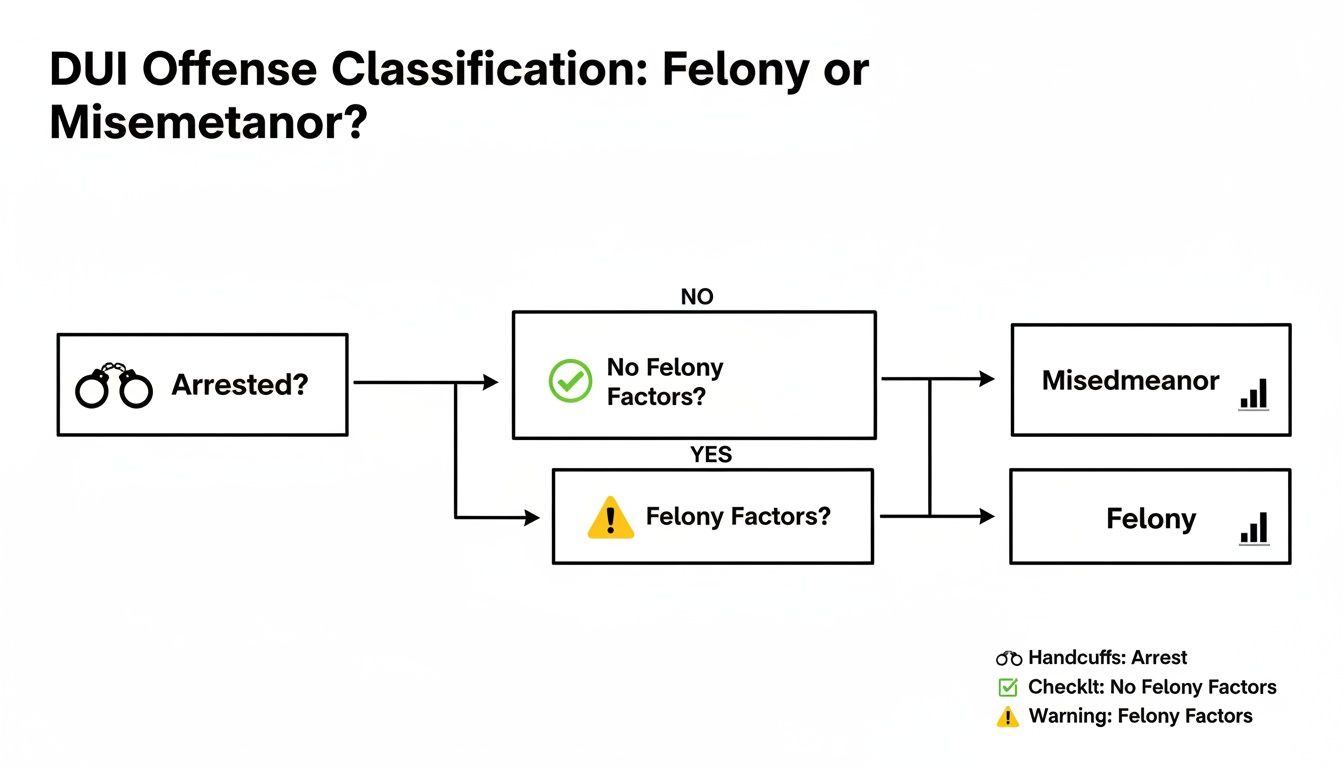
As you can see, the presence of these specific factors is the critical fork in the road that leads to a felony charge.
Causing an Accident with Injury or Death
When a DUI leads to an accident, the potential for felony charges skyrockets. If that accident causes "serious bodily injury" to someone else—think broken bones, severe disfigurement, or the loss of an organ's function—the driver will almost certainly face felony charges. If someone dies, the charges become even more severe, often including vehicular homicide.
This is one of the clearest lines in the sand. The moment an impaired driver's actions physically harm another person, the legal system’s focus shifts from rehabilitation to seeking justice for the victim. The consequences reflect that severe breach of public safety.
Child Endangerment and Other Factors
Driving under the influence with a child in the car is another huge red flag for prosecutors. In Georgia, having a passenger under the age of 14 can lead to separate felony charges, even if it's your first-ever DUI.
Other situations can also push a DUI into felony territory:
- Driving on a Suspended License: If your license was already suspended for a prior DUI, a new arrest is going to be handled much more aggressively.
- Fleeing from Law Enforcement: Trying to outrun the police during a traffic stop can add a felony charge on top of the DUI.
These factors show a compounded level of poor judgment that prosecutors will use to justify felony-level consequences. States have been getting tougher in response to tragic statistics. In 2022, there were 13,524 alcohol-related traffic fatalities nationwide, which has prompted many states to increase penalties for DUIs that cause serious harm. You can learn more about how these criminal defense statistics are influencing the law.
How Georgia Law Defines a Felony DUI
While the general idea of a felony DUI exists nationwide, the real answer to "is a DUI a felony?" comes down to specific state laws. In Georgia, the statutes are clear, and there are several ways a standard misdemeanor DUI can escalate into a life-altering felony conviction.
Understanding these local rules is everything, because the approach taken in courtrooms across North Georgia—from Forsyth County to Cobb County—is built on these precise legal definitions. The state’s legal framework is designed to bring much harsher consequences for actions that show a heightened risk to public safety or a pattern of repeat offenses. This isn't just about punishment; it's a direct response aimed at preventing future tragedies on our roads.
The 10-Year Lookback Period
One of the most critical concepts in Georgia DUI law is the “lookback period.” Think of it like this: the state keeps a running clock on a driving record, and for DUI offenses, that clock runs for 10 years. Georgia law "looks back" over this entire decade to count any prior DUI convictions you may have.
This 10-year window is the key to one of the most common ways a DUI becomes a felony.
Under Georgia Code § 40-6-391(c)(3), a fourth DUI conviction within this 10-year period is automatically charged as a felony. It doesn't matter if the first three were simple misdemeanors with zero aggravating factors. That fourth one crosses a definitive legal line, triggering severe penalties that include mandatory prison time.
This rule applies no matter where the prior convictions happened. A DUI from another state will still count toward the total here in Georgia, as long as their laws are substantially similar to ours. Local prosecutors in jurisdictions like Roswell and Alpharetta are diligent about pulling out-of-state records to see if a new arrest qualifies for a felony prosecution.
Serious Injury by Vehicle
Another direct path to a felony DUI in Georgia involves causing harm to someone else. If an impaired driver causes an accident that results in a serious injury, the charge is no longer just a DUI. It becomes a separate and distinct felony known as Serious Injury by Vehicle.
What counts as a "serious injury" is specifically defined by law and includes:
- Disfigurement: Causing severe and permanent scarring or altering someone's appearance.
- Loss of a Body Part: An injury that leads to the amputation of a limb or other body part.
- Impairment of a Body Part: An injury that renders an organ or part of the body useless.
This charge carries its own severe penalties, completely separate from the underlying DUI. In courtrooms across Marietta and East Cobb, these cases are treated with extreme gravity because another person's life has been permanently changed by the driver's actions.
The Habitual Violator Designation
Georgia law also has a special classification for drivers who repeatedly commit serious traffic offenses: the Habitual Violator (HV). You can be declared an HV after getting three or more major convictions within a five-year period. These convictions include:
- DUI
- Fleeing or eluding a police officer
- Leaving the scene of an accident
- Vehicular homicide
Once declared a Habitual Violator, your driver's license is revoked for five years. If you are caught driving during this revocation period and are arrested for a new DUI, that DUI becomes a felony. This charge, Driving as a Habitual Violator, shows a clear disregard for court orders and public safety, and judges in places like Milton and Johns Creek tend to impose stiff sentences.
The table below breaks down these common felony triggers here in Georgia.
Common Felony DUI Triggers in Georgia
This table illustrates specific situations that can lead to a felony DUI charge under Georgia law, helping you understand the state's statutes more clearly.
| Scenario | Why It Becomes a Felony in Georgia | Potential Consequences |
|---|---|---|
| Fourth DUI in 10 Years | The statute automatically elevates the fourth offense within the lookback period to a felony. | Mandatory prison time (at least one year), fines up to $5,000, and long-term license revocation. |
| Serious Injury by Vehicle | Causing significant, lasting harm to another person while driving under the influence. | One to fifteen years in prison, separate from any other charges. |
| DUI as a Habitual Violator | Driving under the influence after your license has been revoked for being a Habitual Violator. | One to five years in prison, which often must be served without parole. |
Understanding these specific Georgia statutes is the first step in grasping just how serious a DUI charge can be in our local legal landscape. The laws are written to ensure that actions with severe consequences—or those that show a pattern of dangerous behavior—are met with felony-level penalties.
The Lifelong Impact of a Felony DUI Conviction
When the judge’s gavel falls on a felony DUI conviction, the sound echoes far beyond the courtroom. While the immediate shock of prison time and steep fines is overwhelming, the long-term consequences are often what truly reshape a person's life. A felony on your record isn't just a mark—it’s a permanent barrier that can close doors you never even knew were there.
Unlike a misdemeanor that might fade into the background over time, a felony conviction becomes a central part of your story. It’s a ripple effect, touching nearly every aspect of your personal and professional life for years, and sometimes, for the rest of your life.

Loss of Fundamental Civil Rights
For many people, one of the most jarring realities of a felony conviction is the loss of fundamental civil rights. It’s something most of us take for granted. But in Georgia, a felony conviction alters your status as a citizen in very real ways.
Most significantly, a felony conviction can strip you of:
- The Right to Vote: While you are serving your sentence—and this includes any period of probation or parole—you lose your voice in our democracy. You cannot vote.
- The Right to Own a Firearm: Both federal and Georgia state laws permanently prohibit a convicted felon from possessing or owning a firearm. This right is gone for good.
- The Right to Serve on a Jury: You are disqualified from this key civic duty, removing you from participating in the justice system as a juror.
These aren't just minor inconveniences. They represent a profound and lasting shift in your role in society.
Practical Everyday Challenges
Beyond the loss of core rights, a felony DUI creates massive practical hurdles in day-to-day life. That "convicted felon" label shows up on every background check, creating a persistent stigma that follows you everywhere.
This can lead to serious difficulties in several critical areas:
- Employment: Finding a good job becomes incredibly challenging. Many employers are simply unwilling to hire someone with a felony record, especially for jobs that require trust, handling money, or driving. A felony DUI is an automatic "no" for any position needing a commercial driver's license (CDL) or the use of a company vehicle.
- Housing: Landlords almost always run background checks. A felony conviction can make it nearly impossible to find a safe, decent place to live, as many property managers will immediately deny your application.
- Professional Licensing: If your career requires a state license—think nursing, real estate, teaching, or cosmetology—a felony conviction can block you from getting or renewing that license, effectively ending your career.
These obstacles can trap you in a cycle of instability that is incredibly difficult to break. To understand more, you can read our guide on whether you can get a DUI off your record, which details the permanence of these charges in Georgia.
Immigration and Global Consequences
For anyone who is not a U.S. citizen, a felony DUI conviction is a catastrophe. It is often classified as a "crime of moral turpitude" or an "aggravated felony" under immigration law. This can trigger deportation, even if you are a lawful permanent resident (a green card holder). It can also permanently bar you from ever becoming a naturalized U.S. citizen.
The severe consequences for DUIs that cause harm aren't just a U.S. phenomenon. Globally, 22% of the 1.25 million road deaths each year are linked to drunk driving, leading to harsh laws worldwide. A felony DUI conviction in the U.S. that involves a fatality is viewed with the same severity, creating serious problems with international travel and immigration. For more, you can read about how these drink driving statistics shape laws around the world.
A felony DUI is more than a legal problem; it's a life problem. The conviction becomes a permanent part of your identity, affecting where you can live, what work you can do, and even what countries you can visit. Understanding these lifelong ripple effects is crucial when facing such a serious charge.
Common Defense Angles in DUI Cases
Just because someone has been arrested for DUI doesn't mean they'll be convicted. The prosecution carries the entire burden of proving its case beyond a reasonable doubt, and every single step of a DUI investigation can be challenged—from the moment the blue lights flash in the rearview mirror to the final chemical test results.
Think of the State's case like a chain; it's only as strong as its weakest link. A skilled defense attorney knows exactly where to look for those weaknesses. This isn't about finding loopholes; it's about making sure constitutional rights were protected and that law enforcement followed every procedure to the letter.
Questioning the Initial Traffic Stop
It all starts with the stop. The foundation of any DUI case is the officer's reason for pulling a driver over in the first place. An officer can't just stop a vehicle on a whim or a hunch. They must have what the law calls "reasonable articulable suspicion"—a specific, factual reason to believe a traffic violation or crime has occurred.
Common reasons that hold up in court include:
- Observed Traffic Violations: Things like speeding, running a red light, or failing to stay in your lane are straightforward justifications.
- Erratic Driving: Weaving, drifting, braking for no reason, or driving unusually slowly can suggest impairment and give an officer a valid reason to initiate a stop.
- Vehicle Equipment Issues: Even something as simple as a broken taillight or an expired tag is a legitimate reason to pull someone over.
If an officer can't provide a valid, legal reason for the stop, any evidence they gathered after that point—the field sobriety tests, statements, the breathalyzer results—can be thrown out. A successful challenge to the stop can cripple the prosecution's case before it even gets started.
Scrutinizing Field Sobriety Tests
After the stop, an officer will often ask a driver to perform Standardized Field Sobriety Tests (SFSTs). These are the physical coordination exercises you've likely seen on TV, designed to give the officer probable cause for a DUI arrest. But here's the catch: these tests are notoriously prone to error, and their results are only considered reliable if the officer administers them perfectly.
The National Highway Traffic Safety Administration (NHTSA) has a strict, standardized manual for how these tests must be instructed and demonstrated. Any deviation can invalidate the results. Plus, plenty of other factors can make a perfectly sober person "fail" these tests:
- The driver's age, weight, and any existing medical conditions.
- Simple nervousness or fatigue.
- Improper footwear (like high heels or sandals) or an uneven, poorly lit surface.
- The officer giving incorrect or confusing instructions.
Digging into whether the tests were administered by the book is a critical part of building a strong DUI defense.
Challenging Chemical Test Results
The breathalyzer or blood test result often feels like the final word in a DUI case. But these scientific results are far from foolproof. Both the machines and the procedures for handling samples have to meet very strict legal and scientific standards.
The accuracy of a breathalyzer is entirely dependent on its proper maintenance, calibration, and operation. These devices are complex instruments that require regular servicing to function correctly. If the machine was not calibrated according to schedule or if the officer operating it was not properly trained, the results may be unreliable.
Blood tests have their own set of potential problems. A strict chain of custody must be followed to ensure the sample isn't contaminated, mislabeled, or mishandled from the moment it's drawn to the time it's analyzed at the lab. Any break in that chain casts serious doubt on the final result.
Reviewing machine maintenance logs, officer training records, and lab procedures is non-negotiable. To learn more about the different angles involved, understanding how to beat DUI charges can provide deeper insight into these complex but crucial defense strategies.
What to Do After a DUI Arrest in North Georgia

Being arrested for a DUI is a deeply stressful and confusing experience. But the decisions made in the hours and days that follow are absolutely critical. Staying calm and moving deliberately is often the best course of action.
The clock starts ticking immediately on some very important deadlines, and actions taken now will directly impact what happens down the road.
One of the most urgent issues is the administrative suspension of your driver's license. In Georgia, you have only 30 days from the date of your arrest to file an appeal. If you miss this deadline, you will almost certainly face an automatic license suspension, regardless of what happens in your criminal case.
Document and Preserve Information
Your memory is one of the most powerful tools you have right now. As soon as you can, write down every single detail you remember about the traffic stop, your conversation with the officer, any tests you took, and the arrest itself.
Don't hold back or try to filter anything. Small, seemingly insignificant details often turn out to be the most important.
Try to answer these questions:
- What reason did the officer give for pulling you over?
- Where exactly were you? What were the road and weather conditions like?
- What did the officer ask you, and how did you answer?
- What do you recall about how the field sobriety tests were conducted?
The point is to create a detailed record while the events are still fresh in your mind. This account can be invaluable for uncovering procedural mistakes or inconsistencies that can be used to build a strong defense.
Knowing what steps to take can feel overwhelming, which is why having a clear plan is so vital. For a more detailed guide, check out our post on what to do after a DUI arrest, which provides a practical checklist to help you navigate this difficult time and protect your rights.
Answering Your Questions About Felony DUI
When you're dealing with a DUI charge, a lot of questions pop up. It's a stressful and confusing time. This section tackles some of the most common questions head-on, giving you straightforward answers to help you understand what's at stake.
The goal is to clear up the confusion around what makes a DUI a felony and what that really means for your future.
Can a First-Time DUI Be a Felony?
Yes, but it's rare. The vast majority of first-time DUIs are charged as misdemeanors. However, the law carves out exceptions for situations that are considered especially dangerous.
A first DUI can jump straight to a felony if it involves a serious accident. If someone is severely injured or killed, you're looking at a felony charge from day one. Another common scenario is driving under the influence with a child in the car. In Georgia, if a passenger is under the age of 14, you can face a separate felony charge for child endangerment, even if you have a perfectly clean record.
How Long Does a Felony DUI Stay on Your Record?
Forever. A felony DUI conviction is a permanent mark on your criminal record. In Georgia, just like most other states, a felony conviction is not eligible to be restricted or expunged. It will be there for life.
This is one of the harshest consequences of a felony conviction. It will show up on every background check for jobs, housing applications, professional licenses, and even loans. It creates obstacles that can follow you for decades.
A misdemeanor DUI creates huge problems, but a felony DUI builds a permanent wall. The fact that the record can never be restricted means the conviction will shadow you forever, closing doors to opportunities you might not even be thinking about today.
Is Refusing a Breathalyzer Test a Felony?
No, refusing to take a chemical test like a breathalyzer isn't a felony by itself. But don't mistake that for meaning it's a good idea. Refusing has immediate and serious consequences.
Under Georgia's implied consent laws, if you refuse the test, you will face an automatic administrative suspension of your driver's license. This happens completely separately from your criminal case. On top of that, the prosecutor will absolutely use your refusal against you in court, arguing that it shows "consciousness of guilt"—in other words, that you refused because you knew you were drunk. It's not a felony, but it can make your case much harder to defend.
What Is the Difference Between a DUI and a DWI?
Honestly, not much. The terms DUI (Driving Under the Influence) and DWI (Driving While Intoxicated/Impaired) are mostly just different labels for the same crime. Which term is used simply depends on the specific wording in a state's laws.
Some states say DWI, others use OWI (Operating While Intoxicated), but they all mean the same thing: operating a vehicle while impaired by alcohol or drugs. Here in Georgia, the official legal term is DUI. So while you might hear people use different acronyms, they're all talking about the same charge.
The information in this article is for educational purposes only and is not intended to be a substitute for professional guidance. If you are facing a DUI charge in Alpharetta, Cumming, Johns Creek, or the surrounding North Georgia area, understanding the specifics of your case is crucial. Contact Brian Hansford Law to discuss your situation by visiting https://challengemycharge.com.
