
Yes, trespassing is a crime in Georgia. It’s not just a minor disagreement; the law treats it seriously because it relates to a property owner’s right to privacy and security.
What Makes Trespassing a Crime in Georgia
At its core, trespassing is all about crossing a line you weren’t invited to cross. Think of a home or land as being surrounded by an invisible boundary. When someone steps over that line without permission—or refuses to leave when asked—they’ve gone against the owner’s right to control who comes and goes. This is the fundamental idea behind why trespassing is a criminal offense.
This isn’t just a Georgia thing; it’s a basic principle of property law around the world, from the United States and the United Kingdom to Canada. The specific rules might change from place to place, but the central concept of respecting property boundaries is universal.
What’s interesting is how often these incidents might go unreported. Statistics from 2022 show that only about 41.2% of trespassing offenses in the U.S. were actually reported to the police. This suggests many cases are either handled privately or simply go undocumented. You can explore more U.S. crime data to see where trespassing fits into the larger landscape.
The Two Main Paths to a Criminal Charge
In Georgia, the law outlines two main ways a simple act of being on someone’s property can escalate into a criminal charge. It really boils down to either being somewhere you shouldn’t be or breaking something while you’re there.
Here’s a quick look at the two main types of criminal trespass and the actions that define them.
Two Paths to Criminal Trespass in Georgia
| Type of Trespass | What It Involves | Simple Analogy |
|---|---|---|
| Unlawful Presence | Knowingly entering or staying on property after being told to leave or seeing “No Trespassing” signs. | It’s like staying at a party after the host has asked everyone to go home. |
| Intentional Damage | Purposely causing damage to someone’s property that’s valued at $500 or less. | This is like knocking over and breaking a lamp at that party, even if you were invited. |
As you can see, the law distinguishes between simply being present without permission and actively causing harm.
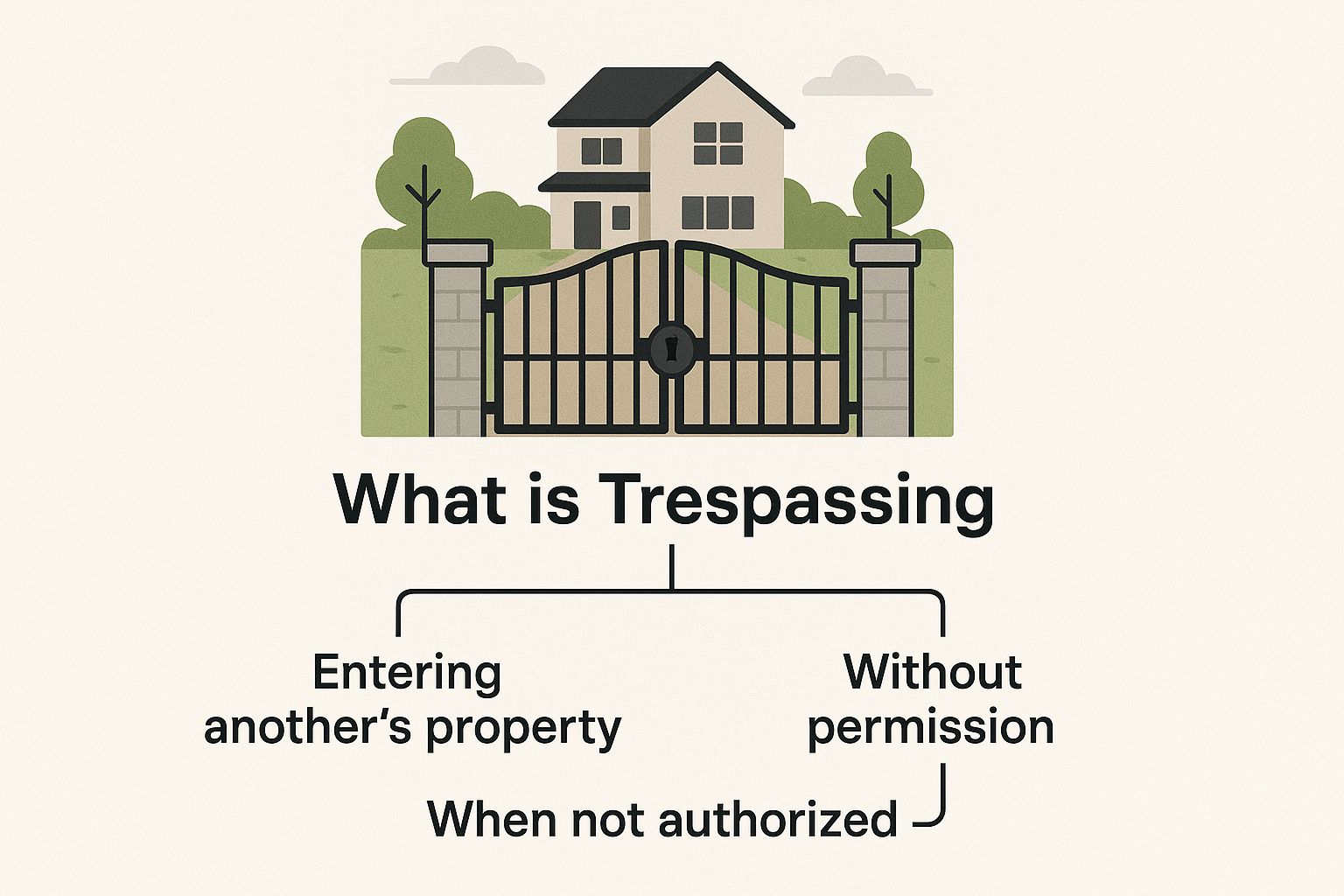
The image of a locked gate is a perfect visual for this. It’s a clear, physical signal that says, “This is a private space—entry requires permission.”
A critical piece of the puzzle in most trespassing cases is “notice.” The prosecutor has to show that the person knew, or should have known, they weren’t welcome. This notice can be a fence, a sign, or a direct verbal warning from the property owner.
Now, let’s dig a little deeper into these two types of criminal trespass. Each one has specific elements that must be proven for a charge to stick, starting with what it means to unlawfully enter or remain on a property.
Entering or Remaining on Property Unlawfully
When most people think about trespassing, this is the exact situation that comes to mind. It’s the straightforward act of being on someone else’s land or inside their building with no right to be there. But for this to become a criminal offense in Georgia, a couple of key things have to happen.
First, there must be a knowing entry or stay on the property without permission. Second, there must have been notice that entry is not welcome. This idea of “notice” is the linchpin; it’s what separates an honest mistake from a deliberate act.
What Counts as Notice
“Notice” isn’t just about a classic, weathered “No Trespassing” sign tacked to a tree. The law is a lot more practical than that and recognizes a few different ways an owner can make it clear that people need to stay out.
Here’s how notice is typically given:
- Direct Communication: This is the clearest method. The owner, a renter, or even an employee simply tells someone to leave. If a verbal warning is given and the person stays, they’re crossing the line into trespassing.
- Posted Signs: A sign posted in a spot where people are likely to see it works just as well. It’s a clear, standing message from the owner to anyone who comes near the property.
- Fences and Enclosures: A fence, a wall, or any other kind of enclosure sends a powerful, non-verbal message. It creates a physical boundary that says, “This area is private, not public.”
Think about it this way: someone who accidentally wanders off a hiking trail in a park onto an adjacent, unfenced private lawn might genuinely not know they’ve left public land. Now, picture someone hopping a tall fence plastered with “Private Property” signs. The second person has clearly been put on notice, and that makes all the difference in the eyes of the law.
The Role of Intent
This brings us to the person’s state of mind at the time—their intent. To be charged with criminal trespass, there must be a knowing entry or presence without authorization. The prosecutor has to look at the person’s state of mind.
The real question is: did the person know, or should they have reasonably known, that they weren’t supposed to be there? This is why a hiker who gets lost and stumbles onto private property is in a completely different situation than someone who flat-out ignores a homeowner yelling at them to leave.
Take a delivery driver, for example. They have implied permission to walk up the driveway and leave a package on the porch. But if the homeowner comes out and tells them to get off the property and they refuse to budge, their status instantly changes. Their continued presence is no longer welcome and can become criminal trespass.
Ultimately, this common form of trespassing boils down to a simple combination: an unauthorized presence plus clear notice that a person isn’t wanted there. The law protects a property owner’s right to peace and privacy, but it also takes into account whether a person was reasonably aware they were breaking the rules.
How Property Damage Changes a Trespass Case
Most people think of trespassing as simply being somewhere you’re not supposed to be. But in Georgia, the charge can have less to do with where you are and more to do with what you do. Damaging property—even if you were initially invited—can lead to a criminal trespass charge.
This is where the law gets specific. It’s not just about breaking down a door to get in. If someone intentionally causes damage to another person’s property, and the value of that damage is $500 or less, that action crosses the line into criminal trespass.

It’s a surprising twist for many. The law doesn’t care if the person was an invited guest or a complete stranger at that point. The act of intentionally causing harm is what matters.
When an Invitation Turns into a Crime
Let’s paint a picture. Someone is at a party, legally and with permission. But things get heated, an argument breaks out, and they punch a hole in the drywall.
Even though they were a welcome guest just moments before, that act of destruction could be charged as criminal trespass. Their right to be there ended the moment they chose to cause damage. This is a crucial detail that often gets overlooked. A lawful presence isn’t a free pass to act destructively.
This part of the law really speaks to a broader issue. Property crimes, like vandalism, are a persistent problem. While exact trespassing numbers can be hard to isolate, the focus on property damage shows how seriously the state takes these offenses. You can get a sense of the bigger picture by looking into crime rates by country.
Beyond Just Breaking Things
Criminal trespass isn’t limited to smashing a window or kicking in a door. The law also singles out other specific acts of interference, where the dollar value is less important than the malicious intent behind the action.
These are considered criminal trespass because they show a clear disrespect for property and public safety.
- Malicious Interference: This is about deliberately meddling with property to cause trouble for the owner. Think about someone disabling a security camera or jamming a gate lock.
- Defacing Property: Georgia law specifically protects memorials and gravesites. Vandalizing, defacing, or desecrating a grave marker or monument is a form of criminal trespass.
- Damaging Public Signs: Tearing down or damaging signs and posters on public land also falls under this statute.
The common thread here is intent. For any of these actions to become a crime, the prosecution has to prove the person acted “knowingly and maliciously.” Accidentally knocking something over is worlds apart from deliberately destroying it.
At the end of the day, when property damage enters the picture, it completely changes the game. The case is no longer about just being in the wrong place at the wrong time. It becomes about actively causing harm, which the courts always treat with more severity. It shows that asking “is trespassing a crime” can have very different answers depending on exactly what happened.
So, What Are the Penalties for Criminal Trespass?
When a person is facing a criminal charge, the first question on their mind is usually, “What happens now?” If someone has been charged with criminal trespass in Georgia, the answer is pretty straightforward in most situations: it’s almost always treated as a misdemeanor.
That classification sets the stage for the potential consequences. While “misdemeanor” might not sound as serious as a felony, it’s not something to take lightly. A conviction can still have a major impact on a person’s life, and the law outlines some pretty clear maximum penalties a judge can hand down.
The Standard Misdemeanor Penalties
For a typical criminal trespass conviction, the consequences fall under Georgia’s general sentencing guidelines for misdemeanors. This gives the court a defined playbook for sentencing.
Here’s what the maximum penalties look like:
- Jail Time: Up to 12 months behind bars in a county jail.
- Fines: A fine of up to $1,000.
- Probation: A person could also be sentenced to a period of supervised probation, either instead of jail time or in addition to it.
It’s crucial to understand that these are the absolute maximums. A guilty verdict doesn’t automatically mean a sentence of a year in jail and a huge fine. The final sentence really hinges on the unique details of the case. For a closer look at how these charges can differ, you can learn more about criminal trespassing in the 3rd degree.
To give you a clearer picture, here’s a quick summary of the maximum penalties a person could be looking at.
Georgia Misdemeanor Trespass Penalties at a Glance
| Penalty Type | Maximum Consequence |
|---|---|
| Incarceration | Up to 12 months in jail |
| Financial Penalty | Up to $1,000 fine |
| Court Supervision | Up to 12 months of probation |
Remember, this table shows the upper limits. The actual sentence is tailored to the specifics of each individual case.
Factors That Can Change the Outcome
A judge doesn’t just look at the charge on paper. They look at the whole picture—the person, the situation, and everything that led to the arrest. Several factors can push a sentence toward the higher end of the scale or, conversely, lead to a much more lenient outcome.
The court aims to make the punishment fit the crime. Things like a person’s criminal history and the specific nature of the trespass are weighed heavily to determine a fair and just sentence.
Here are a few of the key factors that can sway a judge’s decision:
- Criminal Record: Someone with a clean slate is naturally going to be seen in a better light than a person with a history of similar charges.
- Where the Trespass Happened: The law can treat trespassing on certain types of property more severely. For example, entering a public housing project without permission might have different consequences.
- Any Property Damage: Did the trespass involve breaking a window or causing other damage? The court will definitely consider the cost of repairs and whether the act seemed malicious. A minor incident is worlds away from one that causes thousands in damage.
- How the Situation Was Handled: A person’s level of cooperation with law enforcement during the arrest and investigation can also be taken into account.
Ultimately, the penalties are meant to be flexible. The judge puts all the evidence on the scale to land on a sentence that makes sense for the unique facts of the case, which could be anything from a small fine to the maximum penalties allowed by law.
Common Defenses in a Trespassing Case
When a person is facing a criminal charge, it’s critical to remember that there are always two sides to every story. Answering the question “is trespassing a crime” isn’t always a simple yes or no; it often boils down to the specific circumstances and what a person was thinking at the time. Several common defenses can be raised against a trespassing charge, each one chipping away at the core elements the prosecution needs to prove.
The goal of these defenses is to show that a key piece of the puzzle—like unlawful presence or criminal intent—was never really there. Let’s break down how these arguments work.

Lack of Notice
One of the most powerful and straightforward defenses is a lack of notice. As we covered earlier, a person generally can’t be guilty of trespassing if they didn’t know—and had no reason to know—that they weren’t welcome. If the property had no signs, no fences, and no one ever told them to leave, a strong case can be made that they honestly didn’t realize it was private property.
Think about it this way: imagine a huge, open field right next to a public park. If someone wanders onto that field chasing a frisbee, they could reasonably argue that they had no idea they’d crossed an invisible property line. Without clear notice, it becomes incredibly difficult for the prosecution to prove they knowingly trespassed. This gets to the heart of the legal standard known as the burden of proof, which rests entirely on the prosecution.
Consent or Permission
Another rock-solid defense is consent. It’s simple: you can’t be a trespasser if you had permission to be there. This permission doesn’t always have to be a formal invitation; it can be explicit (spoken or written) or implied (understood from the situation).
- Explicit Consent: This is the easy one. The property owner says, “Feel free to fish in my pond anytime.” The person now has direct permission.
- Implied Consent: This is more about common sense. A retail store, by its very nature, gives implied consent for the public to enter during business hours to shop. A mail carrier has implied consent to walk up to a front door to deliver a package.
If a person had a reasonable belief that they were allowed on the property, it can completely dismantle a trespassing charge. The key is whether that belief was justifiable given the circumstances.
The Necessity Argument
In some very specific, often dramatic, situations, a person can argue they trespassed out of sheer necessity. This defense claims that entering the property was the only way to prevent a much more serious and immediate danger to themselves or someone else.
At its core, the necessity defense is about choosing the lesser of two evils. The argument is that the minor crime of trespassing had to be committed to avoid a far greater harm.
For example, a hiker gets caught in a sudden, life-threatening blizzard. To survive, they break the lock on an empty, remote cabin to take shelter from the storm. In that case, the act of trespassing was absolutely necessary to avoid freezing to death. While it’s not a defense that comes up every day, it shows just how important context is when evaluating a criminal charge.
Answering Your Questions About Trespassing
Let’s wrap up by tackling some of the most common questions people have when it comes to trespassing laws in Georgia. These are the real-world situations and “what-ifs” that often cause the most confusion.
Can Someone Just Get a Warning Instead of a Charge?
Absolutely. In fact, for a first-time or minor incident, a criminal trespass warning is often the first step police will take. Think of a teenager cutting through a shopping center’s parking lot after it’s closed—that’s a classic example.
An officer will issue a formal warning, which gets documented. This puts the person on official notice. If they are ever found on that same property again, that warning becomes powerful evidence against them, making an arrest and a formal charge almost certain.
Is It Trespassing If There Are No Signs Posted?
Not always. While a “No Trespassing” sign is the clearest way to forbid entry, it’s far from the only way. A locked gate, a fence, or even the owner telling someone to get off their land all serve as legal notice.
On the other hand, if a property is wide open, without any fences or signs, it’s much harder for a prosecutor to prove a person knew they weren’t welcome. This is a common and often effective angle for a defense.
The core of the issue is what a reasonable person would have understood in that situation. A missing sign is a big piece of the puzzle, but the court looks at the entire picture.
What Happens If I Trespass by Accident?
Intent is everything here. To be guilty of criminal trespass, a person has to knowingly enter or remain on a property without permission. If someone genuinely got lost on a poorly marked hiking trail and stumbled onto private land, they haven’t committed a crime.
But here’s where things can change quickly. The moment the property owner finds them and tells them to leave, the clock starts. If they refuse to go, the innocent mistake just became a deliberate act, and a charge could follow. The presence is no longer accidental; it’s defiant.
Can a Trespassing Charge Be Removed from a Record?
Yes, in Georgia, it’s often possible to get a trespassing charge restricted, which is what most people think of as “expungement.” This seals it from public view on a criminal record. This is most common when the charges were dropped, a person was found not guilty, or they successfully completed a pretrial diversion program.
Whether someone qualifies depends on the specifics of their case and their past history. For anyone navigating the court system, it helps to understand what happens when someone is arrested to see the full picture from the initial charge to the final outcome.
A trespassing charge can be incredibly stressful, with consequences that ripple through a person’s life. Information and support can make a difference. The team at Brian Hansford Law is available to explain the process and work toward the best possible result. If you or someone you know needs help, visit us at https://challengemycharge.com to learn how we can support you.
