
A DUI arrest in Georgia puts your driver's license in immediate jeopardy. This isn't something that waits for a court date down the road. An administrative license suspension can be triggered on the spot if you refuse a chemical test or your Blood Alcohol Concentration (BAC) is over the legal limit.
This entire process is handled by the Georgia Department of Driver Services (DDS), running on a completely separate track from any criminal proceedings you might face.
What Happens to Your License After a DUI Arrest
The moments after a DUI arrest can be a whirlwind of confusion and anxiety. For most people in places like Alpharetta, Cumming, and throughout Forsyth County, the most pressing question is: "Am I going to lose my license?" It's the key to getting to work, school, and just living life.
Georgia's system is designed to act fast. This immediate action is called an Administrative License Suspension (ALS). Think of it as a temporary hold the DDS places on your driving privileges, kicked off by the arresting officer long before a judge ever sees the case. It’s a civil matter, not a criminal penalty, which is why it happens so quickly.
The Administrative Suspension Trigger
The ALS process starts under two specific conditions:
- Test Refusal: You refuse to take the state's chemical test—breath, blood, or urine—after being lawfully arrested.
- Test Failure: You agree to the test, and the results show a BAC of 0.08% or higher (or 0.02% for drivers under 21).
If either of these happens, the officer will usually take your physical license and hand you a temporary driving permit. This starts a critical countdown you can't ignore. The infographic below lays out this initial chain of events, from the arrest to the crucial decision that has to be made.
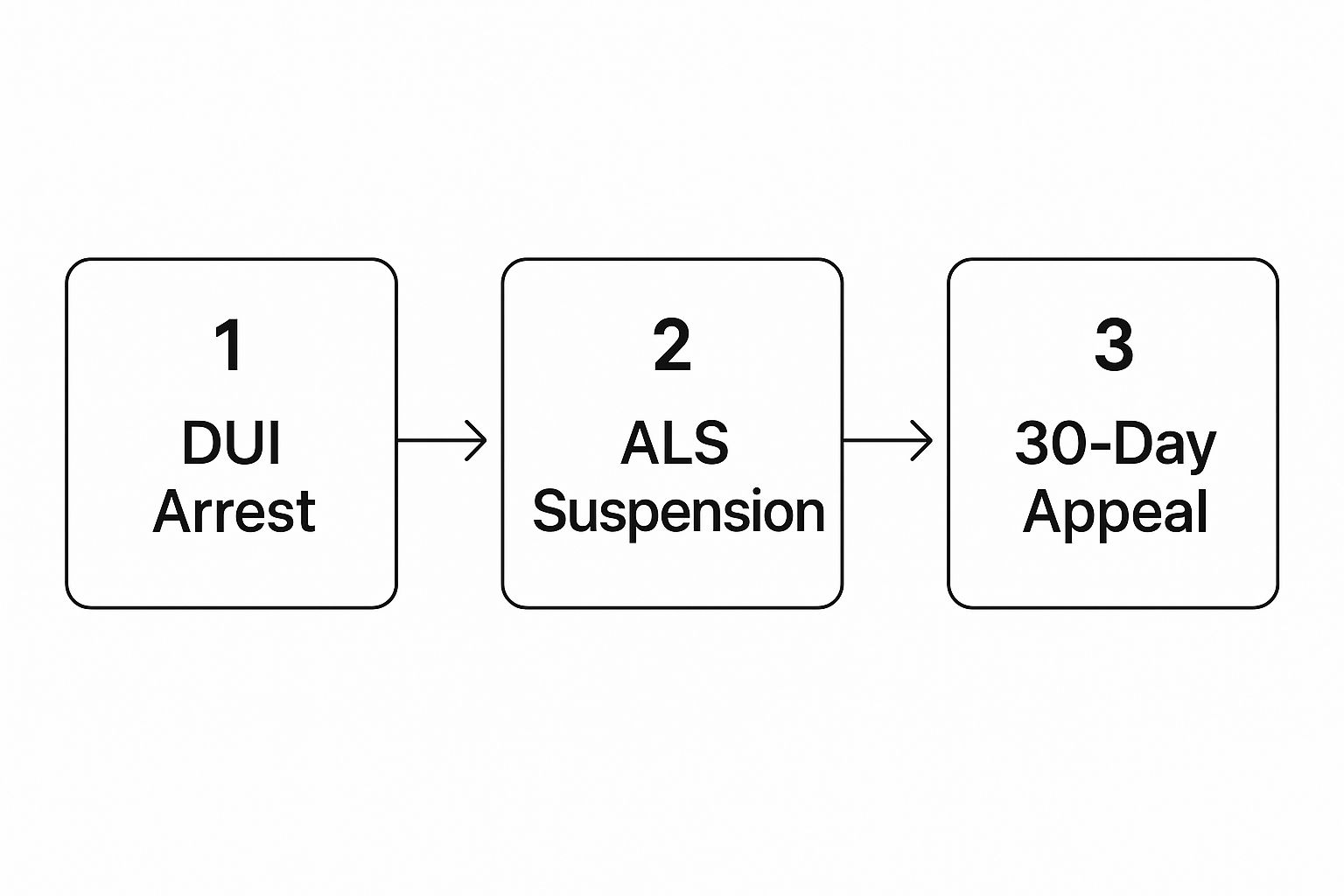
As you can see, the suspension is an automatic step that leads directly to a time-sensitive choice. How a person reacts in these first few days is critical. To get the full picture, you can review our guide on what to do after a DUI arrest.
The table below breaks down these first critical moments and deadlines that cannot be missed.
Immediate Actions and Timelines After a DUI Arrest in Georgia
| Event | What Happens | Critical Deadline |
|---|---|---|
| DUI Arrest | The arresting officer initiates the process if a test is refused or the BAC is over the limit. | N/A |
| License Confiscation | Your physical driver's license is taken. You are issued a temporary driving permit (Form 1205). | Happens at the time of arrest. |
| Suspension Starts | The Administrative License Suspension (ALS) automatically begins 45 days after the arrest. | 45 days from the date of arrest. |
| Appeal Window | There is a very short window to formally appeal the suspension. This is the chance to fight it. | There are only 30 days to file an appeal. |
Missing the 30-day appeal deadline means an automatic loss of the right to challenge the administrative suspension, and the license will be suspended for a full year without any chance for a limited permit.
A Common Consequence Nationwide
This immediate suspension isn't unique to Georgia. Across the United States, taking away a driver's license right after a DUI arrest is a common tool used as both a deterrent and a way to keep roads safer. Since the 1980s, federal and state laws have gotten much tougher, with automatic license suspensions becoming standard practice.
Even with these strict rules, studies show that a staggering 50-75% of people convicted of DUI continue to drive on a suspended license. This unfortunately increases the risk of repeat offenses and accidents.
The most important takeaway is this: the process impacting a license starts the moment of arrest, not weeks or months later in a courtroom. The administrative and criminal components of a DUI are two separate tracks running at the same time.
The Two Tracks of a Georgia DUI Case

After a DUI arrest in Georgia, most people think everything gets handled in one court case. The reality is quite a bit more complicated. A person is actually facing two separate processes that run at the same time on parallel tracks, like two trains leaving the station at once.
One train is the Administrative License Suspension (ALS). This is a civil matter handled directly by the Georgia Department of Driver Services (DDS). The other train is the criminal case, which moves through the court system to deal with the DUI charge itself.
It's absolutely critical to understand this dual-track system. Each process has its own rules, its own timelines, and its own potential outcomes. What happens on one track doesn't automatically fix the other, and a license suspension after dui can come from either one.
The Administrative Track: The DDS and Your License
The administrative track is all about the immediate ability to drive. This process kicks off the second a person is arrested for DUI and they either refuse a chemical test or the results come back over the legal limit. It's an immediate civil action the DDS takes to get the license off the road.
This is exactly why a license can be suspended long before a person ever sees the inside of a courtroom for their DUI charge. The ALS isn't about deciding if someone is guilty or innocent of DUI; it only focuses on a very narrow set of facts surrounding the arrest and the chemical test.
Think of it this way: the administrative suspension is a separate, faster-moving process. Its main goal is public safety, and it operates completely independently of the criminal justice system's schedule.
This administrative process leads to a potential ALS hearing, but this should not be confused with a criminal trial. It’s a hearing to determine if the officer followed the proper procedures during the arrest and if there was a legitimate basis to suspend the license.
The Criminal Track: The Court and the DUI Charge
The second track is the one people are more familiar with—the criminal case. This is what happens in the court system, whether that's a municipal court in Alpharetta or a state court in Forsyth County. This is where a prosecutor has to prove the DUI charge beyond a reasonable doubt.
The criminal track moves much, much slower than the administrative one. It can take months, sometimes even longer, to work its way through plea negotiations or a full trial. And the consequences here go far beyond just losing a license.
If a person is convicted in criminal court, the penalties can include:
- Jail Time: From a few days up to a year or more, depending on the case.
- Fines and Fees: Significant court-imposed fines and surcharges.
- Probation: A period of court-supervised monitoring.
- Mandatory Classes: Completion of a DUI Risk Reduction Program is required.
- Community Service: A required number of hours of unpaid work.
A DUI conviction also triggers a separate, court-ordered license suspension. This suspension has nothing to do with the initial administrative one. A person could actually win the ALS hearing and keep their license, only to lose it later if they're convicted of the criminal DUI. On the flip side, even if a criminal charge gets reduced, the administrative suspension might still stick if it wasn't challenged correctly within the first 30 days.
Understanding the ALS Hearing Process
After a DUI arrest, the first and often most confusing hurdle a person may face is the Administrative License Suspension (ALS) hearing. This isn't the criminal trial. It’s a completely separate civil proceeding that has one laser focus: the driver's license.
The process kicks off the moment a person is arrested and either refuses a chemical test or blows over the legal limit. From that second, a strict 30-day clock starts ticking. If a formal appeal letter is not filed within this window, the administrative license suspension after dui becomes automatic.
What Is the Purpose of the ALS Hearing?
Think of the ALS hearing as a procedural review. Its job isn't to decide if a person is guilty of DUI, but to check if the arresting officer followed all the rules when they moved to suspend the license.
An administrative law judge runs the show, and it’s a much less formal setting than a criminal courtroom. The judge is there to hear the facts and decide one thing: did the officer have the proper grounds to take the license?
The core of the ALS hearing is procedural. It's a checkpoint to confirm that the arrest and the events leading to the suspension were handled correctly according to Georgia law.
This is a critical distinction to grasp. A person could eventually beat their criminal DUI charge, but if the ALS hearing is ignored, they could still lose their license for up to a full year. They are two separate battles.
Key Issues Examined During the Hearing
The scope of an ALS hearing is intentionally narrow. The judge isn't there to hear about a person's character or why they need their car for work. They are only concerned with a specific checklist of requirements.
Here’s what the judge will focus on:
- Reasonable Grounds for the Stop: Did the officer have a legitimate reason to believe the person was driving under the influence? This could be something as simple as weaving or failing to maintain a lane.
- Proper Arrest Procedures: Was the arrest itself lawful? The judge needs to see that the officer followed every step correctly.
- Implied Consent Warnings: This is a big one. Did the officer read Georgia's Implied Consent notice at the right time and in the right way? This warning explains what happens if a test is refused.
- Chemical Test Results or Refusal: If a breath or blood test was taken, was it administered properly? If it was refused, was the refusal clear and absolute?
These rules are everything in an ALS hearing. To get a better handle on this, you can read our detailed explanation of Georgia’s Implied Consent Law. A mistake on any one of these points could be the key to getting a license back.
Potential Outcomes of the Hearing
After reviewing the evidence and listening to the arresting officer's testimony, the judge will make a final call. There are really only three ways it can go.
The table below breaks down what can happen and what it means for the ability to drive.
| Hearing Outcome | Description | Impact on Your License |
|---|---|---|
| Suspension Upheld | The judge finds the officer did everything by the book and had good reason to suspend the license. | The license will be suspended for the full term, which is typically one year for a refusal or a first-offense DUI. |
| Suspension Modified | In some situations, the judge might alter the suspension, for example, by granting a limited driving permit. | Driving is restricted, but not gone completely. An Ignition Interlock Device will likely be required on the car. |
| Suspension Dismissed | The judge finds that the officer made a procedural error or didn't have enough grounds for the suspension. | The administrative suspension is "rescinded." The license is returned, and this part of the case is over. |
It's crucial to remember that even a "win" here—getting the suspension dismissed—has zero impact on the separate criminal DUI case. That case will keep moving forward on its own track, with its own set of penalties, including a potential court-ordered license suspension after dui if a conviction occurs.
How a DUI Conviction Impacts Your Driving Privileges
Getting arrested for a DUI in Georgia sets off two separate clocks when it comes to a driver's license. The first is the Administrative License Suspension (ALS), which we've talked about. That's the immediate consequence handled by the Department of Driver Services. But the second clock starts ticking once the criminal case goes to court.
A DUI conviction in court triggers its own separate, court-ordered license suspension after dui. This is a formal penalty handed down by a judge, and it operates completely independently of whatever happened with the initial ALS. Even if the ALS hearing was won, a criminal conviction means facing another suspension with its own set of rules.
The Penalties Get Steeper with Each Offense
Georgia law is not forgiving when it comes to repeat DUI offenses. The state uses a five-year "lookback period" to determine penalties, and they escalate quickly. A conviction today carries a much heavier weight if there is another one from a few years ago.
This tiered system is designed to send a clear message: the more offenses, the longer a person will be off the road.
Here’s how the court-ordered suspensions break down:
- First DUI Conviction (in 5 years): For a first offense, a person is looking at a 12-month suspension. The good news is that there are often paths to get the license back early.
- Second DUI Conviction (in 5 years): The consequences jump significantly. A second conviction triggers a 3-year suspension of the license.
- Third DUI Conviction (in 5 years): A third offense within five years is a major problem. A person will be declared a Habitual Violator, and their license will be revoked for 5 years.
Remember, these suspensions kick in after the criminal case is resolved, no matter the outcome of the initial administrative suspension.
More Than Just Waiting: What You Have to Do
A DUI conviction isn't just about losing your license for a while. The court will also order the completion of specific programs before a person can even think about reinstatement. These aren't suggestions; they are mandatory requirements.
Two of the most common hurdles to clear are:
- DUI Risk Reduction Program: Most people know this as "DUI School." It’s a required 20-hour course that educates on the serious dangers of driving under the influence. The program must be finished to get a certificate.
- Clinical Evaluation: It is likely an order will be given to see a certified professional for a substance abuse evaluation. Based on their assessment, a recommended treatment program may need to be completed.
A person can't just sit back and wait for the suspension period to end. They have to be proactive and complete these state-mandated programs to have any chance of getting their license reinstated.
Georgia’s Approach in a Global Context
Suspending a driver's license is a primary tool used around the world to deter drunk driving. While the specifics change from country to country, the basic idea is the same. The United States, where 31% of all fatal crashes are alcohol-related, leans heavily on license suspensions to keep the roads safe. Most states, like Georgia, enforce these penalties right after an arrest, with zero tolerance for high-risk drivers like repeat offenders. To learn more about how these statistics compare globally, you can read more about drunk driving statistics on bestonlinetrafficschool.co.
The key takeaway is that a criminal conviction adds another layer to the license suspension after dui. It introduces longer suspension periods, especially for repeat offenses, and requires the completion of specific educational and evaluative programs before reinstatement is possible.
Options for Limited Driving During a Suspension

A license suspension after dui can bring a person's world to a screeching halt. For most of us in places like Roswell and Johns Creek, a car isn't a convenience—it’s a necessity for getting to work, taking kids to school, and just managing daily life. But losing a full license doesn't always mean a person is completely stranded.
Georgia law thankfully provides a few pathways for getting limited driving privileges while a license is suspended. These aren't handed out to everyone and come with very strict rules, but they can be an absolute lifeline.
What Is a Limited Driving Permit
A limited driving permit, which you might hear called a hardship license, lets a person drive for specific, necessary reasons. It's not a get-out-of-jail-free card for a license; think of it more like a special key that only unlocks certain doors at certain times.
This permit severely restricts where and when a person can legally be behind the wheel. The state defines what counts as an essential trip, and it usually includes:
- Driving to and from your job.
- Getting to and from classes if you're a student.
- Attending necessary doctor or pharmacy appointments.
- Driving to required substance abuse counseling or support meetings.
- Attending court-ordered programs, like DUI School.
Whether or not a person can get one of these permits depends entirely on the facts of the case, especially if it's a first offense and the specific reason for the suspension.
The Role of an Ignition Interlock Device
For some drivers, especially those facing a second DUI, getting a limited permit is only possible if they install an Ignition Interlock Device (IID). This is basically a small breathalyzer that's wired directly into the car's ignition.
Before the car will start, the driver has to blow into the device. If it detects any alcohol—even a tiny amount—the engine won’t turn over. It also requires random "rolling retests" while driving to prove the person hasn't been drinking since starting the trip.
An Ignition Interlock Device is essentially a gatekeeper for a vehicle. It’s a piece of technology that forces sobriety every single time a person drives, and it’s become a standard requirement for regaining even limited driving privileges in many DUI cases.
The IID process involves a few steps:
- Find a Certified Provider: The device can't just be bought online; a state-approved vendor must be used for the installation.
- Installation and Maintenance: A technician installs the device, and it must be brought in for regular calibration, typically every 30-60 days, which is paid for out-of-pocket.
- Data Monitoring: The device logs all activity, including any failed breath tests, and that data is reported straight to the Department of Driver Services (DDS).
Comparing Permit Eligibility
Not everyone's situation is the same, and neither is their eligibility for a permit. Georgia has very specific rules that shift based on a person's driving history and the details of their DUI.
Here’s a simplified table to give you a clearer picture of how eligibility can differ.
Georgia Limited Permit Eligibility Overview
| Offense Type | Permit Eligibility | Common Requirements |
|---|---|---|
| First DUI (ALS Suspension) | Often eligible for a permit right away. An IID may or may not be required depending on the circumstances. | DUI School completion, application fees. |
| First DUI (Conviction) | Generally eligible for a limited permit, but only after serving a short "hard suspension" with no driving. | DUI School, clinical evaluation, reinstatement fees. |
| Second DUI (in 5 years) | May be eligible for a permit only after a long hard suspension period (12 months of no driving). An IID is mandatory. | 12 months "hard suspension," IID installation, completion of a treatment program. |
Getting a handle on these options is the first step toward navigating life during a license suspension after dui. Each path comes with its own heavy set of responsibilities and zero tolerance for breaking the rules.
The Path to Reinstating Your Full License
After a license suspension for DUI, the end goal is always the same: getting full driving privileges back. But it’s not an automatic process. Think of it as a checklist that has to be completed for the Georgia Department of Driver Services (DDS) before they’ll clear a license.
This final stage takes patience and a close eye for detail. If a step is skipped or a document is missed, it could mean frustrating delays that will keep a person off the road longer than necessary. Understanding what’s ahead is the best way to get through it efficiently and avoid common mistakes.
Completing the Suspension Period
First things first, the entire suspension period has to be served. Whether a person is looking at 12 months for a first offense or something longer for a repeat offense, they simply have to wait for that time to officially end. There are no shortcuts here.
It's critical to know the exact date the suspension is set to expire. Getting it wrong could lead to driving illegally, which brings a whole new set of serious penalties.
Reinstatement is something that must be actively pursued. Just waiting for the suspension period to end isn’t enough. A person has to proactively complete every single requirement the state mandates to get their full license back.
Before doing anything, it’s a good idea to confirm eligibility. You can learn more about how to check the status of a driving record in our guide on how to check for a suspended license. This makes sure a person is starting on the right foot.
Fulfilling Mandatory Program Requirements
While waiting for the suspension period to run its course, a person needs to be working on any court-ordered programs. These are non-negotiable—a license can't be reinstated without them.
Most people will have to tackle two main requirements:
- DUI Alcohol or Drug Use Risk Reduction Program: This is what most people call "DUI School." It's a 20-hour course that educates on the dangers of impaired driving. The entire program must be finished to get a certificate of completion.
- Clinical Evaluation and Treatment: A state-approved evaluator will assess the individual for any substance abuse issues. If they recommend a treatment program, it must be completed, and proof must be shown to the DDS.
It is important to hold on to all paperwork, especially the official completion certificates. These documents will be needed to prove that all obligations have been met.
Final Steps to Reinstatement
Once the suspension period is officially over and the program certificates are in hand, a person can start the final steps with the DDS. This is where finances are settled up and documentation is turned in.
The final checklist will look something like this:
- Paying the Reinstatement Fee: A fee will have to be paid directly to the DDS to get the reinstatement application processed.
- Settling All Fines: Any outstanding court fines tied to the DUI conviction must be paid off completely.
- Submitting Proof of Completion: The DDS must be given the DUI School certificate and any paperwork from the clinical evaluation or treatment program.
After the DDS has confirmed that every single requirement has been met—from serving the time and paying fees to completing programs—the license will be reinstated. This marks the end of a long road and the return to being a fully licensed driver in Georgia.
Got Questions About Your License After a DUI?
If a person has been arrested for a DUI in Georgia, they are probably worried about their license. It’s the number one concern for most people, and for good reason. The rules can feel confusing, but getting straight answers is the first step toward figuring out what to do next.
Here are some of the most common questions people in places like Marietta, Milton, and all over Cobb County have about how a DUI affects driving privileges.
Can I Get a Work Permit After a DUI?
Yes, in many cases, it is possible to get what’s known as a limited driving permit (often called a work permit or hardship license). Whether a person qualifies really depends on the specifics of their situation, like if it is a first DUI and why the license was suspended in the first place—was it the administrative suspension or a later court conviction?
These permits are not a free pass to drive anywhere. They come with strict limits and are only for essential travel, such as:
- Driving to and from a job.
- Getting to required medical appointments.
- Attending school or court-ordered classes, like DUI school.
Following these rules is critical. If a person is caught driving for any other reason, they will face much more serious problems.
How Long Is Your License Suspended for a First DUI?
For a first-time DUI in Georgia, a person is looking at two different potential suspensions, which can be confusing. The first is the Administrative License Suspension (ALS), which happens right after the arrest if the chemical test is refused or the test is over the limit. This suspension lasts for 12 months.
Then, if a person is convicted of the DUI in criminal court, there's a second, separate suspension. This one is also typically for 12 months. The good news for a first conviction is that it is often possible to apply to get the license fully reinstated after just 120 days, as long as all the requirements have been completed.
It's crucial to understand that the administrative suspension and the criminal court suspension are two separate issues. Resolving one doesn't automatically take care of the other. Both must be addressed.
Does a Georgia DUI Affect My Out-of-State License?
Yes, it absolutely will. A person can't just go home and hope it disappears. Georgia is part of the Driver License Compact, which is an agreement between most states to share information about traffic violations and license suspensions.
When Georgia convicts an out-of-state driver of DUI, they report it to the driver's home state DMV. The home state will then almost certainly take action against the license based on its own laws, which usually means a suspension just as if the DUI happened there.
At Brian Hansford Law, we understand how stressful and overwhelming a DUI charge can be, especially when the ability to drive is on the line. If you're in Alpharetta, Cumming, or nearby and want to understand your options for protecting your license, our team is ready to help. For a detailed review of your situation, visit us at https://challengemycharge.com.
