
If you find yourself being questioned by police in Alpharetta, GA, or worse, under arrest, your mind is going to be racing. It’s a stressful, overwhelming experience. But the single most important thing to do in that moment is to understand one fundamental right: your right to remain silent. If you are facing an investigation in Alpharetta or anywhere in Fulton County, do not speak to police without representation. Call Brian Hansford Law immediately for a confidential consultation.
At its core, the meaning of "pleading the Fifth" is just that—you cannot be forced to say anything that could be used by North Fulton prosecutors to charge you with a crime.
Why This Matters in Alpharetta, GA

We've all heard the phrase "I plead the Fifth" on TV, but it's far more than a dramatic line. It's a real, powerful constitutional shield. For anyone pulled over or being investigated in Alpharetta, this right is your absolute first line of defense. When an officer with the Alpharetta Police Department or a Fulton County sheriff's deputy starts asking you questions, remember their job: they are there to gather evidence. Your only job is to protect yourself. Anything you say, no matter how harmless you think it is, can be twisted and used by North Fulton prosecutors to build their case.
Why Silence Is Your Strongest Ally in North Fulton
Let's be clear: invoking your right to remain silent is not an admission of guilt. It's the smartest move you can make. As a criminal defense attorney practicing in Alpharetta daily, I’ve seen it countless times—an innocent person, nervous and confused, tries to explain the situation and ends up talking themselves right into a corner. Their words sound like a confession, even when they’re not.
Think about these common scenarios around Alpharetta:
- You're pulled over on GA-400 and the officer casually asks, "Just a couple of drinks tonight?"
- Police show up at your door in Johns Creek or Milton wanting to talk about a complaint from a neighbor.
- Investigators want to "just ask a few questions" about a recent theft in Roswell or Sandy Springs.
In every single one of these situations, the best response is to politely refuse to answer. You don't need a clever comeback. All you have to say is, "Officer, I am going to remain silent, and I would like to speak with my lawyer." That's it.
Your silence forces the state to prove its case on its own, without you helping them do it. This is a fundamental protection that keeps the burden of proof exactly where it should be: on the prosecution.
The time immediately following an arrest is disorienting, and you need to know what happens when you get arrested. The process is fast, and deadlines for court dates in the Alpharetta Municipal Court or Fulton County State Court move quickly. Don’t wait to get help. Your first and most critical action is to say nothing and immediately call a defense attorney who knows the local courts and prosecutors.
The Right to Remain Silent: What Does It Mean for Your Case in Alpharetta?
You’ve heard it on TV, but what does it really mean to "plead the Fifth" when you're dealing with law enforcement in Alpharetta? Think of the Fifth Amendment's right against self-incrimination as your constitutional right to stay quiet. It’s a powerful shield designed to stop the government from forcing you to hand them the evidence they need to convict you.
This isn't an admission of guilt. Far from it. Pleading the Fifth simply means you are choosing not to be a witness against yourself.
Whether you're stopped in Roswell, questioned at your home in Milton, or brought in for an interrogation at the Alpharetta Police Department, invoking your right to remain silent is a critical strategic move. It prevents you from saying something—anything—that could be twisted and used against you down the road.
The Core Principle: Not Helping Fulton County Prosecutors
At its heart, the Fifth Amendment protects you from being forced to give testimony that could get you into criminal trouble. This protection is often most vital for the innocent. It’s easy to get flustered and make confusing statements under pressure, and a North Fulton prosecutor can easily paint those nervous words as a confession.
When you remain silent, you force the State of Georgia to prove its case on its own, without your assistance. This is your right, whether you're facing a simple misdemeanor in Alpharetta Municipal Court or a serious felony charge in Fulton County Superior Court.
Where Does the Right to Silence Come From?
This right is a cornerstone of American law, dating back to the Bill of Rights ratified on December 15, 1791. Our country’s founders created the Fifth Amendment to stop the kinds of abusive government tactics and forced confessions they had fought to escape.
The U.S. Supreme Court has repeatedly strengthened this protection. The most famous case is Miranda v. Arizona (1966), which established that police must inform you of your right to remain silent during a custodial interrogation. You can explore the history of this fundamental right on Wikipedia to see just how deep its roots run.
Key Takeaway: Pleading the Fifth isn't about guilt or innocence. It's about controlling the narrative and making sure law enforcement can't use your own voice to build their case.
A Critical Difference: Criminal vs. Civil Cases in Fulton County
The power and consequences of pleading the Fifth change completely depending on whether you are in a criminal or civil court in Fulton County. You must know the difference.
In a Criminal Case: As the defendant, your decision to remain silent and not testify cannot be held against you. The judge in Alpharetta Municipal Court or Fulton County State Court must specifically instruct the jury not to draw any negative conclusions from your silence.
In a Civil Case: The rules are flipped. In a personal injury or family law dispute, for example, the judge or jury can assume the worst. They are allowed to make a "negative inference," meaning they can conclude your testimony would have hurt your case.
This distinction is massive. An action you take during a criminal investigation in Johns Creek could come back to haunt you in a related civil lawsuit. It’s exactly why you should never try to handle these situations alone. Your first and only move should be to say you are invoking your right to remain silent and that you want a lawyer.
How and When to Invoke Your Right to Remain Silent in Alpharetta
Knowing your constitutional rights is one thing. Actually using them under the intense pressure of a police encounter is another matter entirely. Whether you're in a traffic stop on Old Milton Parkway, face a DUI checkpoint in Cumming, or get an unexpected knock on your door in Sandy Springs, how you respond needs to be clear, polite, and firm.
What most people don't realize is you don't have to wait for an officer to read you your Miranda rights to stay silent. That right exists from the very first moment an officer starts asking you questions.
In my years of practice defending clients across North Fulton, I’ve seen simple conversations turn into the primary evidence prosecutors use. This guide will give you the exact phrases and steps to take in different situations you might face right here in Alpharetta and surrounding cities like Dunwoody and East Cobb.
The Exact Words to Use
When you decide to invoke your right to silence, there can be no room for misinterpretation. Vague statements like, "I don't think I should talk," often aren't enough to stop the questions. You must be direct.
The most effective and legally sound phrase is this: "Officer, I am invoking my right to remain silent and I want to speak with my lawyer."
Say this calmly and respectfully. Then, stop talking. Don't try to explain yourself or add anything else. This one sentence achieves two critical legal goals: it invokes your Fifth Amendment right against self-incrimination and your Sixth Amendment right to an attorney. Once you say this, law enforcement is legally required to stop questioning you.
Remember, your silence cannot be used against you as evidence of guilt in a criminal case. It's a strategic act of self-preservation, not an admission of wrongdoing. The goal is to prevent police from gathering statements they can later twist and use against you in Alpharetta Municipal Court or Fulton County State Court.
A Practical Guide to Different Police Encounters
Knowing what to say is half the battle; knowing when and how to say it in common situations around North Fulton is just as important. The key is to be prepared so you can respond correctly under pressure.
To help you, here’s a quick-reference table with clear, actionable phrases for various scenarios you might encounter with law enforcement in our local communities.
Invoking Your Fifth Amendment Rights in Different Scenarios
| Scenario | What to Say in Alpharetta | Why It Matters in Fulton County |
|---|---|---|
| Traffic Stop | "Officer, I will provide my documents, but I am invoking my right to remain silent." | You must provide your license and registration, but you don't have to answer questions like, "Have you been drinking?" or "Do you know why I pulled you over?" |
| Police at Your Door | "I do not consent to a search, and I will not answer any questions without my attorney present." | Police need a warrant to enter your home. Step outside, close the door, and clearly state your position to avoid accidentally giving consent. |
| Formal Interrogation | "I invoke my Fifth Amendment right to remain silent, and I am demanding my lawyer." | This is the highest-stakes scenario. These are the only words you should say until your attorney arrives. Don't say anything else. |
| Detained on the Street | "Am I free to leave? If not, I am exercising my right to remain silent." | This forces the officer to clarify if you are being detained. If you aren't free to go, you are in a custodial situation and should not answer questions. |
These phrases aren't magic words, but they are the legally recognized way to activate your constitutional protections. Using them stops the flow of information to law enforcement and gives you the space to consult with an attorney who is familiar with the Alpharetta legal landscape.
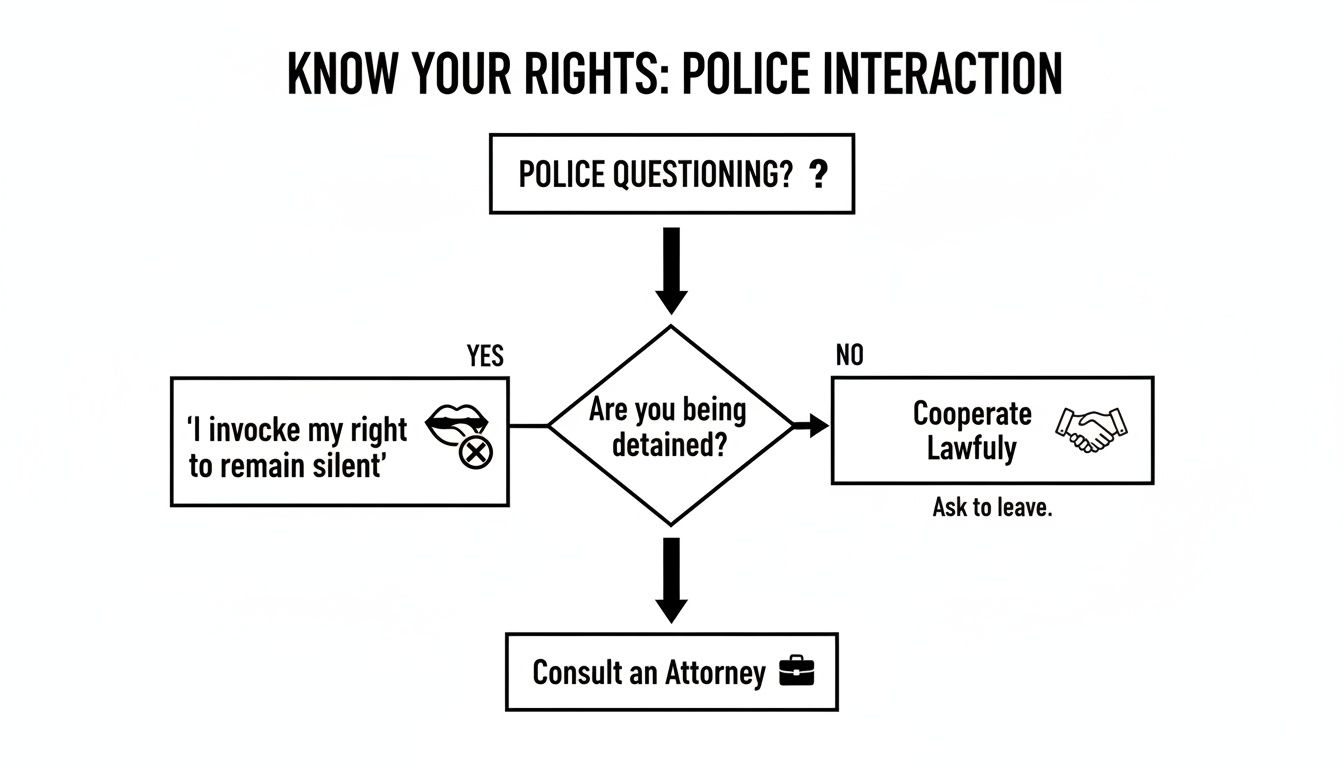
The flowchart above illustrates a simple but critical choice you must make. The moment questioning begins, you have a clear path to protect yourself by immediately invoking your right to silence. This simple action is your most powerful tool.
For a deeper understanding of the rights police must read to you during an arrest, you can learn more about Miranda Rights and what they mean for your case.
The Court Process in Fulton County: Using the Fifth Amendment
Using your Fifth Amendment right inside a courtroom is a whole different ballgame than using it during a police stop on the streets of Alpharetta. The rules, strategies, and consequences change dramatically once your case enters the Alpharetta Municipal Court or the Fulton County Superior Court. You must understand these differences.
As the defendant in your own criminal trial, the Constitution gives you an ironclad right: you never have to take the witness stand. If you choose not to testify, the judge must tell the jury they cannot use your silence against you. It cannot be a factor in their decision.
This is a powerful shield. An experienced Alpharetta criminal defense attorney like Brian Hansford knows how to use this right to control the trial's narrative, keeping the focus where it belongs—on the State's duty to prove its case.
As a Defendant vs. As a Witness in Fulton County
That absolute right not to testify applies only to you, the defendant, in your own criminal case. If you're called as a witness in someone else's trial—whether in Fulton County or anywhere else—the rules are different. You can't just refuse to take the stand.
Instead, you have to take the stand and answer questions one by one. You can only "plead the Fifth" on specific questions where a truthful answer could get you in trouble in a separate criminal matter. This is a tricky and high-stakes situation that demands on-the-spot legal guidance. A mistake could expose you to new charges or damage the case.
Crucial Distinction: As a defendant in Alpharetta, you can stay silent completely. As a witness, you must invoke the right on a question-by-question basis. Misunderstanding this can lead to serious legal trouble.
Grand Juries and Pleading the Fifth in Georgia
The Fifth Amendment is also vital during grand jury proceedings, which are often the first stop for serious felony charges in Fulton County. While the federal government must use a grand jury, Georgia uses them frequently for cases involving drugs, theft, and assault—the kinds of charges we see daily in courts serving Alpharetta, Johns Creek, and Cumming.
If you are called to testify before a grand jury, you can plead the Fifth to avoid incriminating yourself. This protection is a critical defense against an overzealous prosecution, which was a core concern of the Founding Fathers. For more on the history of this right, you can explore the framework of the Fifth Amendment on Cornell Law School's site.
Ultimately, deciding whether to testify is one of the most important decisions you'll make. An attorney who knows the local prosecutors and the rules of North Fulton courts is your best asset. Brian Hansford provides strategic advice tailored to your case, weighing the risks and benefits of taking the stand to build the strongest defense.
If the prosecution’s evidence includes illegally obtained statements, a sharp attorney can also fight to get them thrown out. We cover this in our guide on what is a motion to suppress evidence.
Why Choose Brian Hansford in Alpharetta

The Fifth Amendment isn't just a right you have in theory; it's a strategic tool we use to protect your freedom from the very start. As an experienced Alpharetta defense lawyer, I can tell you that a client's silence is the first, and often most critical, part of a strong defense. The moment you invoke your rights, we build a wall between you and the prosecution.
The main goal is to control the information. When you stop talking, you prevent law enforcement and North Fulton prosecutors from twisting your own words—no matter how innocent they seem—to build their case. It puts the burden entirely on them to find independent evidence, which is a much harder task. This strategic silence is absolutely vital in the early stages, whether you're being questioned by the Alpharetta Police Department or a deputy from the Fulton County Sheriff's Office.
Building Your Defense Strategy in Alpharetta
From the moment we're hired, we instruct our clients in Alpharetta, Johns Creek, and Milton to stop all communication with investigators. It’s not about being difficult; it's about taking control. This allows us to handle all communications and manage the narrative on your behalf.
Here’s how we immediately use this strategy to your advantage:
- Preventing Accidental Self-Incrimination: Our first step is making sure you don't accidentally give the prosecution the one piece of evidence they're missing. This could be as simple as admitting you were at a certain place or knew a certain person.
- Challenging Police Conduct: If officers keep questioning you after you've clearly asked for an attorney, any statement they get is likely illegal. We can file a motion to suppress that evidence, which can completely dismantle the prosecution's case.
- Forcing the State's Hand: By cutting off their main source of information—you—we force the State to prove its case with only what it has. In many DUI or drug cases in Roswell or Sandy Springs, that isn't nearly enough for a conviction.
This proactive approach is non-negotiable. Deadlines in the Fulton County court system are tight, and building a solid defense has to start on day one.
A case where the defendant remains silent from the start is fundamentally different—and often much stronger—than one where we have to clean up damaging statements made without counsel. Your silence is the foundation of a powerful defense.
Practical Scenarios in North Fulton Courts
Think about a DUI charge from a traffic stop in Cumming. If you politely refuse to answer questions about where you were or if you were drinking, the case may hinge entirely on a field sobriety test or breathalyzer result. Both of those are things we can, and often do, challenge in Alpharetta Municipal Court.
Now consider a more complex theft or drug case in Dunwoody or East Cobb. Invoking your Fifth Amendment right creates a major evidence gap for the police. Without your statements to connect the dots, prosecutors in Fulton County Superior Court might not even have enough to get an indictment from a grand jury, let alone secure a conviction at trial. My role as your attorney is to be your shield. I use my in-depth knowledge of local court procedures and prosecution tactics in North Fulton to make your constitutional rights work for you. Pleading the Fifth isn’t just about what you don't say; it’s about what your attorney can achieve because you stayed silent.
Frequently Asked Questions About Pleading the Fifth in Alpharetta, GA
When you're caught up in a criminal investigation in the Alpharetta area, you have urgent questions. Below are answers to common questions grounded in how the law is actually applied in Fulton County, Roswell, and our surrounding communities.
Q: Is pleading the Fifth in Alpharetta an admission of guilt?
A: No. The right to remain silent exists to protect everyone, especially the innocent. Under stress, it's easy to misspeak or have your words twisted by investigators. Choosing to stay silent in Alpharetta is a smart, constitutional move to protect yourself from helping the government build a case against you.
Q: Can my silence be used against me in Fulton County criminal court?
A: In a criminal case, absolutely not. If you are on trial in Fulton County State or Superior Court, the prosecutor is forbidden from telling the jury that your silence is evidence of guilt. The judge will specifically instruct the jury that they cannot hold your silence against you. It is your right.
Q: Do I have to wait for police to read my Miranda rights in Johns Creek?
A: You do not have to wait. Your Fifth Amendment right to remain silent begins the moment an officer in Johns Creek, Milton, or anywhere else starts asking you questions. You can and should invoke your right immediately by stating, "Officer, I am using my right to remain silent, and I want a lawyer."
Q: What if I only answer a few questions for the Alpharetta police?
A: Answering even a few "simple" questions is a serious mistake. A court can see this as you giving up—or "waiving"—your right to remain silent for that entire line of questioning. This can give Alpharetta police or North Fulton prosecutors the exact ammunition they need to charge you with a crime.
Q: Can pleading the Fifth affect a divorce or child custody case in Fulton County?
A: Yes. While your silence is protected in a criminal case, the rules change completely in civil court. In a Fulton County family law case, a judge can make an "adverse inference" from your silence, meaning they can legally assume that whatever you would have said would have hurt your case.
Facing criminal charges is a serious matter, and every decision counts. Protecting your rights from the very beginning is the most important step you can take. If you or a loved one has been arrested or is under investigation in Alpharetta, Roswell, or anywhere in North Fulton, you need immediate legal advice. Call Brian Hansford Law now for a confidential case review and start building your defense today. Protect your record and your future by calling us at https://challengemycharge.com.
