
“You have the right to remain silent.”
We’ve all heard it on TV and in the movies. But those words are much more than a famous line—they’re a critical set of protections known as your Miranda Rights. This warning is designed to make sure you know about two of your most fundamental rights: the right to remain silent and the right to an attorney. Understanding them is the first, most important step in any police encounter.
What Are Miranda Rights and Why Do They Matter?

At its heart, the Miranda warning is a shield. It exists to make sure you’re aware of your constitutional protections before law enforcement starts asking questions while you’re in custody. The whole point is to prevent anyone from being pressured into saying things they wouldn’t otherwise say.
Think of it as a mandatory timeout in a high-stakes game. When an officer reads you your rights, the action is paused so you have a moment to understand the rules. These rules help create a more balanced playing field between an individual and the authorities, especially during a stressful arrest in places like Alpharetta, Cumming, or anywhere in Forsyth County.
The Foundation of Your Protections
The requirement for this warning traces back to a landmark 1966 Supreme Court case, Miranda v. Arizona. That single ruling completely changed how police operate across the entire country. The Court was crystal clear, mandating that officers deliver a specific set of warnings: ‘You have the right to remain silent. Anything you say can and will be used against you in a court of law. You have the right to an attorney. If you cannot afford one, one will be appointed for you.’
These rights aren’t just police procedure; they are pulled directly from the Fifth and Sixth Amendments to the U.S. Constitution. The Fifth protects against self-incrimination, and the Sixth guarantees the right to a lawyer. This warning is simply a practical reminder of those core principles right when they are needed most. It’s also closely tied to your reasonable expectation of privacy, which limits how far the government can intrude into your life.
Breaking Down the Core Components
The Miranda warning has four key parts, and each one protects an individual in a different way. Once these are understood, it becomes clear what’s being offered during a police encounter.
To make it even clearer, let’s break down the Miranda Rights and what they really mean.
Your Miranda Rights at a Glance
| The Right | What It Means in Simple Terms |
|---|---|
| You have the right to remain silent. | You don’t have to answer police questions. This is a shield against being forced to provide information that could hurt your case. |
| Anything you say can and will be used against you in a court of law. | This is the consequence of giving up the right to silence. It’s a serious warning that words have legal weight. |
| You have the right to an attorney. | You can have a lawyer present during any questioning. This ensures a knowledgeable expert is on your side to navigate the process. |
| If you cannot afford an attorney, one will be appointed for you. | Financial situation doesn’t matter. Everyone, regardless of their ability to pay, is guaranteed access to representation. |
These aren’t just formalities to be recited and forgotten. They are fundamental safeguards. Knowing them ensures that if a person is ever arrested in Roswell, Marietta, or Johns Creek, they understand the ground rules from the very beginning.
The Story Behind Your Rights: The Miranda v. Arizona Case
Those famous words, “you have the right to remain silent,” feel like they’ve always been a part of our culture, but they weren’t always standard practice. To understand why we have these protections, we need to look at a real-life story—a case that shows what happens when people are questioned without knowing their fundamental rights.
This isn’t just some dry history lesson. It’s the story of a man named Ernesto Miranda, whose arrest and interrogation forever changed the American justice system. His case is the reason the Miranda warning became a necessary shield for every single one of us.
The Arrest of Ernesto Miranda
The events that sparked this legal shift began on March 13, 1963, when a 24-year-old man, Ernesto Arturo Miranda, was arrested in Phoenix, Arizona. After being picked out of a lineup, he was taken into an interrogation room where police began questioning him intensely.
During a grueling two-hour interrogation, detectives questioned Miranda without ever telling him he had a right to stay quiet or have a lawyer in the room. Under that immense pressure, he signed a written confession. That confession became the cornerstone of the prosecution’s case, and it led to his conviction and a harsh prison sentence of 20-30 years. You can explore the full history of this landmark case to see exactly how these events played out.
The core issue was simple but profound: Can a confession truly be considered voluntary if the person giving it doesn’t even know they have the option to not speak at all?
This question eventually made its way to the U.S. Supreme Court. The justices took a hard look at the nature of police interrogations and recognized that being in custody is inherently intimidating. Without being told their rights, people could easily be pressured into saying things they otherwise wouldn’t.
A Landmark Supreme Court Decision
On June 13, 1966, the Supreme Court issued a historic 5-4 ruling in Miranda v. Arizona. The Court’s decision was clear: Ernesto Miranda’s confession couldn’t be used against him because he was never informed of his constitutional rights.
The Court established that before any “custodial interrogation,” a person must be clearly told their rights. This decision didn’t create new rights out of thin air; it created a procedure to protect rights that already existed in the Fifth and Sixth Amendments.
- Fifth Amendment Protection: This gives us the right against self-incrimination. The warning makes sure people know they don’t have to be a witness against themselves.
- Sixth Amendment Protection: This guarantees the right to an attorney. The warning clarifies that everyone has a right to legal counsel during questioning.
The ruling was a direct response to the kind of coercive police tactics that were all too common at the time. By requiring this warning, the Court aimed to level the playing field between law enforcement and individuals, especially in the high-stress environment of an interrogation room.
The Lasting Impact of the Case
Because of this one case, the Miranda warning became a standard part of arrest procedures across the entire country. It ensures that every person, whether they’re in Forsyth County or Cobb County, understands their basic protections from the moment they are taken into custody for questioning.
So, what happened to Ernesto Miranda? His original conviction was overturned. He was tried again without the confession, and although he was convicted a second time based on other evidence, his case left a permanent mark on our justice system. The story of Miranda v. Arizona is a powerful reminder that these rights were born from a real-world injustice, reinforcing just how critical they are for every single person today.
When Police Must Read You Your Rights
Here’s one of the biggest myths, fueled by countless TV shows: police have to read a person their rights the second they slap on the handcuffs. The belief is that if they don’t, the arrest is illegal and the whole case gets thrown out.
That’s just not how it works in the real world. For the police to be required to give a Miranda warning, two specific things must be happening at the same time: custody and interrogation. If either one of those pieces is missing, they generally don’t have to read anything. Getting a handle on this two-part trigger is the key to understanding how these rights actually apply in a real-life situation, whether in Marietta or Milton.
The First Condition: Custody
First, let’s talk about custody. This means more than just being arrested or having hands cuffed behind the back. For Miranda purposes, an individual is officially “in custody” when a reasonable person in their shoes would not feel free to just get up and leave.
Imagine this: an officer stops to have a casual chat on a sidewalk in Alpharetta. You can walk away anytime. That’s not custody. But being put in the back of a locked patrol car and driven away? That is absolutely a custodial situation. The entire analysis hinges on how much freedom of movement has been restricted.
A person is in custody if their freedom of action is curtailed to a “degree associated with a formal arrest.” This is an objective standard, meaning it’s not about what the officer was thinking, but about how a reasonable person would perceive the situation.
This distinction is critical because it allows police to ask questions during a general investigation before a person is in custody, all without needing to read any warnings. It’s only once things escalate to the point where freedom is significantly taken away that the first condition for Miranda is met.
The Second Condition: Interrogation
The other piece of the puzzle is interrogation. And no, this doesn’t just mean a detective firing off a list of direct questions under a hot lamp. In this context, an interrogation includes any words or actions by the police that they should know are reasonably likely to make someone say something incriminating.
This is a clever way the law prevents officers from getting around the rule. An officer in Roswell can’t just make a strategic comment designed to bait a confession—for instance, saying something like, “Look, we already know you did it, and your buddy is in the next room telling us everything.” Even though that’s not a direct question, it’s a tactic designed to get a response, and that can be considered an interrogation. It’s all about the intent behind the officer’s words and actions.
The flowchart below breaks down how the combination of arrest and interrogation in the landmark Miranda v. Arizona case set this precedent.
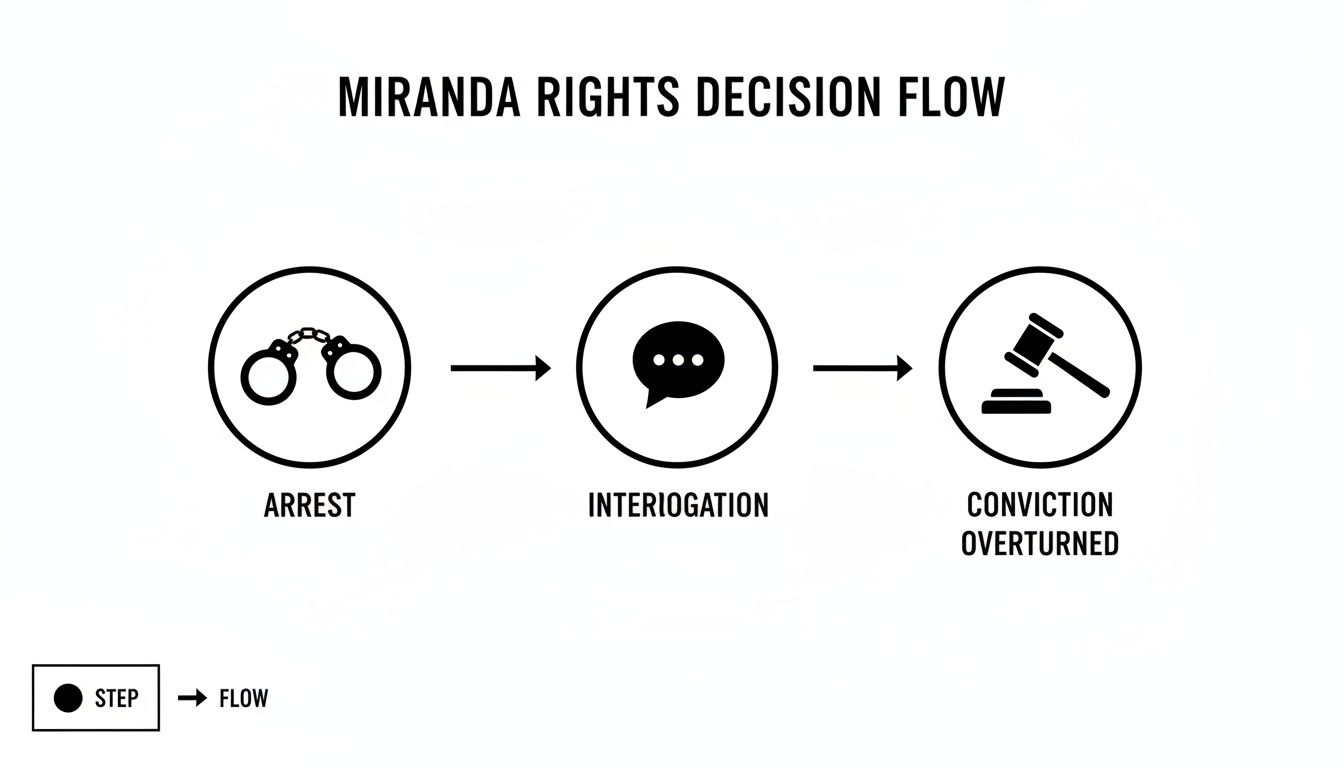
As you can see, it was the fact that he was both arrested and then interrogated without being told his rights that led to his conviction being overturned by the Supreme Court.
Putting Custody and Interrogation Together
Remember, both custody and interrogation have to be in play for Miranda to be required. This “custody plus interrogation” formula is the absolute core of the rule.
Let’s walk through a few scenarios to make it crystal clear:
- No Custody, No Interrogation: An officer on the street asks for directions. No Miranda warning needed here.
- Custody, but No Interrogation: A person is arrested for shoplifting in Johns Creek and placed in the back of a patrol car. The officer says nothing on the ride to the station. No warning is required yet because they aren’t being questioned. For a deeper dive into the arrest process, you can read more about what happens when someone is arrested.
- Interrogation, but No Custody: A detective calls and asks if someone would be willing to come down to the station to answer some questions. Since that person is not in custody and can leave at any time, no Miranda warning is required.
- Custody AND Interrogation: A person has been arrested, is in the back of a police car, and an officer starts asking questions about the alleged crime. This is the moment the officer must stop and read them their Miranda rights.
Understanding this two-part test helps explain why a person might not hear those famous words right after being arrested. The protections are specifically aimed at the unique pressures of a custodial interrogation—the exact situation where a person is most vulnerable.
Common Exceptions to the Miranda Rule
While Miranda rights are a cornerstone of protection under the law, they aren’t an impenetrable shield. The courts have carved out specific situations where police can ask questions before reading that famous warning. These aren’t loopholes meant to trip people up; they exist for practical reasons, like public safety or simple administrative procedure.
Knowing these exceptions is crucial because it shows how complex a real-life arrest can be compared to what is seen on TV. But remember, even if an exception applies, any statement made must still be voluntary. Coercion is never acceptable.
The Public Safety Exception
Imagine police respond to a chaotic scene in downtown Marietta. They’ve just arrested a suspect after a short chase, but they have reason to believe he ditched a handgun in a nearby park where kids are playing. An officer asks, “Where’s the gun?”
In that moment, the officer’s priority isn’t building a case—it’s preventing an immediate tragedy. This is the heart of the public safety exception. It allows police to ask questions about an urgent threat to the public without first giving a Miranda warning. The Supreme Court created this exception in a case called New York v. Quarles, recognizing that stopping immediate danger can sometimes take temporary precedence over procedural warnings.
- The Condition: There must be a real, immediate threat to the police or the public.
- The Scope: Questions have to be narrowly focused on neutralizing that specific threat.
- The Result: The answers can often be used against the person, even without a prior Miranda warning.
Once the threat is over—the gun is found, for example—this exception evaporates. Any further questioning would require the standard Miranda procedure.
Routine Booking Questions
After an arrest in Forsyth or Cobb County, the individual will be taken to the station for booking. This is an administrative process where an officer will ask for basic information.
These routine booking questions—like name, address, and date of birth—are not considered an interrogation. They’re for identification and record-keeping, so no Miranda warning is needed.
But there’s a line. If an officer asks something that seems routine but is actually designed to get an incriminating response, it crosses into interrogation. For instance, asking “Where do you live?” is fine. But asking, “Is that the house where the stolen goods are?” is not.
Spontaneous Statements
Sometimes, people in custody just start talking. A person sitting in the back of a Roswell police car might, out of sheer nervousness or regret, blurt out a full confession without any prompting.
These are called spontaneous or volunteered statements. Because they aren’t the result of police questioning, Miranda doesn’t protect them. If someone offers up information on their own, it can almost always be used against them in court.
This is a powerful reminder to use the right to remain silent from the very start. The entire point of Miranda was to stop police from forcing confessions. Historically, courts used a “voluntariness” test, and studies from that time estimated that 20-30% of confessions were coerced. Spontaneous statements, on the other hand, are seen as freely given. You can discover more insights about the timeline of these rights on the Library of Congress website.
When Miranda Warnings Might Not Apply
The line between a protected interrogation and a permissible question can feel blurry. This table breaks down common scenarios to help clarify when a Miranda warning is—and isn’t—typically required.
| Scenario | Miranda Warning Required? | Reason |
|---|---|---|
| Questioning at a Traffic Stop | No | You are not yet in police “custody” during a routine traffic stop. |
| Post-Arrest Interrogation at the Station | Yes | You are in custody and being questioned to elicit an incriminating response. |
| Asking “Where’s the weapon?” at a crime scene | No | This falls under the Public Safety Exception to neutralize an immediate threat. |
| Asking for your name and address during booking | No | These are considered Routine Booking Questions, which are administrative, not investigative. |
| You confess without being asked a question | No | This is a Spontaneous Statement and was not prompted by police interrogation. |
| An undercover officer asks you questions in a jail cell | Yes | Even if you don’t know they’re a cop, it’s a custodial interrogation. |
Understanding these nuances is key. An officer’s question might seem innocent, but an answer could become a critical piece of evidence if an exception applies. This is why many suggest saying nothing until speaking with a lawyer.
How to Properly Invoke Your Rights
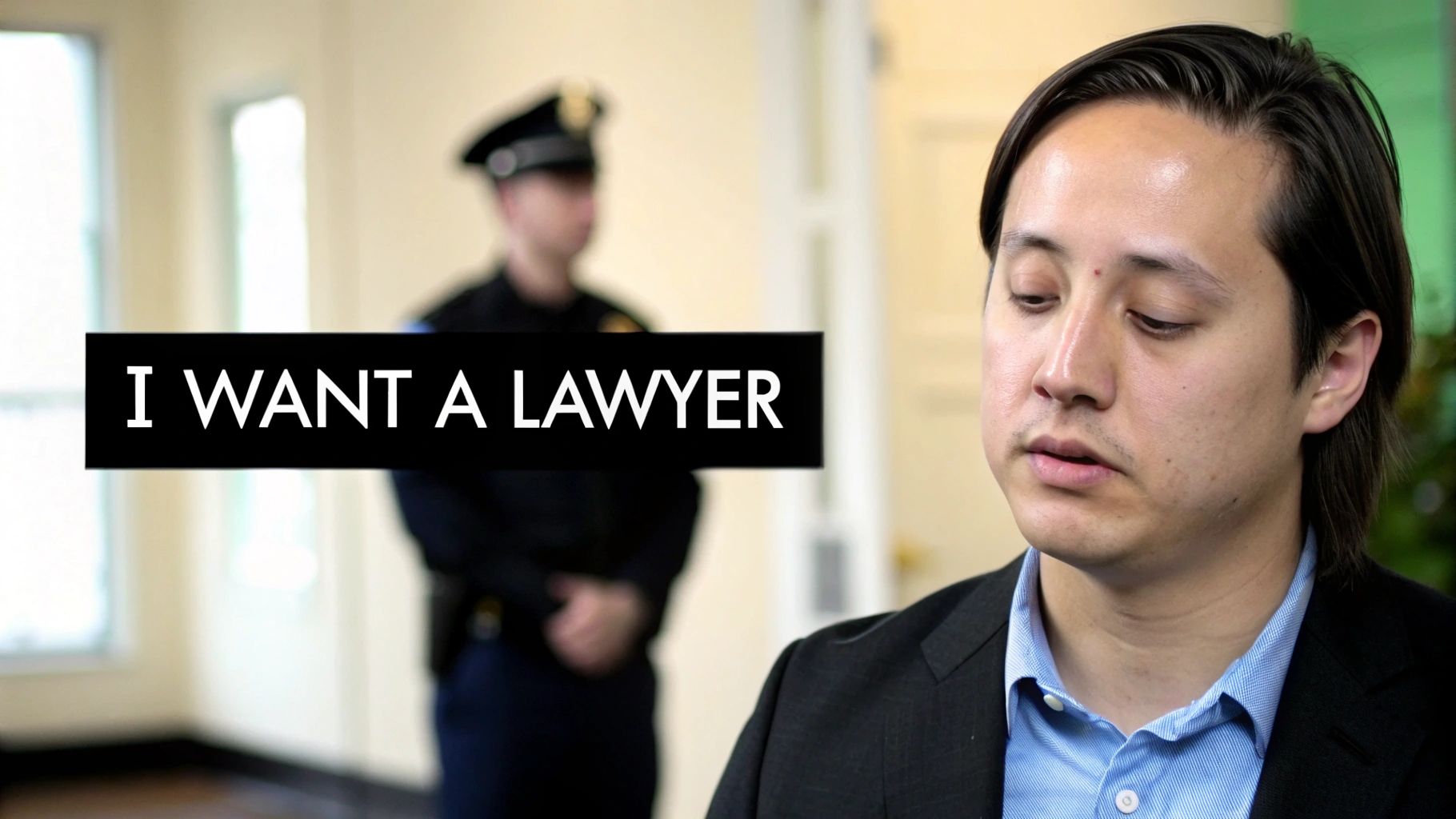
Knowing your rights is just the first step. The real challenge is knowing how to use them under the immense pressure of an arrest in Cumming or Alpharetta. The communication has to be crystal clear and direct.
If it is vague or hesitant, police might misinterpret what is being said and continue their questioning. The courts have been very clear on this: only a firm, direct statement will reliably stop an interrogation and provide protection.
Be Unambiguous and Direct
When invoking Miranda rights, there’s absolutely no room for “maybe.” Statements like, “I think I might need a lawyer,” or “Should I talk to someone?” just don’t cut it. An officer can often legally continue questioning if the language is uncertain.
To properly use these rights, a statement must be made that any reasonable officer would understand as a request to stop. Leave no doubt.
Key Takeaway: You must clearly and affirmatively state that you are exercising your rights. Anything less can be seen as a willingness to keep talking, which leaves a person vulnerable.
Once that unambiguous request for a lawyer or statement to remain silent is made, the interrogation is supposed to halt. That pause is everything—it gives the space needed to think and get assistance.
How to Invoke Your Right to Remain Silent
Exercising the right to remain silent is more than just staying quiet. It actually has to be said. Simply refusing to answer questions without verbally invoking the right might not be enough to stop the questioning.
To do it effectively, one should state clearly and calmly:
- “I am exercising my right to remain silent.”
- “I do not wish to speak with you.”
- “I am invoking my Fifth Amendment rights.”
After saying this, do not answer any more questions about the incident. Consistency is crucial. Answering some questions but not others can complicate things and could be interpreted as waiving these rights.
How to Invoke Your Right to an Attorney
The right to an attorney is just as critical, and the rule is the same: be direct. A fuzzy mention of a lawyer isn’t going to work.
A clear request needs to be made, such as:
- “I want a lawyer.”
- “I will not speak to you without my lawyer present.”
Once a clear request for counsel is made, all questioning must cease until an attorney is there. This is a bright-line rule that officers must follow. If they keep questioning after a clear request, any statements made may be thrown out. To understand more about that process, you can read our guide on the motion to suppress evidence.
Remember, using these rights is not an admission of guilt. It’s a smart, constitutionally protected way to handle a difficult and intimidating situation. Being firm and clear is how you make sure these protections are honored.
Miranda Rights FAQs: Your Questions Answered
Even after laying out the basics, Miranda rights can still feel complicated. Real life is messy, and what happens in a police encounter rarely looks as clean and simple as it does on TV. Here, we’ll tackle some of the most common questions people ask about their rights during police stops in Georgia.
Think of this as a quick-reference guide to reinforce what we’ve already covered. These are the practical, real-world concerns that come up time and again.
If the Police Didn’t Read Me My Rights, Does My Case Get Dismissed?
This is easily the biggest myth in this area of information. The short answer is almost always no—a Miranda violation doesn’t automatically get a case thrown out.
The consequences for a Miranda mistake are actually very specific. It only becomes a real issue if three things happened:
- The individual was in custody (not free to leave).
- The police started interrogating them (asking questions designed to get an incriminating answer).
- They made incriminating statements during that interrogation.
If all three of those conditions are met, the solution isn’t to dismiss the case. Instead, a lawyer may file a motion to suppress the statements. This means the prosecutor can’t use what was said against the person in court. While losing a key confession can cripple the state’s case and might lead to a dismissal down the road, it’s not a guarantee. Any other evidence they have—physical evidence, witness testimony, video—is still fair game.
What If I Start Talking and Then Want to Stop?
An interrogation can be stopped at any time. It doesn’t matter if rights were already waived and questions were answered. A person always has the right to change their mind.
To do it, the statement has to be crystal clear. It is necessary to say something direct and unambiguous like, “I want to remain silent,” or “I want a lawyer.” Once a statement that clear is made, the police are required to stop all questioning immediately.
Just remember, anything said before the rights were invoked can still be used. The key is to be firm and direct the moment the decision is made to stop talking. That’s what slams the door shut on the interrogation.
Do Miranda Rights Apply During a Georgia DUI Stop?
This is a tricky one, and it all comes down to timing. During a typical roadside DUI investigation in Georgia, an individual is not considered to be in “custody” for Miranda purposes.
That means the officer can ask questions like, “How much have you had to drink tonight?” or ask for performance of field sobriety tests without reading any rights first. At that stage, it’s considered a temporary detention for investigation, not a formal arrest.
The game changes completely the second the officer puts the person in handcuffs and tells them they’re under arrest. From that point on, they are officially in custody. Any interrogation that follows must be preceded by a Miranda warning.
This is a critical distinction. A lot of people think their rights kick in the moment they see flashing blue lights, but in Georgia, it’s the formal arrest that triggers the protection.
Are Miranda Rights Different for a Misdemeanor vs. a Felony?
No, not at all. Miranda rights are exactly the same whether a person is accused of shoplifting or a serious felony. The protections of the Fifth and Sixth Amendments don’t scale based on the severity of the crime.
The standard for when the warning is required never changes. It always comes down to two simple factors: custody and interrogation. If a person is in custody and the police start questioning them, they have the right to be told they can remain silent and have a lawyer. The charge itself makes no difference.
Can the Police Lie to Me During Questioning?
Yes, they absolutely can, and it’s a common tactic. Police are allowed to use deception during an interrogation. They might lie and say they have evidence they don’t, like fingerprints on a weapon, or claim a friend in the next room already confessed and blamed the individual.
These tricks are designed to create a feeling of hopelessness and pressure to talk. While they can lie, what they can’t do is make threats or false promises that would make a confession involuntary. For example, an officer can’t threaten to harm family or promise probation if a confession is given. The line is drawn at coercion. This is a huge reason why having an attorney present is so critical—they can see through these tactics and provide protection.
What if I’m Not a U.S. Citizen?
Miranda rights apply to every single person on U.S. soil. It doesn’t matter what their citizenship or immigration status is. If a person is in the U.S. and police take them into custody for interrogation, they must be read the Miranda warning. They have the exact same right to remain silent and the same right to an attorney as a U.S. citizen.
Additionally, if a person is a foreign national, the Vienna Convention on Consular Relations gives them the right to contact their country’s consulate. Police should inform them of this right after they’re taken into custody. These rules ensure everyone is given the same basic protections.
Understanding your rights is the first step, but navigating the complexities of the criminal justice system in areas like Alpharetta, Cumming, or Forsyth County requires experienced guidance. If you are facing criminal charges, the stakes are too high to go it alone. The team at Brian Hansford Law has the knowledge and experience to protect your rights and fight for the best possible outcome. For a dedicated defense, contact us to see how we can help. Learn more at challengemycharge.com.
