
You open the mail after a DUI arrest, a reckless driving stop, or a crash tied to a traffic case in Alpharetta or Cumming, and the language doesn't even sound criminal. It says motion for default. Many drivers freeze at that point because they assume they've already lost.
You haven't. But you also can't ignore it.
A motion for default usually shows up on the civil side of a problem that started with a traffic stop, license issue, accident, or parallel lawsuit. That matters because your criminal case and your civil exposure can move on separate tracks at the same time. A person can be fighting a DUI in Fulton County while also dealing with a license problem or a damages claim tied to the same event.
If you're searching for a DUI lawyer in Alpharetta, a traffic ticket attorney in Cumming, a reckless driving lawyer in Roswell, or a license suspension lawyer near me, this is one of the hidden risks that can cost you money, driving privileges, and your strategic advantage if you wait too long.
What a Motion for Default Means for Your Case
A motion for default means the other side is telling the court that you failed to respond the way the rules required. In plain terms, they're trying to win because you missed a procedural step, not because a judge has already heard all the evidence and ruled against you.
That distinction matters. A motion for default is serious, but it is not the same thing as a criminal conviction, and it is not automatically a final civil judgment either.

Why this catches people off guard
In North Atlanta, this often starts with ordinary confusion. Someone gets arrested for DUI in Johns Creek. Someone else gets a reckless driving citation in Milton after an accident. Another person misses paperwork tied to a license issue in Forsyth County because they're focused on the criminal court date and assume that's the only deadline that matters.
Then the civil paperwork starts moving.
A default problem can grow out of:
- An accident-related lawsuit after a traffic or DUI arrest
- A missed response deadline in a civil case tied to the same incident
- A licensing or administrative issue where the person didn't appreciate how fast deadlines arrive
- A bad address problem where notices went somewhere you weren't watching carefully
Practical rule: If a court paper uses the word “default,” treat it like an emergency even if it doesn't look connected to your criminal charge.
What it is not
It isn't the court saying you're guilty of DUI, drug possession, speeding, or reckless driving. It also isn't proof that the other side followed every required step correctly.
In practice, I tell people to stop asking, “Did I already lose?” and start asking better questions:
- What deadline did the other side say I missed?
- Has default already been entered, or are they only requesting it?
- Is there already a hearing date?
- What filing can still be made right now to protect me?
Those questions lead to action. Panic doesn't.
The Default and Default Judgment Process in Georgia
Think of default like forfeiting a game. Missing the deadline doesn't always end the matter on the spot, but it gives the other side a path to ask the court for that result. Many people use default and default judgment as if they mean the same thing. Courts often don't.
Federal practice is a useful model because it makes the sequence easy to see. Under Rule 55, the clerk enters default when a party “has failed to plead or otherwise defend,” and default judgment comes later under a separate step, as noted in the Western District of Wisconsin default judgment packet. The same packet also shows a strict two-step filing sequence, which is why sloppy online advice causes so many problems.
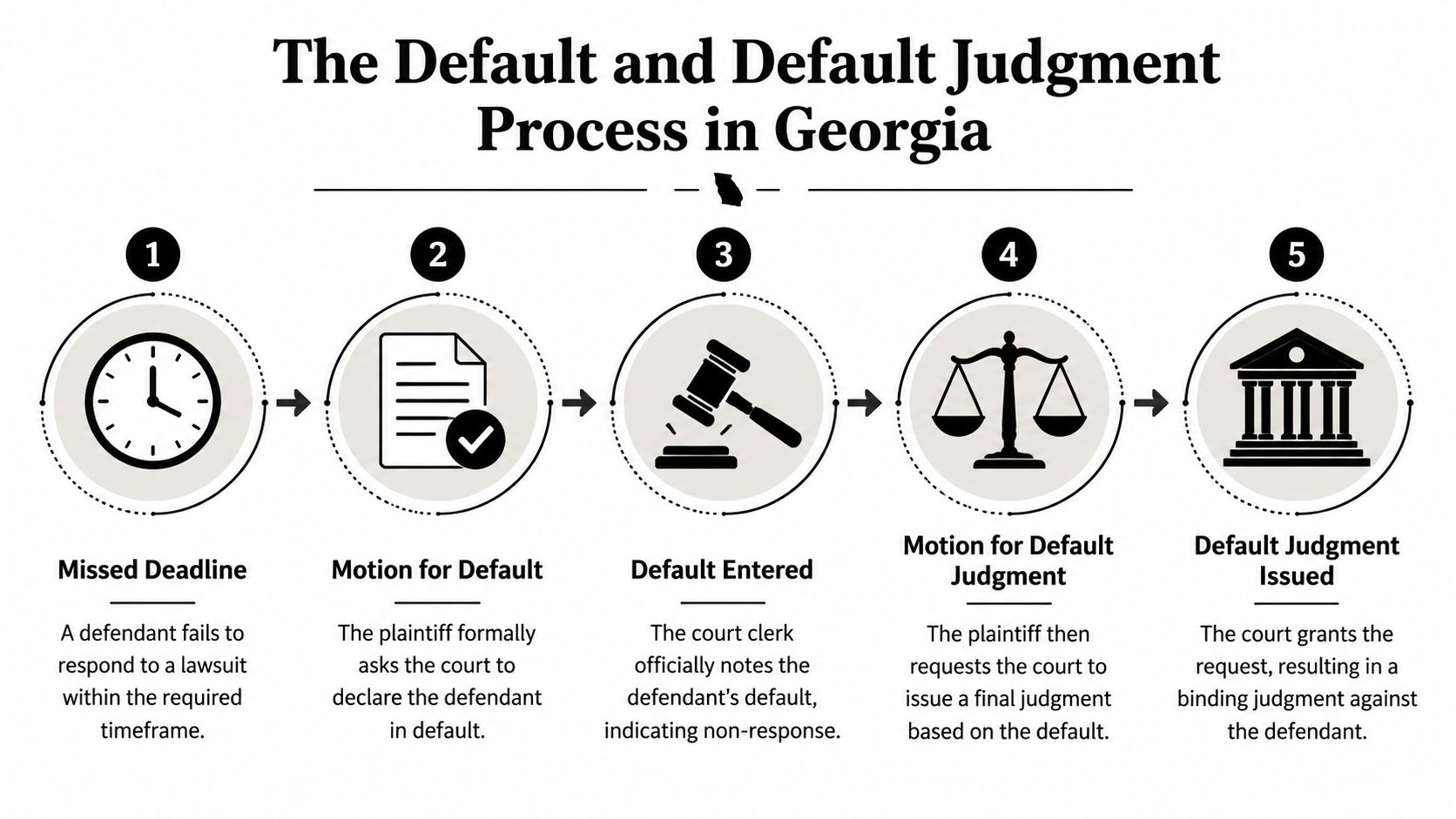
The sequence that matters
Here is the practical order people need to understand:
- A deadline is missed. The defendant doesn't respond in time.
- The plaintiff asks for default. This is the request that the court recognize the non-response.
- Default gets entered. In many systems, the clerk handles that initial procedural step.
- The plaintiff seeks default judgment. That is the request for actual relief.
- The court decides what judgment, if any, should be entered.
That sequence is why you should never assume one paper means the whole case is over.
Where people make costly mistakes
The biggest mistake is silence. The second biggest is filing the wrong thing in the wrong place because someone confused a missed criminal court date with a civil response deadline.
If you've also missed a court appearance, it helps to review practical information on warrant checks and court options so you can separate the criminal exposure from the civil default issue and address both without guessing.
The paperwork may look routine, but default problems are procedural traps. The person who acts first and correctly usually has the advantage.
Why the distinction matters in real life
For a driver in Marietta, Sandy Springs, or Duluth, this can affect more than paperwork. A default path can put pressure on your finances, insurance position, and negotiating position while your criminal or traffic case is still pending.
That's why the right response is rarely “wait and explain it later.” The right response is to identify exactly where the case sits in the sequence and file accordingly.
Where Default Motions Intersect with Criminal Charges
The most dangerous default cases are the ones people don't recognize as part of their criminal defense problem. They think, “I need a DUI attorney,” or “I need a speeding ticket lawyer,” but they don't realize the same event can create a second legal front.
A DUI arrest, reckless driving charge, or drug case can trigger consequences outside the criminal courtroom. A crash can produce a civil lawsuit. A missed hearing or ignored notice can create separate procedural damage. The result is that someone defending one case can lose ground badly in another without understanding how the pieces fit.
The accident case people ignore
This is common after a wreck tied to reckless driving or DUI allegations. The criminal case is in one court. The injured driver's claim for money damages is somewhere else. If the defendant ignores the lawsuit because they're focused on avoiding jail, points, or license consequences, the civil plaintiff may push for default.
That doesn't mean the plaintiff automatically gets everything requested. In federal court, a motion for default is still only part of a two-step process. After default is entered, the plaintiff can apply for default judgment, and if the claim isn't for a “sum certain,” the court, not the clerk, must enter it. A defendant who has appeared is also entitled to at least 7 days' written notice before the default-judgment hearing, according to the District of Massachusetts default judgment procedure guide.
That notice point can matter. It gives counsel room to challenge procedure, appearance issues, damages proof, or the sufficiency of the claim.
The license problem that snowballs
People facing DUI charges in Alpharetta, Roswell, and Forsyth County often focus on bond conditions, court dates, and whether they can avoid a conviction. Those are major issues. But the license side moves fast and can create its own crisis if ignored.
If you're sorting out the first steps after an arrest, this guide on what to do after a DUI arrest helps frame the bigger picture so you don't overlook the administrative and civil fallout while focusing only on the criminal accusation.
The ticket that becomes a file problem
Not every default risk starts with a major felony or DUI. Sometimes it starts with a speeding case, a suspended-license issue, or a minor collision where the paperwork looked unimportant. That's why I tell people to gather every document before they decide what matters.
If you need help organizing the facts in a traffic matter, tools that walk through how to analyze traffic tickets with AI can help you sort citations, dates, and allegations before you sit down with counsel. That kind of review isn't a substitute for legal advice, but it can help you spot which documents belong to the criminal case and which belong to a separate civil or administrative problem.
A missed response in a civil case can hit your bank account and property while your criminal case is still being negotiated.
Why one strategy has to cover both fronts
A narrow defense can fail even when the criminal case is manageable. If your lawyer only addresses the DUI, drug possession, or traffic charge, but nobody responds to the civil default threat, you may end up protecting your record while losing ground elsewhere.
That's why serious representation in Fulton County, Cobb County, Gwinnett County, and Cherokee County has to account for the entire event. Not just the charge. Not just the court date. The whole chain of consequences.
How to Fight a Default Motion in Georgia
Georgia law gives defendants a real path to recover from default, but the path is technical and time-sensitive. The core point is simple. A default can sometimes be opened before final judgment, but the court expects a proper legal showing, not excuses written in a hurry.
Under Georgia practice, default may be opened before final judgment if the movant shows providential cause, excusable neglect, or another proper case. The showing must be under oath, must include a meritorious defense, and must be accompanied by an immediate offer to plead and pay costs, as reflected in O.C.G.A. § 9-11-55.
What the court usually wants to see
Judges want specifics. “I was busy” usually won't carry much weight. “I never took it seriously” is worse. The court is looking for a legally recognizable basis to reopen the case and a real defense worth hearing.
That usually means building a response around these elements:
- A sworn explanation that tells the court why the default happened
- A meritorious defense that shows the case should be decided on the merits
- Immediate action to file the responsive pleading and address costs
- A clean procedural request that asks for the right relief in the right court
Georgia Default Motion Deadlines and Requirements
| Timeline | Action Required | Legal Standard |
|---|---|---|
| As soon as default is discovered | Review the complaint, service history, court docket, and any hearing dates | Urgency matters because delay weakens credibility |
| Before final judgment | File the appropriate motion to open default with supporting sworn material | Must show providential cause, excusable neglect, or another proper case |
| At the time of the request | Present a meritorious defense | The court expects more than a bare denial |
| With the filing | Make an immediate offer to plead and pay costs | Required under Georgia practice for opening default |
| At hearing or submission | Be prepared to explain both the failure and the defense clearly | Courts focus on facts, diligence, and procedural compliance |
What works and what doesn't
What works is a prompt filing backed by facts. That means dates, documents, a sworn affidavit, and a proposed response that shows the court there is a genuine dispute to litigate.
What usually doesn't work:
- Waiting to see what happens
- Calling the other side without filing anything
- Sending an informal letter and assuming it solved the issue
- Giving the court reasons without giving the court a defense
- Filing something fast but unsupported
What judges tend to hear: “If I open this default, is there a real case to decide, and has this person acted responsibly once the problem became clear?”
Why the defense itself matters
A lot of people focus only on the excuse. That's only half the job. Georgia courts also want to know why your side should be heard at all. If there's no meaningful defense, opening default becomes harder to justify.
That's one reason pretrial strategy matters. If you're trying to position the case for an early attack, this discussion of how to get a case dismissed before trial helps explain why legal sufficiency, evidence problems, and procedure all matter before a case ever reaches a final hearing.
Why You Need an Experienced Defense Attorney Immediately
Default problems punish hesitation. They also punish half-measures.
This isn't a niche procedural corner of the law. Default practice has been part of the litigation system for decades, and the Federal Judicial Center's review of Rule 55 notes both the long-running role of default practice and the importance of the rule-based sequence that makes default the gateway to judgment rather than the judgment itself, as discussed in the Federal Judicial Center Rule 55 report.
What a lawyer actually does in this situation
An experienced defense attorney does more than “file something.” Counsel identifies whether the actual problem is service, timing, appearance, proof, damages, notice, or the adequacy of the motion itself. That changes the response.

In practical terms, counsel may need to:
- Audit the docket for what was filed and what wasn't
- Prepare sworn materials that support excusable neglect or another proper basis
- Draft the responsive pleading so the court sees a live defense
- Challenge the other side's sequence if they skipped a required step
- Appear in court quickly in Alpharetta, Cumming, Marietta, or elsewhere in North Atlanta
Why local criminal defense experience matters
A lawyer handling DUI, reckless driving, license suspension, and misdemeanor defense work sees the overlap that general advice often misses. The civil filing may affect insurance pressure, settlement posture, or a client's ability to keep driving and keep working. The criminal case may affect what can safely be said in the civil one.
That's why clients should be careful about DIY filings and “I'll just explain it to the judge” plans. Those approaches often create admissions, waive arguments, or fail to satisfy the sworn and procedural requirements Georgia courts expect.
For people evaluating counsel, this guide on how to find a good criminal lawyer is worth reading because the right fit in a default-related matter is someone who can handle urgency, court process, and the overlap between civil and criminal exposure.
The fastest way to lose leverage is to treat a default issue like paperwork instead of litigation.
One practical option for fast intervention
For North Atlanta clients dealing with both criminal charges and related civil response issues, Brian Hansford Law provides criminal defense representation in matters such as DUI, drug offenses, theft, and other charges, and can help evaluate how a civil default threat fits into the larger defense strategy.
Protect Your Rights Before It's Too Late
A motion for default threatens more than a file. It can threaten your license, your property, your money, and your ability to defend yourself on fair terms. The danger is that it often arrives while you're already overwhelmed by a DUI case, a reckless driving charge, a speeding ticket, or a license suspension issue.
The good news is that default is often still fightable when you move quickly and do it correctly. The bad news is that delay gives the other side momentum.
If you're in Alpharetta, Cumming, Roswell, Johns Creek, Milton, Marietta, or anywhere in Fulton, Forsyth, or Cobb County, the safest next step is to gather every paper you've received and get a lawyer's eyes on the timeline immediately. Don't sort the documents into “important” and “probably not important” on your own. That's how people miss the filing that changes everything.
There's also a practical privacy concern after court involvement. If your case has already created an online trail, you may want to learn how to clean up your online legal footprint once the immediate court response is under control.
What matters right now is speed, accuracy, and strategy. If the other side is pushing for default, your job is not to hope it goes away. Your job is to respond before a procedural problem turns into a judgment that hits your future long after the traffic stop or arrest is over.
If you're dealing with a motion for default after a DUI, traffic stop, accident, or related criminal charge in North Atlanta, contact Brian Hansford Law for a free, confidential consultation. Fast action can protect your rights, your license, and your financial future in Alpharetta, Cumming, Roswell, Johns Creek, Milton, Marietta, and surrounding courts.
