
You leave court in Alpharetta, Marietta, or Cumming thinking the case is over. Then the consequences start landing. Your license is at risk. The DUI or reckless driving plea you accepted suddenly looks much worse than it did in the hallway. Or your lawyer stops responding, and your next hearing is getting close.
That kind of panic is common in criminal cases. It also creates bad decisions if you move too slowly or trust the wrong advice.
A motion to withdraw can be the right tool, but only if you understand which kind of withdrawal you mean. In one situation, you're asking the court to let you take back a plea. In another, your lawyer is asking the court for permission to step out of the case. Those are very different problems, and they require different strategies.
For DUI, drug possession, traffic, misdemeanor, and felony cases in North Atlanta, timing matters. Judges care about deadlines, prior hearings, and whether the request is real or just a delay tactic. If you're facing a court date in Roswell, Johns Creek, Milton, Sandy Springs, Duluth, or the surrounding counties, the right next move depends on the exact posture of your case.
Regretting a Plea Deal or Losing Faith in Your Lawyer
A lot of people arrive at this issue the same way. They pled guilty to a DUI in Roswell or a traffic charge in Marietta because they wanted to get out of court, avoid more stress, or because someone told them it was the safest option. A few days later, they realize the plea didn't just end the case. It triggered bigger problems.
Sometimes the problem isn't the plea. It's the relationship with counsel. Calls aren't returned. Questions get brushed off. A key hearing is approaching in Fulton County or Forsyth County, and you don't trust the person standing next to you in court.
That doesn't always mean the case is lost. It means the case needs a careful reset.
Two crisis points that often trigger this issue
One is plea regret with a legal basis. You may believe you agreed to something without understanding the long-term impact on your license, job, immigration status, or criminal record.
The other is a breakdown with your lawyer. You may want to change attorneys, or your attorney may be trying to leave the case.
A motion to withdraw matters because it affects your representation, your deadlines, and sometimes your ability to keep fighting the charge at all.
What works is acting early, gathering the right documents, and getting clear about what happened. What usually doesn't work is telling the judge, "I changed my mind," without anything more. Judges hear regret every day. They respond to facts, timing, and procedure.
What to do right now
If you're in this position, focus on three things first:
- Get the paperwork. Pull the accusation, citation, plea documents, bond conditions, and any notice of upcoming court dates.
- Write down the timeline. Include when you entered the plea, what advice you were given, and when communication with counsel started breaking down.
- Get a second legal review quickly. If you're trying to decide whether current counsel is still the right fit, this guide on how to find a good criminal lawyer can help you evaluate your options without guessing.
Two Critical Motions With One Name
You call the clerk in Alpharetta and say you need to file a "motion to withdraw." That phrase can mean two very different things, and filing the wrong one can cost time you may not have. In a DUI, drug, or traffic case, that mistake can affect whether you keep your trial options, whether you stay represented, and how much control you have over the next court date.
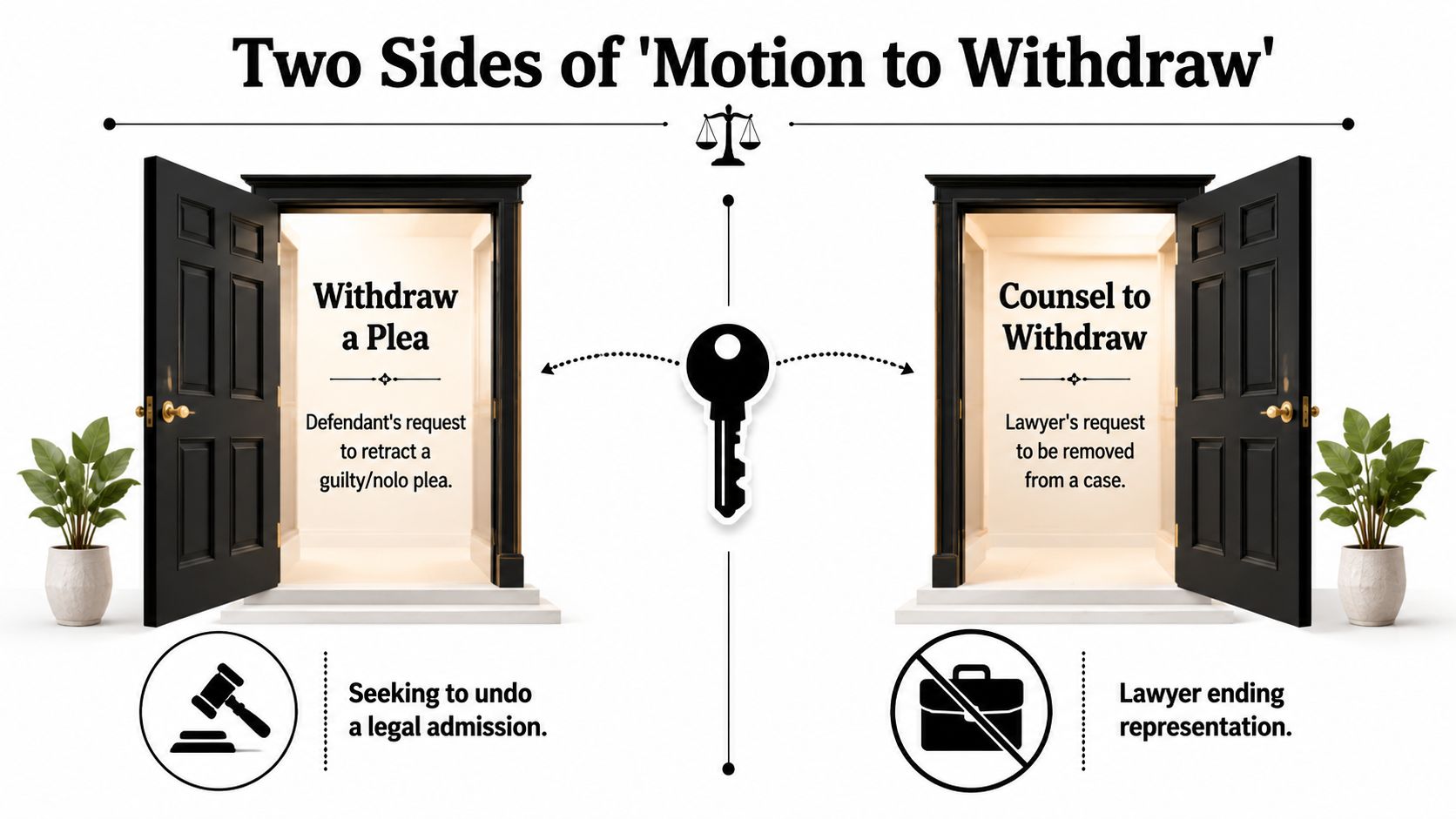
One motion is filed for you. The other is filed about you.
Withdrawing a plea
This is the defendant's request to take back a guilty plea or nolo plea. If the judge allows it, the case goes back into a posture where the charge can be challenged instead of carried out through sentencing or probation terms.
From a defense standpoint, this motion is about restoring options. It may be the difference between living with a rushed plea and getting another chance to contest the stop, the testing, the search, or the facts. If you are weighing that route, this explanation of whether you can appeal a plea bargain after the fact helps clarify why plea withdrawal is often the immediate issue, not appeal.
Counsel withdrawing from the case
This is the lawyer's request to leave the case. A judge usually must approve it, especially when a hearing, trial, or sentencing date is close.
That matters to you for a practical reason. If your lawyer asks to withdraw, the court does not automatically pause your case until you feel ready. Deadlines can keep running. Discovery issues, motions deadlines, and court appearances still have to be handled. In North Atlanta courts, judges often focus on timing, prejudice to the client, and whether the withdrawal will disrupt the calendar.
Why clients get these mixed up
In my practice, clients often use "withdraw" as shorthand for any major reset they need. The court does not. Judges treat these as separate requests with separate consequences.
A person in Johns Creek or Marietta might mean any of the following:
- "I want to undo my plea." That is a plea-withdrawal motion.
- "I want to replace my lawyer." That may require substitution of counsel, and sometimes a motion by current counsel to withdraw.
- "My lawyer is trying to get off the case before trial." That puts the court's approval and your protection front and center.
- "I need new counsel so I can start fighting the DUI the right way." That can involve both attorney withdrawal and a larger defense reset.
The first step is naming the problem correctly. If the legal issue is unclear, the remedy usually is too.
A quick comparison
| Issue | Who usually files it | Main goal |
|---|---|---|
| Withdraw a plea | Defendant through counsel | Undo a guilty or nolo plea |
| Counsel withdraws | Lawyer | End representation with court approval |
For your case, the distinction is not technical wordplay. It determines what facts matter, what deadline controls, and what the judge needs to see before granting relief.
How to Withdraw a Guilty Plea in Georgia
If you want to take back a plea in Georgia, regret alone won't carry the day. A judge is looking for a real legal reason. In criminal practice, that usually comes down to whether the plea was entered knowingly and voluntarily, and whether there's good cause to let you withdraw it.
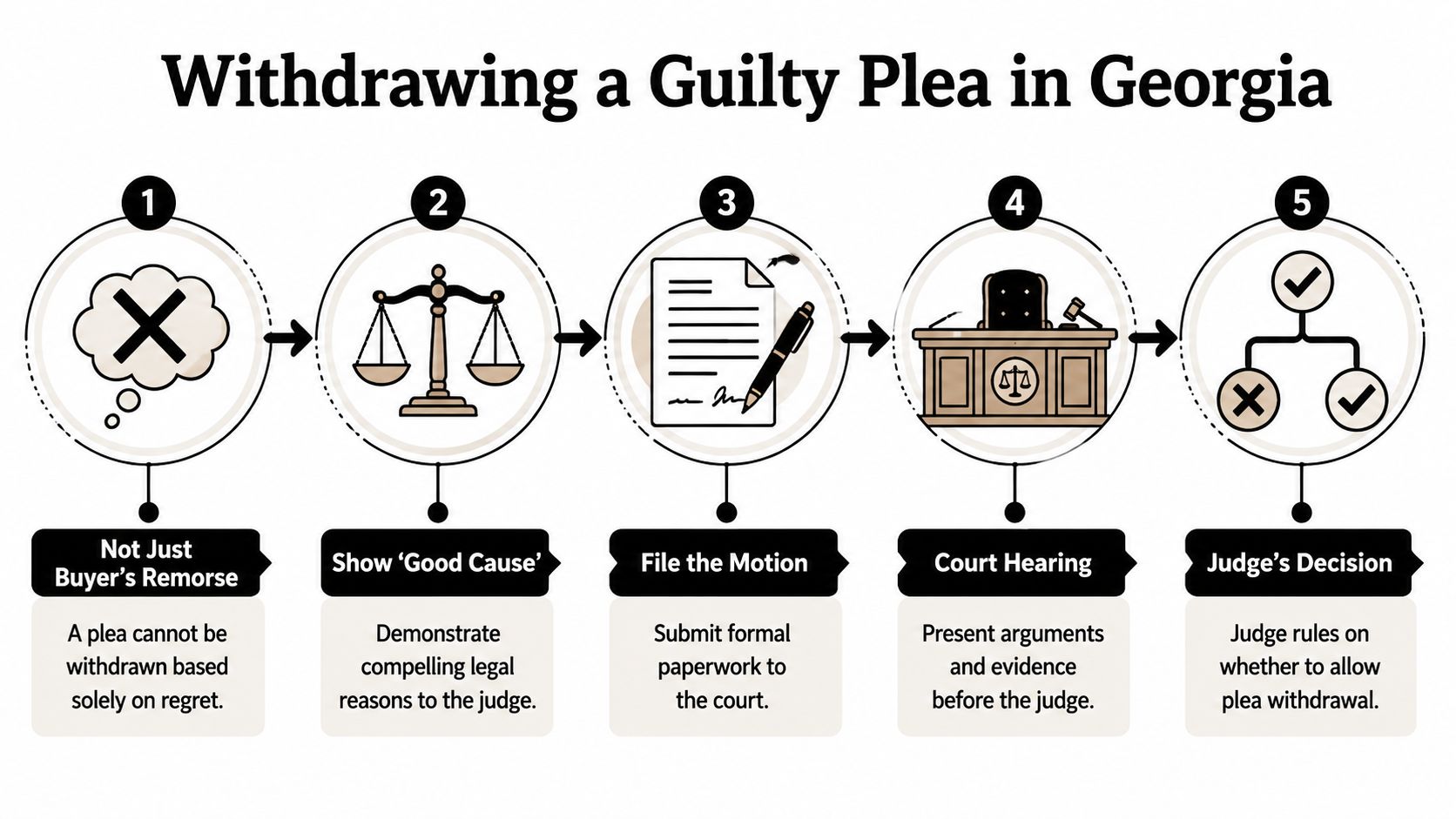
A useful reference point comes from California plea-withdrawal practice. In that context, a defendant must generally move before sentencing, or within six months after a probationary sentence, and must show "good cause" such as mistake, ignorance, inadvertence, or ineffective assistance of counsel rather than mere buyer's remorse, as described in this discussion of withdrawing a DUI plea under Penal Code section 1018. That same core idea applies here. You need more than regret. You need a substantive reason.
What good cause can look like
Judges usually want specifics. For a DUI lawyer or misdemeanor defense attorney handling a Georgia plea-withdrawal issue, common fact patterns include:
- Bad advice about consequences. A person pleads without understanding the license impact, employment fallout, or another serious collateral consequence.
- Failure to explain the plea terms. The defendant failed to understand what rights were being given up.
- New information that changes the case. Evidence problems or undisclosed issues emerge after the plea.
- Ineffective assistance concerns. The plea may have been entered based on legal advice that was materially deficient.
A weak motion says, "I want another chance." A stronger motion ties the plea to a concrete problem in the decision-making process.
What to gather before filing
Don't rely on memory alone. Build the record.
Start with the plea paperwork, transcript if one exists, any written waiver forms, your lawyer's correspondence, and anything showing what you were told before entering the plea. If the issue involves your DUI attorney's advice about a suspension, an ignition interlock consequence, or a professional-license concern, preserve every message and note.
If the judge sees a clean, documented timeline instead of a vague complaint, your position becomes much easier to understand and defend.
Why speed matters
Plea-withdrawal issues are time-sensitive. Delay makes everything harder. The longer you wait, the more a judge may suspect the motion is about second thoughts rather than a real defect in the plea.
For many people, the next smart step is to get a second opinion on whether the plea can still be challenged or whether another route makes more sense. If you're sorting through that decision, this page on whether you can appeal a plea bargain is a helpful place to start.
Using Plea Withdrawal to Fight Your DUI Charge
A plea-withdrawal motion isn't just a reset button. In the right DUI case, it's a way to reopen the entire defense.
That matters because many people plead before the case has been fully tested. They take the deal based on the police report, the arrest narrative, or pressure from a looming court date. Later, a closer review shows the stop was weak, the detention expanded without proper justification, or the blood or breath evidence may have constitutional problems.
The strongest DUI cases connect the plea to a defect in the evidence
For DUI cases, plea withdrawal often works best when paired with suppression litigation. The advantage arises from demonstrating the original plea was based on evidence that should have been excluded. If key evidence such as an unconstitutional blood draw is suppressed, the prosecution's case can collapse, creating a concrete reason the earlier plea shouldn't stand, as explained in this analysis of motions to suppress in DUI cases under Penal Code section 1538.5.
The principle is straightforward. If the evidence that pushed you into the plea turns out to be vulnerable, the plea itself becomes vulnerable too.
What that strategy looks like in practice
In a North Atlanta DUI or reckless driving case, the defense often needs to ask questions like these:
- Was the initial stop lawful. Did the officer have a valid reason to stop the vehicle in the first place?
- Did the encounter expand too far. A lawful stop can still become unlawful if the detention goes beyond what the facts support.
- Was the arrest supported. Probable cause isn't automatic just because an officer says it was.
- How was the chemical evidence obtained. Blood and breath evidence can raise separate legal issues.
A motion to withdraw becomes much stronger when it's tied to a fact-specific defense theory rather than a general complaint about the outcome.
What doesn't work
What usually fails is filing a motion that treats withdrawal as pure fairness. Judges don't revisit DUI pleas just because the sentence now feels harsh.
What can work is showing that the plea happened before critical defects were uncovered, or before you understood facts that would have changed the decision to plead.
The best plea-withdrawal arguments in DUI cases don't ask for sympathy. They show why the original plea decision was legally unreliable.
If you're trying to reopen a DUI case in Alpharetta, Roswell, or Cumming, a useful next step is reviewing the broader defense strategy, not just the motion itself. This guide on how to beat DUI charges can help frame the underlying issues that may support a stronger challenge.
What Happens When Your Lawyer Wants to Quit
Getting served with a motion for your attorney to withdraw can feel like the floor just dropped out. Most clients immediately ask the same question. "Am I going to court alone?"
In many cases, the answer is no, at least not immediately. Your lawyer cannot stop showing up because the relationship has gone bad. Withdrawal in a pending case is controlled by the court.
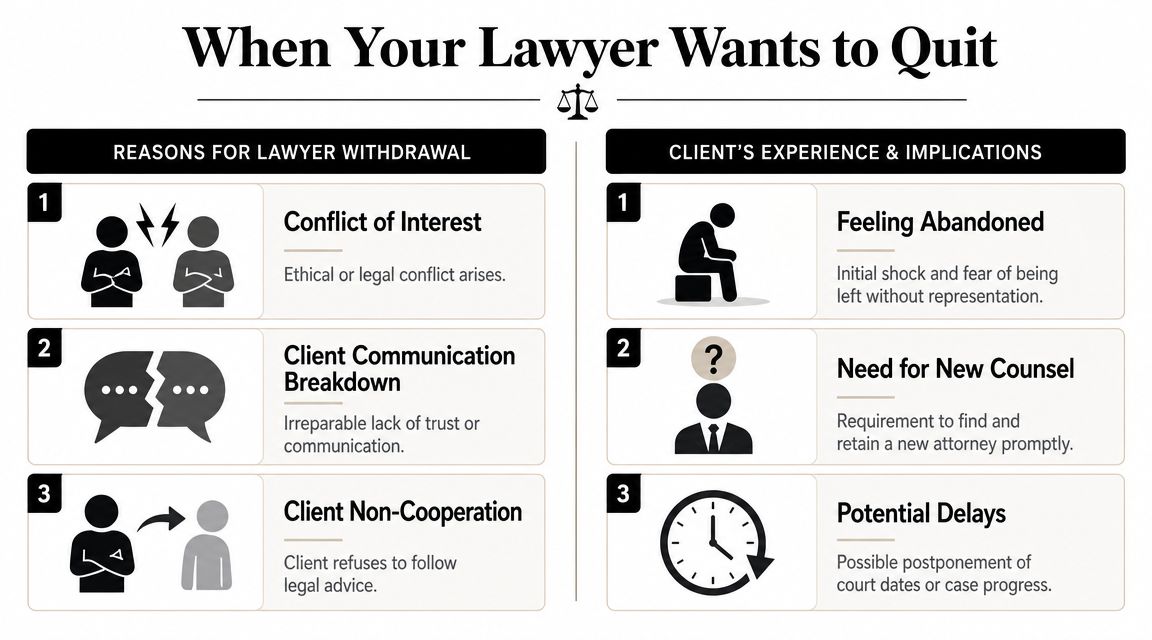
Why lawyers seek to withdraw
Some reasons are practical. Others are ethical.
A lawyer may seek withdrawal because communication has collapsed, the client won't cooperate in preparing the case, the client demands improper action, or the attorney-client relationship has become unworkable. In some situations, the issue is fee-related. In others, the problem is much deeper and affects whether competent representation is still possible.
There's also an important ethical limit on how much the lawyer can say publicly when asking to get out. Legal ethics commentary discussing ABA Formal Opinion 519 explains that, absent an exception or informed consent, a lawyer may not reveal "information relating to the representation" to support the motion, and if disclosure is necessary it should be precisely limited and preferably submitted in camera or under seal. That same commentary also discusses a Tennessee disciplinary case where a lawyer's public filing exposed confidential client information and led to a suspension, as summarized in this discussion of noisy withdrawal problems and confidentiality limits.
What protections the court can provide
Courts can deny an attorney's motion to withdraw if granting it would materially harm the accused. Guidance also shows courts can impose conditions and require specific notice about pending deadlines, which confirms that withdrawal is a managed legal event, not just a private decision between lawyer and client, as described in this overview of court handling of motions to withdraw and notice requirements.
That matters for people with DUI, drug, theft, or traffic cases in Alpharetta and Roswell. A judge may look closely at whether a key hearing, discovery deadline, plea setting, or trial is approaching.
What you should do if this happens
If your lawyer files a motion to withdraw, don't assume the case pauses on its own. It may not.
Use a checklist:
- Read the motion carefully. Find the hearing date, pending settings, and whether your lawyer says you consent or object.
- Get your file immediately. Ask for the citation, accusation or indictment, discovery, motions, and correspondence.
- Check future dates yourself. Don't rely on assumptions about continuances.
- Be ready to tell the court your position. If withdrawal would leave you exposed at a critical stage, that matters.
A judge is much more likely to take your concern seriously if you can point to the exact hearing, deadline, or trial setting that will be affected.
Local Court Practices in Alpharetta and North Atlanta
You hire a lawyer for a DUI in Alpharetta or a drug case in Marietta, then the case starts to slide. A plea date is coming up. Trust is gone. Or you need to withdraw a plea fast and the clerk tells you your case is already on a packed calendar. At that point, local practice affects your freedom in a very real way.
North Atlanta courts do not all handle these motions the same way. The written law sets the framework, but day-to-day results often turn on timing, notice, and whether the judge believes the request is legitimate or just a last-minute disruption. That is true in municipal courts handling traffic and misdemeanor cases, and it is just as true in State Court and Superior Court when more critical matters are involved.
Procedure can decide the outcome
A motion to withdraw lives or dies on details. Judges want the filing done correctly, served correctly, and brought at a time that does not unfairly derail the calendar.
Federal courts show how exact these rules can be. The Middle District of Florida requires at least 14 days' notice to the client before counsel moves to withdraw, unless the client consents. The motion must also address notice or consent and provide contact information if the person will proceed without counsel, under Middle District of Florida Local Rule 2.02. Georgia criminal courts have their own procedures, but the practical lesson is the same. If the filing is sloppy, the judge may never get to your side of the story.
What clients usually run into in Alpharetta, Cumming, and Marietta
In a real North Atlanta case, the court usually focuses on a short list of practical questions.
- Was the motion filed promptly? A judge is more receptive when the problem is raised early, not on the eve of trial or a plea calendar.
- Did everyone get proper notice? If notice is disputed, the court may focus on that before anything else.
- What court date is about to happen? A pending motion hearing, plea, trial call, or probation issue changes the risk analysis.
- Will granting the motion hurt your defense or just delay the case? Those are very different situations.
- Do you already have replacement counsel, or a concrete plan to proceed? Judges in busy dockets want answers, not uncertainty.
That matters to defendants directly. In Alpharetta Municipal Court, a traffic or misdemeanor case can move fast. In Forsyth, Cobb, or Fulton County, a DUI or drug case may involve more hearings, more discovery, and more room for timing disputes. Either way, waiting too long usually makes the problem worse.
What strong local practice looks like
The best filing tells the court three things clearly. What relief you want. Why you are asking now. What happens next if the judge grants it.
That last part gets overlooked. If your lawyer wants to withdraw, the court wants to know whether you need time to hire new counsel, whether a hearing must be reset, and whether any deadline will be affected. If you are trying to withdraw a guilty plea, the court wants a legally grounded reason and a record that supports it. Judges in North Atlanta courts see rushed, generic motions all the time. Generic usually loses.
A strong motion also respects the judge's calendar without sacrificing your rights. That balance matters in local practice. Courts are more willing to hear a serious request when the filing is specific, supported, and realistic about scheduling.
If your case is in Alpharetta, Cumming, Marietta, Roswell, Johns Creek, or Milton, do not assume a form pulled from the internet fits your court, your judge, or your deadline. In these cases, local procedure is part of the defense strategy.
Frequently Asked Questions About Motions to Withdraw
A lot of clients reach this point after a bad night and a worse court notice. You pled guilty because you felt boxed in, or your lawyer just told you they want off the case, and now the question is simple. Can this be fixed before the next court date?
Can I take back a guilty plea just because I regret it
Regret alone usually will not get a plea set aside. The issue is whether the plea was entered knowingly, voluntarily, and with a real understanding of the consequences.
If you were rushed, misinformed, confused about the license impact, or pressured into pleading without reviewing the evidence, those facts may matter. In DUI, drug, and serious traffic cases, that can be the difference between a closed case and a live defense.
Can I fire my lawyer in a criminal case
Yes, in many retained cases, but a pending criminal case still stays under the court's control. Your lawyer does not disappear because trust has broken down.
If you want new counsel, act before the relationship collapses completely. Waiting until the week of a plea or trial can limit your options, increase the chance of a continuance fight, and put you in front of the judge without a clear plan.
Will the judge let my lawyer quit right before trial
Sometimes. Sometimes not.
Judges look closely at timing, the reason for the request, and whether granting it would unfairly disrupt the case. If withdrawal would leave you unprepared for trial, the judge may deny it, continue the case under strict conditions, or require you to be ready with replacement counsel quickly.
If my lawyer withdraws, do I have to appear alone
You may. A motion to withdraw does not automatically cancel a hearing.
Until the court signs an order and resets the case, assume you are expected to appear. Missing court because you thought your lawyer had "handled it" can create a separate problem fast, including a bench warrant in some courts.
Does this only matter in felony cases
No. I see this issue in DUI, reckless driving, suspended license, drug possession, probation matters, city court traffic cases, misdemeanors, and felonies.
A plea in a lower-level case can still affect your record, job, insurance costs, immigration situation, driver's license, and future sentencing exposure. "Minor case" is not the same as "minor consequence."
What should I do today if this is happening in my case
Start with the basics, and do them now:
- Confirm your next court date and courtroom. Do not rely on memory or a text message.
- Get your full file together. That includes citations, accusation or indictment, plea paperwork, bond conditions, discovery, and messages with counsel.
- Write out a short timeline. Include arrest date, plea date, motions, court settings, and anything your lawyer told you about deadlines.
- Do not miss court while sorting this out. If you are unsure, show up.
- Get a second legal review fast. In these cases, delay costs options.
The goal is not to panic. The goal is to protect your position before a deadline closes off the best remedy.
If your DUI, traffic, drug, or criminal case in Alpharetta, Roswell, Johns Creek, Milton, Cumming, Marietta, or the surrounding North Atlanta counties involves a plea you want to challenge or a lawyer who may be stepping out, Brian Hansford Law can help you assess the situation quickly and decide on the next move. When court dates are close, the right strategy starts with a focused review of the file, the timeline, and the options still available.
