
A past criminal charge in Alpharetta, GA, can feel like a permanent roadblock, affecting your ability to get a job, secure housing, or even own a firearm. If a case from Fulton County is holding you back, it is critical to understand your legal options for moving forward. Two key remedies exist: a pardon and record restriction (Georgia's form of expungement). Choosing the right path requires a clear understanding of what each can and cannot do.
A pardon is an official act of forgiveness from the state. It restores rights lost due to a conviction, but the conviction itself remains on your public record. In contrast, record restriction (expungement) seals your arrest record from public view, making it inaccessible to most employers, landlords, and background check companies.
If you are facing the consequences of a criminal record from a case in Alpharetta, Roswell, or anywhere in North Fulton, taking strategic action is the only way forward. Call Brian Hansford Law today for a confidential consultation to determine the best path to protect your future.
Pardon vs. Expungement: An Overview for Alpharetta Residents

When a criminal record from a case in the Alpharetta Municipal Court or Fulton County State Court is holding you back, the first step is understanding the critical difference between a pardon and record restriction. In Georgia, these are not interchangeable terms. They are distinct legal tools with separate goals, processes, and outcomes.
For anyone living in North Fulton communities like Johns Creek, Milton, and Roswell, choosing the right strategy will directly shape your future. The choice depends entirely on what you are trying to accomplish.
A pardon is an official statement of forgiveness granted by the Georgia State Board of Pardons and Paroles. It does not erase or seal the conviction. Instead, it serves as a powerful testament to your rehabilitation. A pardon can restore civil rights lost from a felony conviction, such as the right to serve on a jury or hold public office in Georgia.
Record restriction, which is what people in other states call "expungement," focuses on privacy. It restricts public access to your arrest record. Once a charge is successfully restricted, it should not appear on most background checks run by employers or landlords in places like Sandy Springs or Cumming.
It is essential to get this right. Are you seeking official forgiveness from the state, or do you need the privacy that comes from a sealed record? Your answer will determine which path we take. For a more detailed analysis, see our guide on the difference between expunged and sealed records.
Pardon vs. Record Restriction At a Glance for Your Alpharetta Case
Here’s a quick breakdown of how these two legal remedies compare. This table cuts straight to the core differences, showing what each tool does and how it affects your record.
| Aspect | Georgia Pardon | Georgia Record Restriction (Expungement) |
|---|---|---|
| Primary Purpose | Official forgiveness and restoration of civil rights. | Seals the arrest record from public view for privacy. |
| Effect on Record | The conviction remains visible on your criminal history. | The arrest record is sealed and hidden from the public. |
| Granting Authority | Georgia State Board of Pardons and Paroles. | The court where the charge originated (e.g., Alpharetta Municipal Court, Fulton County State Court). |
| Main Benefit | Demonstrates rehabilitation, restores rights (e.g., jury duty, firearm rights). | Prevents most employers and landlords from seeing the arrest. |
| Best For… | Individuals seeking to restore rights or those with non-restrictable convictions. | Individuals with eligible dismissed or resolved charges needing a clean slate for background checks. |
As you can see, one is about public forgiveness, and the other is about practical privacy. Knowing which remedy applies to your specific situation in Fulton County is the key to successfully moving on from a past charge.
What a Georgia Pardon Actually Accomplishes
Let's clear up a common misconception: a pardon is not a magic wand that makes a past conviction disappear. Think of it as an official act of forgiveness from the State of Georgia. It is a formal declaration that you have served your time, paid your debt, and are recognized as a rehabilitated citizen.
For anyone with a conviction from a court in Fulton County, or anywhere in North Fulton, understanding this distinction is crucial. While it will not erase the past, a pardon from the Georgia State Board of Pardons and Paroles restores critical rights and carries significant weight.
Restoring Your Civil Rights and Public Standing in Alpharetta
The most significant impact of a Georgia pardon is the restoration of your civil and political rights following a felony conviction. For my clients in Alpharetta, Milton, and Roswell, this is often life-changing.
A pardon from the Georgia State Board of Pardons and Paroles can allow you to:
- Serve on a jury in Fulton County Superior Court or your local jurisdiction.
- Hold public office in your community.
- Possess or carry a firearm, in most cases, after a felony conviction.
If you are a professional in a place like Johns Creek or Sandy Springs, a pardon serves as powerful proof of your rehabilitation. When applying for or trying to protect a professional license—such as nursing, real estate, or teaching—a pardon is an official, state-level endorsement of your character. It is the best character reference you can obtain.
A pardon tells licensing boards, business partners, and the community that Georgia formally recognizes your good character and successful rehabilitation. It's a strategic investment in your public and professional reputation.
What a Pardon Does Not Do
We need to be direct about a pardon's limitations. It’s forgiveness, not forgetfulness. The conviction itself remains on your criminal history.
So, when an employer in Cumming or Dunwoody runs a comprehensive background check, the original charge will still be visible. However, the record will also clearly state that a pardon was granted, which can significantly alter how that information is perceived.
This is a critical distinction. A pardon does not function like record restriction (expungement). Its value is not in hiding your past but in demonstrating that you have officially moved beyond it. This makes it an essential tool, especially for individuals with convictions that are not eligible for restriction under current Georgia law. For them, a pardon is the primary path to demonstrating official closure.
Georgia Pardons in a National Context
The effect of a pardon varies significantly from state to state. While some states grant pardons that automatically clear a record, Georgia's process is different. Here, a pardon is primarily about restoring rights and offering official forgiveness.
In some states, a pardon is a direct route to expungement. For example, in 18 states, a pardon can lead to a record being sealed. This is particularly relevant in the metro Atlanta area, where obtaining a felony expungement is often only possible after first securing a pardon. You can find more state-by-state pardon details from the Collateral Consequences Resource Center.
How Record Restriction Cleans Your Slate in Alpharetta

For most people I speak with in Alpharetta, Cumming, and across North Fulton, the goal is not about seeking forgiveness—it's about reclaiming privacy. You simply want to prevent a past mistake from appearing on a background check and costing you a job or housing opportunity.
This is precisely what Georgia's record restriction law was designed to do.
Unlike a pardon, which leaves the conviction on your public record, record restriction seals the case from public view. This is the legal process that replaced what many still refer to as "expungement" in Georgia, and its entire purpose is to provide a clean slate.
When a potential employer in Roswell or a landlord in East Cobb runs a standard background check, a correctly restricted charge should not be visible. It is the single most effective tool we have to prevent an old arrest from derailing your future.
What Does It Mean to Restrict a Record in Fulton County?
Let’s be precise: when a record is restricted, it is not completely destroyed. Instead, access is limited almost exclusively to law enforcement and certain government agencies for criminal justice purposes. For the public, including most employers, it is effectively gone. The entire process is governed by Georgia law, and eligibility is strict.
This is where the distinction between a pardon and record restriction becomes critical. A pardon forgives, but the conviction remains visible. Record restriction aims to make it as if the event never happened from a public standpoint. This is especially relevant as other states clear old charges, but individuals here in Johns Creek and Milton still face a complex, petition-based system. Clear legal guidance is essential for navigating the local court procedures.
For a look at the national conversation on this topic, you can read more on the expungement efforts from VOA News.
Which Offenses Are Eligible for Record Restriction in Alpharetta?
Eligibility is the most critical part of the process. The rules depend almost entirely on how your case was resolved in courts like the Alpharetta Municipal Court or Fulton County State Court.
Generally, you may be eligible for record restriction if:
- Your charges were dismissed: If the prosecutor dropped the case or a jury found you not guilty, your arrest is very likely eligible for restriction.
- You completed a pretrial diversion program: Many first-time offenders in Fulton and surrounding counties resolve their cases this way. Upon successful completion, your record becomes eligible.
- You were convicted of certain misdemeanors as a youth: Georgia law allows for the restriction of some misdemeanor convictions that occurred before you turned 21.
- You completed a sentence under the Georgia First Offender Act: This is a vital pathway for many. It prevents a conviction from being formally entered on your record, making restriction possible after sentence completion.
It is vital to understand that many convictions, especially for serious traffic offenses like DUI and most felonies, are not eligible for record restriction under current Georgia law. This is a key difference in the pardon vs expungement analysis.
The process demands precision, from filing the correct paperwork to ensuring the prosecutor and judge sign off. A single mistake can lead to denial, forcing you to start over. For a deeper look, you can read our guide on how to seal criminal records.
Navigating The Eligibility Process in The Fulton County System
Determining if you qualify for a pardon or record restriction is often the most challenging part of the entire process. The rules are specific, and a mistake can cost you years. This is not a path to navigate with guesswork, especially when dealing with the Fulton County court system or North Fulton courts.
Your eligibility hinges on the facts of your case: the charge, the outcome, and the time that has passed. Let's examine what it takes to qualify for each of these legal remedies here in Alpharetta and the surrounding North Atlanta area.
Qualifying For Record Restriction in Alpharetta
In Georgia, eligibility for record restriction (expungement) is all about how your case was officially resolved, not how long ago it happened. Generally, you can qualify if your case did not result in a conviction.
You can likely get an arrest record restricted if:
- Your case was dismissed or nolle prossed: This occurs when the North Fulton prosecutor decides not to pursue the charges.
- You were found "not guilty" at trial: An acquittal in Fulton County State or Superior Court makes your arrest eligible.
- You completed a pretrial diversion program: Many cases in local courts like the Alpharetta Municipal Court are handled this way. Once you complete the program's requirements, the arrest is eligible for restriction.
- You were sentenced under the Georgia First Offender Act: This special sentencing option allows for restriction after you complete your sentence without any violations.
It is critical to know that under Georgia law, you cannot restrict convictions for offenses like DUI, family violence battery, and nearly all felonies. If you were convicted of one of these, a pardon is likely your only path forward.
Understanding The Pardon Eligibility Requirements in Georgia
A pardon is different. It is designed for individuals who were convicted and have already completed their sentence. The Georgia State Board of Pardons and Paroles has a strict set of rules.
To be considered for a pardon, you must meet these baseline requirements:
- Sentence Completed: You must be completely finished with every part of your sentence, including all jail time, probation, and parole.
- Five-Year Waiting Period: After your sentence is fully complete, you must remain law-abiding for at least five years before you can apply.
- No Pending Charges: You cannot have any new criminal charges pending against you anywhere.
The application is a serious undertaking. You are not just filling out a form; you are building a compelling case for why you deserve forgiveness. You will need to provide solid proof of your rehabilitation through documentation and character references. The Board wants to see undeniable evidence that you have become a productive member of your community in places like Roswell, Milton, or Johns Creek.
A strategic review of your case by an experienced attorney is critical. North Fulton prosecutors and judges in local courts like the Alpharetta Municipal Court have discretion. A poorly filed petition can be swiftly denied, forcing you to wait years before you can reapply.
Why You Need A Strategic Review Of Your Case
These eligibility rules are complex. The final outcome of your case in the Fulton County court system dictates which path is available. For example, a charge handled under the Georgia First Offender Act has its own unique restriction process, completely different from a case that was dismissed outright.
Was your case in Alpharetta, Cumming, or Sandy Springs dismissed? Did you complete a diversion program? How long has it been since your sentence ended? The answers to these questions are everything. Do not leave your future to chance—the first step must be a detailed legal analysis of your criminal history.
Deciding Between a Pardon and Expungement for Your Alpharetta Case
Knowing the difference between a pardon and record restriction is one thing; deciding which is right for your case is another. The best strategy depends on your personal goals and the specific details of your criminal history, whether the case was in a Fulton County court or another North Atlanta jurisdiction.
Think of this as your decision-making hub. We have structured this section based on the real-world scenarios we handle every day in our Alpharetta practice. By examining these examples, you can see your own circumstances reflected and gain a clearer idea of which legal tool will help you move forward.
This decision tree illustrates the core choice. It all begins with your primary goal: are you seeking forgiveness from the state, or do you need privacy from your past?
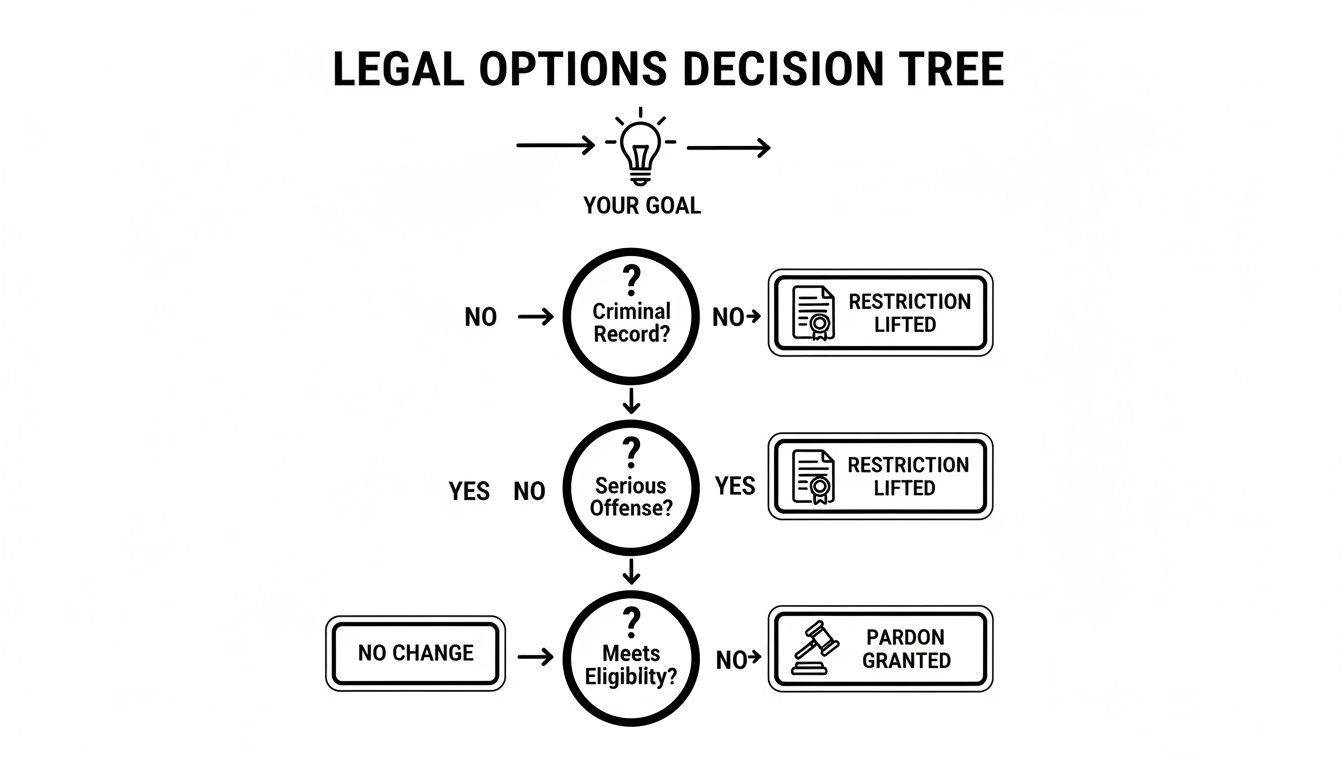
As the chart shows, your end goal—whether it's restoring your rights or clearing a background check—points you directly toward either a pardon or a record restriction.
Scenario 1: The College Student in Cumming
A college student was arrested for shoplifting a few years ago. The case was in Forsyth County, and they successfully completed a pretrial diversion program, leading to a dismissal. Now, they are applying for competitive internships that require background checks.
- Goal: Pass a background check for an internship and future job applications.
- Best Strategy: Record Restriction.
- Why: Because the case was dismissed after completing diversion, it is eligible for restriction. Sealing the arrest record makes it disappear from public view, meaning it should not appear on standard background checks. A pardon is not needed—the goal is privacy, not forgiveness for a conviction that never occurred.
Scenario 2: The Professional in Roswell with a Felony
A professional living in Roswell has a 10-year-old felony drug possession conviction from Fulton County Superior Court. They served their sentence and have built a stable life. Their primary goal is to restore their right to own a firearm for personal protection.
- Goal: Restore firearm rights lost due to the felony conviction.
- Best Strategy: Pardon.
- Why: Under current Georgia law, this felony conviction cannot be restricted or expunged. A pardon from the Georgia State Board of Pardons and Paroles is the only way to restore firearm rights. While the conviction remains on their record, the pardon officially states their rehabilitation and restores that fundamental right.
For many Georgians with older, non-restrictable convictions, a pardon is not just an option—it is the only option to regain lost rights and demonstrate official forgiveness from the state.
Scenario 3: The Alpharetta Resident with a Non-Restrictable Conviction
A person in Alpharetta has a misdemeanor conviction that, due to its nature, is ineligible for record restriction under Georgia law. They are applying for a professional license and know the conviction will appear on the background check. Their main concern is that the licensing board will deny their application.
- Goal: Show a professional licensing board that they have been rehabilitated.
- Best Strategy: Pardon.
- Why: With record restriction off the table, the best move is to address the conviction head-on. A pardon is powerful proof of good character. The licensing board will still see the conviction, but they will also see that the State of Georgia has officially forgiven the offense, which can make all the difference.
Choosing Your Path: Pardon or Record Restriction in North Fulton
To connect your goals to the right legal strategy, we've created this quick reference table based on common scenarios in Fulton County and surrounding areas like Dunwoody and Sandy Springs.
| Your Primary Goal | Most Likely Legal Strategy | Key Consideration For Fulton County |
|---|---|---|
| Pass a standard background check for a job. | Record Restriction (Expungement) | Your case must have been dismissed, diverted, or fall under a specific exception like the Georgia First Offender Act. |
| Restore your right to own a firearm. | Pardon | This is the primary path for restoring rights after a felony conviction that cannot be restricted. |
| Show a licensing board you've been rehabilitated. | Pardon | A pardon is an official endorsement of your character, even if the conviction remains visible. |
| Serve on a jury or hold public office. | Pardon | A pardon is required to restore these civil rights after a felony conviction in Georgia. |
Your journey toward a clear record starts with a clear strategy. Whether you need assistance with a pardon or record restriction for a case in Alpharetta, Milton, or Johns Creek, the first step is a thorough evaluation of your case history.
Contact Brian Hansford Law today for a strategic review of your options.
Why Choose Brian Hansford To Clear Your Record In Alpharetta

When your future hangs in the balance, the attorney you trust to clear your name is the most important decision you will make. The difference between moving forward and having a petition denied often comes down to experience, precision, and a smart, local strategy.
My name is Brian Hansford. I provide calm, focused, and direct representation for clients in Alpharetta and across North Fulton. Unlike large firms where your case may be passed to an associate, you work directly with me from the first call to the final outcome.
A Former Prosecutor’s Insight on Your Side
Before dedicating my career to criminal defense, I served as a prosecutor. This experience gives my clients a significant advantage. I understand how prosecutors in Fulton County and surrounding jurisdictions review these petitions. I know what arguments are persuasive and which administrative errors can halt a case in its tracks.
This is not knowledge from a textbook; it is insight gained from years inside the very system we now must navigate for you. Whether your case originated in Alpharetta Municipal Court or Fulton County Superior Court, I know the procedures, the personnel, and the local court rules.
Navigating the path to a pardon vs. expungement requires more than just filling out forms. It demands a detailed, persuasive case that anticipates and overcomes potential objections from the prosecution and the State Board of Pardons and Paroles.
Meticulous Preparation for Your Alpharetta Case
Whether you live in Alpharetta, Roswell, or Johns Creek, your petition for a pardon or record restriction must be flawless. A single mistake can cause an immediate denial, forcing you to wait years before trying again. I prepare every document with absolute precision, building a strong narrative that proves you meet all legal requirements.
My protective process involves:
- A deep review of your entire criminal history to identify the correct legal path.
- Gathering all necessary records from courts and law enforcement agencies like the Alpharetta Police Department.
- Crafting a persuasive argument tailored specifically to Georgia law and your situation.
- Proactively communicating with court clerks and prosecutors’ offices to ensure your case does not stall.
Do not leave your future to chance. To clear your record, you need an attorney who combines deep local knowledge with a protective, client-first approach. To learn more, read a detailed overview of my legal experience.
Call Brian Hansford Law today to protect your record and move forward with your life.
Common Questions About Pardons and Record Restriction in Georgia
When trying to move on from a criminal charge, urgent questions arise. Here are direct answers to concerns we frequently hear from clients in Alpharetta, Johns Creek, and throughout North Fulton.
Q: How long does record restriction take in Fulton County?
A: The timeline for record restriction in Fulton County varies, but you should anticipate it taking several months. After we file the petition, it must be reviewed by the prosecutor's office before it can be sent to a judge for a final signature. Delays are common, which is why having an attorney who knows how to monitor the case and navigate the specific procedures of Fulton County courts is essential.
Q: Can I get my DUI conviction expunged in Alpharetta, GA?
A: No. Under current Georgia law, a DUI conviction cannot be expunged or restricted. It remains permanently on your criminal and driving records. However, if your DUI charge was dismissed, you were found not guilty, or you completed a pre-trial diversion program, you are likely eligible for record restriction. An attorney can review the final disposition of your case from Alpharetta Municipal Court or Fulton County State Court to confirm.
Q: Do I need a lawyer to apply for a Georgia pardon?
A: While you can technically apply for a pardon yourself, the application is detailed and requires you to build a powerful case for your rehabilitation. The State Board of Pardons and Paroles looks for a compelling narrative, not just completed forms. An experienced lawyer knows how to frame your story, gather impactful supporting documents, and handle every procedural step correctly to maximize your chances of success.
Q: If my record is restricted, can federal agencies still see it?
A: Yes, in most cases, they can. Record restriction is primarily about blocking access for the general public, including most private employers and landlords. However, law enforcement and certain government entities—especially federal agencies conducting in-depth security clearance checks—can often still access restricted arrest records. It is critical to be honest on any application asking about past arrests, even after restriction.
Q: What happens if my record restriction petition is denied in Alpharetta?
A: If a judge in Alpharetta Municipal Court or another Fulton County court denies your petition, you may have to wait a significant time before you can reapply. The waiting period depends on the reason for the denial. A denial often stems from a procedural error or failure to prove eligibility, underscoring the importance of getting the petition right the first time with professional legal help.
Q: Can a pardon help me get a job in Johns Creek or Milton?
A: Absolutely. While a pardon does not hide a conviction, it is a powerful tool when job searching. It serves as an official declaration from Georgia that you are forgiven and rehabilitated. For professional roles in communities like Johns Creek or Milton, a pardon sends a strong message to employers, showing you took accountability and have officially earned back the state's trust.
Your future is too important to leave to chance. At Brian Hansford Law, we have the local experience to guide you through every step of the pardon or record restriction process.
Don't let a past mistake define your future. Call us now for a confidential case review to understand your options. Contact Brian Hansford Law today to start building your case.
