
Deciding on a plea bargain comes down to a fundamental choice: taking a guaranteed outcome versus going to trial. A plea deal often means a lesser charge or a lighter sentence in exchange for pleading guilty. This provides certainty and avoids a long, stressful court battle. But it comes at a cost—giving up important rights, including the right to have a jury decide the case.
How a Plea Bargain Works in the Justice System
A plea bargain is a negotiation in a criminal case between the prosecutor and a defense attorney. At its core, it’s an agreement where the defendant agrees to plead guilty. In return, the prosecutor offers some kind of concession. This is not a rare backroom deal; it’s how the vast majority of criminal cases are resolved.
Each person at the table has a clear role. The prosecutor, who represents the state, aims to secure a conviction without the time and expense of a trial. The defense attorney’s role is to advocate for their client and get the best possible result. The defendant has the final say on whether to accept any offer that’s put on the table.
The Negotiation Process
Plea negotiations can start surprisingly early. Sometimes they begin right after an arrest, even before formal charges have been filed. Understanding what happens when someone is arrested can provide a good idea of just how quickly these talks can get going. The process itself is usually a back-and-forth of offers and counteroffers until an agreement is reached—or it becomes clear that a trial is the only path forward.
There are a few common types of deals one might see:
- Charge Bargaining: This is where a defendant pleads guilty to a less serious charge than the one they were originally facing.
- Sentence Bargaining: The defendant pleads guilty in exchange for the prosecutor recommending a specific, lighter sentence to the judge.
- Fact Bargaining: This is a less common type where the defendant and the prosecutor agree on certain facts of the case, which can prevent a defendant from being charged with a more serious crime.
Just how common is this? In the United States, plea bargaining is the norm, not the exception. Statistics show that an overwhelming 95% to 98% of all criminal cases end with a guilty plea, not a trial verdict. This number alone shows how much courts rely on plea deals to keep cases moving. Of course, it also raises serious questions about whether people feel pressured into pleading guilty. You can learn more about this dynamic from organizations like Fair Trials.
The table below breaks down the key differences between taking a plea and going to trial.
| Aspect | Plea Bargain Path | Trial Path |
|---|---|---|
| Outcome | Certain and agreed upon in advance | Uncertain and decided by a judge or jury |
| Timeline | Relatively quick resolution | Can be lengthy and drawn-out |
| Rights | Forfeits right to trial and appeal | Retains all constitutional rights |
| Control | Defendant has some control over the outcome | Outcome is out of the defendant’s hands |
What Are the Upsides of Taking a Plea Deal?
When weighing the pros and cons of a plea bargain, the benefits often boil down to one powerful concept: certainty. Facing criminal charges can throw a person’s life into a state of total unpredictability. A plea agreement is a way to gain some control over the final outcome.
Frankly, this is probably the single biggest advantage for anyone accused of a crime. Instead of taking a chance with a judge or jury, a plea deal locks in a clear, definite result.
This usually means pleading guilty to a less serious charge or getting a lighter, more predictable sentence than one might face after losing at trial. The value of that kind of certainty can’t be overstated. It can erase the enormous stress and anxiety that come with the high-stakes gamble of a trial.
Securing a Better Outcome
A primary reason people accept plea deals is the chance for a substantially better result. Prosecutors often have the leeway to offer terms that are far more attractive than the maximum penalties tied to the original charges. This strategic edge can play out in a few key ways.
For example, a defendant might be able to:
- Reduce a felony to a misdemeanor: This is a huge win. A misdemeanor conviction has far less damaging long-term consequences on a person’s ability to find a job, secure housing, and maintain their civil rights.
- Avoid mandatory minimum sentences: Some offenses have legally required minimum sentences that a judge has no power to go below if convicted at trial. A plea bargain can often get around those rigid requirements.
- Get multiple charges dropped: If a person is facing a laundry list of charges, a common arrangement is to plead guilty to one or two in exchange for the prosecutor dropping everything else.
This negotiation provides a direct path to minimizing the potential fallout from a conviction. It is essentially trading the risk of a worst-case scenario at trial for a guaranteed, less severe punishment.
Here’s the bottom line: Plea agreements aren’t just about admitting to an act. They are a strategic tool for managing risk and locking in the most predictable, and often least damaging, resolution available.
Saving Time, Money, and Your Sanity
Beyond the sentence itself, the practical costs of going to trial are a massive factor. A criminal trial isn’t just emotionally draining; it’s also incredibly expensive and time-consuming. The whole ordeal can drag on for months, sometimes even years, turning every part of a person’s life upside down.
By taking a plea deal, these burdens can be dramatically lessened. The financial savings are often huge, since the spiraling costs of a lengthy trial are avoided—things like high attorney fees, expert witness costs, and investigation expenses.
But it’s not just about the money. The emotional toll is significantly reduced. A quick resolution allows a person and their family to start moving forward and rebuilding, rather than living under the dark cloud of uncertainty and public scrutiny that a trial brings. This efficiency is a core reason plea bargains are so common. Finalizing a case quickly saves everyone involved valuable time and resources.
Understanding the Major Disadvantages of a Plea Deal

While a plea bargain might seem like a predictable way out of a legal storm, that certainty comes at a very high price. The single biggest trade-off is giving up some of the most fundamental constitutional rights. Once a guilty plea is entered, that’s it—the right to a trial by jury, the right to face accusers in court, and the right to remain silent are waived.
This is the core dilemma when weighing plea bargaining pros and cons. It effectively closes the door forever on the chance of being found not guilty and walking away completely free. It’s a final decision that is incredibly hard to take back, representing a true point of no return in any criminal case.
The Long Shadow of a Criminal Record
Beyond just waiving rights, accepting a plea deal means an official criminal conviction will be on the person’s record. This isn’t a small detail; it’s a permanent mark that can cast a long shadow over almost every part of the future.
Even a conviction for a lesser charge creates serious real-world barriers. These are often called “collateral consequences,” and while they aren’t part of the formal sentence, they can feel just as punishing.
- Employment struggles: A huge number of employers run background checks. A criminal record can automatically disqualify a person from entire fields, especially jobs that require a professional license or deal with sensitive information.
- Housing limitations: Landlords almost always screen potential tenants. A conviction can make finding a safe, decent place to live incredibly difficult.
- Loss of civil liberties: Depending on the conviction, a person could permanently lose their right to vote, own a firearm, or qualify for certain government benefits like federal student loans for college.
These long-term consequences can turn a single legal problem into a lifetime of obstacles. It’s an enormous price to pay for the certainty a plea deal might offer on the front end.
The real punishment of a plea bargain often begins after the sentence is served. The lasting impact on a person’s reputation, career, and basic freedoms can be a far greater burden than the time spent in jail or on probation.
The Pressure to Plead Guilty
One of the most disturbing parts of the plea bargaining system is the crushing pressure it puts on defendants—and that includes people who are actually innocent. Prosecutors hold a massive power advantage, often threatening much more severe charges and longer sentences if a defendant insists on taking their case to trial.
This creates a chilling effect known as the “trial penalty.” In short, the punishment for simply exercising one’s constitutional right to a trial becomes a drastically harsher sentence if they lose. Faced with choosing between a guaranteed lesser sentence versus the terrifying risk of decades behind bars, many people feel they have no real choice but to take the deal.
This dynamic can, and does, lead to wrongful convictions. Studies have shown that a startling percentage of people who were later proven innocent through exoneration had originally pleaded guilty to crimes they didn’t commit. They took the plea to escape the gamble of a trial and the threat of a life-destroying sentence. It’s a systemic flaw that shows how a process built for efficiency can sometimes completely undermine the pursuit of justice.
Plea Bargaining from a Global Perspective
While plea bargaining feels like a non-negotiable part of the American justice system, its role and acceptance vary dramatically across the globe. Looking at the plea bargain pros and cons from an international standpoint reveals a deep divide in legal philosophies. Many countries approach the practice with caution, and some reject it outright.
This global context makes one thing clear: heavy reliance on plea agreements is far from a universal standard.
Many nations with civil law traditions—unlike the common law system in the U.S.—have historically prioritized a full judicial investigation to get to the truth. In those systems, the idea of a negotiated plea is often seen as a threat to transparency and the fundamental right of the accused to have their case heard in open court. Still, the modern pressures of crowded dockets and rising judicial costs are pushing more countries to consider plea-like systems.
Divergent Paths in Global Justice
Plea bargaining has spread far and wide, but its adoption is anything but uniform. There are vastly different usage rates depending on a country’s legal culture and existing frameworks.
For example, some countries have adopted plea-like procedures strictly for minor offenses to speed things up, while others permit them for more serious crimes, but only with tight judicial supervision. This patchwork approach really highlights the ongoing debate between the need for an efficient system and the commitment to a trial-centered process.
The global debate often boils down to a single question: Can a system designed for efficiency still deliver true justice? This conflict is what shapes how different countries either implement or reject plea bargaining.
A comprehensive survey of 174 jurisdictions found that 101 allow some form of plea bargaining, but the rates of use are all over the map. This data shows just how diverse criminal justice cultures are worldwide. You can dive into the full research on how plea bargaining is applied globally on Wiley Online Library.
Ultimately, this international perspective underscores a crucial point. While plea bargains offer a pragmatic solution to case backlogs, their implementation requires a delicate balance between efficiency and the core principles of fairness and justice—a challenge every legal system grapples with in its own way.
Key Considerations Before Making a Decision
Deciding whether to take a plea offer is one of the most stressful, high-stakes moments in any criminal case. This isn’t just about picking the lesser of two evils; it requires a hard look at the specific situation, starting with the strength of the evidence the prosecution has.
A deep dive into their case is the first order of business. Are their witnesses credible, or do they have a history that a good cross-examination could expose? Was the evidence collected legally? The answers to these questions are what separate a winnable trial from an unnecessary gamble.
This is where a person must be brutally honest with themselves and their attorney, weighing the certainty of a plea deal against the roll of the dice that is a jury trial.
Evaluating the Sentence Differential
One of the most powerful factors is what is known as the “trial penalty.” This is the gap between the sentence offered in a plea and the sentence one could face if they lose at trial. Prosecutors often build this difference into their offers to make a plea seem like the only sensible choice.
For example, if a person is offered probation for a felony charge, but a conviction at trial could land them in prison for years, the decision becomes much clearer. To understand just how high the stakes can get when someone is charged with a felony, it’s important to see how these potential outcomes drive the entire negotiation process.
The data below lays out the statistical reality of plea bargains versus trials, showing just how different the outcomes can be.
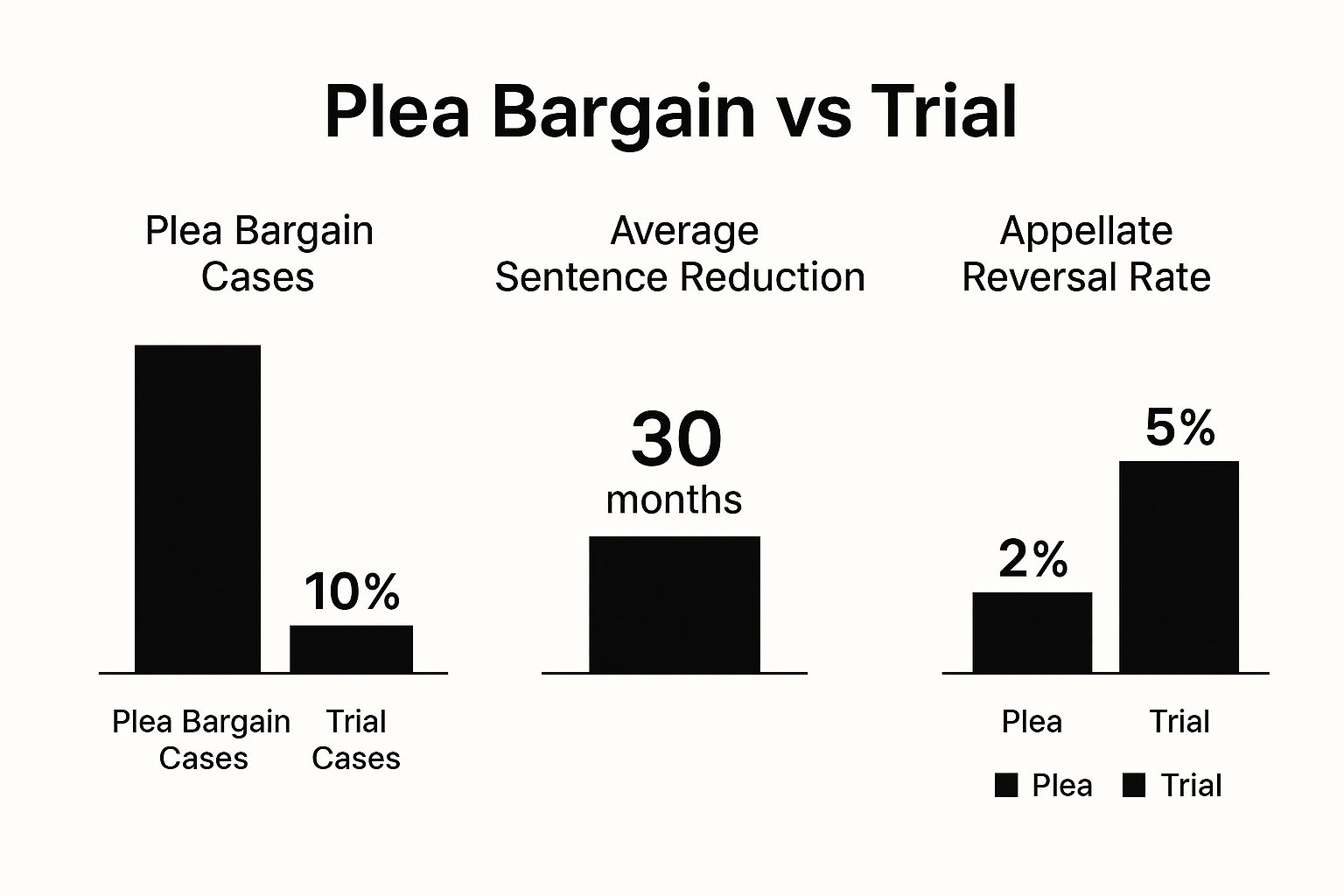
As can be seen, plea bargains are not just how most cases get resolved; they often lead to dramatically lighter sentences than what a judge or jury might impose after a conviction at trial.
To put these choices into clearer perspective, let’s compare the key factors side-by-side.
Comparing Potential Outcomes: Plea vs. Trial
| Factor | Accepting a Plea Offer | Proceeding to Trial |
|---|---|---|
| Outcome Certainty | Guaranteed. The sentence and conviction are known upfront. No surprises. | Uncertain. A jury’s decision is unpredictable. A defendant could be acquitted or face a much harsher sentence. |
| Sentence Severity | Usually lighter. The primary incentive is a reduced sentence compared to the maximum possible at trial. | Potentially severe. If convicted, a defendant faces the “trial penalty”—a longer sentence for not taking the plea. |
| Time & Cost | Faster and less expensive. The case resolves quickly, avoiding lengthy court proceedings and legal fees. | Time-consuming and expensive. A trial can drag on for months or even years, accumulating significant costs. |
| Control | The defendant has control. The decision to accept the deal is theirs, based on a known outcome. | Loss of control. Once a case goes to trial, a person’s fate is in the hands of a judge or jury. |
| Public Record | Admission of guilt. The conviction becomes a permanent part of the public record. | Potential for acquittal. A win means there is no conviction on the record for this charge. A loss means a conviction. |
This table highlights the fundamental trade-off: a plea deal offers certainty and a lighter sentence in exchange for a guaranteed conviction, while a trial offers a chance at freedom at the risk of a much worse outcome.
Understanding Collateral Consequences
A criminal conviction creates ripple effects that spread far beyond the courtroom walls. These collateral consequences are the long-term, often hidden, penalties that can change a person’s life forever, and they are a critical piece of this decision. Remember, pleading guilty is a conviction—it triggers the same consequences as a guilty verdict at trial.
A person has to think about how a conviction will impact their future.
- Professional Licenses: Many careers that require a state license—like nursing, contracting, or real estate—can be jeopardized. A conviction could lead to suspension or outright revocation.
- Immigration Status: For anyone who is not a U.S. citizen, a criminal conviction can lead to deportation, no matter how light the sentence is.
- Civil Rights: Depending on the charge, a person could permanently lose fundamental rights, like the right to vote or own a firearm.
A plea agreement is not just about the sentence; it’s about the permanent mark it leaves on a person’s record. Understanding the full scope of these consequences is essential before making a final choice.
Ultimately, a good defense attorney’s job is to lay everything on the table—the immediate penalties and the lasting damage a conviction will cause. This is the only way a defendant can make a fully informed decision that protects their best interests for the long haul.
Common Questions About the Plea Bargain Process
The plea bargain process is a world unto itself, filled with legal jargon that can easily overwhelm anyone new to the system. To help clear things up, let’s walk through a few of the most common questions people have. Getting a handle on these details is key to understanding the real-world plea bargain pros and cons.
A question that comes up all the time is whether a plea deal, once accepted, can be undone. The short answer is that backing out of a plea agreement is incredibly difficult.
Once a judge formally accepts a guilty plea in court, that decision is pretty much final. To even have a chance at withdrawing it, a defendant would need to show a “fair and just reason”—for instance, proving they were coerced or didn’t understand what they were agreeing to. The bar gets even higher after sentencing, which really underscores how serious this commitment is.
Are Plea Deals Always an Option?
It’s a common myth that a plea bargain is on the table in every single criminal case. While it’s true that a huge majority of cases—around 90-95%—end this way, a plea offer is a strategic decision, not an automatic right.
The prosecutor holds all the cards here. They can choose not to offer a deal for any number of reasons, like the seriousness of the crime, the strength of their evidence, or internal office policies. On the other hand, a defendant always has the absolute right to say “no” to any offer and take their chances at trial. If at that crossroads, it’s necessary to understand the differences between a bench trial vs a jury trial to build a solid defense strategy.
The decision to offer or accept a plea is strategic for both sides. It’s a calculated negotiation, not an automatic step in the criminal justice process.
This negotiation often leads to different types of agreements, each tailored to the specifics of the case. Knowing the basic types is crucial for understanding how a final deal gets put together.
Understanding Different Types of Bargains
Not all plea agreements look the same. They typically fall into a couple of main categories, each with a different goal. The two seen most often are charge bargains and sentence bargains.
- Charge Bargains: This is where a defendant agrees to plead guilty, but to a less serious crime. For example, a felony charge could get knocked down to a misdemeanor in exchange for the plea. This can make a huge difference in the long-term consequences faced.
- Sentence Bargains: With this type, a defendant pleads guilty to the original charge. In return, the prosecutor agrees to recommend a lighter sentence to the judge. It’s critical to remember, though, that the judge isn’t legally obligated to follow that recommendation.
There’s another strategic move that can come up during these talks: the “no contest” plea.
A “no contest” plea, legally known as nolo contendere, is a unique option. When this plea is entered, the defendant accepts the conviction and the punishment without actually admitting guilt for the crime.
As far as the criminal court is concerned, it has the same effect as a guilty plea. The real benefit comes into play later. A no contest plea usually can’t be used against the defendant as an admission of guilt if someone files a civil lawsuit against them over the same incident. This makes it a valuable tool when a person is facing trouble on both the criminal and civil fronts.
Each of these pieces—the finality of the decision, the types of deals on the table, and the strategic pleas available—shapes the complex math of plea negotiations.
At Brian Hansford Law, we understand that facing criminal charges is a daunting experience. If you or a loved one needs guidance through the complexities of the legal system, our team is here to provide experienced and dedicated representation. Visit us at https://challengemycharge.com to learn how we can help protect your future.
