
When facing criminal charges, one of the first and most critical decisions involves who will provide representation in court. The "public defender vs. private attorney" question boils down to one fundamental difference: how they are obtained. A public defender is appointed by the government if an individual cannot afford a lawyer, while a private attorney is someone hired directly. This single distinction ripples out, affecting everything from caseload to communication.
Understanding Legal Representation Options

The choice of legal representation can set the tone for an entire defense. The two main avenues are working with a public defender or hiring a private criminal defense attorney.
A public defender is an attorney paid by the government to represent people who meet specific income requirements. The court assigns them to a case, which means the individual does not get to pick their lawyer.
A private attorney, on the other hand, is hired directly by an individual or their family. This provides complete control to choose a lawyer whose experience, reputation, and approach seem to be the right fit for the case.
Key Foundational Differences
The most obvious split is cost and choice. Public defenders are provided at no direct cost to the individual—a right guaranteed by the Sixth Amendment. In contrast, private attorneys are paid for their services, and we'll get into those fee structures later. But how they're retained is just the starting point.
This decision isn't just about money. It’s about weighing caseloads, the amount of access someone may have to their attorney, and whether a case might need a lawyer with a highly specific skill set. Each path has its own set of real-world advantages depending on the circumstances.
Does the type of attorney change the outcome? It's a fair question. Interestingly, some research suggests conviction rates have more to do with the types of cases each attorney handles rather than the attorney themselves. This is because public defenders and private attorneys are often assigned or take on very different kinds of cases from the start.
Quick Comparison: Public Defender vs. Private Attorney
To see the differences at a glance, here’s a straightforward breakdown. This table provides a quick snapshot of the key distinctions. Thinking through these points is a great first step, and knowing the right questions to ask a criminal defense attorney can help dig deeper.
| Attribute | Public Defender | Private Attorney |
|---|---|---|
| How You Get One | Assigned by the court based on financial need | Hired directly by the client |
| Cost | Provided at no direct cost to the client | Paid by the client (hourly, flat fee, or retainer) |
| Attorney Choice | The client cannot choose their specific lawyer | The client selects the lawyer or firm they want to work with |
| Caseload | Typically handles a very high volume of cases at once | Manages a smaller, more controlled number of cases |
| Availability | Communication may be limited due to high workload | Generally offers more direct and frequent communication |
Ultimately, this comparison helps frame the practical realities of each option. The most suitable choice depends entirely on a person's financial situation, the complexity of their case, and what they need from their legal advocate.
Breaking Down the Financial Commitments

When deciding between a public defender and a private attorney, the first thing on most people's minds is the cost. The financial side of things can feel overwhelming, but understanding exactly how each option is funded can bring a lot of clarity. This isn't just about the upfront price tag; it's about the entire economic picture of a defense.
Public defenders are a cornerstone of the justice system, guaranteed by the Sixth Amendment. They are government-funded, which means if an individual meets specific income requirements, a public defender is appointed to their case by the court at no direct cost. The court determines eligibility by looking at income, assets, and expenses to see if a person qualifies as indigent.
Private attorneys, on the other hand, are hired directly. Their services come with a fee, and how that fee is structured can vary quite a bit from one firm to the next. Knowing these models is key to managing the financial commitment.
Common Fee Structures for Private Attorneys
Most private law firms use one of a few billing methods. The most suitable one often depends on the complexity of a case.
- Hourly Billing: This is straightforward. The attorney charges a set rate for every hour they put into a case, whether it's research, court appearances, or meetings.
- Flat Fees: For more common or predictable cases, like a first-time DUI in Forsyth County, an attorney might offer a single, upfront flat fee. This fee covers the entire case from beginning to end.
- Retainers: A lump sum is paid upfront, and the attorney bills their hourly rate against that amount. If the retainer runs out, more funds may need to be added. If money is left over at the end, it might be returned.
Choosing an attorney involves more than just comparing rates. It's important to understand what is being paid for—experience, dedicated attention, and a well-thought-out defense strategy.
The Value Proposition of Private Counsel
Hiring a private attorney is an investment. While the upfront cost is higher, the payment covers a level of personalized service and resources that can be tough to find in an overloaded public defender's office. A private attorney in a place like Alpharetta or Cumming typically has a much smaller caseload, which means more time to focus on an individual and their defense.
That focused attention allows them to get to work right away—conducting investigations, interviewing witnesses, and digging into the specific details of a situation to build a strong defense. It also means they're more available to talk, keeping their clients in the loop every step of the way.
The decision often comes down to this: weighing the potential consequences of a conviction against the cost of representation. When facing serious charges that could impact freedom or a career for years to come, that investment can make a significant difference.
Many people assume they can't afford private representation, but a good first step is to simply have a conversation. To make that easier, we've put together a guide on what to expect during a criminal lawyer free consultation. An initial meeting allows for a discussion of the case and an understanding of the potential costs without any commitment, providing the facts needed to make a solid financial decision.
How Caseload Impacts an Attorney's Availability
If there's one single factor that shapes the day-to-day experience with a lawyer, it's their caseload. An attorney's workload directly impacts how much time and personal attention they can give. This isn't just about feeling heard; it influences everything from how often you talk to how deep they can dig into a defense.
The tough reality for most public defender offices, including those serving Forsyth County, is a mountain of cases. These are skilled, dedicated lawyers, but they are often juggling hundreds of cases at once. This isn't a knock on their commitment—it's a structural problem rooted in underfunding and overwhelming demand.
On the flip side, private attorneys in areas like Alpharetta or Cumming can and do control their caseload. They deliberately take on fewer clients so they can dedicate more time and energy to each one. When hiring private counsel, this focused attention is a big part of what is being paid for.
The Public Defender's Workload: A System Under Pressure
Public defenders are on the front lines, managing a constant stream of cases assigned by the court. It’s completely normal for a public defender to be responsible for upwards of a hundred cases simultaneously, all at different stages of the legal process.
This forces them to take a triage approach. They have to prioritize the most urgent tasks—an upcoming court date, a critical filing deadline, or a client who is currently in jail. While they become experts at managing this pressure, it naturally leaves less time for proactive check-ins or long, sit-down meetings.
A heavy caseload can directly impact the client-attorney relationship. With limited hours in the day, a public defender may have to conduct brief meetings in the courthouse moments before a hearing, making it challenging to build a detailed understanding of a client's unique situation.
The system itself means that while a public defender is absolutely committed to defending their client, their availability for a quick question or an extended discussion might be limited. It’s a crucial expectation to set if working with one.
Private Attorneys: A Focus on Personalized Attention
When a person hires a private attorney, they are investing in their time. A private criminal defense lawyer, whether in Johns Creek or Cobb County, intentionally keeps their caseload manageable. This business model is built around providing a higher level of personal service.
With fewer cases to juggle, a private attorney can offer:
- More Frequent Communication: They are simply more available for phone calls, emails, and face-to-face meetings to walk through what's happening and answer questions.
- Deeper Case Investigation: They have the bandwidth to dive deep from the very beginning—interviewing witnesses, analyzing every piece of evidence, and leaving no stone unturned.
- Proactive Strategy Development: A lighter workload allows for more time to think creatively about a defense, explore every angle, and prepare meticulously for negotiations or a trial.
This availability helps build a stronger, more collaborative relationship. Clients get more chances to tell their side of the story, to truly understand the legal maze they're in, and to feel like an active participant in their own defense. That sense of clarity and control can make all the difference during such a stressful time.
What This Means for a Case
The difference in caseload has real-world consequences. Let’s say a key piece of evidence—like security footage from a local Milton business—needs to be obtained before it’s erased. A private attorney with a lighter schedule can jump on it immediately, sending an investigator or handling it themselves that same day.
A public defender would know it's just as important, but they might be stuck in court all day on other clients' cases, making it harder to react with the same speed. Again, it’s not for a lack of diligence; it’s about the crushing weight of competing priorities.
Ultimately, the caseload divide creates two very different client experiences. Both public defenders and private attorneys are dedicated professionals bound by the same ethical duties. But the systems they work in dictate how their most valuable resource—time—gets spent. Understanding this from the start is key to deciding which path is the right one.
When weighing a public defender against a private attorney, one of the biggest factors is experience. Both bring a ton of legal know-how to the table, but the kind of experience they have can be worlds apart. Figuring out that difference is crucial to matching the right lawyer to a specific case.
A public defender’s experience is forged in the fire of high-volume criminal court. They are in the courtroom every single day, managing a constant flow of cases from simple misdemeanors to the most serious felonies. This daily grind gives them an incredible familiarity with the local legal landscape, especially in busy jurisdictions like Forsyth County and Cobb County.
Because they're always there, public defenders develop a deep, practical understanding of how the system really works. They know the personalities and tendencies of local judges, the negotiation tactics of specific prosecutors, and the unwritten rules of the courthouse. This insider knowledge can be a massive advantage, particularly in more standard cases where navigating the system efficiently is the name of the game.
The Power of Niche Expertise
Private attorneys, on the other hand, often build their careers around a different model. While they certainly know their way around a courtroom, many choose to specialize in very specific areas of criminal law. This lets them cultivate a highly focused skill set that goes way beyond general criminal defense.
You might find a private lawyer in Alpharetta who is a recognized expert in DUI defense or a firm in Roswell that deals exclusively with complex white-collar crimes. This kind of specialization allows them to stay on top of the very latest defense strategies, scientific evidence, and legal nuances that are hyper-specific to those charges.
This focused knowledge can be a game-changer. Think about a case that involves digging through complicated financial records or one that hinges on challenging the results of a forensic lab test. A private attorney who has handled dozens of similar cases will bring a level of specific expertise that is tough to match.
How Different Experiences Serve Different Needs
The type of experience that is needed really boils down to the charges one is up against. Let's look at how these different backgrounds play out in the real world.
- Routine Misdemeanors: For a common charge, a public defender’s familiarity with the local court’s standard procedures and plea bargain habits can be incredibly effective. They know what prosecutors are likely to offer and can often get cases resolved quickly.
- Complex Felonies: A serious felony case could benefit from a private attorney’s ability to pour extensive time into investigation and strategy. Their deep specialization in areas like violent crimes or drug trafficking becomes a major asset.
- Cases Requiring Experts: When a defense needs to challenge scientific evidence, bringing in expert witnesses is often a must. Private attorneys usually have established networks of trusted experts—from toxicologists to digital forensic analysts—and the resources to hire them.
The core question is this: does the case require a generalist with deep local court knowledge, or a specialist with deep subject-matter expertise? The answer will point toward the right choice.
It’s also important to get rid of outdated ideas about performance. While heavy caseloads are a real challenge for public defenders, recent data shows they are achieving impressive results. For instance, an analysis of outcomes from 2019 to 2023 showed that public defenders' success rates nearly doubled from 18% to 35%, closing the gap with private lawyers significantly. These numbers suggest that the quality of representation from public defenders has improved dramatically. You can explore the full analysis of these performance outcomes for more information.
Ultimately, both paths offer skilled lawyers. The key is to be honest about how complex a case is. A straightforward matter in Cumming or Marietta might be a perfect fit for a public defender’s hands-on court experience, while a high-stakes, nuanced case is likely better served by the specific, focused knowledge a private specialist brings to the fight.
What the Data Says About Case Outcomes
When it comes to choosing between a public defender and a private attorney, the bottom line is results. Everyone wants to know which path leads to a better outcome. But keep in mind, a "win" isn't always a "not guilty" verdict. It could mean getting charges reduced, securing an alternative sentence, or having the case dismissed entirely before it ever sees a courtroom.
There's a common belief that paying more for a private attorney guarantees a better result. While that might hold true in some highly complex cases, the data tells a much more complicated story. Once you actually account for the types of cases each attorney typically handles, that supposed performance gap often shrinks—or disappears completely.
Challenging Common Perceptions with Data
It’s easy to assume that because public defenders are juggling so many cases, their clients must get the short end of the stick. But studies that control for things like the seriousness of the initial charges and the strength of the evidence paint a different picture. These analyses often show that public defenders achieve outcomes that are right on par with, and sometimes even better than, what private lawyers accomplish.
Think about it: their constant presence in the courthouse is a huge advantage. Public defenders in jurisdictions like Forsyth County or Cobb County are in front of the same judges and prosecutors day in and day out. This gives them an insider's understanding of how to negotiate, how a specific judge might view a case, and what kind of plea bargain is likely to be accepted.
The key takeaway from the research is that an attorney’s effectiveness isn't just about whether they're publicly or privately funded. Things like their experience, familiarity with the local court system, and the specific facts of a case play a much bigger role in the final outcome.
In fact, some deep dives into the numbers reveal a surprising trend. One analysis of San Francisco's court-appointed defense system found that after leveling the playing field for all other factors, defendants with public defenders actually had better case outcomes. The data showed that these individuals had a 57% likelihood of conviction, while those with court-appointed private attorneys had a 61% likelihood—that's a 6% lower conviction rate for public defenders. You can explore more of these indigent defense system findings yourself.
This really challenges the myth that public defenders are automatically less effective. Their dedicated focus on criminal law and daily courtroom grind are powerful, often underestimated, assets.
Situational Guide for Choosing Representation
The most suitable choice really boils down to specific circumstances. There is no one-size-fits-all answer here. The right decision requires an honest look at priorities and the unique details of a case.
This table is designed to help with thinking through that decision by looking at a few common scenarios.
| Situation or Priority | Consider a Public Defender If… | Consider a Private Attorney If… |
|---|---|---|
| Financial Constraints | The court's eligibility requirements are met and private legal fees cannot be afforded. | There are financial resources to hire an attorney or a payment plan can be arranged. |
| Case Complexity | The case is a common misdemeanor or a straightforward felony without unusual evidentiary issues. | The case involves complex evidence, multiple charges, or requires specialized knowledge (like white-collar crime). |
| Need for Personal Attention | You are comfortable with less frequent communication and trust an attorney to manage things efficiently. | You prefer regular updates, want to be deeply involved in strategy, and value direct access to a lawyer. |
| Specific Expertise Required | The charges fall into a standard area of criminal defense where local court familiarity is the biggest advantage. | An attorney is needed with a proven track record in a niche area, like DUI defense in Alpharetta or federal charges. |
At the end of the day, both public defenders and private attorneys are dedicated to defending their clients' rights. By looking past the common myths and focusing on the data and one's own needs, a much more informed and confident choice can be made for a defense.
Making a Confident and Informed Choice
Choosing between a public defender and a private attorney isn't about which one is "better" in a vacuum. It’s about figuring out which one is the right fit for an individual, their finances, and the specific charges they're facing. This decision comes down to a practical look at cost, the level of communication desired, and just how complex the case really is.
The first step is a frank assessment of one's financial situation. Can a private lawyer realistically be afforded? After that, think about the charges. A straightforward misdemeanor in Forsyth County might be handled perfectly by a public defender who works in that courthouse every single day. On the other hand, a serious felony charge often benefits from the dedicated time and specific resources a private attorney can bring to the table.
Key Questions to Guide a Decision
To cut through the confusion, ask a few direct questions. The answers may point in the right direction.
- How serious are the charges? Major felonies with life-altering consequences usually demand a deeper level of investigation and defense strategy.
- How important is direct communication? If someone needs constant updates and wants to be hands-on with their defense, a private attorney's greater availability will likely be a better match.
- Does the case involve a specialized area of law? Charges that hinge on complex evidence like digital forensics or financial records may require an attorney with a focused practice in that niche.
- Does a person even qualify for a public defender? This is the threshold question. Eligibility is based on income and assets, so it's a logical place to start.
This decision tree helps visualize those first few steps, starting with the most practical one: finances.
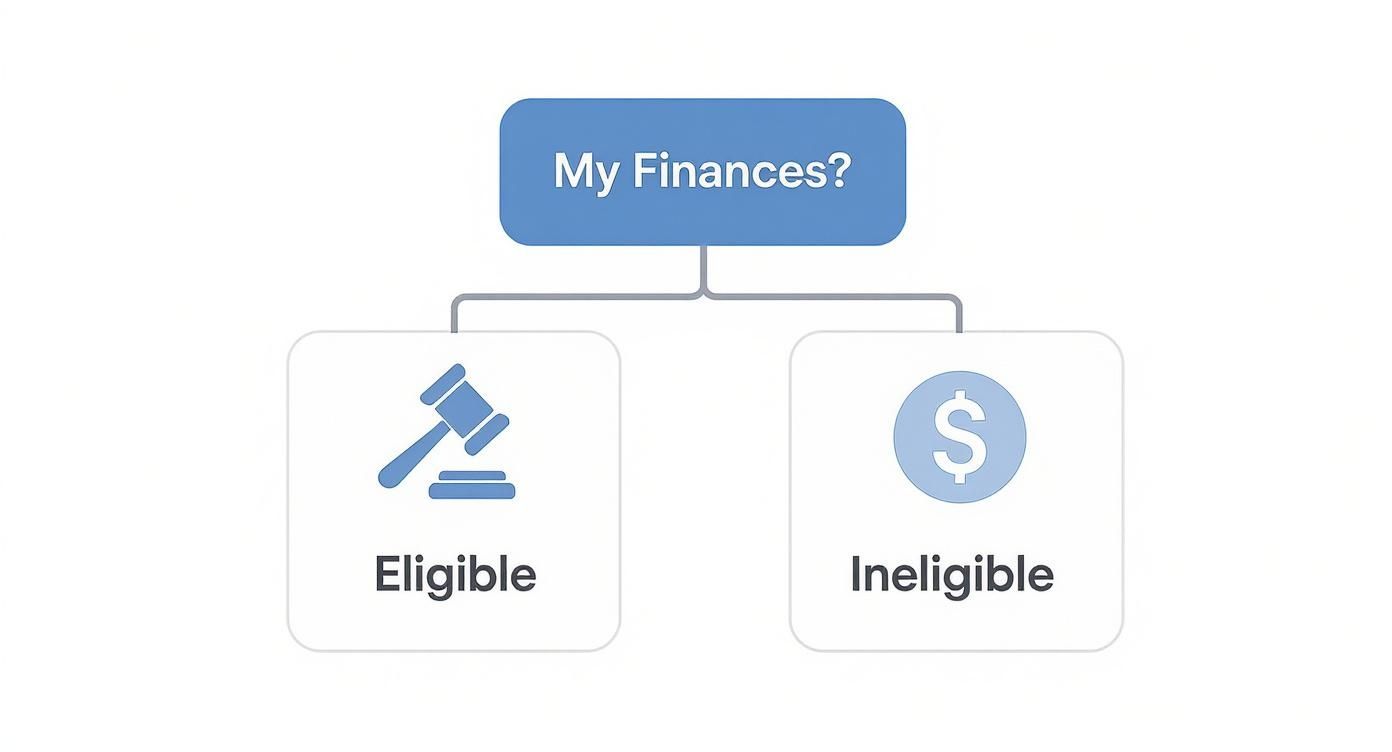
As the graphic shows, financial eligibility is the first gate to pass through when making this choice.
Moving Forward with Confidence
At the end of the day, this choice is a personal one. By methodically thinking through these key factors—cost, caseload, experience, and potential outcomes—a person can go from feeling uncertain to being confident in their path forward. If hiring private counsel seems like the right move, the next step is finding a suitable advocate. You can learn more about how to find a good criminal lawyer in our detailed guide.
Remember, the goal is to secure representation that inspires trust and is well-suited to the specifics of a case. Whether an individual is assigned a dedicated public defender or hires a private attorney, making an informed choice is the most powerful first step.
By honestly assessing the situation, a person puts themselves in the best position to face the legal system with a clear plan and a suitable professional by their side.
Frequently Asked Questions
When caught in the legal system, figuring out whether to use a public defender or hire a private attorney brings up a lot of questions. Getting clear, straightforward answers can make a huge difference. Here are some of the most common things people ask.
How Do I Know If I Qualify for a Public Defender?
Qualifying for a public defender isn't just a simple yes or no—it all comes down to a financial review by the court. A judge will look at income, any assets (like property or savings), debts, and how many people are dependents. Based on all that, they'll decide if a person is "indigent," which is the legal term for not being able to afford a private lawyer.
It's a standardized process designed to be fair. A person will probably have to show some paperwork to back up their financial claims, and the judge makes the final call based on the guidelines in that specific jurisdiction.
Can I Switch to a Private Attorney Later On?
Yes, absolutely. A person has the right to hire a private attorney at just about any stage of their case. If someone starts out with a public defender but their situation changes—or they simply decide they want a different level of representation—that switch can be made.
The transition is usually pretty smooth. The new lawyer will file a "substitution of attorney" with the court, which officially puts them in charge of the defense. They'll get up to speed on all the details of the case so things can keep moving forward.
It's not uncommon for someone to start with a public defender and later decide to hire private counsel. This often happens when a case proves more complex than expected or when someone wants more direct, one-on-one communication with their lawyer.
Do They Both Have the Same Resources?
This is where one of the biggest differences is often seen. While both public defenders and private attorneys get the same discovery materials from the prosecution, private lawyers usually have a bigger toolbox and can access resources much faster.
- Investigators: Private law firms often have their own investigators on staff or a network of trusted professionals they can call on immediately. This means they can start gathering evidence or tracking down witnesses right away.
- Expert Witnesses: Bringing in experts like forensic specialists or psychologists costs money. A private attorney can hire them directly. A public defender, on the other hand, often has to ask the court for funding approval, a process that can sometimes lead to delays.
Public defenders are incredibly skilled and resourceful, but the reality is they work within the constraints of a government budget. A private firm just doesn't have those same limitations when it comes to building a defense.
At Brian Hansford Law, we know how stressful it is to face criminal charges. With over 25 years of experience, including time as a prosecutor, Brian Hansford offers a tough, personalized defense built around your specific case. If you need a dedicated attorney in Alpharetta, Cumming, or anywhere in the surrounding area, contact us to start protecting your rights and your future. Learn more at https://challengemycharge.com.
