
You've probably heard the term "Romeo and Juliet laws" thrown around, but it can be a bit misleading. It’s not an official term you'll find in the statute books. Instead, it’s a common nickname for provisions that act as a defense in certain statutory rape cases, specifically those involving teenagers who are close in age.
These provisions essentially create a close-in-age exemption to draw a common-sense line between predatory acts and consensual relationships between young peers.
Understanding The Purpose Of Romeo And Juliet Laws

Think of these provisions as a safety valve in the system. Their whole point is to distinguish between genuinely predatory conduct and typical teenage relationships that might otherwise get swept up and classified as a serious felony. Without them, a standard high school relationship between two students with a small age gap could trigger devastating consequences.
In states that have these laws, very specific criteria have to be met for them to apply. Usually, this includes:
- A specific, narrow age gap between the two people (for instance, less than four years).
- The relationship must be entirely consensual, with zero force or coercion involved.
- The younger person must be over a certain minimum age, often 14.
These laws acknowledge a simple reality: not every situation that technically fits the definition of statutory rape involves exploitation. They are designed to prevent lifelong penalties, like mandatory sex offender registration, from being unfairly applied to young people in peer relationships.
Why These Provisions Matter
The consequences of a statutory rape conviction are life-altering. Having a felony on a record can shut doors on education, jobs, and even housing. These provisions matter because they bring a necessary layer of context and fairness to the table.
The core idea behind Romeo and Juliet laws is proportionality—making sure the punishment fits the actual situation. It helps the system focus its resources on genuine instances of exploitation while providing an alternative path for cases involving consensual teenage relationships.
Understanding this concept is the first critical step for families in our local communities like Alpharetta, Milton, and Johns Creek. While many states have these exemptions, Georgia's specific approach is unique, and it’s crucial to understand how it works here. The stakes are incredibly high, as the absence or strict interpretation of such a law can completely change the outcome of a case and have a lasting impact on juvenile records.
Here’s what is important to know about Georgia’s tough stance on relationships where one person is a minor.
Unlike a lot of other states, Georgia does not have a formal “Romeo and Juliet” or close-in-age exemption for statutory rape charges under O.C.G.A. § 16-6-3. This is the single most important fact to understand. Without this specific protection written into the law, the situation becomes much more serious for teenagers in communities like Alpharetta, Roswell, and Cumming.
In Georgia, the age of consent is 16. If one person is under 16, the law doesn't automatically forgive or lessen the charge just because the age gap is small. This creates a strict liability situation where the only things that really matter are the birth dates of the people involved, not the context of their relationship.
This approach gives prosecutors in counties like Forsyth and Cobb a huge amount of power. Without a clear legislative exemption to point to, the decision to file charges that could ruin a young person's life often comes down to one person's judgment.
The Power Of Prosecutorial Discretion
Because there isn't a "Romeo and Juliet" safety net built into the law, prosecutorial discretion becomes the most critical factor. A prosecutor can look at the facts—like a consensual relationship between a 17-year-old and a 15-year-old—and decide if pursuing a felony statutory rape charge is actually in the interest of justice.
When making this call, they might consider several things:
- The specific age gap: Are we talking about a few months or a few years?
- The nature of the relationship: Was this a normal peer relationship between high school students?
- Any evidence of coercion: Was there any pressure, manipulation, or exploitation?
- The wishes of the parents: How do the families of both teenagers feel about the situation?
This discretion means that two identical scenarios in different counties could end up with completely different outcomes. One might lead to no charges at all, while the other could result in a felony indictment. It’s this uncertainty that makes it so important to present the context of a case clearly and persuasively right from the start.
The lack of a formal Romeo and Juliet law in Georgia means that a prosecutor isn't required to make an exception for close-in-age relationships. Their decision to file charges—or not—is based on their individual assessment of the case, making early intervention and communication absolutely vital.
When Other Charges Come Into Play
The landscape doesn't stop with statutory rape. Depending on the ages and the specific acts involved, other serious charges could come up. For instance, Georgia’s child molestation statutes can apply even in what seems like a consensual teenage relationship, especially if there's a significant age difference or the younger person is under 14.
Understanding how these laws overlap is critical. The lack of a clear exemption has led to inconsistent enforcement across the country. A famous case in Kansas from the late 1990s really highlights the danger of poorly written "Romeo and Juliet" provisions. In that case, a law that only applied to heterosexual couples resulted in a young man getting a 17-year sentence for a consensual act. The case sparked a national conversation and led to reforms to make sure these laws are applied more fairly. You can find out more about how these laws evolved following landmark cases.
At the end of the day, the strict nature of Georgia law puts a heavy burden on young people and their families. Without a clear-cut defense based on being close in age, every single detail matters. The perception of the relationship, the credibility of everyone involved, and the way the facts are presented can dramatically change a prosecutor's mind. This is exactly why navigating the system in areas like Milton, Marietta, and Johns Creek requires a deep understanding of local practices and the unwritten rules that guide prosecutorial discretion.
The Lifelong Impact Of A Conviction

A statutory rape conviction in Georgia carries a weight that reaches far beyond the courtroom doors. It creates a ripple effect, touching nearly every part of a person's life for years—sometimes decades—to come.
Even when the situation involves what many would consider a consensual teenage relationship, a conviction under Georgia law can be absolutely devastating. The penalty phase isn't the end of the road; for many, it's just the beginning of a long and difficult journey.
These consequences aren't temporary. They are designed to be long-lasting and very public. If a person is facing allegations in Cumming, Johns Creek, or Milton, it's crucial to understand the full scope of what's at stake. This is about much more than just fines or probation.
The Heavy Weight Of Sex Offender Registration
The single most life-altering consequence of many statutory rape convictions is mandatory registration as a sex offender. This isn't some private record tucked away in a file cabinet—it's a public label that follows a person everywhere they go.
The Georgia Sex Offender Registry is available online, putting a person's name, address, and conviction details out there for anyone to see with a few clicks. Neighbors, potential employers, and new acquaintances can find this information easily, often leading to judgment and exclusion without any context.
This isn't a short-term penalty. Depending on the offense, a person could be required to register for decades, or even for life. This involves strict check-in requirements and immediate penalties for any failure to comply with the rules.
Severe Restrictions On Daily Life
Being on the registry brings a long list of strict rules that dictate where a person can live, work, and even spend time. While these restrictions are meant to keep registrants away from children, they often make finding a place to live nearly impossible.
In Georgia, registrants are typically barred from living within 1,000 feet of places where children gather. This includes:
- Schools: Both public and private elementary, middle, or high schools.
- Daycare centers: Any licensed childcare facility.
- Parks and playgrounds: Public recreational areas where kids play.
- Community swimming pools: Any public pool open to the community.
In populated areas like Marietta or East Cobb, finding a home that isn't inside one of these restricted zones is an enormous challenge. It forces people into a stressful housing search where landlords often deny applications after running a simple background check.
A conviction doesn't just result in a sentence; it fundamentally alters a person's freedom of movement and ability to build a normal life. The residential and employment restrictions create a state of permanent supervision and limitation.
The limitations don't stop there. A conviction makes it virtually impossible to find work in many fields, including education, healthcare, coaching, or any job involving contact with minors. Even in unrelated industries, employers are understandably hesitant to hire someone with this type of felony on their record.
For a young person, this closes doors on future careers before they even have a chance to open. It's why a strong, proactive approach from the very beginning is so critical.
Fighting Back: Common Defense Strategies In Georgia
Just because Georgia law doesn't have a formal, written-out "Romeo and Juliet" defense doesn't mean every accusation automatically leads to the worst-case scenario. When a person is facing the system in Forsyth County, Cobb County, or surrounding areas like Roswell, there are absolutely ways to respond. The key is knowing how to present the complete context of a situation to the people making the critical decisions.
The lack of a specific close-in-age exemption actually makes prosecutorial discretion even more important. A prosecutor has the power to look at all the circumstances of a case before deciding whether to file serious felony charges, pursue something lesser, or even drop the case entirely. A powerful, well-documented presentation of the facts can make all the difference.
A representative's most important job here is often to tell the full story—the story that the raw numbers on a birth certificate can't possibly convey. This means gathering and presenting information that paints a true picture of a peer relationship, not one of exploitation.
Influencing Prosecutorial Discretion
In many of these situations, the immediate goal is to give the prosecutor a solid reason to use their discretion in a favorable way. This starts with a thorough, independent investigation to uncover all the details that highlight the real nature of the relationship and the circumstances involved.
Here are several key factors that can be presented to help shape a prosecutor's perspective:
- The Minimal Age Gap: Clearly showing that the age difference is small (think a high school senior and a junior) immediately frames the situation as a relationship between peers, not a predator and a victim.
- A Genuinely Consensual Relationship: Evidence like text messages, social media history, or even statements from mutual friends can be used to demonstrate the relationship was consensual and ongoing. This directly counters any narrative of coercion.
- The Absence of Coercion or Force: Proving that no force, threats, or manipulation were ever involved is critical. This is what separates these cases from the serious crimes the laws were actually written to prevent.
- The Defendant’s Character: Information about the accused person's clean record, good grades, and positive standing in the community can be incredibly persuasive.
When presented clearly and professionally, these elements encourage a prosecutor to see that a lifelong felony conviction and sex offender registration would not serve the interests of justice.
Challenging The Evidence
Another crucial part of any defense is putting the prosecution's case under a microscope. Every piece of evidence, every statement, and every report has to be examined for weaknesses, inconsistencies, or constitutional problems. This isn't about attacking people; it's about holding the state to its high standard of proof.
A strong defense often comes down to one simple principle: the prosecution must prove every single element of its case beyond a reasonable doubt. Questioning their evidence is how they are held to that standard.
Common areas for investigation include:
- Credibility of the Accuser: An investigation might reveal major inconsistencies in an accuser's story. Sometimes, it can even uncover motives for a false accusation, like jealousy, anger, or pressure from parents.
- Disputing the Timeline: If a solid alibi can be established or holes poked in the timeline of events the prosecution presents, serious doubt can be created. Digital evidence is huge here—things like GPS data from a phone, social media posts, or text message timestamps can be a game-changer.
- Contesting the "Sexual Conduct" Element: In some cases, the defense is straightforward: the alleged sexual conduct never actually happened. This requires a meticulous review of all available evidence and witness statements to find the contradictions that prove it.
Ultimately, navigating these complex situations in local courts in Marietta, Johns Creek, and Milton requires a detailed, strategic game plan. By focusing on influencing the prosecutor and rigorously challenging the evidence, it's possible to work toward much better outcomes—like reduced charges or even a full dismissal—and protect a young person’s future from permanent damage.
Exploring Options For Record Restriction
When a young person faces accusations stemming from a close-in-age relationship, the biggest concern is almost always the future. A single charge, even one that doesn't lead to a conviction, can throw up roadblocks for years to come. That’s why it’s so critical to understand the options for reducing charges or restricting a criminal record.
These aren't guaranteed outcomes, but they offer a path forward that keeps a young person’s opportunities from slamming shut. What used to be called "expungement" is now known as record restriction in Georgia, and it's a powerful tool for sealing a public criminal record from view.
Getting a record restricted can be truly life-changing. It makes it much easier to pass the background checks that are now a standard part of applying for just about anything—colleges, jobs, and even apartments.
Who Is Generally Eligible For These Options?
Eligibility for getting a charge reduced or a record restricted is very specific and hinges entirely on how the case is resolved. Every situation is different, but these options are most often on the table for first-time offenders or in cases that end in a favorable way.
Common scenarios where record restriction might be possible include:
- Dismissed Cases: This happens when the prosecutor decides to drop the charges before a trial.
- "Not Guilty" Verdicts: If a case goes to trial and the person is acquitted.
- Completion of a Diversion Program: Some first-time offenders may be offered a pre-trial program. Completing it successfully often leads to the charges being dismissed, making the record eligible for restriction.
This flowchart gives a simplified look at how a case moves through the system and where things like investigation and negotiation can change the outcome.
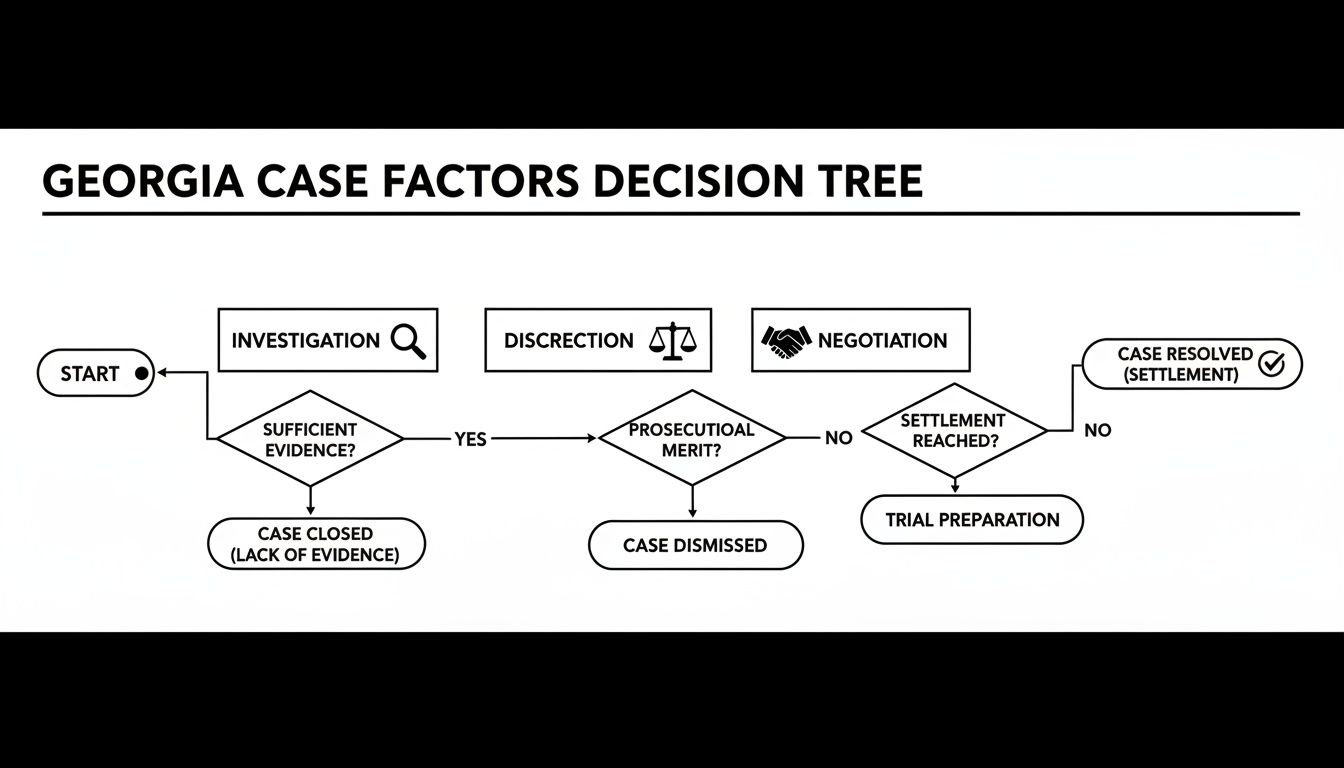
As can be seen, the path isn't always a straight line. Key decision points, especially during negotiation, can steer a case toward a much better result.
The Power Of A Restricted Record
The benefit of getting a record restricted is immense. Once it's done, the record is no longer accessible to the general public. That includes most employers, landlords, and college admissions officers. So, when a background check is run for a job in Alpharetta or an apartment in Roswell, that restricted incident simply won't show up.
The goal of record restriction is to give someone a true second chance. It prevents a youthful mistake or a wrongful accusation from creating a lifelong shadow that limits their potential and defines their future.
It's crucial to understand, though, that this isn't an automatic process. It involves complex paperwork, strict deadlines, and specific requirements that have to be met perfectly. The rules are unforgiving, and one small mistake can lead to a denial. You can learn more about getting records expunged in Georgia to get a better sense of all the steps involved.
Successfully navigating this system requires careful attention to detail and a solid understanding of the procedures in local courts like those in Forsyth County and Cobb County. For families hoping to secure the best possible outcome, experienced guidance is essential to make sure every opportunity to protect their child’s future is pursued correctly.
Why A Former Prosecutor's Insight Matters
When a young person’s future is on the line, the right experience can change everything. As has been shown, Georgia's laws are strict, and there is no simple “Romeo and Juliet” defense to just fall back on. The consequences of a conviction are severe, making every single decision critical from day one.
This is exactly where having a representative who has seen the other side of the courtroom becomes a massive advantage. A background as a former prosecutor gives a unique perspective into how the state builds its cases in communities like Cumming, Milton, and Alpharetta.
Understanding The Prosecutor's Playbook
A former prosecutor understands the system from the inside out. They know what kind of evidence hits hardest, which arguments are most persuasive to a judge or jury, and where the strategic weak points in a case are likely to be hiding.
This firsthand knowledge allows them to anticipate the prosecution's next move and build a defense designed to counter it effectively. It’s not just about knowing the black-and-white letter of the law; it’s about understanding the people and the local practices in Forsyth and Cobb County courts.
A representative with prosecutorial experience doesn't have to guess what the other side is thinking—they already know. This insight is crucial for identifying opportunities for charge reductions, negotiating favorable outcomes, and protecting a client’s future.
This unique perspective helps in several key ways:
- Evaluating Evidence: Knowing how a prosecutor scrutinizes evidence allows for a much more effective challenge against weak or inconsistent points in their case.
- Negotiating Effectively: Understanding a prosecutor's priorities and pressures makes it possible to present facts and arguments that are far more likely to lead to a positive resolution.
- Building Credibility: A former prosecutor often has established relationships with current prosecutors and judges, which can be incredibly beneficial when presenting a case and advocating for a client.
For families in Roswell, Marietta, or Johns Creek, this experience can be the difference-maker. You can learn more about the crucial role of prosecutorial discretion in our detailed guide. It's all about using that insider knowledge to build the strongest possible defense.
Frequently Asked Questions
When it comes to Georgia's laws on close-in-age relationships, a lot of questions and confusion can come up. Here are some plain-English answers to the most common concerns.
The goal is to provide a clear picture of how things work, but it's crucial to remember that every single case is different, and the specific facts matter immensely.
Is It a Defense If the Relationship Was Consensual?
In Georgia, consent is generally not a defense to a statutory rape charge if the younger person is under the age of 16. The law is written to protect minors, so the court’s primary focus is on the age gap, not on whether the relationship was wanted by both people.
That said, the consensual nature of the relationship is still a critical piece of the puzzle. It’s a fact that a prosecutor will weigh heavily when deciding whether to file charges in the first place, or which specific charges to bring. This is where the unique circumstances of a case can completely change the outcome.
Can These Charges Be Reduced From a Felony?
Statutory rape is a felony in Georgia, plain and simple. Unlike some other states, the law doesn't have an automatic rule that reduces the charge to a misdemeanor just because the age difference is small.
While a reduction isn't automatic, negotiation can sometimes lead to a lesser charge. This is never guaranteed and hinges entirely on the facts of the case, the defendant's history, and the specific policies of the local prosecutor's office.
Getting a charge reduced often means building a strong case that highlights mitigating factors—like the fact that it was a peer relationship between two teenagers, not a situation involving exploitation.
What Is the First Step If Accused of This Offense?
If a person or a loved one is accused of or even just being investigated for an offense involving a close-in-age relationship, the absolute first thing to consider is speaking with an experienced representative.
It's important not to talk to law enforcement, investigators, or school officials without professional representation. A professional is there to protect a person's rights, analyze the situation from every angle, and map out a course of action to protect their future. Acting fast is essential for building a strong position from the very beginning.
If you or a family member is facing a tough situation in Alpharetta, Cumming, or anywhere in Forsyth or North Fulton County, having a former prosecutor on your side can make all the difference. Contact Brian Hansford Law for a confidential consultation to understand your options at https://challengemycharge.com.
