
When facing a criminal charge, the path ahead can feel like a tangled, confusing maze. The steps in the criminal justice process aren't always intuitive, but they do follow a logical sequence—from the initial investigation and arrest, through the court proceedings, and all the way to a final resolution.
This guide is designed to be a map through that maze. We'll walk through each stage, step by step, explaining what’s happening, who the key players are, and what one might realistically expect.
Your Map Through the Criminal Justice System
Think of a criminal case as a journey with distinct phases. It starts with an investigation, moves into the courtroom, and ends with a resolution. Understanding this progression is the first step to feeling more informed about the situation.
We’re going to demystify the roles of police officers, prosecutors, and defense attorneys and show how they interact at every turn. Grasping what each person does is crucial to seeing the full picture.
This infographic below breaks down the three main stages of the journey.
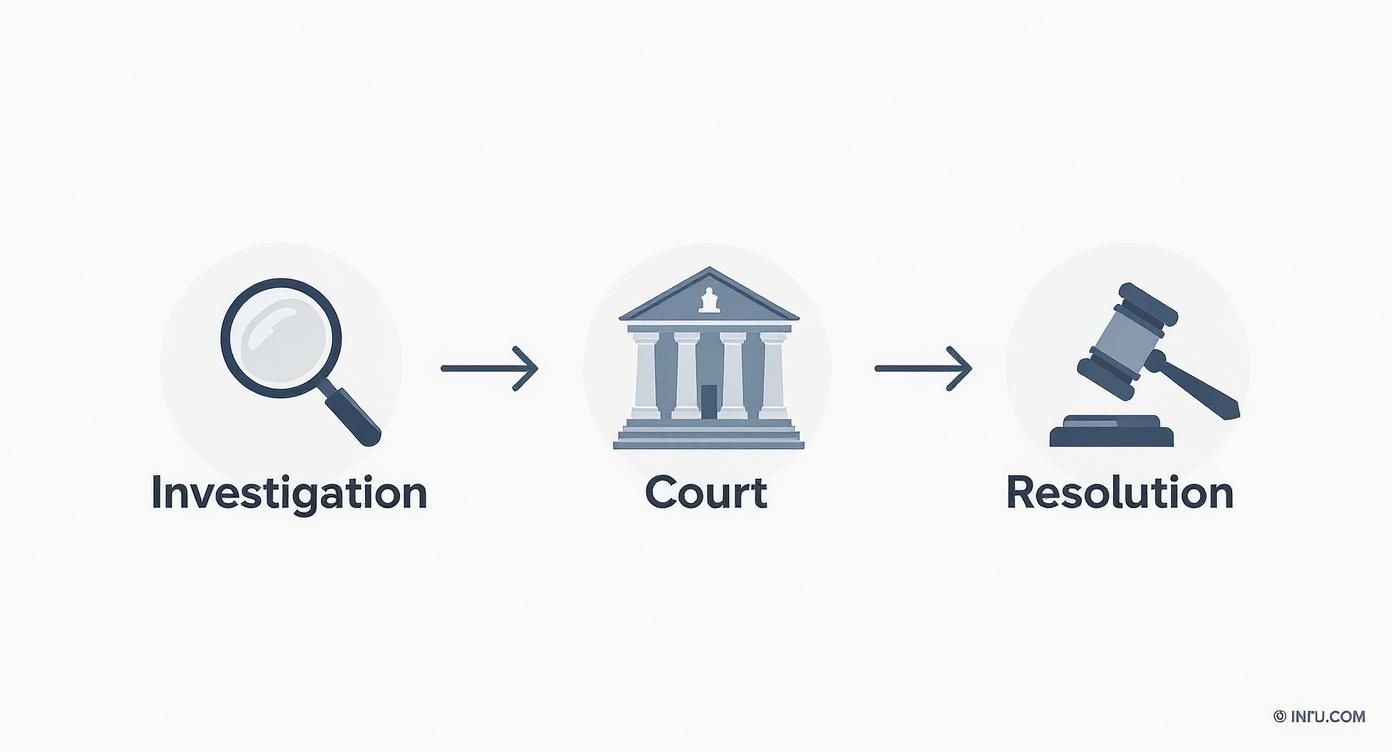
As you can see, each phase builds on the one before it. The investigation gathers the raw materials, the court phase puts those materials to the test, and the final stage determines the outcome.
To provide a quick reference point, here's a simple breakdown of the key stages.
Key Stages of the Criminal Justice Process at a Glance
This table provides a high-level overview of what happens at each major step.
| Stage | What Happens | Primary Goal |
|---|---|---|
| Investigation & Arrest | Law enforcement gathers evidence and may take a suspect into custody. | To determine if a crime was committed and identify a suspect. |
| Pre-Trial | Formal charges are filed, bail is set, and both sides exchange evidence (discovery). Plea negotiations often occur here. | To prepare the case for trial and explore potential resolutions. |
| Trial | A judge or jury hears evidence from both the prosecution and defense to determine guilt or innocence. | To formally adjudicate the facts of the case. |
| Sentencing | If found guilty, the judge imposes a punishment, such as fines, probation, or jail time. | To determine the appropriate penalty for the offense. |
| Appeals & Post-Conviction | The defendant may challenge the verdict or sentence in a higher court. | To review the trial proceedings for errors. |
This structured process helps ensure that every case is handled methodically and fairly.
The Purpose of a Structured Process
So, why all the steps? The criminal justice system is built on a series of checks and balances. This deliberate, structured approach is meant to protect the rights of everyone involved while working toward a just outcome. It’s a safeguard against rash decisions.
The journey starts long before anyone sets foot in a courtroom. It begins the moment an incident triggers a law enforcement response, leading to evidence collection and, potentially, an arrest.
The system is intentionally deliberate. Every step, from the first police interaction to the final verdict, is governed by specific rules and procedures designed to ensure fairness and consistency across all cases.
From there, the case moves into the judicial system, where prosecutors and defense attorneys make their arguments. This is where many of the most critical decisions are made—often determining whether a case even goes to trial. The entire framework is built to filter cases, with many chances for resolution along the way.
Please note, this guide is for informational purposes only and is not intended as advice.
How a Criminal Case Begins

Every criminal case starts somewhere. It usually begins with two key steps that set the stage for everything else: the investigation and the arrest. An investigation kicks off when police either witness a crime in progress or get a call about suspicious activity.
At this point, officers are focused on one thing: gathering enough evidence to establish probable cause. This is a term for having a solid, reasonable belief that a specific person committed a specific crime. To build that case, they'll be talking to witnesses, collecting physical evidence, and documenting every detail of the scene. The quality of this initial legwork can make or break a case down the road.
Understanding the Arrest
An arrest isn't just a brief detention for questioning. It's the moment law enforcement formally takes someone into custody because they believe they have probable cause. This is a serious step that officially removes a person's freedom of movement.
Once under arrest, officers will typically read the Miranda rights—including the crucial right to remain silent. From there, the individual is taken to a police station for booking. This is an administrative process, but it can feel overwhelming. It involves:
- Recording name, address, and other personal details
- Taking fingerprints and a mugshot
- Cataloging personal belongings, which are held for safekeeping
The entire experience can be confusing and disorienting. For a more detailed look at this phase, check out our guide on what happens when someone is arrested. This is the official entry point into the criminal justice system.
From Arrest to Potential Prosecution
Just because someone is arrested doesn't mean their case will automatically end up in front of a judge. In 2023, the FBI reported around 10.5 million arrests in the United States, which works out to a rate of about 3,180 for every 100,000 people. Those numbers show how many people enter the system, but many will exit just as quickly.
It's a critical fact that not every arrest leads to a conviction. Statistics show that in 2021, only about 40% of felony arrests in the U.S. resulted in a conviction, underscoring the many potential outcomes that can occur during the process.
In fact, many cases for minor offenses are dismissed or diverted away from the courtroom entirely.
For less serious crimes, like traffic violations or petty misdemeanors, an officer might just issue a citation or a notice to appear in court instead of making a physical arrest. It feels less intense, but it’s still the start of a formal case that requires a response. It’s simply a different door into the same system.
The First Days in Court
After an arrest, the entire process shifts from the police station to the courthouse. These initial court appearances are some of the most critical steps in the whole timeline because they truly set the stage for everything that comes next.
The first major court date is the arraignment. This is the formal hearing where an individual is officially told what charges have been filed. It's the moment the prosecution’s case is formally put on the record for the first time.
At the arraignment, the defendant will be asked to enter a plea—usually "guilty," "not guilty," or "no contest." Pleading "not guilty" is extremely common at this stage and is what moves the case forward. To get a better handle on this hearing, you can read our detailed guide on what happens at an arraignment hearing.
The Question of Bail
Right after the plea, the court turns its attention to pretrial release, which almost always means talking about bail. Bail isn’t a fine or a punishment; think of it as a financial guarantee that the defendant will show up for future court dates.
A judge decides on the bail amount after weighing a few key things: how serious the charges are, the defendant's criminal history, and whether the person is considered a risk to flee or a danger to the community. The goal is to strike a balance between individual freedom and public safety.
There are a couple of ways this can go:
- Released on Recognizance (ROR): This is the best-case scenario. The judge releases the person on their own promise to return to court, no money required. This is usually reserved for people with little to no criminal record who are facing less serious offenses.
- Posting Bond: If the judge sets a dollar amount for bail, it has to be paid for release. The full amount can be paid in cash, but what’s far more common is hiring a bail bonds company. They typically charge a non-refundable fee of 10-15% of the total bail amount.
Determining if There Is Enough Evidence
The last piece of these early court proceedings is a vital checkpoint: Does the prosecution actually have enough evidence to keep the case going? This is determined through either a preliminary hearing or a grand jury proceeding.
Both serve the same purpose—to see if there’s enough evidence, or probable cause, to move forward toward a full trial.
This stage acts as a critical filter. A surprising number of cases are resolved, dismissed, or rerouted right here, long before a trial is ever on the table. It keeps weak cases from jamming up the court system.
In a preliminary hearing, a judge listens to the evidence and decides if the case has merit. In a grand jury system, a group of citizens hears the evidence in secret and votes on whether to hand down an indictment. If probable cause is found either way, the case officially moves into the pre-trial phase.
What Happens Before a Trial
The time between the first court appearance and a potential trial is anything but quiet. It might seem like nothing is happening from the outside, but this is actually a critical phase where both the prosecution and defense teams are working hard behind the scenes. This is when the real strategic maneuvering begins, primarily through two key processes: discovery and plea bargaining.
The "Show Your Cards" Phase: Discovery
Think of the discovery process as a mandatory "show your cards" moment in the process. It's the formal procedure where the prosecutor is required to turn over all the evidence they have collected against the defendant. This isn't just a courtesy; it's a constitutional right.
This isn't a one-way street, either. The defense often has its own obligations to share certain types of evidence it plans to use at trial, like expert witness reports or alibi notices. This exchange is designed to prevent any major "gotcha" moments or surprises in the courtroom, allowing both sides to prepare their case based on the full picture. The evidence shared can include police reports, witness statements, lab results, body cam footage, and photos. This is the first real look at the strength—or weakness—of the state's case, and it’s where a counter-strategy starts to form.
Plea Bargaining and Resolving the Case
Once all the evidence is out in the open, both sides can realistically size up their chances of winning at trial. This is what usually kicks off negotiations for a plea bargain, a process that resolves the vast majority of criminal cases—some studies show over 90%—without ever setting foot in a trial courtroom.
A plea bargain is basically a negotiated agreement. The defendant agrees to plead guilty, usually to a lesser charge or in exchange for a more predictable, often more lenient, sentence. Why would a prosecutor offer a deal? To secure a conviction without the time, expense, and uncertainty of a trial, especially if their case has some holes. For the defendant, it can offer a guaranteed outcome and help avoid the risk of a much harsher sentence if a jury finds them guilty. Weighing the advantages and disadvantages is a crucial step; you can learn more about the complexities involved by exploring the pros and cons of a plea bargain.
A plea agreement is a calculated resolution. It replaces the uncertainty of a jury verdict with a negotiated outcome that both the prosecution and defense have agreed upon, effectively ending the case before a trial begins.
The Power of Pre-Trial Motions
Another huge part of this pre-trial phase is filing pre-trial motions. These are formal requests asking the judge to make a specific ruling on an issue before the trial starts. A single successful motion can completely change the trajectory of a case.
Here are a few common and powerful pre-trial motions:
- Motion to Suppress Evidence: This is a big one. This motion asks the judge to throw out evidence that the police obtained illegally, like from a bad search or an interrogation without a Miranda warning. If the judge grants it, that evidence is gone, which can cripple the prosecution's case.
- Motion for a Change of Venue: If a case has gotten a ton of media attention, it might be impossible to find an impartial jury in that area. This motion asks to move the trial to a different location to ensure a fair hearing.
- Motion to Dismiss: This motion argues that the case has such significant flaws that the charges should be dropped entirely before a trial even begins. This could be due to a lack of evidence, a violation of speedy trial rights, or other procedural failures.
Winning these motions can sometimes get a case dismissed outright. More often, it puts significant pressure on the prosecutor, forcing them to offer a much better plea deal. This is where a sharp strategy can make all the difference.
Inside the Courtroom During a Trial
When plea negotiations can’t get a case resolved, it moves to what most people picture when they think of the criminal justice system: the trial. This is the formal showdown where the prosecution and defense lay out their cases in front of a neutral party—either a judge or a jury—to decide guilt or innocence.
Think of a trial as a highly structured storytelling contest. Each side gets to tell their version of what happened, but they have to play by a very strict set of rules. The whole point is to present evidence and arguments in a way that convinces the decision-maker that their story is the one that's true.
Jury Selection: The First Hurdle
Before anyone starts arguing, there's a critical first step called jury selection, or "voir dire." This is the process of picking a group of impartial citizens from the community who will listen to all the evidence and decide the facts of the case.
Both the prosecution and the defense get to question potential jurors. They are looking for any biases or preconceived notions that might keep someone from being fair. The goal is to end up with a jury that is as neutral and open-minded as possible.
The Main Phases of a Trial
Once the jury is sworn in, the trial moves through several distinct phases. Each one has a specific purpose, ensuring that both sides get a fair shot to make their case.
-
Opening Statements: This is where each side gives the jury a roadmap of their case. The prosecutor goes first, outlining the evidence they plan to show to prove the defendant is guilty beyond a reasonable doubt. The defense attorney then gets their turn, explaining why the evidence will actually show their client is not guilty.
-
Presentation of Evidence: Now the storytelling begins. The prosecution presents its "case-in-chief" by calling witnesses to the stand and introducing evidence like documents, photos, or physical objects. The defense team has the right to cross-examine every single one of their witnesses. Once the prosecution rests, it's the defense's turn to present its own witnesses and evidence, and the prosecutor gets to cross-examine them.
-
Closing Arguments: After all the testimony and evidence is in, both sides get one last chance to talk directly to the jury. They summarize everything that was presented and make a final, persuasive argument for why the jury should rule in their favor.
-
Jury Instructions and Deliberation: The judge reads the jury a set of instructions, explaining the relevant laws and how they should apply them to the facts they've heard. The jury then heads into a private room to deliberate and, hopefully, reach a unanimous verdict.
A trial is fundamentally about storytelling under oath. The prosecution and defense construct narratives based on evidence, and the jury's role is to decide which story is supported by the facts presented in court.
Jury Trial vs. Bench Trial
Not every trial has a jury. For some cases, especially less serious offenses, the defendant might opt for a bench trial. In a bench trial, there is no jury at all. The judge alone listens to the evidence, weighs the facts, and decides the outcome of the case.
Choosing between a jury trial and a bench trial is a major strategic decision that depends on the unique facts and issues in a case.
To help clarify who handles what, here's a simple breakdown of the key players in the courtroom.
Who Does What in a Criminal Trial
| Participant | Primary Role and Responsibilities |
|---|---|
| Judge | Acts as the neutral referee. Rules on issues, instructs the jury on the law, and ensures the trial is conducted fairly. In a bench trial, the judge also decides guilt or innocence. |
| Prosecutor | Represents the government (the "State" or "People"). Their job is to present evidence and witness testimony to prove the defendant's guilt beyond a reasonable doubt. |
| Defense Attorney | Represents the accused (the defendant). Their job is to challenge the prosecution's case, protect the defendant's rights, and present evidence that creates reasonable doubt about their guilt. |
| Defendant | The person accused of the crime. They have the right to be present at their trial but are not required to testify. They are presumed innocent until proven guilty. |
| Jury | A panel of impartial citizens from the community. They listen to the evidence, determine the facts of the case, and deliver a verdict of guilty or not guilty. |
| Court Reporter | Creates an official, word-for-word record of everything that is said and done during the trial. |
| Witnesses | People who testify under oath about what they saw, heard, or know. They can be called by either the prosecution or the defense. |
Understanding these roles is the first step to making sense of the controlled, and often intense, environment of a criminal trial. Each person has a specific and crucial part to play in the process.
The Final Stages: Sentencing and Appeals
A guilty verdict doesn't mean the case is over. Whether it comes from a plea deal or a jury trial, it simply moves the case into its final, and often most critical, phases: sentencing and, if necessary, appeals.
The first of these is the sentencing hearing. This is a separate court date where the judge officially decides the punishment. It's not a cut-and-dry decision; the judge has to weigh a lot of information to make a final call.
How a Sentence Is Decided
At the sentencing hearing, both the prosecutor and the defense attorney get a chance to present their arguments. The judge listens to both sides and considers several key factors to make sure the punishment fits the crime—and the person.
These factors almost always include:
- Sentencing Guidelines: Most states have official guidelines that suggest a penalty range based on how serious the crime was and the defendant's criminal record.
- Defendant's History: The judge will look closely at a person's past—or lack of one. A clean record can make a big difference.
- Case-Specific Details: Every fact of the case matters here. The judge reviews all aggravating circumstances (things that make the crime worse) and mitigating circumstances (things that might call for a lighter sentence).
The final sentence can be anything from fines and probation to significant time behind bars. Imprisonment is a common outcome. According to the Bureau of Justice Statistics, there were roughly 1.2 million people in state and federal prisons and another 664,800 in local jails in 2023. You can even explore more data on incarceration trends to see the bigger picture.
Understanding the Appeals Process
Even after a sentence is handed down, the fight might not be over. If there's a strong belief that a major error happened during the trial, a defendant has the right to file an appeal.
It’s absolutely crucial to understand that an appeal is not a do-over. The appeals court won't hear from witnesses or look at new evidence. Its only job is to review the trial court's record for mistakes that could have changed the outcome.
The process starts with filing a "notice of appeal." This kicks off a lengthy and detailed process where lawyers for both sides submit written arguments, called briefs. The higher court will comb through the trial record, looking for problems like a judge giving the jury wrong instructions or evidence being allowed when it shouldn't have been.
From there, the appeals court can uphold the original verdict, overturn it and order a completely new trial, or, in some situations, just change the sentence. It's a vital safety net built into the system.
A Few Common Questions About the Criminal Justice Process
When first pulled into the criminal justice system, it's natural to have a lot of questions. Getting straight answers can help with understanding what's happening and what might come next.
How Long Does This All Take?
This is one of the first things many people want to know, and the honest answer is: it depends. A simple misdemeanor case where a plea deal is worked out might be over in just a few weeks or a couple of months.
But a serious felony case headed for a jury trial is a different story entirely. These can easily stretch out for more than a year. If there’s a conviction followed by an appeal, the timeline can extend for several more years. The system doesn't move quickly.
What’s the Real Difference Between a Misdemeanor and a Felony?
It all comes down to the seriousness of the potential punishment.
Felonies are the most serious crimes. A conviction typically means facing more than a year in state prison.
Misdemeanors, on the other hand, are less severe offenses. The penalties are usually capped at a year in the county jail, along with things like fines or probation. This distinction is crucial—it affects everything from the initial bail amount to the specific court that will hear the case.
The first thing that shapes how a case moves through the system is whether the charge is a misdemeanor or a felony.
Can Charges Be Dropped After an Arrest?
Yes, absolutely. An arrest isn't a conviction. After an arrest, a prosecutor has to review the evidence the police gathered. If they look at the file and decide there just isn't enough to prove the case, they can refuse to file formal charges right then and there.
Even if charges are filed, a judge might dismiss them later if there were major procedural mistakes or if the prosecution fails to present enough evidence at a preliminary hearing. It's also very common for charges to be dropped or reduced as part of a plea negotiation.
Facing criminal charges in Alpharetta, Roswell, or anywhere in the surrounding area can feel like the world is turning upside down. With over 25 years of experience, including valuable time spent as a prosecutor, Brian Hansford Law knows how to navigate this system. If you need a defense attorney who understands both sides of the courtroom, find out how they can help at https://challengemycharge.com.
