
When a loved one is arrested, the first question is always, “How do we get them out?” The answer almost always involves a bond hearing. This is the first real opportunity to get in front of a judge and argue for release from jail while the case is pending.
The entire point of this hearing is for a judge to decide if the person arrested can be released before their trial. It’s not about guilt or innocence; it’s a focused assessment of two key things: Is this person a risk of fleeing, and are they a danger to the community?
Your First Look Inside a Georgia Bond Hearing
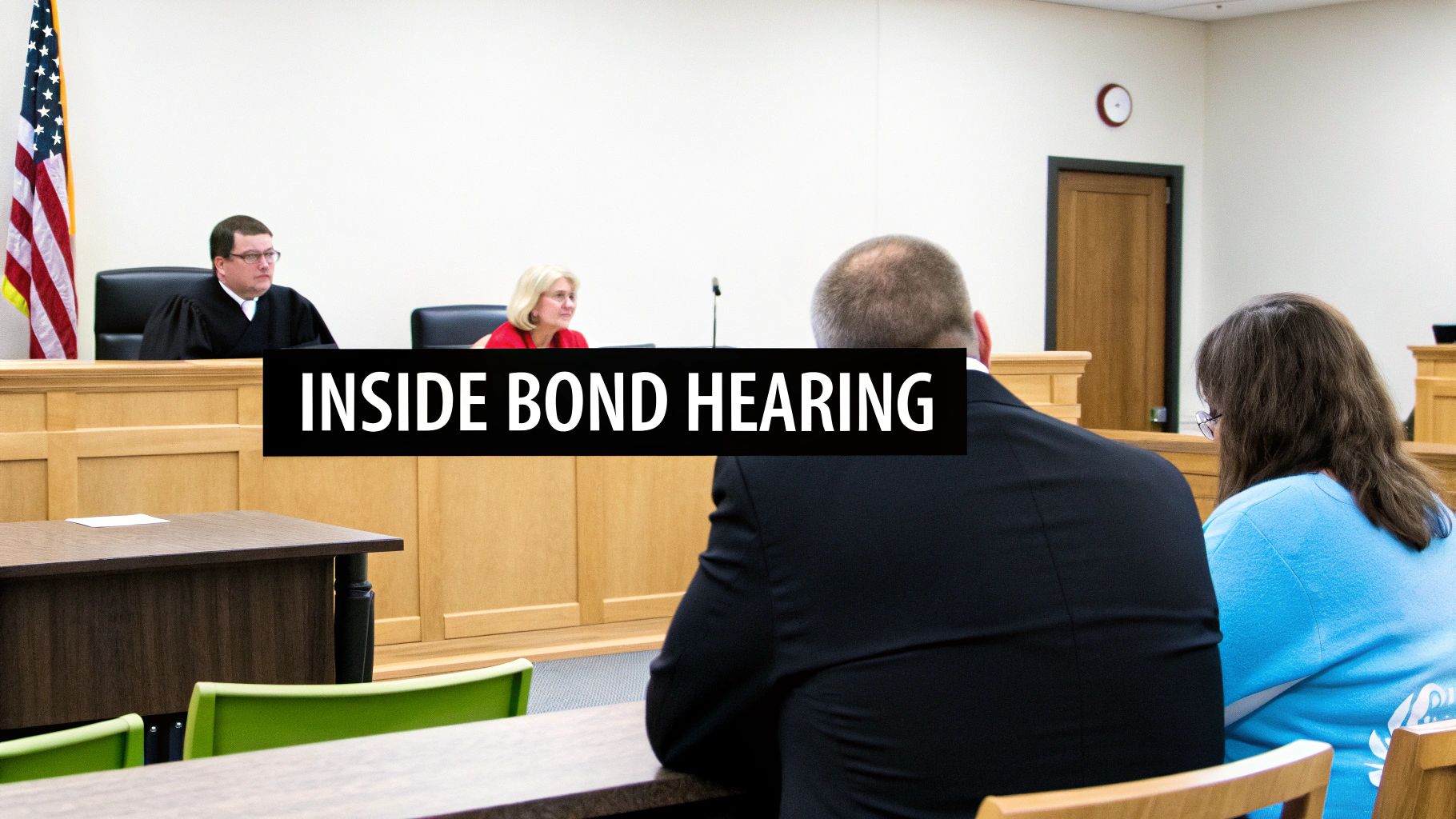
The moments and hours after an arrest are a blur of confusion and anxiety. Understanding what happens when you get arrested can help, and the bond hearing is one of the most critical early hurdles.
This isn’t the trial you see on TV. The judge isn’t there to hear the whole story. Instead, they are asking a much simpler question: can we trust this person to show up for their future court dates and stay out of trouble if we let them out of jail? Think of it as a preliminary risk assessment, and the stakes couldn’t be higher.
Who Is in the Room and What They Do
Every bond hearing has a standard cast of characters, and knowing their roles helps demystify the process.
- The Judge: This is the ultimate decision-maker. They listen to arguments from both sides before ruling on whether to grant bond and what the conditions of release will be.
- The Prosecutor: This attorney represents the State of Georgia. Their job is to protect public safety, so they will often argue for a high bond amount or strict conditions—or sometimes, no bond at all.
- The Defense Attorney: This is the defendant’s advocate. Their goal is to present a compelling picture of an individual with strong community ties who is not a flight risk or a danger.
Having an experienced defense attorney in your corner is more than just a good idea; it can be an advantage. Studies have shown that defendants with legal representation are 3.5 times more likely to be granted bond than those who go it alone.
The Typical Sequence of Events
While the details change from case to case, the overall structure of a bond hearing is fairly predictable. Things move fast, so being prepared for the flow is key.
At its heart, a bond hearing is a balancing act. The judge must weigh the constitutional presumption of innocence and the right to pretrial liberty against the community’s need for safety and the court’s need for the defendant to return.
First, the judge calls the case and reviews the official charges. The prosecutor then gets their turn, making arguments against release or for a high bond. After that, a defense attorney steps up to present evidence of community ties—like a job, family, or homeownership—and argue for a reasonable bond.
Finally, the judge makes their call. They can grant bond with specific conditions, set a cash amount, or, in the most serious cases, deny bond completely.
For a clearer picture, this table breaks down the fundamental stages of a Georgia bond hearing.
Quick Overview of the Bond Hearing Process
| Stage | What Happens | Primary Goal |
|---|---|---|
| Case Call | The judge formally calls the case and reviews the charges filed against the defendant. | To establish the legal basis for the hearing. |
| Prosecution’s Argument | The prosecutor presents their case for why bond should be high, restricted, or denied, citing flight risk or danger to the community. | To convince the judge to impose conditions that ensure public safety and the defendant’s return to court. |
| Defense’s Argument | The defense attorney presents evidence of the defendant’s community ties (job, family, residency) and argues for release on reasonable terms. | To show the judge that the defendant is not a flight risk or a danger, justifying pretrial release. |
| Judge’s Ruling | The judge weighs both arguments and makes a final decision on whether to grant bond, the amount, and any specific conditions of release. | To balance the defendant’s right to liberty with the need to protect the community and ensure the integrity of the judicial process. |
This process can feel incredibly intimidating, but understanding each step helps individuals and their families know what to expect.
Key Factors a Judge Considers for Bond

When a judge in Alpharetta, Roswell, or anywhere in Georgia decides whether to grant bond, it’s far from a random choice. They’re performing a careful, calculated risk assessment based on specific criteria laid out in Georgia law. The ultimate goal is to strike a balance between a defendant’s right to be presumed innocent and the community’s need for protection.
This whole evaluation boils down to two core questions: Is this person going to show up for their future court dates? And if they are let out, are they going to be a danger to anyone? Answering these involves a deep dive into who the defendant is, what they’re accused of doing, and how connected they are to the area.
Assessing the Risk of Flight
The first big hurdle is convincing the judge that the defendant isn’t going to vanish before their next court date. This is called assessing the “risk of flight.” A judge needs to see real, tangible evidence that a person is grounded and has compelling reasons to stick around.
Think of it like an anchor holding a ship steady in a storm. The more anchors someone has in their community, the less likely they are to drift away when things get tough. A judge is actively looking for these “anchors.”
The bottom line on flight risk is pretty simple: Does this person have more to lose by leaving than by staying? A stable life, family nearby, and a steady job are powerful signs that someone will remain accountable.
Judges in Cobb County, Forsyth County, and surrounding areas will zero in on a few key areas:
- Family and Community Connections: Does the defendant have family living in the area? Are they involved in local groups, a church, or other organizations? Strong personal ties suggest a person isn’t just going to pack up and leave everything behind.
- Employment and Financial Stability: Having a steady job is a huge factor. It shows responsibility and gives someone a good reason to stay put. The judge will want to know how long the person has been employed and what they do for a living.
- Residency: How long has the defendant lived in Milton or the surrounding area? Owning a home or having a long-term lease demonstrates a level of commitment to the community that judges see as a positive sign.
Someone with a lifelong history in Marietta, a decent job, and family sitting in the courtroom is a much lower flight risk than a person with no local connections to speak of.
Evaluating Any Danger to the Community
The second critical piece of the puzzle is whether releasing the defendant would create a threat to public safety. This factor gets dialled up significantly when the alleged crime is violent.
To figure this out, the judge will closely examine the details of the current charges and the defendant’s background. This isn’t about deciding guilt or innocence—it’s about trying to predict future behavior based on the available facts.
A judge will weigh several things to assess potential danger:
- The Nature of the Alleged Offense: Charges that involve violence, weapons, or direct harm to another person are going to get a lot more scrutiny. The judge has to think about the safety of any alleged victims and the community as a whole.
- Prior Criminal History: A track record of similar offenses or a history of violence can weigh heavily against granting bond. On the flip side, a clean record or only minor, unrelated priors can be a big help.
- Potential for Witness Intimidation: The judge also has to consider if there’s a risk that the defendant, once released, might try to threaten or influence witnesses. That’s a direct threat to the justice process itself.
For example, a person in Johns Creek facing their first non-violent charge is going to be seen in a completely different light than someone with multiple past convictions for violent crimes. The judge’s job here is to prevent any more harm while the case moves forward.
Other Important Considerations
Beyond the two main pillars of flight risk and community safety, a few other things can influence what happens at a bond hearing. The judge’s final decision is a product of all the information presented, not just one or two factors.
This can include a defendant’s ability to pay. A judge might set a bond high enough to make sure the person comes back to court, but not so high that it’s impossible for someone with limited means to post it.
Sometimes, the strength of the prosecution’s evidence—even at this early stage—can play a role. If the case against the defendant seems particularly weak, a judge might be inclined to set a more lenient bond. Every piece of information helps the judge build a complete picture before making a ruling that will have a massive impact on a person’s freedom.
Understanding the Roles of Each Party
To really get what’s happening at a bond hearing, you need to know who is in the room and what their job is. It’s a bit like a structured debate with very high stakes, where each person has a specific, critical role.
The whole thing is basically a conversation between three key people, with the judge acting as the final decision-maker. Knowing what each person is there to do pulls back the curtain on the courtroom process, making it clear why certain things are said and how a judge lands on a final decision.
The Judge: The Neutral Decision-Maker
Sitting at the center of it all is the judge. Their job isn’t to decide if someone is guilty or innocent—that comes much later. Right now, the judge is a neutral referee tasked with one thing: figuring out what, if any, conditions are needed to make sure the defendant comes back to court and doesn’t pose a threat to anyone.
They listen carefully to both sides, look over the defendant’s background, and apply the law. The judge weighs factors like community ties, past criminal history, and the seriousness of the charge. Their final ruling is the result of this balancing act, and in that courtroom, their word is final.
The Prosecutor: The Voice for Public Safety
The prosecutor represents the State of Georgia, and their main focus is public safety. During the bond hearing, they will lay out the state’s argument for why the defendant might be a flight risk or a danger to the community. This usually involves pointing out the severity of the charges or the defendant’s prior record.
The prosecutor might push for a high bond amount to create a strong financial reason for the person to show up for future court dates. For more serious accusations, they could ask for extra conditions like an ankle monitor or an order to stay away from a certain person. In the most extreme cases, they’ll argue to deny bond completely, telling the judge that no amount of money or conditions can keep the public safe.
The Defense Attorney: The Defendant’s Advocate
On the other side of the aisle is the defense attorney, who is there to be the advocate for the person who was arrested. Their mission is to make a powerful case for their client’s release with the fewest restrictions possible. This means gathering evidence to directly challenge the prosecutor’s claims about flight risk and danger.
A skilled defense lawyer will do a few key things during the hearing:
- Highlight Positive Community Ties: They will bring up things like a steady job, supportive family in areas like Alpharetta or Milton, and how long the person has lived in the community.
- Challenge the Prosecution’s Narrative: They can point out weak spots in the state’s initial evidence or offer context that makes the alleged crime seem less severe.
- Humanize the Client: They work to show the judge that the defendant isn’t just a case number but a real person with a family, a job, and a life to get back to.
Who represents a defendant can make a difference. Knowing the distinctions between a public defender vs private attorney is critical, as an experienced private attorney has the time to build a strong, personalized argument designed for a specific case and the judge who will hear it.
Ultimately, the defense attorney’s role is to ensure their client’s side of the story is heard loud and clear. They are the counterbalance to the prosecution, fighting to protect the presumption of innocence and the right to pretrial liberty.
Understanding the Different Types of Bonds a Judge Can Set in Georgia
Once a judge agrees to grant bond, the next critical question is, “What kind of bond will it be?” This isn’t a minor detail—the type of bond set by the court has massive financial and practical consequences for the defendant and their family. Knowing the difference is the first step in navigating what comes next.
Think of it this way: a bond is the court’s insurance policy. The judge needs a solid guarantee that the person arrested will show up for all their future court dates. Each type of bond provides that guarantee in a different way, from a simple handshake agreement to a serious financial pledge.
The Best-Case Scenarios: No-Cost Release Options
In certain cases, usually for less serious offenses where the person has strong ties to the community and a clean record, a judge might decide a financial penalty isn’t needed to ensure their return. This leads to the most favorable outcomes.
- Own Recognizance (OR) Bond: This is a favorable outcome. An OR bond means the judge is releasing someone on their word alone. No money changes hands. The defendant just signs a paper promising to appear in court, and they are free to go.
- Signature Bond: This is a close cousin to the OR bond. It also costs nothing upfront to get out of jail. The key difference is that a signature bond has a dollar amount attached to it. For instance, if a judge sets a $5,000 signature bond, you don’t pay anything to post it. But if the defendant misses a court date, they (or whoever co-signed) are suddenly on the hook for the full $5,000.
Judges typically reserve these options for people they see as a very low risk of fleeing.
When Money is on the Line: Bonds Requiring Payment
More often than not, a judge will want some financial skin in the game to make sure the defendant comes back to court. This is where things can get complicated and expensive for families in places like Cumming, Alpharetta, or Marietta.
The logic behind a financial bond is straightforward: people are far more likely to meet their obligations when their own money—or a large amount of someone else’s—is at stake.
The most direct option is a Cash Bond. To get released, the defendant or their family has to pay the full bond amount directly to the court clerk. If bond is set at $10,000, you literally have to hand over $10,000 in cash or a cashier’s check.
The court holds onto that money until the case is completely over. As long as the defendant makes every court appearance, the full amount is returned at the end (though court fees or fines might be deducted). If they skip court, that money is forfeited for good.
Using a Bail Bondsman or Property as Collateral
Let’s be realistic—most families don’t have thousands of dollars sitting around to pay a full cash bond. That’s where surety and property bonds become essential alternatives.
A Surety Bond is, by far, the most common way people post bond. It involves hiring a commercial bail bondsman. Instead of paying the court the full amount, you pay the bondsman a non-refundable fee, which is usually 10-15% of the total bond. The bondsman then gives the court a promise, or “surety,” for the full amount, guaranteeing the defendant’s appearance.
So, for that same $10,000 bond, you would pay a bondsman somewhere between $1,000 and $1,500. This fee is their payment for taking the financial risk, so you don’t get it back, even when the case is resolved.
Finally, there’s the Property Bond. This lets a defendant use real estate as collateral to secure their release. The property has to be in Georgia and must have enough equity to cover the entire bond amount. It’s a much slower and more involved process that requires appraisals and a lot of paperwork at the courthouse, but it can be an option in some cases.
Comparing Common Types of Bonds in Georgia
Each bond type has its own rules, costs, and risks. To make it clearer, here’s a simple breakdown of how they stack up against each other.
| Bond Type | What It Means | Typical Cost | Key Consideration |
|---|---|---|---|
| Own Recognizance (OR) | Release on a written promise to appear. | $0 (No money required) | Based on the judge’s trust; reserved for low-risk individuals. |
| Signature Bond | Release on a promise, with a financial penalty only if the defendant fails to appear. | $0 (Initially) | A financial penalty is triggered by missing a court date. |
| Cash Bond | The full bond amount is paid directly to the court. | 100% of the bond amount | The money is refundable at the end of the case, minus fees. |
| Surety Bond | A bail bondsman is paid a non-refundable fee to post the bond. | 10-15% of the bond amount | The fee is non-refundable; it’s the cost of the service. |
| Property Bond | Real estate equity is used as collateral for the full bond amount. | Varies (appraisal, filing fees) | A slow and complex process that puts the property at risk. |
Understanding these distinctions is crucial because the choice made at the bond hearing will impact a family’s finances and freedom for the entire duration of the case.
What to Expect on the Day of the Hearing
The day of a bond hearing is almost always packed with anxiety and a lot of unknowns. Knowing what to expect when you get to the courthouse can make a world of difference, helping individuals and their families feel more prepared for what’s ahead. Here’s a straightforward walkthrough of how the day usually unfolds.
Walking into a courthouse in Forsyth County or Cobb County for the first time can be intimidating, but there’s a set rhythm to it all. The first task is simple: find the right courtroom. Look for the monitors near the courthouse entrance, which will list the day’s cases and courtroom assignments. It is absolutely crucial to get there early. Court schedules are anything but set in stone, and arriving early provides time to get your bearings without feeling rushed.
Navigating the Courthouse and Courtroom Etiquette
Once you’re in the right place, you need to be aware of the courtroom’s rules of decorum. These aren’t just for show; they signal to the judge that you respect the court and understand the gravity of the situation.
- Dress Appropriately: Think business casual. Steer clear of shorts, graphic t-shirts, or anything too informal. Appearance sends a message of respect and can make a subtle, positive impression.
- Silence Your Phone: Don’t just put it on vibrate—turn it completely off. A phone going off can get you removed from the courtroom. It’s a serious disruption.
- Be Respectful: No talking, eating, or drinking while court is in session. Everyone is expected to stand when the judge enters or leaves the room.
These small gestures really do matter. They show the judge you’re taking the process seriously. Family and friends who come for support to courthouses in Alpharetta, Milton, or Roswell should also follow these rules.
Expect the courtroom to be busy. A loved one’s case will be just one of many on the schedule, which is called the docket. You’ll have to wait for the case to be called, and that can sometimes take hours, so come prepared to be patient.
The Hearing Begins: The Arguments and Decision
When a case is called, the defendant will be brought out to stand before the judge. The hearing itself is surprisingly fast, often lasting just a few minutes. Because things move so quickly, this is the moment when having an experienced attorney is absolutely vital.
First, the prosecutor gets their turn. They’ll state the charges and argue why they think bond should be set high—or denied completely. To make their point, they might bring up the defendant’s criminal history or emphasize the severity of the alleged crime, framing the person as a flight risk or a danger to the community.
A bond hearing is a concise, focused event. It’s not about determining guilt but about assessing risk. The arguments presented are snapshots intended to give the judge enough information to make an informed decision on pretrial release.
Next up is the defense attorney. Their job is to push back against the prosecutor’s claims by highlighting the defendant’s ties to the community. They’ll talk about things like a steady job, supportive local family, and how long the person has lived in the area, whether it’s Johns Creek or Marietta. The goal is to paint a picture of a responsible person who can be trusted to show up for future court dates.
The infographic below shows the common types of bonds the judge will be weighing while listening to these arguments.

This visual breaks down the financial options, from a simple signature release to bonds requiring payment, that a judge considers based on the case presented.
What Happens Immediately After the Ruling
After hearing from both sides, the judge makes a decision right then and there. The ruling is immediate. The judge will state whether bond is granted and, if so, for how much and under what conditions. These conditions might include a no-contact order, regular check-ins with a supervision officer, or even electronic monitoring.
If bond is granted, the next step is to “post” it. This means either going to the clerk’s office to pay a cash bond or getting in touch with a bail bondsman for a surety bond. Once the payment is squared away, the jail will start the release process, though this can still take several hours to complete.
If the judge denies bond, the person will remain in jail. It’s tough news, but it’s important to know this stage is separate from what comes next. To learn more, check out our guide on what happens at an arraignment hearing, which is a completely different court proceeding. Understanding each step helps you prepare for what’s ahead.
Common Questions About Georgia Bond Hearings
Even after you get a grasp of the big picture, a lot of specific questions pop up about what actually happens at a bond hearing. These proceedings move fast, and it’s easy for families to walk away feeling confused. Let’s clear up some of the most common questions people ask about bond hearings in Georgia.
Think of this as a quick rundown of the practical details you need to know right now.
How Long After an Arrest Does a Bond Hearing Happen?
In Georgia, there’s a real sense of urgency around that first court appearance where bond is usually handled. Typically, this hearing has to happen within 48 to 72 hours if the arrest was made without a warrant. The exact timing can shift depending on the county, the court’s own schedule, and even what day of the week the arrest took place.
For more serious charges, especially felonies that land in Superior Court, a separate, more formal bond hearing might be set for a later date. But that initial, quick hearing is a critical protection to make sure someone isn’t just left in jail indefinitely without a judge reviewing why they’re being held.
What Happens if Bond Is Denied?
If a judge denies bond, it’s straightforward: the person stays in custody until their case is over—whether that’s through a plea, a dismissal, or a trial. A judge usually denies bond after deciding the person is a significant flight risk or poses a danger to the community. This decision, however, isn’t always the final word.
A bond denial can feel like the end of the road, but it’s vital to remember it has nothing to do with guilt or innocence. It is simply a decision about pretrial detention based on the facts at hand.
A defense attorney can ask the judge to reconsider bond later on. This is usually done by filing a motion arguing there has been a significant change in circumstances. Maybe new evidence has come to light, or new information is available that shows the defendant has stronger ties to the community than originally thought. Without that kind of change, though, the person will likely remain in jail.
Can a Bond Amount Be Reduced After It Is Set?
Yes, it’s definitely possible to ask for a bond reduction. When a judge sets a bond so high that a family can’t possibly pay it, it might as well be a bond denial. In these situations, an attorney can file what’s called a “Motion for Bond Reduction.”
This motion is a formal request for the judge to take a second look at the amount. The attorney will lay out arguments and present evidence showing why the current bond is excessive and why a lower amount would still be enough to ensure the defendant comes back to court. The judge then decides whether to lower the bond, keep it the same, or deny the motion.
What Are Bond Conditions?
Bond conditions are basically a set of rules a person has to follow to stay out of jail while their case is pending. These aren’t punishments; they are safeguards put in place to protect the community and make sure the defendant shows up for all their court dates.
A judge can impose a wide range of conditions, including:
- No-Contact Orders: A strict rule against contacting the alleged victim or any witnesses.
- Regular Check-ins: Requiring the person to report to a pretrial supervision officer weekly or monthly.
- Electronic Monitoring: This often means wearing an ankle monitor to track a person’s location.
- Curfews: An order to be home during certain hours, usually overnight.
- Substance Abuse Counseling: Mandating participation in drug or alcohol treatment and testing.
Violating any of these conditions is a big deal. The judge can revoke the bond, and the defendant will be sent right back to jail to wait for their trial.
Navigating a bond hearing can be a complex process where a fast response and a strong case for release are important. If your loved one has been arrested in Alpharetta, Cumming, or the surrounding counties, the team at Brian Hansford Law is ready to fight for them. Don’t wait—contact them today to protect their rights and their freedom. Learn more at https://challengemycharge.com.
