
Receiving notice of a grand jury proceeding in Alpharetta, GA, is a serious and unnerving experience. You are likely stressed, unsure of what comes next, and concerned about the consequences. A grand jury hearing is a private, one-sided meeting where a Fulton County prosecutor presents evidence to a group of citizens. Their sole purpose is to decide if "probable cause" exists to formally charge you with a felony through an indictment. If you have been notified of a grand jury investigation, your first step should be to call a defense attorney immediately.
At Brian Hansford Law, we protect clients in Alpharetta, Roswell, and across North Fulton from the moment an investigation begins. Your future is at stake. Call now for a confidential case review.
Why This Matters in Alpharetta

When you learn your case is headed to a grand jury in Fulton County, it is a critical development. Whether you live in Alpharetta, Johns Creek, or Milton, understanding this process is the first step toward protecting yourself. The most important thing to know is that a grand jury hearing is not a trial. It does not determine guilt or innocence.
Think of it as the prosecution’s private pitch to a group of citizens, asking for permission to proceed with a felony case. It happens behind closed doors, and the rules are completely different from what you would see in Alpharetta Municipal Court or Fulton County Superior Court.
Your Rights Are Limited in an Alpharetta Grand Jury Hearing
One of the most unsettling parts of this process is that neither you nor your defense attorney are allowed in the room. This is standard procedure in Georgia.
Here are the key aspects of a Fulton County grand jury:
- One-Sided Presentation: Only the prosecutor presents evidence and questions witnesses. No defense attorney is present to cross-examine or challenge the evidence shown to the jurors.
- Lower Standard of Proof: The prosecutor does not have to prove guilt "beyond a reasonable doubt." They only need to show probable cause—enough evidence to make a reasonable person believe a crime may have occurred.
- Total Secrecy: The entire proceeding is secret. This protects the reputations of those who are not indicted and encourages witnesses to speak freely.
This setup gives North Fulton prosecutors a significant advantage. Deadlines in the Fulton County court system move quickly. Waiting to see what the grand jury decides is a dangerous gamble.
Do not speak to police or prosecutors without representation. An indictment can trigger an immediate arrest warrant and officially begins a felony case in Fulton County Superior Court. Your first opportunity to defend yourself is now.
Even though your attorney cannot be inside the hearing, a strategic defense starts long before the grand jury meets. An experienced Alpharetta criminal defense lawyer can intervene by negotiating with the prosecutor, presenting favorable evidence, and building a strong response. If you are facing a potential indictment, contact an attorney who knows the North Fulton legal system inside and out. Call Brian Hansford Law today for a confidential review of your case.
The Purpose of a Grand Jury in the Georgia Justice System
To understand what happens in a grand jury hearing, you must first understand why it exists. The grand jury is an old concept, designed to act as a shield between the government and its citizens.
Its roots are in the 5th Amendment of the U.S. Constitution, which mandated its use for federal felonies as a check on prosecutorial power. Georgia follows this tradition. Our state constitution requires a grand jury indictment for all felony charges before a case can proceed to trial.
This is a critical stage. If you are facing serious felony charges from an arrest in Alpharetta, Roswell, or anywhere in Fulton County, your case must pass through a grand jury.
A Screening Process for Fulton County Prosecutors
The best way to view a grand jury is as a filter. Its only job is to decide if the State has enough evidence to move forward. The legal standard is probable cause—essentially, whether there is enough evidence to justify putting someone through the stress and expense of a criminal trial.
A grand jury does not determine guilt or innocence.
The entire process is run by a prosecutor from the Fulton County District Attorney's office. They present their case to 16 to 23 citizens from the local community, which could include your neighbors from Milton, Sandy Springs, or Johns Creek.
The grand jury only hears the prosecutor’s version of events. This one-sided nature is why these proceedings are legally termed ex parte. The defendant and their attorney are not present to challenge evidence or offer a different perspective.
Because the prosecutor controls the information the grand jurors hear, the system is naturally weighted in the State's favor. This is why having an experienced attorney working behind the scenes before the hearing is so critical. The prosecutor's decision on what to show and what to omit is a powerful tool known as prosecutorial discretion. Learn more about prosecutorial discretion in our guide.
Why Are Grand Jury Hearings Secret?
The secrecy of grand jury proceedings in Fulton County can feel intimidating, but there are specific legal reasons for it. These hearings occur behind closed doors for two primary purposes:
- To Protect Reputations: If the grand jury finds there is not enough evidence for an indictment (an outcome called a "No Bill"), the person under investigation is protected. Their name is not publicly tarnished over an accusation that lacked sufficient proof.
- To Encourage Witness Testimony: Witnesses are often more likely to speak freely when they know their testimony is private. This removes the fear of retaliation, a real concern in sensitive cases handled by the Alpharetta Police Department or other North Fulton agencies.
While these reasons are valid, that secrecy also means you have no way of knowing what is being said about you. This imbalance makes a proactive defense strategy essential to counter the prosecutor's narrative from the outside.
It is one of the hardest things for a client to accept: if you are the target of a grand jury investigation, you are not allowed in the room. Not only that, your attorney is barred from attending, too.
This is not a personal slight—it is how the system is designed in Georgia. To understand what you are facing, you need to know who is in that room.
The entire hearing is a private, one-sided affair controlled by the prosecutor. Only people who serve the prosecution's purpose of securing an indictment are allowed inside.
Who Is in the Room During a Fulton County Hearing
A grand jury hearing in Fulton County is nothing like a trial you might see in the Alpharetta Municipal Court. The doors are locked to the public, the press, and most critically, the defense.
Here’s who is present:
- The Prosecutor: An Assistant District Attorney (ADA) from the Fulton County DA’s office. The ADA controls everything: the evidence shown, the witnesses who testify, and the narrative the jury hears.
- The Grand Jurors: A panel of 16 to 23 citizens from the local community, which could include residents from Roswell, Milton, Dunwoody, or Sandy Springs. They listen and vote.
- The Witness: The prosecutor calls witnesses to testify. This is often the lead detective from the Alpharetta Police Department, but it could be anyone the prosecutor believes has relevant information.
- A Court Reporter: A certified reporter creates a secret, official transcript of everything said.
You and your defense lawyer are conspicuously absent. There is no judge, and no one is there to object to leading questions or challenge the evidence.
The grand jury is an investigative tool for the prosecution, not an adversarial hearing. Its only job is to decide if the State has enough evidence to file formal charges. It is not designed to determine guilt or innocence.
The Prosecutor's Home-Field Advantage
This closed-door system gives the prosecutor a massive advantage. They can present evidence that might be inadmissible in a real trial, like hearsay—information a witness heard from someone else.
Witnesses are only questioned by the prosecutor or, occasionally, the grand jurors. There is no cross-examination from a defense attorney to point out inconsistencies or provide crucial context. If a witness receives a subpoena, it is vital to know the rules. You can learn more by reading our guide on how subpoenas are served in Georgia.
The entire setup is designed to lead to an indictment. This is why having an experienced defense attorney from day one is so critical. Even though we cannot be in the room, the work we do before the grand jury meets can shape the outcome by communicating with the prosecutor and building a defense.
The Court Process: The Grand Jury Stage in Fulton County
When you are facing a potential felony charge, the grand jury hearing can feel like a black box. It happens behind closed doors, and since you are not allowed inside, the uncertainty is stressful. Understanding what goes on in that room—especially within the Fulton County court system—can give you back a sense of control and clarify why building a defense before an indictment is so critical.
The process is structured to give the prosecution the advantage. This flowchart gives you a quick look at who is in the room and who is intentionally excluded.
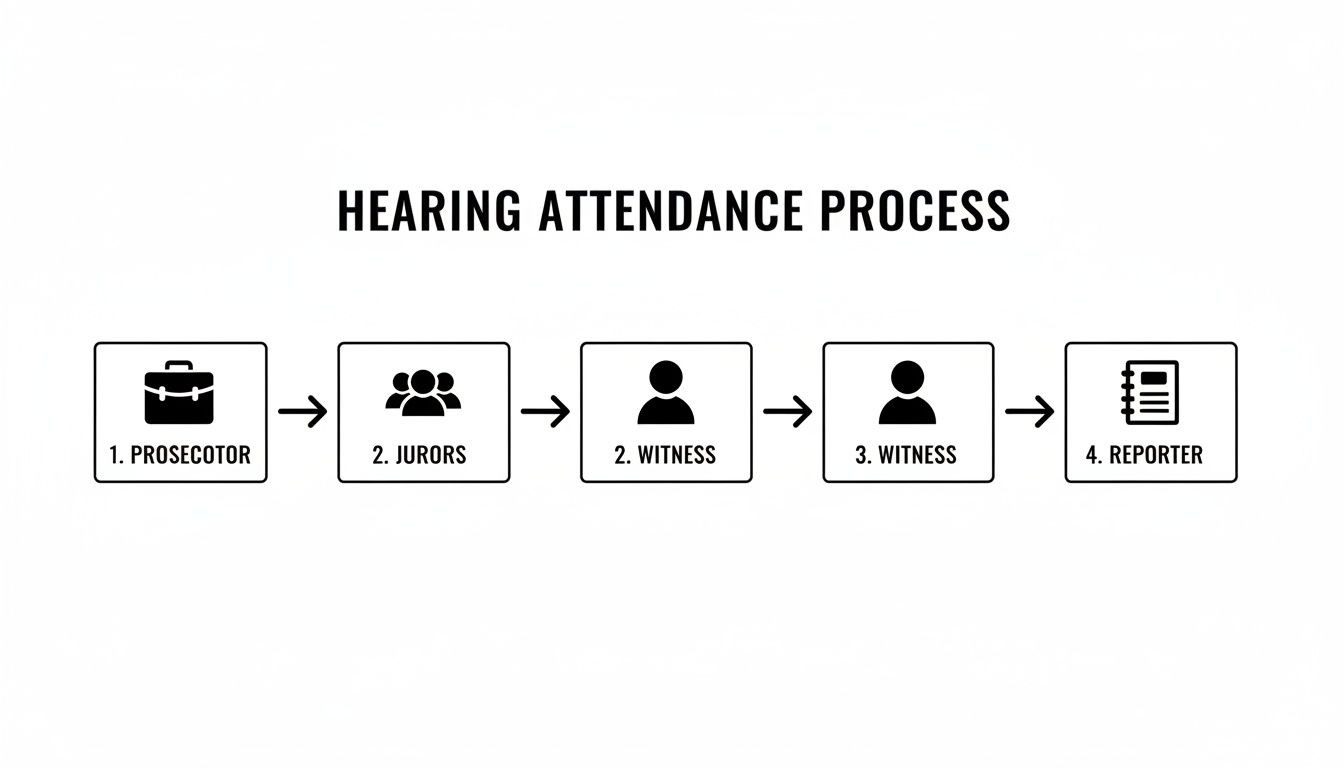
As you can see, it is a one-sided affair. The defendant and their attorney are nowhere to be found. In Fulton County, a typical grand jury hearing follows four quick steps.
Step 1: The Prosecutor Presents the Case
The hearing begins with the Assistant District Attorney (ADA) from the Fulton County DA’s office laying out their case. As the only lawyer present, they serve as the legal guide for the grand jurors.
The ADA tells a story using evidence, which might include:
- Police reports from the Alpharetta Police Department or other local agencies.
- Crime scene photos.
- Physical items collected during the investigation.
Their goal is to present a narrative convincing enough for the jury to believe there is a good reason to proceed with a felony charge.
Step 2: Witness Testimony
Next, the prosecutor calls their witnesses. This is usually the lead detective on the case or the arresting officer, who will summarize the investigation from their perspective.
This is not like a trial in Fulton County Superior Court. There is no cross-examination. Your attorney is not there to challenge what is being said. The prosecutor asks all the questions. Any mistakes, assumptions, or holes in the witness's story are unlikely to be pointed out.
Step 3: Juror Deliberation
Once the prosecutor finishes, they leave the room. The grand jurors—citizens from local communities like Johns Creek, Roswell, and Sandy Springs—are left alone to deliberate.
They privately discuss what they have heard and decide if the prosecutor met the low legal bar of “probable cause.” This discussion is completely confidential.
Step 4: The Vote for a True Bill or No Bill
Finally, the grand jurors vote. They can either issue a “True Bill” of indictment or a “No Bill.”
- A True Bill means the jury found probable cause exists, and a formal felony indictment is handed down. Your case now moves to Fulton County Superior Court.
- A No Bill means the jury did not find enough evidence to support the charge, and the case is usually dropped.
A trial jury needs a unanimous vote, but a Georgia grand jury vote does not. This has led many legal professionals to see the grand jury as a rubber stamp for the prosecution. For instance, a 2010 federal report showed that out of 162,000 cases, grand juries refused to indict in only 11—a rate of over 99.9%.
While that data is federal, the trend is similar here in Fulton County. You can explore more data on the federal grand jury system. This statistic proves that a proactive, pre-indictment defense is a necessity.
Defense Strategy: Understanding the Possible Outcomes
After the prosecutor makes their case, the grand jurors vote. The result determines what happens next for your case in the local justice system, whether in Fulton County, Forsyth, or Gwinnett.
One outcome is a “True Bill of Indictment.” This is the formal accusation that the grand jury found enough probable cause to move forward with a felony charge. Once a True Bill is returned, your case is officially filed in Superior Court. If you are not already in custody, an indictment almost always comes with an arrest warrant—a serious development that demands an immediate response.
The Significance of a "No Bill" in Your Alpharetta Case
The other, far better outcome is a “No Bill.” This means the grand jury reviewed the prosecutor's evidence and decided it was not strong enough to meet the probable cause standard. A No Bill stops the case in its tracks. For anyone in Alpharetta, Roswell, or Johns Creek, this is a major victory that can finally close a stressful chapter.
However, a No Bill is not always the absolute end. In rare cases, a prosecutor could present the case to a different grand jury if new evidence emerges. It is uncommon, but it is a reason to remain prepared.
A "No Bill" is the best possible result from a grand jury hearing. It means the citizen panel found the prosecutor’s evidence unconvincing, and no formal charges will be filed at that time.
Confronting a Difficult Reality in Fulton County
Now for a dose of reality. The way grand jury proceedings are structured heavily favors the prosecution. As a result, indictments are returned in the vast majority of cases. I say this not to alarm you, but to be direct and strategic about the situation.
The statistics are stark. A study on federal prosecutions, which mirror how things work in Georgia's Northern District covering areas like Alpharetta and Cumming, found that prosecutors secure an indictment nearly 99% of the time. In one year, out of 162,000 federal cases, only 11 were declined. You can find more details in the official report on federal prosecutions.
This lopsided reality shows why waiting to see what happens is a flawed strategy. The system is built to produce indictments. Your best chance at a No Bill—or positioning yourself for a better outcome—comes from the work done before the jury hears the case. This is where an experienced defense attorney can challenge the narrative, present counter-evidence to the prosecutor, and work to get the case dismissed before an indictment is returned. If you are facing a potential felony charge, acting now is your most powerful move.
Why Choose Brian Hansford in Alpharetta

It is tough to learn your attorney is not allowed in the grand jury room. Many people feel powerless, but that is not the case. An effective criminal defense lawyer does the most critical work long before a grand jury sees the case.
While I cannot be physically present in the hearing, I can absolutely shape the process from the outside. As a former prosecutor, I know exactly how the Fulton County District Attorney’s Office builds a case for indictment. That experience provides a playbook for a proactive defense while the State is still investigating.
Waiting for an indictment is not a strategy—it is surrender. The moment you suspect a grand jury might be involved, your defense must begin.
Early Intervention with the Fulton County Prosecutor
The most powerful move we can make is early intervention. I can contact the prosecutor directly before they step in front of the grand jury. This opens a vital line of communication.
My job is to show them your side of the story—the part the grand jury might otherwise never see. We do this by presenting:
- Exculpatory Evidence: Any evidence that points toward your innocence.
- Mitigating Circumstances: Context that may explain what happened or reduce your perceived involvement.
- Witness Affidavits: Sworn statements that can challenge the prosecution’s version of events.
Sometimes, presenting a solid, well-documented defense this early can convince a North Fulton prosecutor to drop the charges, reduce them to a misdemeanor, or offer a pretrial diversion program. If successful, we can avoid the grand jury process entirely.
Preparing a Persuasive Grand Jury Packet for Your Alpharetta Case
If direct negotiation does not stop the case, our next move is to assemble a formal “grand jury packet.” This is a collection of evidence and legal arguments we give to the prosecutor, who is legally required to share it with the grand jurors.
A grand jury packet is your only voice in a room you cannot enter. It’s a strategic counter-narrative designed to create doubt and show the jurors that the prosecutor’s version is not the only one.
This packet might include witness statements, character references, expert reports, and a legal brief explaining why an indictment is not warranted. For clients in Alpharetta, Milton, or Johns Creek, this packet signals that you are already building a robust defense, which can make both the prosecutor and jurors think twice.
Planning for What Comes After the Hearing
Everything we do before the hearing also lays the groundwork for a strong defense if the grand jury does return an indictment. By that point, we have already started gathering our own evidence, identifying holes in the State's case, and locking in witness testimony.
This pre-indictment work means we are not starting from square one if the case moves to Fulton County Superior Court. We are already several steps ahead, ready for bond hearings, pretrial motions, and trial. For anyone in Alpharetta, Roswell, or Sandy Springs, your defense starts now—not after you have been formally charged. Speak with an attorney today to protect your record.
Frequently Asked Questions About Grand Jury Hearings in Alpharetta, GA
Facing a potential grand jury hearing is confusing. Here are answers to common questions we hear from clients in Alpharetta, Cumming, and across North Fulton.
Do I have to testify if I'm subpoenaed by a Fulton County grand jury?
Yes, a subpoena is a court order, so you must appear. However, you retain your Fifth Amendment right against self-incrimination. This means you cannot be forced to give answers that could be used against you. It is critical to have an attorney like Brian Hansford guide you on how to assert this right correctly within the Fulton County court system.
How long does a grand jury hearing take in Alpharetta?
Hearings are surprisingly fast, sometimes lasting only a few minutes per case. The prosecutor might give a quick overview and call only one witness, such as the arresting officer from the Alpharetta Police Department. A Fulton County grand jury can hear dozens of cases in a single day, which is why a defense must be in place beforehand.
Will my Alpharetta criminal case go to a grand jury?
If you are charged with any felony in Georgia, your case must be presented to a grand jury for an indictment before it can proceed to trial in Superior Court. Many felony cases originating from arrests in Alpharetta, Roswell, or Johns Creek are "bound over" from a local court like the Alpharetta Municipal Court to the Fulton County grand jury for this review.
What happens if the grand jury returns a 'No Bill' in my case?
A "No Bill" is an excellent outcome. It means the grand jury decided there was not enough probable cause to charge you with a crime. For all practical purposes, the case is over and dismissed. While a prosecutor could technically try again with a new grand jury, this rarely happens. A No Bill often results from a strong, proactive defense.
Is a grand jury indictment the same as a guilty verdict?
No, not at all. An indictment, or "True Bill," is merely a formal accusation based on the low standard of probable cause. It is not a finding of guilt, and you are still presumed innocent. An indictment simply moves the case into the trial phase in Fulton County Superior Court, where the prosecutor faces the much higher burden of proving guilt beyond a reasonable doubt.
Facing a grand jury investigation in North Fulton requires immediate, strategic legal action. Do not wait to see what happens. At Brian Hansford Law, we build proactive defenses to protect your rights, your record, and your future from the very beginning. Contact us today to discuss your case by visiting https://challengemycharge.com or calling our office for a consultation.
