
After an arrest in Georgia, the legal road ahead can feel overwhelming. One of the very first, and most important, forks in that road is the preliminary hearing. This isn't a trial to decide guilt or innocence; instead, think of it as a critical checkpoint.
A preliminary hearing is where a judge takes a first look at the state's case and decides one simple thing: is there enough evidence to move forward?
Unpacking the Preliminary Hearing in Georgia
When a person is facing felony charges, the system provides this early opportunity to challenge the very foundation of the case. The entire hearing revolves around one key standard: probable cause.
Think of it like a movie trailer. The prosecutor shows a few key scenes—maybe a key witness statement or the arresting officer's testimony—to convince the judge that the story is worth seeing through to the end. The standard for probable cause is much, much lower than the "beyond a reasonable doubt" needed to convict someone at a trial. The goal here is just to filter out cases that are too weak to proceed, saving everyone time and resources.
While it's an early step, it's completely different from other initial appearances. For instance, knowing what happens at a bond hearing is about securing a person's release from jail, while the preliminary hearing is all about challenging the evidence itself.
The Core Purpose Explained
So, what’s the real point of this hearing? In places like Alpharetta, Cumming, and across Forsyth and Cobb Counties, a preliminary hearing serves several strategic purposes for the defense. It’s the first chance to officially test the strength of the prosecutor’s evidence in front of a judge.
This hearing can accomplish a few very important things:
- Evidence Preview: The defense gets its first real look at what the prosecutor is holding. This often includes the arresting officer taking the stand and explaining why they made the arrest.
- Witness Testimony: This is a major part of the process. It allows the defense to cross-examine the state’s witnesses, locking them into their story early on and potentially exposing any weaknesses or inconsistencies.
- Case Screening: The judge has the power to dismiss the charges right then and there if the state's evidence is flimsy and doesn't meet the probable cause standard.
- Potential for Negotiation: A weak performance by the state’s witness can sometimes open the door for negotiations, like getting the charges reduced to a lesser offense.
It's crucial to understand this isn't about winning or losing the entire case. The focus is squarely on whether the evidence presented meets the bare minimum threshold to keep the prosecution going. This distinction is fundamental to the entire legal journey.
To make this clearer, let's break down the key components.
Key Elements of a Preliminary Hearing at a Glance
This table gives a quick snapshot of what a preliminary hearing is all about and, just as importantly, what it is not.
| Element | What It Means | Is This a Trial? |
|---|---|---|
| Purpose | To determine if there's enough evidence (probable cause) to continue with the case. | No. It's a screening, not a verdict. |
| Key Question | Did the accused likely commit the crime? | No. A trial asks if they are guilty beyond a reasonable doubt. |
| Evidence | The prosecution presents limited evidence—often just one or two key witnesses. | No. In a trial, all available evidence from both sides is presented. |
| Outcome | The judge can dismiss the case, send it to the grand jury, or potentially reduce charges. | No. A trial results in a verdict of guilty or not guilty. |
Understanding these distinctions is the first step in comprehending defense strategy from day one.
A Step-by-Step Guide to the Hearing Process
Walking into a courtroom for a preliminary hearing can be intimidating. Knowing what to expect, step by step, can take away a lot of that anxiety. The best way to think about it is as a structured event with a clear beginning, middle, and end, where everyone in the room has a specific job to do.
This hearing is designed to be quick and focused on one thing: does the state have enough evidence to move forward with the charges? It's the first real checkpoint in the criminal justice system where a judge screens the case. It's a bigger deal than it sounds. These hearings often determine who gets out on bond and who has to wait in jail, which is a major factor in jail populations. With over 5.6 million people jailed every year in the U.S., this screening is a critical moment. You can explore more research about pretrial justice highlights and see just how much of an impact it has.
Who Is in the Courtroom
Before things kick off, it helps to know who's who. Each person plays a key part in how the hearing unfolds.
- The Judge: Think of the judge as the referee. Their job is to listen to the evidence from the prosecutor, hear the arguments from both sides, and make the final call on whether there’s enough probable cause to continue.
- The Prosecutor: This is the lawyer for the state. Their only goal is to convince the judge that there's enough evidence to move the case to the next stage. They do this by calling a witness to testify.
- The Defense Attorney: This is the defendant's lawyer, their advocate. Their job is to poke holes in the prosecutor's evidence, usually by questioning their witness, and argue that the state hasn't met its burden of proof.
- The Defendant: This is the person accused. Their presence is required, but they will almost never be asked to say a word. Their attorney does all the talking for them.
- The Witness: In the vast majority of preliminary hearings in Georgia, the only witness is the arresting police officer or the lead detective on the case. They are there to explain why they made the arrest.
The Hearing Unfolds in Sequence
Once everyone is ready, the hearing starts, and it follows a predictable script. The prosecutor always goes first because the burden is on them to prove their case.
-
The State Presents Its Case: The prosecutor will call their witness—again, usually the arresting officer—to the stand. The officer is sworn in and then answers questions about what happened. This is called direct examination.
-
The Defense Cross-Examines the Witness: After the prosecutor is done, it's the defense attorney's turn. This part, the cross-examination, is where the defense has an opportunity to shine. The goal here is to find inconsistencies in the officer's story, expose weaknesses in the investigation, or show that key evidence is missing.
This flowchart breaks down the basic flow, from the evidence being presented to the judge making a decision.
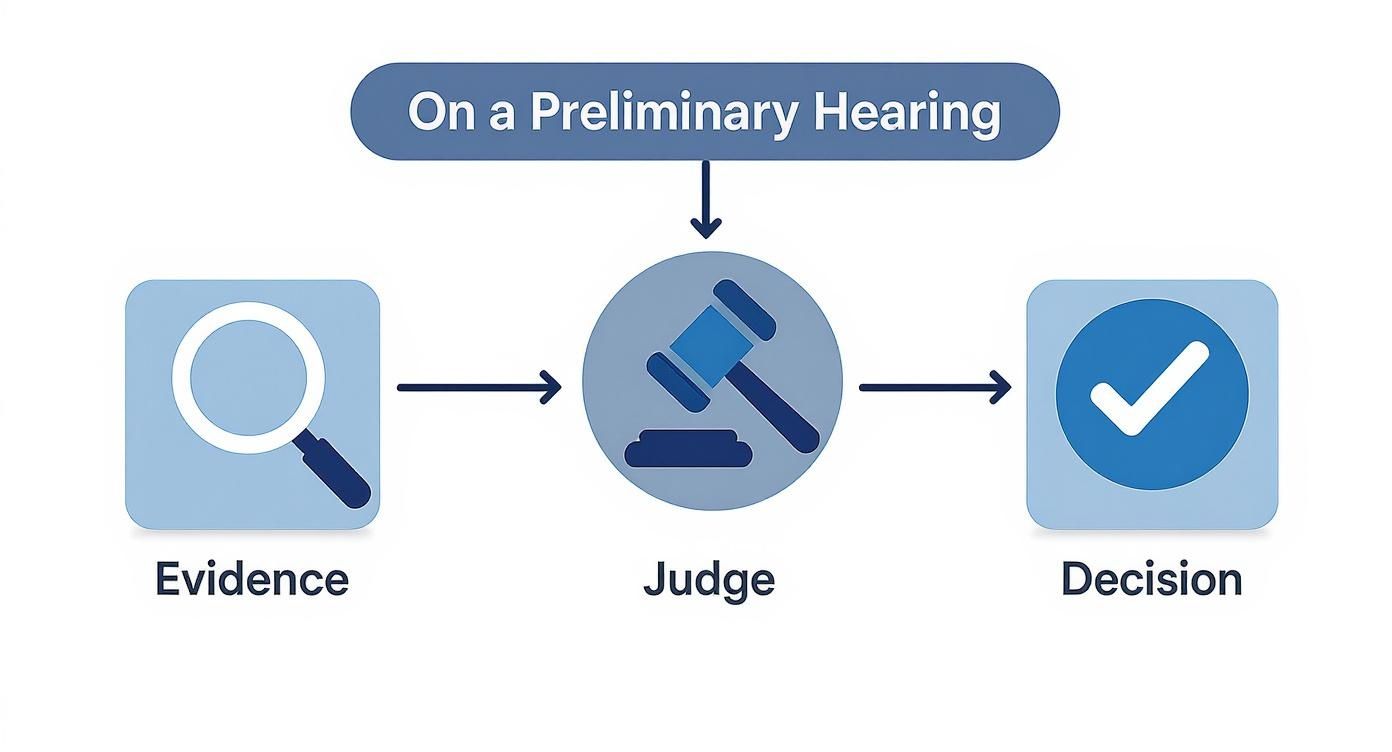
It’s a simple visual, but it captures the core of the hearing: the evidence goes in, the judge weighs it, and a decision on probable cause comes out.
Arguments and the Judge’s Decision
After the witness is done testifying, both lawyers get to make their final pitch to the judge. The prosecutor will stand up and argue why the evidence is strong enough, and then the defense attorney will argue why it isn't.
This is where an experienced defense attorney can be very effective. By pointing directly to the weaknesses they exposed during cross-examination, they can build a powerful argument that the case shouldn't proceed. The judge listens to these closing arguments very carefully before ruling.
Finally, the judge makes the call. They will either find that there is enough probable cause and "bind the case over" to the next court, or they will find that there isn't and dismiss the charges. That decision concludes the hearing and sets the tone for everything that follows.
Understanding the Potential Outcomes of the Hearing
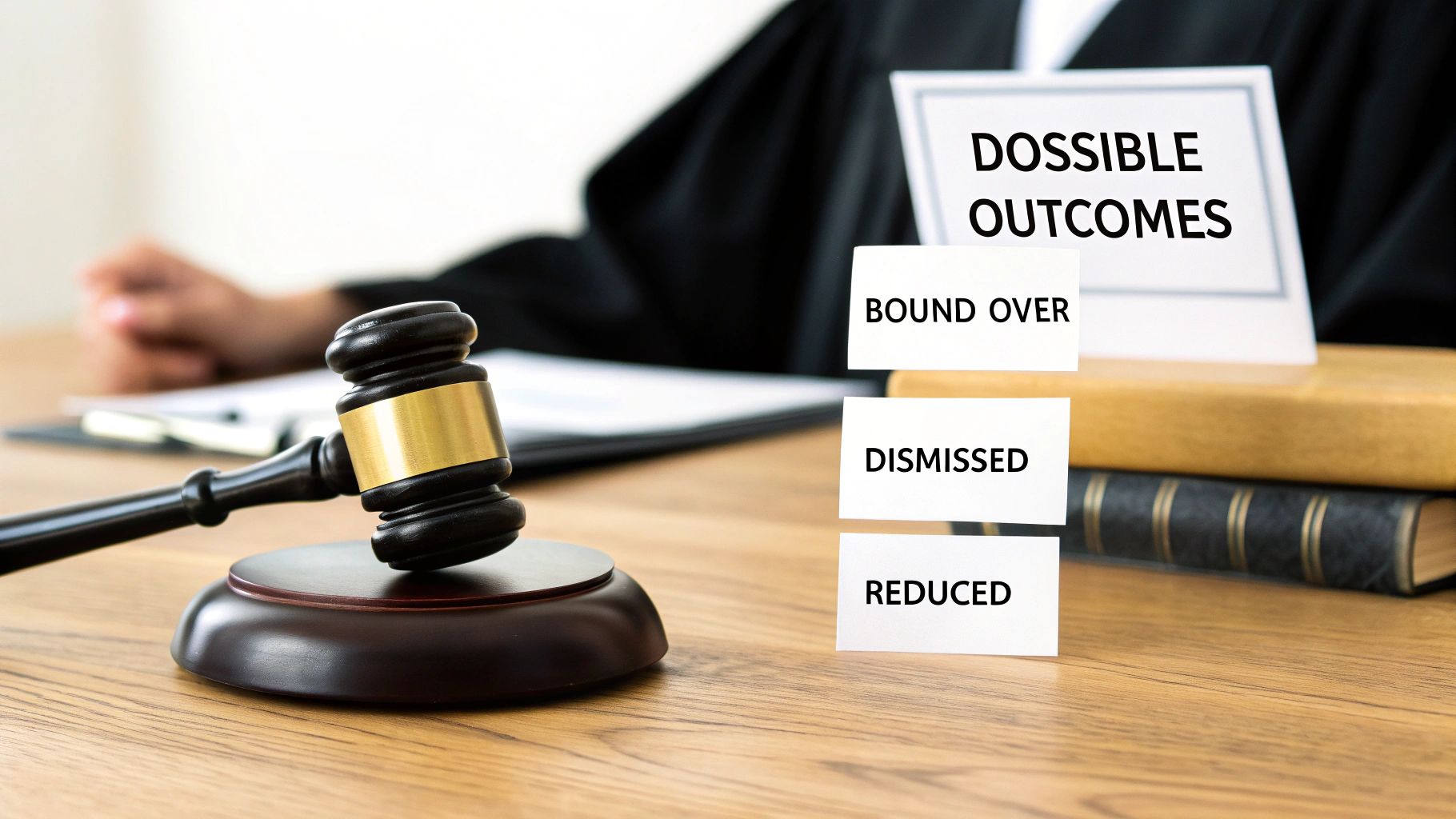
Once the last witness has spoken and both sides have made their arguments, everything comes to a halt. This is the moment the judge makes a decision that will chart the course for the rest of the case.
When trying to understand what happens at a preliminary hearing, it really boils down to three main possibilities. Each one is a direct result of whether the prosecutor managed to meet their burden of proof. And remember, the bar here is pretty low—just probable cause, a far cry from the "beyond a reasonable doubt" standard needed for a conviction at trial.
The judge’s decision will fall into one of these three categories, and each one comes with its own set of consequences and next steps.
Outcome 1: Case Bound Over to Superior Court
The most common result, by far, is the judge finding that the prosecution did enough to establish probable cause. When that happens, the case is officially "bound over," meaning it gets sent up the ladder to Superior Court for the next round of proceedings.
This isn't a "loss" in the way most people think of it. It simply means the case has cleared the first checkpoint and is moving forward.
If a case is bound over, here’s what’s next on the agenda:
- Jurisdiction Changes Hands: The case formally leaves the lower Magistrate or Municipal Court and lands in the Superior Court of the county where the alleged crime took place, whether that's Forsyth, Cobb, or elsewhere.
- Grand Jury Takes a Look: Next, the prosecutor will present the evidence to a grand jury to ask for a formal indictment. This is a non-negotiable step before any felony case can go to trial in Georgia.
- Arraignment is Scheduled: Once there's an indictment, an arraignment will take place in Superior Court. This is where a formal plea of "guilty" or "not guilty" is entered, officially kicking off the next phase.
When a case is bound over, it just means the legal journey is continuing, and the focus shifts to preparing for the next stage in a higher court.
Outcome 2: Charges Are Dismissed
This is the best possible outcome at a preliminary hearing. A dismissal happens when the judge decides the prosecution’s evidence just wasn't strong enough to meet even the low bar of probable cause. The judge will dismiss the felony warrant, and just like that, the case is over—at least for now.
A dismissal can happen for a few key reasons:
- The Evidence Was Weak: Maybe the testimony was too inconsistent, vague, or just didn't convincingly connect the defendant to the crime.
- The Witness Was a No-Show: Sometimes the prosecution's star witness, often the arresting officer, can't make it to court. Other times, their testimony simply falls apart under cross-examination and isn't credible.
It's crucial to understand that a dismissal at this stage isn't the same as being found "not guilty." The legal principle of double jeopardy doesn't apply here, so the prosecutor could technically refile the charges later if they dig up new evidence and take the case directly to a grand jury. Still, a dismissal is a massive victory that almost always stops a case dead in its tracks.
Outcome 3: Charges Are Reduced to a Misdemeanor
There's a third path, which is often a major strategic win: getting the charges reduced. This happens when the evidence points to a crime, but not the serious felony the prosecutor originally charged. For example, a Felony Theft charge might get knocked down to Misdemeanor Theft if the state can't prove the value of the stolen items was high enough to meet the felony threshold.
When charges are reduced, the case is still "bound over," but instead of going to Superior Court, it's sent to State Court, which handles misdemeanor cases. This is a huge development. Misdemeanors carry much lighter penalties, like shorter potential jail sentences and smaller fines.
A reduction often opens the door for much better plea negotiations and can completely change the long-term outlook of a case. It’s a perfect example of how a skilled defense at the preliminary hearing can shape the entire legal fight ahead. To get a better handle on what the prosecution is required to show, you can learn more about the burden of proof in our detailed guide.
Navigating Court Timelines and Duration

One of the first questions people often ask is, "How long is all of this going to take?" It's a completely fair question. Understanding the timeline of a preliminary hearing is crucial for managing expectations about the criminal justice system, which rarely moves as fast as one would like.
The truth is, there's no single answer. The actual time spent in the courtroom can vary dramatically depending on the case. A straightforward case with one charge and a single witness might wrap up in less than an hour. But throw in multiple charges or several witnesses, and the hearing could easily stretch for hours—or in rare cases, even get continued to another day.
When Does a Preliminary Hearing Occur?
Georgia law is very specific about when a preliminary hearing must happen. These rules are in place to make sure the process moves along without unnecessary delays, especially if the person accused is still in jail.
If someone is arrested and can't make bond, they have a right to a preliminary hearing within a tight window after the arrest. This is a vital safeguard to prevent people from being held indefinitely without a judge ever looking at the evidence. The hearing itself slots in after the initial appearances (like a bond hearing) but before a grand jury ever sees the case. It’s also important not to confuse it with an arraignment, which is a totally separate event that happens later down the road. You can learn more about that stage in our guide on what happens at an arraignment hearing.
Think of the preliminary hearing as an early, but critical, checkpoint on the long journey from arrest to a potential trial.
The legal process is often a marathon, not a sprint. The time between arrest and the preliminary hearing gives both the prosecution and the defense a window to prepare their initial strategies, making this period as important as the hearing itself.
This variability isn't just a Georgia thing. Court timelines differ everywhere depending on the facts of the case. For example, one analysis of international courts found that the average time from a judicial request to the start of arguments was 24 days, but the actual times ranged from a lightning-fast 4 days to a grueling 124 days.
Factors That Influence Duration
Several key factors can stretch out a preliminary hearing. The more moving parts there are, the longer one can expect to be in court.
- Number of Witnesses: Most preliminary hearings in Georgia rely only on the testimony of the arresting officer. But if the prosecutor calls additional witnesses, the hearing will naturally take longer to get through direct and cross-examination for each person.
- Complexity of Charges: A case with one simple charge will move much more quickly than one involving multiple serious felony counts. The prosecutor has to establish probable cause for each charge, which takes time.
- Legal Arguments: If there is an opportunity to challenge the legality of a search or the admissibility of a statement, a defense attorney will make that argument. These legal debates can add significant time to the hearing.
- Court Docket: Let's be realistic—the court's own schedule plays a huge role. A busy docket in a place like Cobb County or Forsyth County can mean delays, interruptions, or a judge trying to move things along faster than they should.
How Court Procedures Can Vary Across Georgia
While the legal purpose of a preliminary hearing is the same everywhere in Georgia, the actual experience can feel worlds apart depending on where you're standing. The law itself doesn't change when you cross a county line, but local customs, unwritten rules, and the sheer volume of cases create major differences in how a hearing actually plays out.
An individual's experience in a high-volume urban court like Fulton or DeKalb County will feel completely different from a hearing in a smaller, suburban court in Forsyth County. These regional nuances don’t change fundamental rights, but they absolutely shape the flow and pace of the proceedings.
Local Legal Culture and Its Impact
Every judicial circuit in Georgia has its own "legal culture"—basically, an unwritten set of rules for how things get done. This can dictate everything from how hearings are scheduled to the level of formality a judge expects in their courtroom.
For instance, some courts are on an incredibly tight schedule, moving through cases at a breakneck pace just to manage a crowded docket. On the other hand, courts in less populated areas might allow for much more extensive arguments and detailed cross-examination. These differences often come down to the preferences of the local judges and the working relationships built over years between prosecutors and local defense attorneys.
The key takeaway here is that a good defense strategy is never one-size-fits-all. It has to be informed by the specific tendencies and procedures of the court where the hearing is held, whether that's in Alpharetta, Roswell, or Marietta.
Understanding these subtle but critical variations is a huge part of preparing for a preliminary hearing. An attorney who is familiar with the local landscape can anticipate how a particular judge might rule on an objection or how a specific prosecutor’s office typically presents its cases.
Prosecutorial Approaches in Different Jurisdictions
The approach of the local District Attorney’s Office can also have a massive impact on a preliminary hearing. Some DA's offices use these hearings aggressively to set a tough tone, while others might treat them as just another routine step in the process.
- Aggressive Prosecution: In certain counties, prosecutors may show up ready for a fight. They might bring multiple witnesses and a pile of evidence to make a strong showing right from the start.
- Minimalist Approach: In other jurisdictions, the prosecution may do the absolute bare minimum required to establish probable cause, often relying only on the testimony of the arresting officer.
- Negotiation-Focused: Some DAs use the preliminary hearing as a prime opportunity for negotiation. If the state’s key witness gives weak testimony, the prosecutor might be prompted to offer a favorable plea deal on the spot, like reducing a felony charge to a misdemeanor.
This variability means that a tactic that works perfectly in a Cobb County courtroom might fall flat in Gwinnett County.
The Challenge of Caseloads
The number of cases a court has to get through directly impacts every single part of a preliminary hearing. Globally, court caseloads vary wildly, which changes everything from scheduling to the quality of justice. For example, judges in some countries manage as few as 175 cases a year, while judges here in the United States handle around 1,300 cases annually. That kind of volume inevitably shapes how justice is administered day-to-day. You can read more about judicial case management to see just how much these numbers impact court systems.
This heavy caseload in many Georgia courts often leads to a few common problems:
- Crowded Dockets: A hearing could be just one of dozens scheduled for the same day, which means long waits and a high chance of delays.
- Pressure for Speed: Judges are often under pressure to keep hearings brief to clear the day’s calendar. This can seriously limit the time available for a thorough cross-examination or for making important legal arguments.
- Increased Likelihood of Continuances: With so many cases and people involved, it’s much more common for hearings to get rescheduled because a witness doesn't show up or an officer gets called away on an emergency.
Navigating these realities requires an attorney who knows the local court administration inside and out. A lawyer who regularly practices in these busy courts understands how to manage a crowded docket and fight to make sure a case gets the time and attention it deserves, no matter how packed the schedule is.
Questions We Hear All the Time About Preliminary Hearings
Even after walking through the process, it's completely normal to have more questions. This is a critical stage in a case, and the details matter. Here are some direct answers to commonly asked questions.
Will I Have to Speak or Testify at My Preliminary Hearing?
Almost certainly not. It is extremely rare for a defendant to say anything at all during their own preliminary hearing, let alone get on the stand and testify. The entire point of this hearing is to test the prosecution's evidence—not for the defendant to tell their side of the story.
A defendant has an absolute right to remain silent, and it is almost always recommended to exercise it at this stage. Their lawyer is their voice in that courtroom. The attorney does all the talking, from cross-examining the state's witnesses to making legal arguments to the judge. The defendant's job is just to be there and talk with their lawyer privately when needed.
What Is the Difference Between a Preliminary Hearing and a Grand Jury?
This is a great question because both are used to decide the exact same thing: whether there is probable cause for a felony case to proceed. But how they get to that decision couldn't be more different.
A preliminary hearing is like a mini-trial out in the open. It's held in a public courtroom with a judge, and the defense attorney is right there to poke holes in the state's case and cross-examine their witnesses. It’s an adversarial process where both sides are present.
A grand jury, however, is a secret, one-sided affair.
- No Judge: A group of citizens, the grand jury, hears the evidence.
- Prosecution Only: Only the prosecutor is in the room presenting their version of the facts.
- No Defense: Neither the defendant nor their defense lawyer are allowed to be present. They can't question witnesses, and they can't present any evidence.
If a prosecutor gets an indictment from a grand jury, it serves the same purpose as a preliminary hearing, which often leads to the hearing being canceled.
Can Charges Be Brought Again if My Case Is Dismissed?
Yes, unfortunately, they can. A dismissal at a preliminary hearing is a major win, but it’s not the same as being found "not guilty" after a trial. The principle of double jeopardy—which stops someone from being tried twice for the same crime—doesn't apply here.
A dismissal just means the judge decided the prosecutor didn't show enough evidence of probable cause on that particular day. It doesn't legally prevent the prosecutor from going back, gathering more evidence, and then taking their stronger case to a grand jury to get an indictment for the very same charges. While a dismissal often marks the end of a case, it isn't a 100% guarantee.
Does Every Felony Case in Georgia Have a Preliminary Hearing?
Not every case. While a person has a right to a preliminary hearing after being arrested on a felony warrant, that right isn't set in stone. The single most common reason a hearing gets canceled is that the prosecutor gets a grand jury indictment first.
If the prosecutor takes the case directly to a grand jury and secures an indictment before the scheduled preliminary hearing date, the hearing will be taken off the calendar. The logic is that a grand jury has already found probable cause, so the hearing is no longer necessary. This is a very common tactic used by prosecutors across Georgia.
Thinking about how the system works can lead to other questions, like how lawyers and firms present themselves to the public. This can involve anything from advertising to actively managing lawyer reputation, offering another angle on the profession.
Knowing the answers to these questions helps take the mystery out of the preliminary hearing process. It shows just how important it is to have an experienced lawyer who can handle not just the hearing itself, but all the procedural moves the prosecution might make.
If you or someone you know is facing criminal charges in Alpharetta, Cumming, Forsyth County, or Cobb County, you don't have to figure this out alone. At Brian Hansford Law, we use over 25 years of experience—including critical time spent as a prosecutor—to defend your rights. Contact us today for a consultation at https://challengemycharge.com.
