
Jury selection is the critical first step where the judge and attorneys pick a panel of impartial citizens to hear the facts of a case and decide the outcome. It's a process of questioning potential jurors about their backgrounds, beliefs, and life experiences to uncover any hidden biases.
The goal isn't to find the "perfect" juror for one side or the other. It’s about putting together a fair-minded group of people who can make a decision based only on the evidence presented in court.
An Overview of the Jury Selection Process
You can think of jury selection like casting for a documentary. A director doesn't want actors who already have a strong opinion about the story; they need neutral observers who can simply watch what happens and come to an unbiased conclusion. In the same way, the court system is looking for people who can approach a case with a completely open mind. This whole procedure is a foundational part of the broader steps in the criminal justice process.
The process starts when a jury summons shows up in your mailbox, calling you to the courthouse. From there, a large group of citizens, known as the jury pool, is brought into a courtroom for questioning. This is called voir dire (a French term meaning "to speak the truth"), and it’s where the real evaluation begins.
This graphic breaks down the journey from receiving that summons to being seated on the final jury.
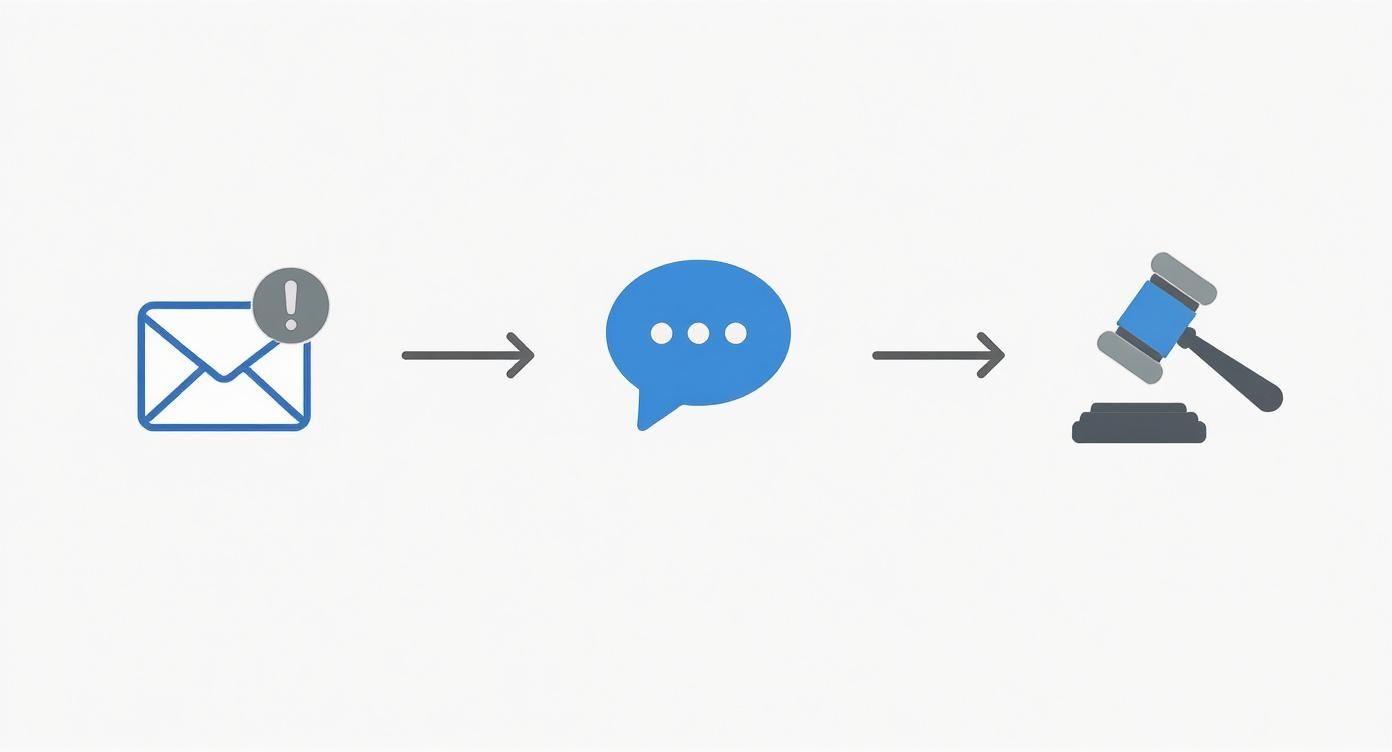
As you can see, each stage is designed to carefully filter the jury pool down to a final, impartial panel. To give you a clearer picture, the process can be broken down into four main stages.
The Four Main Stages of Jury Selection
Here's a quick look at the key phases a potential juror goes through during the selection process.
| Stage | What Happens | Primary Goal |
|---|---|---|
| Summons & Assembly | Citizens receive a summons in the mail and report to the courthouse on a specific date. They are assembled into a large group called the jury pool. | To gather a diverse cross-section of the community to serve as potential jurors. |
| Voir Dire | The judge and attorneys question the jury pool, either as a group or individually, about their backgrounds, beliefs, and potential biases. | To identify any preconceived notions or conflicts of interest that would prevent a juror from being impartial. |
| Challenges | Attorneys use "for cause" challenges to remove jurors with obvious bias and "peremptory" challenges to remove jurors without stating a reason. | To eliminate jurors who cannot be fair and to allow attorneys to shape a jury they believe will be receptive to their case. |
| Final Selection | The first 12 jurors (plus any alternates) who have not been removed through challenges are sworn in to serve on the jury. | To officially empanel a fair and impartial jury that will hear the evidence and deliver a verdict. |
Ultimately, every step is built around the core principle of impartiality.
The Goal of Impartiality
The entire point of this process is to seat a jury that can be fair to both the prosecution and the defense. Attorneys on both sides will ask pointed questions designed to bring any hidden biases to the surface—things that might stop a juror from being truly impartial. It really is a process of elimination, not selection.
The core principle is simple: A verdict should be based on the facts presented in court, not on preconceived notions or personal experiences that a juror brings with them into the courtroom.
The numbers show just how selective this process is. For instance, in the federal court system during one recent 12-month period, 218,203 citizens reported for jury duty. Of those, only 22.4 percent were actually chosen to serve.
That means nearly four out of every five potential jurors who walked into the courthouse were dismissed. This underscores just how seriously the courts take the job of finding a truly unbiased panel.
Receiving a Summons and Arriving at Court
The whole jury selection process kicks off with a piece of mail you weren't expecting: a jury summons. This isn't junk mail—it's an official notice that you’ve been called for a civic duty. Your name was likely pulled from public records, like voter registration or driver's license lists, to build a pool of potential jurors from your local community.
Responding is not optional; it's a legal requirement. This summons is the very first step in the screening process and often includes a questionnaire. This is designed to get some basic information and find out if you have any hardships that would make it impossible for you to serve.

This initial step is really about efficiency. It helps the court system gather key details before hundreds of people show up, making the actual day of selection run a lot smoother. While a summons is a court order demanding your presence, it's different from other legal documents. You can learn more about these differences by looking into how are subpoenas served.
What to Expect on Your Scheduled Day
Walking into the courthouse for the first time can be a little intimidating. You'll go through a security check, much like at an airport, and then be guided into a large waiting area, usually called the jury assembly room. Here, you'll find yourself with dozens, sometimes hundreds, of other citizens from all over the area, whether it's Alpharetta, Roswell, or Forsyth County.
The room is usually pretty quiet, filled with people reading, working, or just waiting for their name to be called. It's a good idea to be prepared for some downtime—the court is juggling multiple cases and schedules at once.
Pro tip: Bringing something to do, like a book, a charged-up laptop, or some work you can do on your phone, can make the waiting periods far less tedious.
From the Assembly Room to the Courtroom
Eventually, a clerk will call out a group of names. This group is called a venire panel, and you'll all be escorted into a specific courtroom. This is when you'll get your first look at the judge, the prosecutor, the defense attorney, and the defendant.
Once everyone is seated in the jury box, the next phase begins. The judge will introduce everyone involved and give a brief overview of what the case is about. This is the moment things shift from administrative waiting to the interactive part of the process known as voir dire.
Understanding Voir Dire: The Questioning Phase
The heart of jury selection is a process called voir dire—a French phrase that literally means "to speak the truth." This is where the abstract goal of finding an impartial jury becomes a real, face-to-face conversation. The judge and the attorneys for both sides get to ask direct questions to the entire group of potential jurors, which is known as the venire.
Think of it less like a high-pressure interrogation and more like a detailed group interview. The real purpose is to get to know the potential jurors and understand their perspective on the world. The lawyers are trying to uncover any life experiences, personal opinions, or hidden beliefs that might stop someone from being completely impartial when they hear the evidence.
This questioning phase is absolutely critical for both the prosecution and the defense. The specific questions asked can give incredible insight into how a person might view the facts of the case. This is one of those areas where having a skilled attorney makes a world of difference. To get a better sense of how different lawyers might approach this, you can explore the distinctions between a public defender vs private attorney in our related guide.
The Types of Questions Asked
The questions asked during voir dire are anything but random. Every single one is carefully designed to uncover potential bias, ranging from the very general to the surprisingly specific, depending on what the case is about.
You can expect questions that touch on a few common areas:
- Your Media Habits: Attorneys often want to know what news you watch or if you've seen any media coverage about this specific case. This helps them figure out if you've already formed an opinion.
- Personal Experiences: You might be asked if you or a close family member has ever been the victim of a crime or worked in law enforcement. Experiences like these can definitely shape how you see testimony and evidence.
- Views on the Justice System: It's common to hear general questions about your trust in the police or your feelings about the court process as a whole.
- Knowledge of the Case: The judge needs to know if you have any personal connection to the people involved, whether it's the attorneys, the witnesses, or the defendant.
It is absolutely essential that potential jurors answer every question truthfully and completely. The entire system is built on the honesty of potential jurors during this phase to assemble a fair panel.
How Attorneys Use Challenges to Shape the Jury
Once the voir dire questioning gets rolling, the focus shifts from gathering information to making some tough decisions. This is where both the prosecution and defense start the strategic work of shaping the final jury panel. The tools they use are called challenges, which are basically formal requests to excuse a potential juror from serving on the case.
This isn't about just picking people you like; it’s a calculated process with very specific rules. Think of it like a sports draft. A coach isn't just picking the fastest players; they're selecting people who fit a particular strategy and will work well as a team. In the same way, attorneys use challenges to build a jury they believe can fairly consider the evidence from their client's perspective.
There are two main types of challenges attorneys can use. Each one serves a very different purpose and comes with its own set of rules. Understanding how both work is the key to seeing how a big pool of potential jurors gets narrowed down to the final 12.
Challenges for Cause
The first type is a challenge for cause. An attorney uses this when a potential juror has shown a clear bias or prejudice that would make it impossible for them to be impartial. You can't just throw this challenge out there; the reason has to be explicitly stated and approved by the judge.
For instance, if a potential juror admits they're related to the defendant or one of the witnesses, that’s an obvious conflict of interest. Or, if someone says that a past personal experience means they could never be fair in this specific type of case, they would almost certainly be excused for cause.
The big thing to remember here is that there is no limit on the number of challenges for cause an attorney can make. As long as they can show the judge that a juror simply cannot be fair, that person will be removed.
Peremptory Challenges
The second, and far more strategic, tool is the peremptory challenge. This lets an attorney excuse a potential juror without having to state a reason. It's often used based on an attorney's gut feeling, a juror's demeanor, or subtle clues from their answers during voir dire.
Each side only gets a limited number of these valuable challenges. In Georgia felony cases, for example, both the prosecution and the defense typically get nine peremptory strikes. Because you only have a few, each one is incredibly important.
A peremptory challenge is an educated guess. An attorney might use one if they feel a juror's body language suggested disapproval of their client or if their life experiences seem misaligned with the themes of the case.
But there's a huge catch. Thanks to the landmark U.S. Supreme Court case Batson v. Kentucky, peremptory challenges cannot be used to discriminate based on race, ethnicity, or gender. If one side suspects the other is striking jurors for discriminatory reasons, they can make what's called a "Batson challenge." This forces the other attorney to provide a neutral, non-discriminatory reason for their decision, acting as a crucial safeguard for fairness.
Challenge for Cause vs Peremptory Challenge
To make the distinction crystal clear, it helps to see the two types of challenges side-by-side. Each has a different purpose and operates under its own set of rules.
| Feature | Challenge for Cause | Peremptory Challenge |
|---|---|---|
| Reason Required? | Yes, a specific bias must be proven. | No, a reason is not required (unless challenged). |
| Judge's Approval? | Yes, the judge must agree with the reason. | No, it is the attorney's discretionary choice. |
| Number Allowed? | Unlimited. | A limited, fixed number for each side. |
| Primary Purpose | To remove jurors who are demonstrably biased. | To allow attorneys to shape the jury strategically. |
Ultimately, both challenges are essential tools that allow the defense and prosecution to remove jurors they believe cannot be fair, ensuring the final panel is as impartial as possible.
The Goal of Creating a Fair and Impartial Jury
When it comes right down to it, everything that happens during jury selection is about one thing: seating a fair and impartial jury. The entire system is built on the idea of giving a defendant a "jury of one's peers," which really just means bringing together a group of people who represent a true cross-section of the local community. This isn't just a lofty goal; it’s the bedrock of public trust in our justice system.
A diverse jury brings a mix of life experiences, different viewpoints, and unique backgrounds into the deliberation room. This variety is critical. It helps ensure the evidence is looked at from all angles, which is what leads to a more thoughtful and just verdict.
Striving for True Impartiality
Of course, finding people who are perfectly impartial is a tough balancing act. Every good attorney is going to think about how a person's life might color their view of the case. For example, a juror with a deep background in accounting will likely scrutinize financial evidence much differently than someone who doesn't work with numbers for a living. These kinds of strategic thoughts are a normal and expected part of the process.
But there are hard lines that absolutely cannot be crossed. The law is crystal clear: you cannot remove a potential juror for discriminatory reasons, like their race, gender, or ethnicity. This creates a built-in tension. Attorneys are trying to understand a juror's potential mindset while operating under strict rules designed to keep prejudice out of the courtroom. The goal is to find a neutral panel that will decide the case based only on the evidence presented—nothing more, nothing less.
The whole point is to filter out bias, not to stack the deck with a friendly audience. A fair trial hinges on finding jurors who can set aside their personal beliefs and decide the case based on the facts and the law alone.
The Complex Reality of a Fair Cross-Section
While the system aims for a jury that truly reflects the community, making that happen is easier said than done. The demographic makeup of a jury can have a huge impact on the outcome of a trial, yet the methods for even tracking this information are inconsistent at best.
In fact, extensive research has shown that many states simply don't have good data to know if their jury selection methods are producing diverse panels. One study described the practices for collecting juror demographics as "wildly inconsistent" from one place to the next. This means the makeup of a jury can change dramatically depending on where the trial is held, which highlights a major challenge in the quest for fairness. You can dive deeper by checking out the full report on jury demographic data. This is an ongoing problem that shows just how difficult it is to turn the ideal of a "jury of one's peers" into a consistent reality in every single case.
Common Questions About the Jury Selection Process
Even with a good grasp of the stages, jury selection can feel like a complete unknown. It's totally normal to have a few practical questions pop up when that summons arrives in the mail. Knowing the answers ahead of time can make the whole experience much less intimidating.
We’ve pulled together answers to some of the most common questions people have when called to serve. From how long it might take to what to wear, these are basics that many find helpful to know.
How Long Does Jury Selection Usually Take?
This really varies from case to case. For a straightforward misdemeanor charge, the whole process might wrap up in just a few hours. A person could be selected for the jury or sent home by lunchtime.
On the other hand, for more complex felony trials, especially those that have gotten a lot of media attention, it's a different story. In those situations, it’s not unusual for the voir dire questioning to last a full day or even stretch across several days as the attorneys carefully work through the jury pool.
What Should I Wear to the Courthouse?
There is no need for a suit and tie, but courthouses are professional settings, and it is a good idea to dress accordingly. A common approach is business casual. This is similar to what one might wear to an office job or a respectable meeting.
Some common options for men and women include:
- Slacks or khaki pants
- A collared shirt or a nice blouse
- A skirt or dress of a professional length
- Closed-toe shoes
Some people bring a sweater or a light jacket. Courtrooms are notoriously cold, and you’ll be sitting for a while, so it helps to be comfortable. Generally, it's best to avoid shorts, tank tops, flip-flops, or any clothing with big logos or distracting graphics.
Can I Be Excused from Jury Duty?
Yes, but only for very specific reasons. The court understands that jury duty is a big commitment and provides a few ways for service to be excused or postponed. The instructions for doing so are usually right on the summons itself.
Common reasons for being excused include:
- Medical Hardship: A significant health issue that makes it impossible to serve.
- Financial Hardship: This would require proof that serving would cause extreme financial difficulty.
- Caregiver Responsibilities: Serving as the primary and sole caregiver for a young child or an elderly individual.
Remember, a person can't just decide not to show up. A formal request for excusal or postponement must be made by following the instructions on the summons. The court makes the final decision, and failing to appear can lead to fines or other legal trouble.
What Happens If I'm Not Selected?
The majority of people who report for jury duty are not chosen for a trial. If a potential juror goes through the questioning in voir dire but is excused—either for cause or through a peremptory challenge—their service for the day is usually done. A court clerk will officially dismiss them, and they’ll be free to leave. Before leaving, it's common practice to get a proof-of-service certificate from the clerk's office, as employers will almost certainly require it.
Navigating the complexities of the criminal justice system requires expertise. If you or a loved one is facing charges in Alpharetta, Cumming, or anywhere in Forsyth County, the guidance of an experienced attorney is invaluable. Brian Hansford Law is dedicated to protecting your rights and building a strong defense. Learn more about how we can help by visiting https://challengemycharge.com.
