
When a child is facing trouble with the law, one of the first questions that races through your mind is simple: what happens in juvenile court? In Georgia, the system is designed very differently from adult criminal court. The focus is on rehabilitation over punishment for anyone under the age of 17, with the goal of getting a young person back on the right path.
The process isn't a single event but a series of structured stages, starting with an initial review and ending with a final decision on how to move forward.
An Overview of the Georgia Juvenile Court Process
The juvenile court system can feel like a confusing and intimidating maze for any family. Unlike adult court, which is centered on guilt and punishment, the juvenile system in Georgia operates under a completely different philosophy. Its primary goal is to figure out what's in the best interest of the child and the community, emphasizing support and intervention over pure penalties.
Understanding this journey from the start helps clear up the confusion and reduces the anxiety that comes with not knowing what to expect. While the details of every case are unique, the general path is fairly consistent. The system is set up to assess the situation, hear the facts, and create a plan that fits a child's specific needs.
The Core Philosophy: Rehabilitation
The entire framework of Georgia's juvenile justice system is built on the idea of rehabilitation. The core belief is that young people have a much greater capacity for change, and that getting to the root of their behavior is far more effective than just handing down a punishment.
This means the court looks beyond the alleged offense itself. They'll consider factors like:
- The child's age and maturity level
- Their family environment and support system
- School performance and any history of issues
- Any underlying challenges, like mental health or substance use concerns
This approach ensures that the final outcome is aimed at helping the child learn from their mistakes and grow into a responsible adult.
One viewpoint on the goal of juvenile justice is that "our clients feel like we’re on their team. They don’t feel like the whole system is against them." This really captures the ideal goal of juvenile justice—to create a collaborative environment focused on positive change, not an adversarial one.
The infographic below shows the three main phases a case will move through.
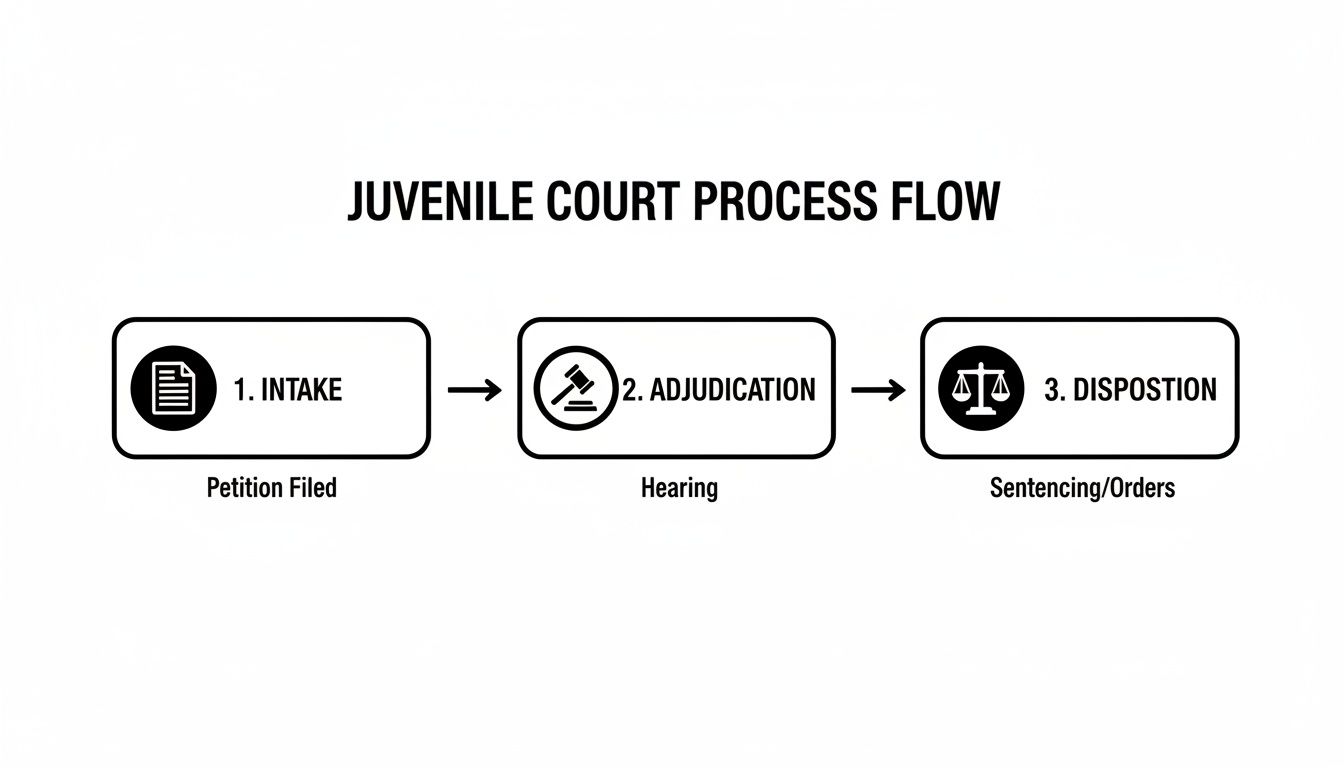
This simple roadmap shows the logical flow from the initial review (Intake) to the fact-finding stage (Adjudication) and, finally, to the outcome determined at the Disposition hearing.
A Summary of Key Stages
To give a clear, big-picture view of what happens in juvenile court, the table below breaks down the main phases. Each stage has a distinct purpose in moving the case forward. Think of it as a guide that helps you see what's coming next.
| Key Stages of a Juvenile Court Case in Georgia |
| :— | :— | :— |
| Stage | Purpose | What Happens During This Phase |
| Intake | To screen the case and decide if it should be handled formally by the court or informally through other means. | A juvenile court intake officer reviews the police report and other documents. They may meet with the child and parents to gather more information. |
| Detention Hearing | To determine if the child needs to be held in a secure facility while the case is pending. | Held within 24-72 hours of being taken into custody. The judge decides if the child poses a risk to themselves or the community. |
| Adjudicatory Hearing | To determine if the child committed the alleged offense. This is the juvenile equivalent of an adult trial. | The prosecutor presents evidence, and the child's attorney can challenge it. A judge, not a jury, decides the outcome. |
| Disposition Hearing | To decide the consequences and rehabilitation plan for the child if they are found "delinquent." | The judge considers reports and recommendations to create a plan, which could include probation, counseling, community service, or placement in a facility. |
We'll dive into each of these steps in much greater detail in the sections that follow, but this gives you a solid foundation for understanding the road ahead.
The First Steps: Intake and Detention Hearings
When a child's case first enters the juvenile justice system in Georgia, it doesn't immediately go before a judge. Instead, it begins at a critical crossroads known as intake. This is the first, and arguably one of the most important, decision points that will shape the entire direction of a child's case.
Think of an intake officer as a gatekeeper. Their job is to review the initial complaint, usually from a police report, and decide how to proceed. It's less about determining guilt and more about assessing the seriousness of the situation and the child's specific circumstances.
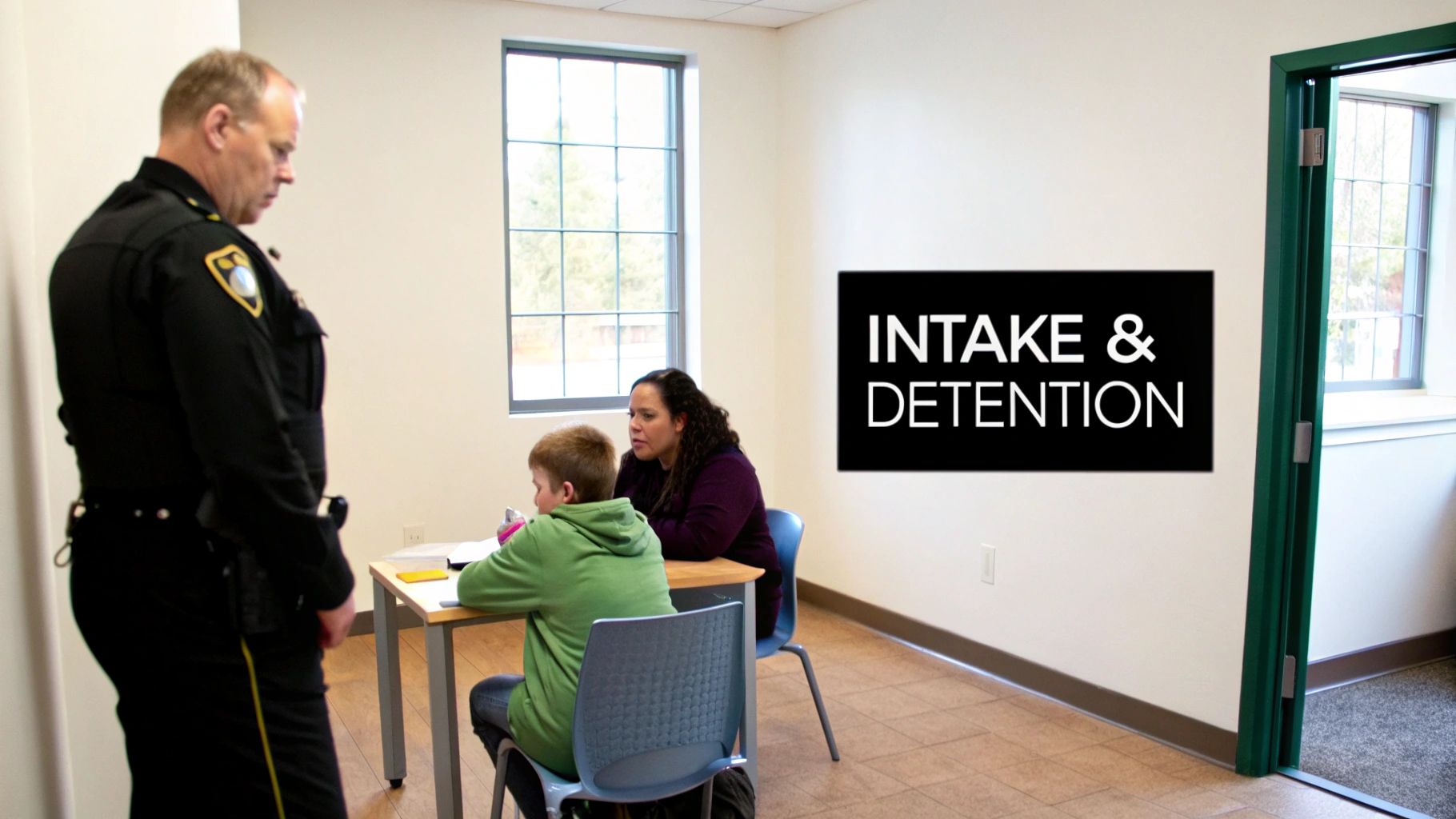
This initial review leads to one of two primary paths. The officer might decide the issue is minor enough to be handled informally, perhaps through a diversion program or a simple warning. Alternatively, if the offense is more serious, they will file a formal delinquency petition with the court, which officially starts the court process.
The Purpose of the Intake Process
The intake process is designed to filter cases, ensuring that court resources are reserved for more significant matters. The intake officer evaluates several key factors to make this determination.
- Severity of the Alleged Offense: A minor issue like shoplifting a candy bar is treated very differently than a more serious charge like assault.
- Prior History: The officer will check if the child has any previous involvement with the juvenile court system.
- Family and School Situation: Information about the child's home life, school attendance, and behavior can influence the decision.
- Attitude of the Child and Parents: A cooperative and remorseful attitude can often lead to a more favorable, informal outcome.
For many families, this stage offers a vital opportunity to resolve the matter without formal court intervention. It underscores the importance of taking the situation seriously from the very first contact. It's also important to remember that the actions of adults can sometimes lead to these situations. You can learn more about how adults can be held responsible in our detailed guide on contributing to the delinquency of a minor.
What Is a Detention Hearing?
If a minor is taken into custody and not immediately released to a parent or guardian, a detention hearing must be held quickly, typically within 24 to 72 hours. This hearing is not a trial to decide if a child committed the offense. Its sole purpose is to decide one thing: where the child will stay while the case proceeds.
The judge listens to arguments from the prosecutor and the child's defense attorney to determine if the child must remain in a secure youth detention center or if they can be safely released to their family's care.
The decision hinges on two main questions:
- Is the child a flight risk? In other words, is there a strong reason to believe they will not show up for future court dates?
- Does the child pose a danger to themselves or the community? This involves assessing the nature of the alleged offense and any past behavior.
A detention hearing is a crucial moment. The outcome directly impacts a child's freedom and can set the tone for the rest of the case. Keeping a child at home, in their school, and with their support system is often a primary goal at this early stage.
The scale of these early decisions is significant. In 2022, a staggering 549,500 delinquency cases were referred to juvenile courts across the United States, with 85% coming directly from law enforcement agencies, highlighting how quickly mistakes can escalate. Furthermore, 134,900 of those cases involved youth held in detention while awaiting their next court date. To learn more about these national trends, you can review juvenile justice fast facts from the Office of Juvenile Justice and Delinquency Prevention. Understanding these first steps is essential for any family navigating what happens in juvenile court.
Understanding the Adjudicatory Hearing
After the intake process and any detention hearings, a case that’s moving forward formally arrives at the adjudicatory hearing. Think of this as the trial phase for the juvenile system. It’s the single most critical moment in the entire process, where the facts of the case are finally laid out before a judge.
The goal here is straightforward: the judge listens to all the evidence and decides whether the child actually committed the offense they’re accused of. The language is important. In juvenile court, a minor isn't found "guilty" or "not guilty." Instead, if the prosecutor proves their case, the child is found to be "delinquent."
This hearing determines everything that happens next. It's a formal, structured proceeding with serious consequences. An outcome here will either lead to the case being dismissed or moving on to the dispositional phase—what most people think of as sentencing. For families, getting a handle on how this hearing works is the key to preparing for what’s ahead.
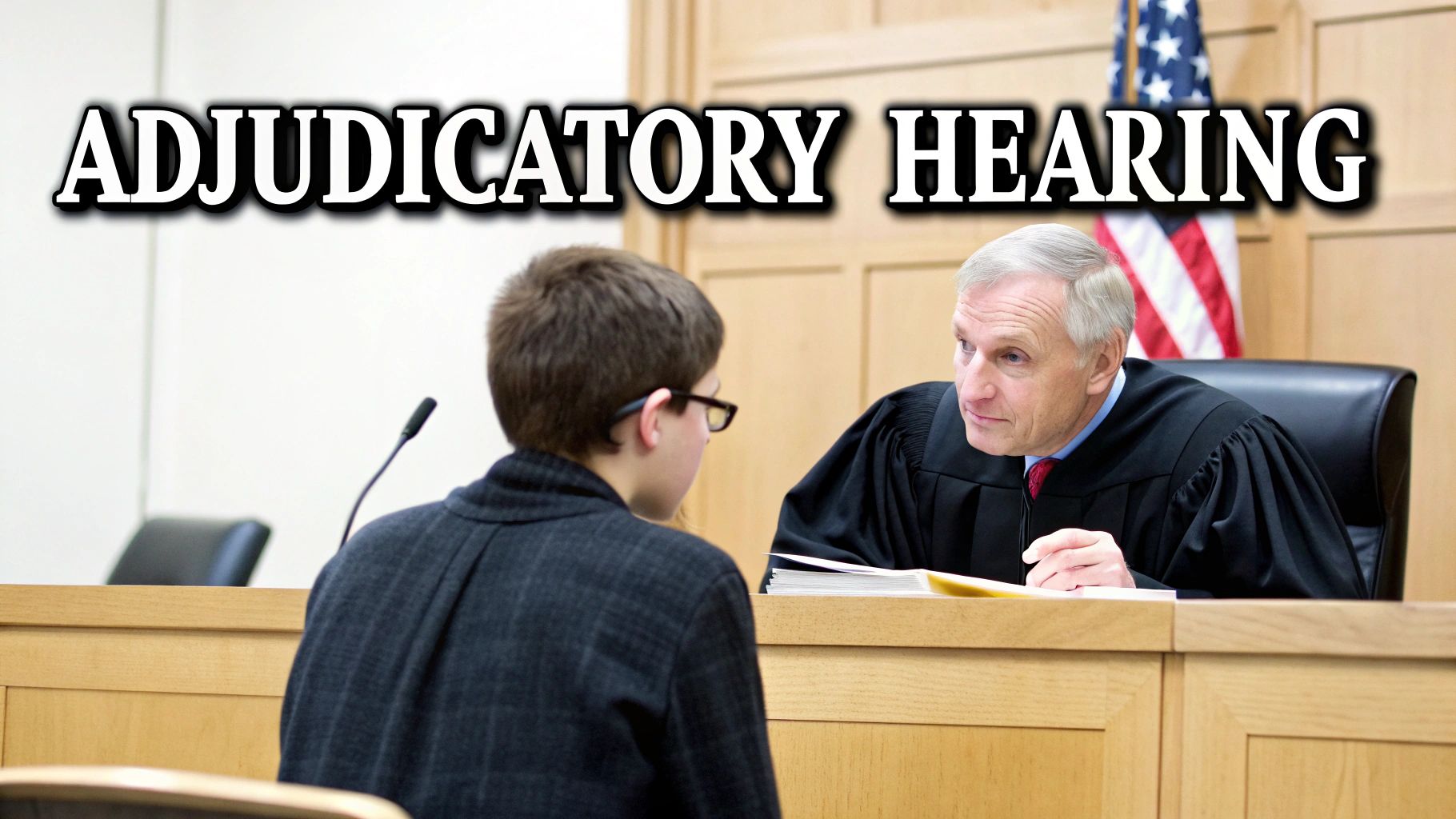
Key Players in the Courtroom
Walking into a courtroom can be an intimidating experience. Knowing who’s who and what they do can help make the entire process feel a little less overwhelming.
- The Judge: In Georgia's juvenile courts, the judge is the ultimate decision-maker. There is no jury. The judge hears all the testimony, rules on legal arguments, and single-handedly determines if the child is delinquent.
- The Prosecutor: This is the attorney representing the state, often from the District Attorney's or Solicitor's office. Their job is to present evidence and call witnesses to prove the allegations against the minor.
- The Defense Attorney: This is your child's advocate. Their job is to protect the child’s rights, challenge the prosecutor's evidence, question witnesses, and build a strong defense.
- The Juvenile and Their Parents: The minor child is at the center of the hearing and has the right to be present. As parents or guardians, you are there to provide support, but your direct participation is typically limited.
Because the judge decides the outcome alone, this hearing is very similar to what’s called a bench trial in the adult system. Our guide explaining the key differences between a bench trial vs a jury trial in Georgia can give you a better sense of how these judge-led proceedings work.
The Standard of Proof and Presenting Evidence
For a judge to find a child delinquent, the prosecutor must meet an incredibly high bar: proof beyond a reasonable doubt. This is the exact same standard used in adult criminal trials. It means the evidence must be so compelling that there’s no other logical conclusion except that the child committed the alleged act.
An adjudicatory hearing isn’t a casual discussion or a mediation. It is a formal, fact-finding trial where the rules of evidence apply. The judge’s decision must be based solely on what is proven in court—not on feelings or assumptions.
During the hearing, both sides get to present their case. The prosecutor always goes first, using different types of evidence to build their argument.
Common Types of Evidence:
- Witness Testimony: This could be anyone from police officers and alleged victims to eyewitnesses who are called to the stand to describe what they saw or heard.
- Physical Evidence: This might include objects related to the alleged offense, such as stolen property, crime scene photos, or surveillance videos.
- Documents: Official paperwork like police reports or school records can also be introduced as evidence.
Once the prosecution rests, the defense attorney has a chance to respond. This is where they can cross-examine the prosecutor's witnesses, pointing out inconsistencies or weaknesses in their stories. The defense can also present its own evidence and witnesses to counter the allegations. It's crucial to remember that the child has a right to remain silent and cannot be forced to testify.
The judge weighs all the evidence and arguments before making a final ruling. If the judge isn't convinced beyond a reasonable doubt, the petition is dismissed, and the case is closed. But if the judge finds the child delinquent, the case moves to a disposition hearing, where the consequences will be decided.
Disposition Hearings and Sentencing Alternatives
If the judge finds a child delinquent after the adjudicatory hearing, the case isn’t finished. It moves into what is often the most critical phase: the dispositional hearing. Think of this as the juvenile court’s version of sentencing, but the entire purpose is different from what you see in adult court.
The focus completely shifts. The question is no longer "what did the child do?" but instead becomes, "what does this child need to get back on track?" The judge's goal is to create a practical plan for rehabilitation and support, making a decision that will absolutely shape a young person's future.
The Goal of Disposition: Rehabilitate, Not Punish
Nowhere is the philosophy of rehabilitation clearer than at the dispositional hearing. The judge’s main objective is to find a solution that serves the best interests of the child while also keeping the community safe. It's a delicate balancing act that requires a hard look at the child’s entire life.
To get this right, the judge relies on a lot of information. A probation officer often prepares a detailed report that covers things like:
- The child's family life and home environment.
- How they are doing in school, both academically and behaviorally.
- Any history of mental health challenges or substance use.
- The specifics of the offense itself.
This background information helps the judge see the whole person, not just the single mistake that brought them to court. It allows for a thoughtful, personalized plan designed to fix the root problems and prevent them from happening again.
Common Outcomes and Sentencing Alternatives
In Georgia, judges have a lot of options, and most are designed to keep the child at home and in their community. The system is built around intervention and guidance, not just locking kids up. Some of the most common dispositions include:
- Probation: This is, by far, the most frequent outcome. A child on probation gets to live at home but has to follow a strict set of rules. This usually means attending school, sticking to a curfew, and checking in regularly with a probation officer.
- Counseling or Therapy: If the judge sees underlying issues that led to the behavior, they can order individual or family counseling. This could be for anger management, dealing with trauma, or substance abuse problems.
- Community Service: The child might be required to complete a set number of hours working for a local nonprofit. This helps them learn responsibility and gives them a chance to contribute positively to their community.
- Restitution: If the offense caused financial damage—like vandalism or theft—the judge can order the child to pay the victim back for the harm caused.
These alternatives are meant to be corrective and educational. The whole point is to help the child understand the real-world impact of their actions and learn how to make better choices moving forward.
The dispositional hearing is where the juvenile court's promise of rehabilitation is put into practice. The outcome is not just a sentence; it's a structured plan intended to guide a young person back onto a productive path, providing support and accountability along the way.
Diversion Programs and More Serious Consequences
For some first-time or minor offenses, there's an even better outcome available called a diversion program. This is an informal agreement where the child completes certain tasks—like attending a class or doing community service—and in exchange, the charges are dismissed. This is the best-case scenario because it avoids a formal delinquency record altogether.
Of course, for more serious or repeat offenses, the consequences can be much tougher. The most significant is out-of-home placement, where a judge orders the child to live in a secure facility, like a Youth Development Campus (YDC). This is almost always a last resort, used only when the judge believes community-based options won't be enough.
The data backs this up. The system truly does focus on rehabilitation, with probation being ordered in 67% of adjudicated delinquency cases in 2022. Only 28% of cases resulted in out-of-home placements. This is part of a much larger trend—youth incarceration across the nation dropped by a massive 74% between 2000 and 2023, thanks to fewer arrests and a smart shift toward alternatives. You can read more about these trends in the state of youth justice in 2025 report on prisonpolicy.org.
This is exactly why having a strong advocate during the dispositional phase is so crucial. The right attorney can fight for an outcome focused on support and opportunity, not just punishment.
When a Juvenile Case Moves to Adult Court
For most families caught up in the juvenile system, the biggest fear is their child’s case getting pushed into adult court. This process, known as a transfer or waiver, is a huge deal. It yanks the case out of the rehabilitative-focused juvenile court and throws it into the superior court system, where the rules, penalties, and lifelong consequences are far more brutal.
While a transfer isn't the norm for most delinquency cases, it's a very real possibility for certain serious offenses here in Georgia. Knowing when and why this happens is key. The possibility of a transfer is exactly why a strong, proactive defense is so important from the get-go—the main goal is to keep the case right where it belongs: in juvenile court.
How a Case Gets Transferred to Adult Court
A case doesn't just slip through the cracks and land in superior court. It’s a formal legal process. First, the prosecutor has to file a motion asking for the transfer. Then, the juvenile court judge must hold a special hearing to decide if moving the case is the right call.
You can think of this hearing as a deep dive into both the child and the alleged crime. The judge has to weigh several factors to figure out if the juvenile system can truly handle the situation or if public safety demands that the case be moved up.
A judge will look at things like:
- The seriousness of the offense, especially if it involved violence.
- The child’s age, maturity, and any past record in the juvenile system.
- The real likelihood of rehabilitation within the juvenile system's timeframe.
- The need to protect the community from any future harm.
It's a serious balancing act. The judge has to decide if the supportive, corrective services of the juvenile system are enough for the facts at hand.
A transfer hearing is a high-stakes moment that can permanently alter a child's future. The decision to move a case to adult court effectively says the rehabilitative goals of the juvenile system are no longer the primary focus, shifting instead to the more punitive nature of the adult criminal justice system.
Georgia’s Seven Deadly Sins Law
Here in Georgia, some situations make the path to adult court much more direct. Under a law commonly called the “Seven Deadly Sins” Act, certain serious felony charges automatically put older teens under the jurisdiction of the superior (adult) court right from the start.
If a youth between the ages of 13 and 17 is accused of one of these specific offenses, the case begins in adult court, completely bypassing the juvenile system.
These offenses are:
- Murder
- Voluntary Manslaughter
- Rape
- Aggravated Sodomy
- Aggravated Child Molestation
- Aggravated Sexual Battery
- Armed Robbery (if committed with a firearm)
This law is a massive exception to the general rule that kids are handled by the juvenile system. The stakes couldn't be higher. A conviction in superior court means an adult criminal record and the potential for sentences that include long-term, adult prison time. Protecting a young person from that outcome demands an immediate and highly skilled defense that starts challenging the charges from day one.
Protecting a Child's Future by Sealing Records
After a juvenile case is closed, a lot of families think the whole ordeal is finally behind them. There's a common—and dangerous—myth that a juvenile record just vanishes once a child turns 18. Unfortunately, that’s not what happens in juvenile court in Georgia. These records can absolutely follow a young person into adulthood, popping up at the worst times and creating unexpected roadblocks.
The good news is that Georgia law offers a clear path forward. The process is called record sealing or, in more formal legal terms, restricting access to the record. You can think of it like putting a sensitive file into a locked vault. The information technically still exists, but public access is cut off for things like background checks for jobs, college applications, and housing searches.

This step isn't automatic, though. It requires taking action by filing a formal petition with the court. Securing a brighter future for a child can mean taking this final, crucial step to ensure a past mistake doesn't unfairly limit their opportunities down the road.
Who Is Eligible to Seal Their Juvenile Record?
Eligibility for sealing a juvenile record in Georgia really depends on how the case turned out and how much time has passed since. It’s a way of rewarding a young person for staying out of trouble and getting their life on the right track.
Generally, a person may be eligible if:
- The case was dismissed or handled informally. If the intake officer decided not to file a petition in the first place, or if the charges were dropped, one can often petition to seal the record right away.
- The child was found not delinquent. An acquittal after an adjudicatory hearing means the record is eligible for immediate sealing.
- A certain amount of time has passed. If the child was found delinquent, they typically must wait at least two years after the case is officially closed (meaning probation and all other requirements are finished). During this two-year period, they cannot have been convicted of a felony or misdemeanor or have another delinquency case filed against them.
This waiting period is there to show the court that the young person has been rehabilitated and isn't a risk to the community. It’s their chance to prove they’ve learned from the experience.
Sealing a juvenile record is one of the most powerful tools available for protecting a young adult's future. It prevents a youthful error from showing up on background checks, opening doors to education, employment, and military service that might otherwise be closed.
The Process for Petitioning the Court
Taking the step to seal a record involves a formal legal process. It’s not something that happens on its own—one has to specifically ask the court to do it.
The steps generally include:
- Filing a Petition: A formal request, known as a petition to seal juvenile records, has to be filed in the same county court where the original case was heard.
- Serving Notice: The prosecutor's office must be notified of the petition, which gives them a chance to object if they have a reason to.
- Court Hearing: The judge will schedule a hearing to review the petition and decide whether to grant the request.
The judge will look at whether sealing the record is in the best interest of both the individual and the public. With so many young people entering the system—youth under 16 made up 54% of all juvenile court cases processed in 2022—it's vital to help them clear their path forward. Knowing that good representation can help secure dismissals (188,487 cases) or later restrictions shows just how important these final steps are for a young person's future. You can discover more about these statistics from The Sentencing Project’s youth justice data.
Understanding the rules is key. For a complete look at the process, learn more about whether juvenile records are sealed in Georgia in our detailed guide. Successfully sealing a record provides true closure, allowing a child to move into adulthood with a genuinely clean slate.
Common Questions We Hear from Families in Juvenile Court
When a family is suddenly thrown into the Georgia juvenile court system, a thousand questions run through their mind. It’s completely normal. Below, are answers to some of the most common questions from parents, hoping to give some clarity and a better sense of what to expect.
Will My Child Have a Lawyer in Juvenile Court?
Yes, absolutely. Every child in Georgia has the right to an attorney for juvenile court proceedings. If a family can't afford to hire a lawyer privately, the court will appoint one—usually a public defender—to represent the child.
While appointed attorneys are hardworking and dedicated, their caseloads are often massive. This can, unfortunately, limit how much time and personal attention they can give to any one case. For that reason, many families make the decision to hire a private juvenile defense attorney to make sure their child gets a defense strategy built specifically for them.
Can Parents Talk Directly to the Judge?
This is a common question, and the answer is generally no, not directly during a formal hearing. While a parent's role is absolutely essential, the courtroom has very specific rules about how information and arguments are presented. All communication with the judge is handled by the attorneys, who know how to navigate those rules effectively.
But that doesn't mean a parent's voice isn't heard. In fact, their input is critical. Parents will be providing their child’s lawyer with all the essential background information they need to build the strongest possible case, especially when it comes to the dispositional hearing, where details about a child's home life and character are front and center.
The most powerful way for a parent's voice to be heard in court is through their child's attorney. This ensures everything they want to say is framed correctly within legal strategy and court procedure, giving it the greatest possible impact.
What's the Difference Between a Delinquent Act and a Status Offense?
This is a core concept in juvenile law, and the distinction is pretty straightforward: it all depends on whether the act would be a crime if an adult did it.
- A delinquent act is something that would be a crime for anyone, regardless of age. Think of things like theft, assault, or vandalism.
- A status offense is only an offense because of the child's age—their "status" as a minor. Common examples are truancy (skipping school), running away from home, or breaking a local curfew for minors.
Cases involving status offenses are often handled as CHINS cases, which stands for "Children In Need of Services." The focus here is usually less on punishment and more on getting the child and family connected with community resources and support systems to address the underlying issues.
Getting a handle on how juvenile court works is the first step toward protecting a child’s future. If your family is facing this challenge in Alpharetta, Cumming, or anywhere in Forsyth or Cobb County, you don't have to navigate it alone. For experienced guidance and a defense focused on getting your child back on the right track, contact Brian Hansford Law today by visiting https://challengemycharge.com.
