
Getting a DUI in Georgia isn't like getting a speeding ticket. It's a sudden, life-changing event that kicks off the second you see those flashing lights. It starts with a traffic stop, but it can quickly lead to an arrest, a night in jail, and a formal process you never saw coming. The consequences begin immediately, impacting your freedom, your finances, and your future.
To really get a handle on what happens when you get a DUI, you have to understand this first, critical stage.
The Roadside Stop: An Inside Look at a DUI Arrest
The path to a DUI charge almost always starts with something that seems routine: a traffic stop. Whether you're in Alpharetta, Marietta, or anywhere in Forsyth County, those flashing blue and red lights in your rearview mirror are where it all begins. Police officers can't just pull people over for no reason; they need a legally valid one, what is known as reasonable suspicion.
This suspicion can come from all sorts of driving behaviors. An officer might see you weaving, driving unusually slow, failing to stay in your lane, or even committing a simple traffic offense like running a red light or having a busted taillight. Once you're pulled over, the officer’s attention immediately pivots from that minor infraction to looking for signs that you might be impaired.
From Traffic Stop to DUI Investigation
The jump from a simple ticket to a full-blown DUI investigation happens fast. Officers are trained to spot specific clues the moment they walk up to your window. Every observation is noted and can include things like:
- Physical Signs: Fumbling to get your license, having bloodshot or watery eyes, slurring your words, or the distinct smell of alcohol on your breath or in the car.
- Your Responses: Seeming confused about where you are, having trouble answering simple questions, or giving conflicting stories about where you’ve been.
- Admissions: Admitting you had anything to drink—even "just one or two beers"—can instantly escalate the situation.
If what the officer sees and hears strengthens their suspicion, they'll almost certainly ask you to step out of your car. This is where things get serious, as the investigation moves into a more formal evidence-gathering phase right there on the side of the road.
A traffic stop for a minor violation can quickly spiral into a major legal problem if an officer suspects you're impaired. From this point on, every action, every word, and every observation is being documented to be used as evidence.
To give you a clearer picture, here’s a breakdown of how a typical DUI stop unfolds from the initial lights to the arrest.
Timeline of a Typical Georgia DUI Stop
| Stage | What Typically Happens | Key Considerations |
|---|---|---|
| The Initial Stop | An officer pulls you over for a traffic violation or erratic driving. | The officer must have "reasonable suspicion" to legally initiate the stop. |
| Driver Interaction | The officer approaches, asks for your license and registration, and observes you for signs of impairment. | Your speech, appearance, and ability to follow instructions are being evaluated. |
| Field Sobriety Tests | If impairment is suspected, you'll be asked to perform a series of roadside tests. | These tests are subjective, and you are not legally required to perform them. |
| Arrest Decision | Based on all observations, the officer decides whether there is probable cause to arrest you for DUI. | This is the critical moment where the investigation shifts to a criminal charge. |
| Implied Consent & Chemical Test | After the arrest, the officer reads you the Georgia Implied Consent Notice and requests a breath, blood, or urine test. | Refusing the test carries its own separate and serious license suspension penalties. |
As you can see, the situation progresses quickly, with each stage building on the last.
The Role of Field Sobriety Tests
The next step in the roadside investigation is usually a request to perform Standardized Field Sobriety Tests (FSTs). These are a set of physical and mental exercises meant to test your balance, coordination, and ability to follow directions. In Georgia, there are three standardized tests:
- Horizontal Gaze Nystagmus (HGN) Test: The officer has you follow a stimulus (like a pen or their finger) with just your eyes to look for involuntary eye jerking.
- Walk-and-Turn Test: This is the classic test where you're told to walk nine steps, heel-to-toe, down a real or imaginary line, turn, and walk back nine steps.
- One-Leg Stand Test: You’ll be instructed to stand on one foot, raise the other about six inches off the ground, and count out loud for thirty seconds.
Your performance on these tests is incredibly subjective. It can be easily affected by things that have nothing to do with alcohol, like bad weather, uneven pavement, a medical condition, or just being nervous. Still, the officer's opinion of how you did will be a major factor in whether they decide to arrest you.
The fallout from a DUI is severe and widespread. It's not just a local issue; it's a national crisis. Every day in the U.S., about 34 people die in drunk-driving crashes—that's one death every 42 minutes, based on 2023 data. In that year alone, 12,429 lives were lost, making up roughly 30% of all traffic crash deaths in the country. You can find the full report from the National Highway Traffic Safety Administration for more on these sobering statistics.
Implied Consent and The Arrest
If the officer believes they have enough evidence after the FSTs, they will place you under arrest for DUI. At that moment, they are legally required to read you Georgia's Implied Consent Notice. This notice explains that, by driving in Georgia, you have already consented to a chemical test (blood, breath, or urine) to measure your Blood Alcohol Concentration (BAC). Refusing this test triggers its own set of harsh consequences. You can learn more about Georgia’s implied consent law and what happens if you refuse a chemical test in our detailed guide.
After the notice is read, you'll be handcuffed, searched, and put in the back of a patrol car. You’ll then be taken to a police station, hospital, or jail for the official chemical test and booking process, which involves fingerprints and a mugshot. This arrest is the official start of two separate battles you are now facing.
Facing Two Battles: The Court Case and License Suspension
Getting arrested for a DUI in Georgia isn't a single problem—it's the start of two completely separate fights that happen at the same time. This is something that surprises a lot of people. You’re not just fighting one case; you're fighting on two different fronts: one in criminal court and the other with the Georgia Department of Driver Services (DDS).
These two battles are totally independent of each other. Winning, losing, or settling one doesn't automatically take care of the other. Each process has its own set of rules, its own timeline, and its own serious consequences. Getting a handle on this dual-track system is the first, most critical step to understanding what’s ahead.
The Administrative License Suspension Process
The first fight, and the one that moves the fastest, is all about your driver's license. This isn't a criminal case. It's an administrative action handled exclusively by the DDS. Their only job here is to decide if your driving privileges should be suspended based on the arrest—not to determine if you are guilty of a crime.
This administrative clock starts ticking the moment you are arrested. For most drivers, you have a non-negotiable 30-day window to act before your license is automatically suspended. If you miss this deadline, you could lose your license long before you ever set foot in a courtroom for the criminal charge.
An administrative license suspension is a civil matter, totally separate from your criminal DUI charge. It moves much quicker and demands immediate attention to save your license, no matter what happens with the court case.
This timeline shows just how quickly things start moving, kicking off both the criminal and administrative processes at once.
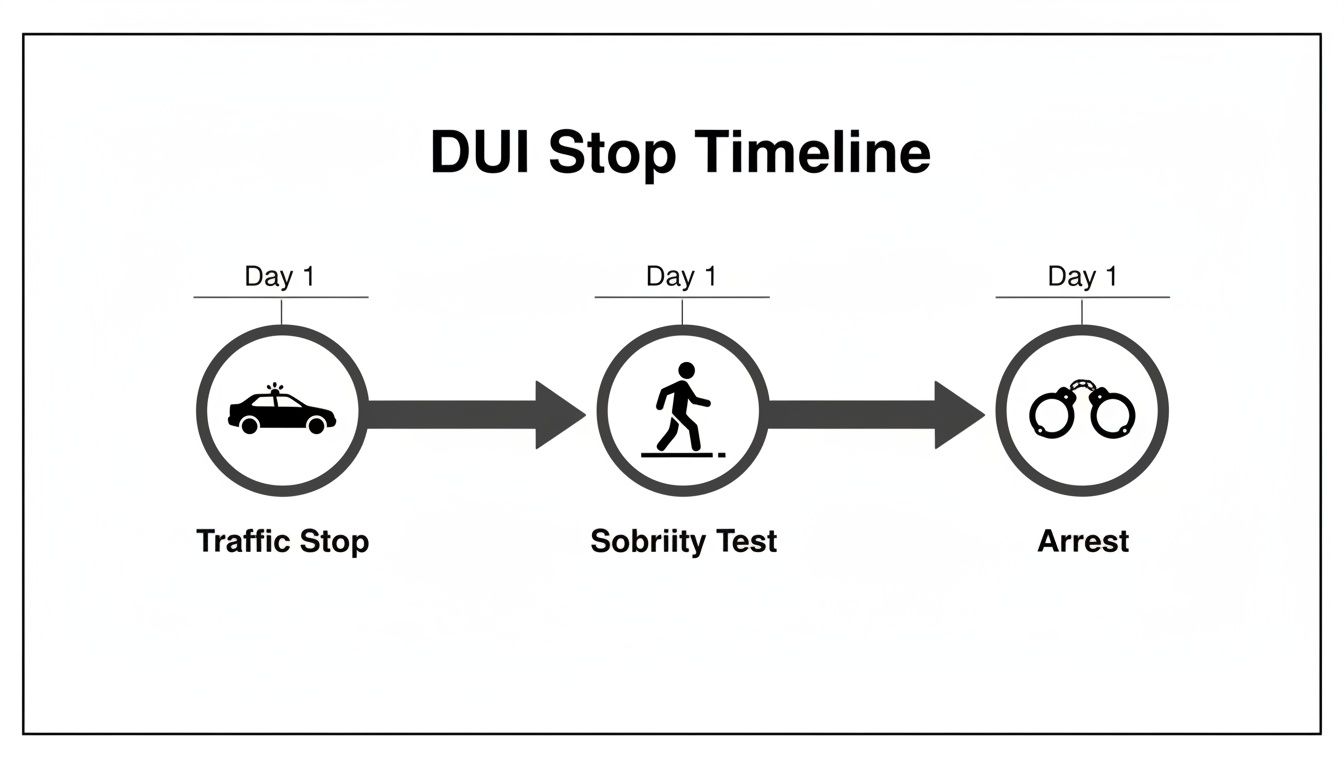
As you can see, the traffic stop, sobriety tests, and arrest all happen in a blur, but they set in motion two very different challenges you now have to face.
There are very specific steps one must take to challenge this potential loss of a license. It's vital to understand the details of a license suspension after a DUI to see how this administrative process works. For those in places like Cumming or Forsyth County, knowing the local procedures is key.
The Criminal Court Case Process
While the DDS is moving on your license, the criminal justice system starts its own, separate process. This is what most people picture when they think of a DUI charge. The criminal case winds its way through the court system—whether that's a municipal court in Roswell or Johns Creek, or a state or superior court, depending on the case specifics.
Here, the goal is to determine if you are guilty of the crime of Driving Under the Influence according to Georgia law. This process moves a lot slower than the administrative one and has several distinct stages:
- Arraignment: Your first appearance in court, where the formal charges are read.
- Pre-Trial Motions: This is where the evidence is examined—police reports, video, chemical test results—to find weaknesses and build a defense.
- Plea Negotiations: There may be discussions with the prosecutor about resolving the case without a full-blown trial.
- Trial: If an acceptable agreement is not reached, the case goes to trial, where a judge or jury will hear the evidence and decide the outcome.
Why The Two Processes Are Separate
It's a huge misconception that winning your criminal case will automatically save your license. It absolutely will not. Because the administrative and criminal fights are independent, you can be found "not guilty" in court and still have your license suspended by the DDS.
On the flip side, you could win your DDS hearing and keep your license, but still end up being convicted of the DUI in criminal court. The reason is that the standard of proof is different. The DDS hearing is often just about whether the officer followed the rules during your arrest. The criminal trial is about proving the DUI charge "beyond a reasonable doubt." A DUI arrest means you have to gear up to fight both battles, right from the start.
Navigating the Georgia DUI Court Process
The criminal court process for a DUI can feel like an overwhelming maze, full of unfamiliar terms and confusing timelines. Once the criminal charge is filed—whether it's in Marietta, East Cobb, or another local court—a very formal journey begins. This section is your roadmap, breaking down what really happens when you get a DUI in the Georgia court system.
Understanding this process helps take some of the mystery out of the experience. It all starts with a first court appearance and moves through several key phases, each with its own specific purpose. Let's walk through it step-by-step so you have a much clearer picture of what to expect.
The Arraignment: Your First Court Appearance
The first formal step in any criminal case is the arraignment. This is your initial court date where you'll appear before a judge. At this hearing, the prosecutor officially presents the charges against you, which could be DUI Less Safe, DUI Per Se, or a combination of charges.
During the arraignment, you will be asked to enter a plea: guilty, not guilty, or nolo contendere (no contest). It is almost always standard practice to enter a plea of "not guilty" at this stage. Doing so preserves all of your rights and gives a defense team the time needed to start building a case.
Pleading not guilty doesn't mean your case is immediately headed for a trial. Far from it. It simply kicks off the pre-trial phase, where most of the critical work on a DUI case actually happens.
The Pre-Trial Phase: Examining The Evidence
After the arraignment, your case moves into the pre-trial phase. This period is truly the backbone of any solid DUI defense. It’s when an attorney files for "discovery," which is a formal demand for the prosecution to turn over every single piece of evidence they have against you. This isn't just a simple request; it's a deep dive into every report, video, and number related to your arrest.
The evidence package typically includes:
- The Police Report: This is the officer’s official story of the traffic stop, their investigation, and why they arrested you.
- Video Evidence: Dashcam and bodycam footage are crucial. They provide an objective look at the entire interaction, from the first blue lights to the ride to the station.
- Chemical Test Results: This is the official report from the Intoxilyzer 9000 or the lab analysis of a blood draw.
- Witness Statements: A review of any statements from other officers or civilians who may have been on the scene.
The pre-trial phase isn't just about looking at the evidence; it's about challenging it. Every detail—from the reason you were pulled over to the calibration records of the breathalyzer—gets put under a microscope to find weaknesses.
This is also the time for filing pre-trial motions. These are formal arguments asking the court to do something specific, like throw out evidence that was obtained improperly. For example, a motion might argue that the initial traffic stop was illegal or that the field sobriety tests weren't administered correctly. A single successful motion can sometimes lead to reduced charges or even a full dismissal of the case.
Plea Negotiations and The Possibility of Trial
As the pre-trial phase progresses, discussions often open up between the defense and the prosecution. This is what's known as plea negotiation. The prosecutor may offer a deal to resolve the case without going to a full-blown trial. This could involve pleading to the original DUI charge or, in some cases, to a lesser charge like reckless driving.
Deciding whether to accept a plea offer or take the case to trial is a huge decision. It depends entirely on the unique facts of a case, the strength of the evidence, and what the potential outcomes look like. If a satisfactory resolution is not reached through these negotiations, the case will be set for trial.
At a trial, the prosecution has the heavy burden of proving your guilt beyond a reasonable doubt to a judge or a jury. Both sides will present their evidence, call witnesses to the stand, and make their arguments. This is the final stage of the court process, where the ultimate verdict of guilty or not guilty is handed down, bringing the criminal side of the DUI journey to its end.
The Lasting Impact of a DUI Conviction
A DUI conviction in Georgia does more than just what the judge orders in court. The consequences ripple out, touching almost every part of your life for years after the case is closed. While the court penalties are tough enough, it's often the hidden, long-term damage that causes the most trouble.
The first wave of consequences comes directly from the judge and is laid out by state law. These can include heavy fines, potential jail time, mandatory community service, and required classes like DUI school or substance abuse evaluations. As you might expect, these penalties get much more severe with each offense, designed to get your attention and prevent it from happening again.

Comparing Potential Court-Ordered Penalties
To get a clear picture of how serious this can get, it helps to see the penalties side-by-side. Every case is different, of course, but Georgia law sets minimum and maximum penalties that a judge must follow.
This table gives a general overview, showing just how quickly things escalate if you get another DUI within a five-year period.
Overview of Potential Georgia DUI Penalties by Offense
| Penalty Type | First DUI Offense | Second DUI Offense (in 5 years) | Third DUI Offense (in 5 years) |
|---|---|---|---|
| Jail Time | 24 hours to 12 months | 72 hours to 12 months | 15 days to 12 months |
| Fines | $300 to $1,000 (plus surcharges) | $600 to $1,000 (plus surcharges) | $1,000 to $5,000 (plus surcharges) |
| Community Service | Minimum 40 hours | Minimum 30 days (240 hours) | Minimum 30 days (240 hours) |
| License Suspension | Up to 1 year | Up to 3 years | 5-year revocation |
| DUI School | Mandatory (Risk Reduction Program) | Mandatory | Mandatory |
| Ignition Interlock | Possible for limited permit | Mandatory for limited permit | Mandatory for probationary license |
But believe it or not, these court-ordered penalties are often just the starting point. A conviction sets off a chain reaction of other consequences that can stick with you for a very long time.
The Hidden Financial Consequences
One of the most immediate and painful hits to your wallet comes from your car insurance company. Once you're convicted of a DUI, you're flagged as a high-risk driver, and your insurance rates will shoot through the roof. It’s common for premiums to double, triple, or even quadruple—an increase that can stick around for three to five years, sometimes longer.
A DUI conviction on your record can cost you thousands of dollars in increased insurance premiums alone over several years. Many insurers may even drop your coverage altogether, forcing you to seek expensive high-risk insurance.
And those fines in the table? They don't include all the court costs and surcharges, which can tack on a significant amount to what you owe. When you add up the fees for DUI school, probation supervision, and getting your license back, the financial hole gets deep, fast.
Long-Term Effects on Your Life and Career
Beyond the money, a DUI conviction leaves a permanent mark on your criminal record. It's something that will show up on background checks for the rest of your life, putting up roadblocks you might never have expected.
- Employment Challenges: Many employers are wary of hiring someone with a DUI, especially for jobs that involve driving, using machinery, or dealing with sensitive information. For careers in commercial driving, education, or healthcare, it can be an automatic deal-breaker.
- Professional Licensing: If you have a professional license—like a pilot, nurse, or real estate agent—a DUI conviction can put your career in jeopardy. Your licensing board will likely open an investigation, which could lead to suspension or even revocation.
- Housing and Education: It doesn't stop there. Some landlords run criminal background checks, and a DUI could be the reason you're denied an apartment. It can even affect your ability to get certain student loans or get into specific college programs.
The fallout from a conviction is widespread. A single mistake on the road can turn into a series of long-term obstacles, affecting everything from your bank account to your career. It truly shows the full gravity of what happens when you're convicted of a DUI in Georgia.
How a DUI Defense Strategy Is Built
A DUI arrest is not a conviction. It is important to remember that many people feel like the case is already over the moment the handcuffs go on, but that’s just not how it works. A DUI case in Georgia is a complex puzzle, and building a strong defense means taking every single piece of that puzzle and putting it under a microscope.
The process starts from the very beginning—those flashing blue and red lights in your rearview mirror. A good defense isn't about finding some single, magical "gotcha" moment. It's about systematically questioning the entire chain of events for procedural mistakes, weaknesses in the state's evidence, and any violation of rights. From the stop itself to the chemical test results, everything gets scrutinized.
Deconstructing the Traffic Stop
The entire foundation of the state's case rests on the initial traffic stop. An officer in Forsyth County or East Cobb can't just pull you over on a whim or a hunch. They must have what's called "reasonable articulable suspicion"—a legitimate, legally valid reason to believe a traffic violation or a crime has occurred. The very first step is to challenge whether that stop was proper in the first place.
Was the reason for the stop truly legitimate? If the officer said you were weaving, does the dashcam video actually show that? Sometimes, a minor drift inside your lane isn't enough to justify a full-blown traffic stop. If that initial stop wasn't on solid ground, any evidence collected after that point—everything—could potentially be thrown out of court.
This analysis covers every single interaction that follows. What the officer claims to have observed, every word that was said, and every instruction you were given are all crucial details that are reviewed.
Scrutinizing Field Sobriety Tests
Field Sobriety Tests (FSTs) are often the centerpiece of the prosecution's case, but they are far from foolproof. The National Highway Traffic Safety Administration (NHTSA) has incredibly strict, standardized protocols for how these tests must be administered. A huge part of a DUI defense strategy is checking to see if the officer followed those protocols to the absolute letter.
Some questions that are examined include:
- Were the instructions given correctly? If an officer mumbles or gives confusing instructions for the Walk-and-Turn test, it’s no wonder someone might perform poorly.
- Was the environment suitable? Trying to perform balance tests on an uneven shoulder, in the pouring rain, or with strobing patrol lights blasting in your eyes makes it difficult for anyone, sober or not.
- Did the officer consider other factors? Things like pre-existing medical conditions, your age, your weight, and just the sheer nervousness of the situation can all impact performance on FSTs.
If the tests weren't done by the book, their results become unreliable and can be attacked as invalid evidence.
A common misconception is that failing a field sobriety test is undeniable proof of impairment. In reality, these tests are highly subjective and prone to error, and a skilled defense will expose any deviation from the strict administration standards required by law.
Challenging Chemical Test Results
The numbers from a breathalyzer or a blood test might seem like concrete science, but they are also vulnerable to a strong challenge. In Georgia, the go-to breathalyzer is the Intoxilyzer 9000. These machines aren't magic; they are complex pieces of equipment that require constant maintenance, precise calibration, and proper operation to give an accurate reading. Any failure on that front can render the result useless.
With blood tests, the process is even more detailed. The "chain of custody" must be perfect. This means there has to be an unbroken, documented record of who handled the blood sample from the moment it was drawn until it was tested at the GBI crime lab. Any gap, mistake, or undocumented transfer in this chain can compromise the integrity of the sample. To explore this topic further, you can find a lot of information on how to beat DUI charges by challenging the evidence.
Ultimately, building a defense is a methodical process of deconstruction. It’s about taking the prosecution's case apart, piece by piece, to find the weak links that can lead to a positive outcome.
Your First Steps After a DUI Arrest

The hours and days following a DUI arrest are a blur of confusion and anxiety. It’s an overwhelming experience, but taking a few organized, practical steps right away can make a huge difference down the road. Your first priority is simple: get organized and hold on to every piece of information from the incident.
Find all the paperwork the police gave you. This will likely include traffic citations, any documents related to bond or bail, and if your car was towed, the impound records. These forms are packed with critical details and deadlines that are incredibly easy to miss when you're still processing everything. Get it all together in one safe place.
Document Everything Immediately
Your memory of the arrest is one of the most important pieces of evidence you have, and it starts to fade fast. As soon as you possibly can, sit down and write out a detailed story of everything that happened. Start before you even got behind the wheel and walk through every moment up to your release from jail.
Try to include specifics like:
- Where you were coming from and where you were headed.
- A specific list of what you ate and drank, and over what timeframe.
- Your version of the traffic stop and every question the officer asked.
- Details about the field sobriety tests—think about the weather, the lighting, and the condition of the road or sidewalk.
This personal account can be invaluable for an attorney later on.
The single most urgent deadline you’re facing isn't for your criminal court date. It's for your driver's license. From the date of your arrest, you have only 30 days to file an appeal and request a hearing to fight the administrative license suspension.
Seek Information Proactively
If you miss that 30-day window, you could lose your driving privileges automatically, no matter what happens in your criminal case. This administrative license process is a completely separate battle, and it moves much, much faster than the court system.
Understanding what happens after a DUI arrest means recognizing you're fighting on two fronts at once. The immediate aftermath is a critical period. By gathering your documents, writing down your story, and getting a handle on that 30-day rule, you're putting yourself in a much stronger, more proactive position. The next move is to seek out information from an experienced DUI defense firm to fully understand the fight ahead and your options.
Your Top Questions About Georgia DUIs Answered
If you've been arrested for a DUI, you're going to have a lot of questions. Getting straight answers is the first step toward understanding what you're up against and how to move forward. Here are a few of the most common questions that are asked.
Will My License Be Suspended Immediately After a DUI Arrest in Georgia?
No, your license isn't suspended on the spot. But the clock starts ticking on an administrative process that can lead to a suspension very quickly.
You have a critical 30-day window from the date of your arrest to file an appeal with the Georgia Department of Driver Services (DDS). If you miss this deadline, you will almost certainly face an automatic license suspension, regardless of what happens in your criminal case. This administrative suspension is completely separate from any court-ordered suspension that might come later if you're convicted.
What’s the Difference Between DUI Per Se and DUI Less Safe?
Georgia law gives prosecutors two different ways to charge someone with DUI, and it's not uncommon to be charged with both.
-
DUI Per Se: This one is all about the numbers. If a chemical test shows your blood alcohol concentration (BAC) was 0.08% or higher, the law says it is "per se" (by itself) that you were driving under the influence. The case is built entirely on that test result.
-
DUI Less Safe: This charge doesn't need a specific BAC number. Instead, the prosecution has to prove that alcohol or drugs made you a less safe driver. They'll use other evidence to make their case, like your driving behavior, your physical appearance, and how you performed on any field sobriety tests.
How Does a Georgia DUI Affect an Out-of-State License?
A Georgia court can't technically revoke a license issued by another state, but it can suspend your privilege to drive within Georgia's borders.
More importantly, Georgia is part of the Interstate Driver's License Compact. This means they will report the DUI to your home state's DMV or licensing agency. Your home state will then almost always take action against your license based on its own laws, which often means imposing a suspension similar to what you would have received in Georgia.
Understanding the complexities of what happens when you get a DUI is the first step toward protecting your future. If you are facing charges in Alpharetta, Cumming, or the surrounding North Georgia area, the experienced team at Brian Hansford Law is here to provide the information you need. For a detailed review of your case, visit us at challengemycharge.com.
