
When you get arrested in Georgia, the first thing that happens is you’re taken into police custody. From there, you'll be told your rights, driven to a detention facility, and put through an administrative process called "booking" before you ever see a judge.
The First Hour After an Arrest in Georgia
The moments right after an arrest can feel like a blur—confusing, chaotic, and overwhelming. If you can understand what's happening step-by-step, it takes some of the mystery out of the experience. Think of it as a roadmap for that initial encounter, from the second you're detained until you arrive at a police station or county jail.
This first phase is critical. It’s where your rights are officially read to you, and your status changes from a private citizen to someone in police custody. The whole thing is designed to be a formal procedure that moves you from the scene of the incident squarely into the criminal justice system.
From Handcuffs to Transport
The process kicks off the moment an officer puts you in handcuffs. That’s the signal that you are not free to leave. Once a person is arrested, they are immediately taken into police custody, where they should be read their Miranda rights. This isn't just something you see on TV; it's a real and crucial step informing you of your right to remain silent and your right to have an attorney. While the exact process can vary, this is the standard starting point. You can find more data about justice systems on Statista.com.
After your rights are read, you'll be searched for any weapons or illegal items before being placed in a patrol car. From there, you're usually transported to the nearest police department or county jail—which could be the Alpharetta jail or the main Fulton County Jail, depending on where the arrest took place.
The most important part of this first hour is the reading of your Miranda Rights. These aren’t just words; they are constitutional protections put in place to keep you from incriminating yourself. The two big ones are the right to remain silent and the right to an attorney.
To make this clearer, we've broken down the key stages of that first hour and what to keep in mind.
Immediate Steps After an Arrest
This table summarizes what happens and your rights are during that critical first hour.
| Stage | What Happens | Your Rights & Key Considerations |
|---|---|---|
| Detainment | An officer places you in handcuffs and informs you that you are under arrest. You are no longer free to leave. | Remain calm and do not resist. Anything you say or do can be used against you. |
| Miranda Rights | The officer reads you your Miranda rights, including the right to remain silent and the right to an attorney. | Listen carefully. You can state that you wish to remain silent and want to speak to a lawyer. |
| Search | You will be searched for weapons or contraband before being placed in the police vehicle. | This is a "search incident to arrest." Do not physically resist, but you can state, "I do not consent to a search." |
| Transport | You are driven to a police station or county jail for booking. | Do not talk about your case with the officers in the car. The vehicle may have recording equipment. |
Knowing these steps helps you protect yourself from the very beginning. The decisions you make in this first hour can have a significant impact on your case down the road.
This visual flow chart breaks down the simple, linear process of that first hour.
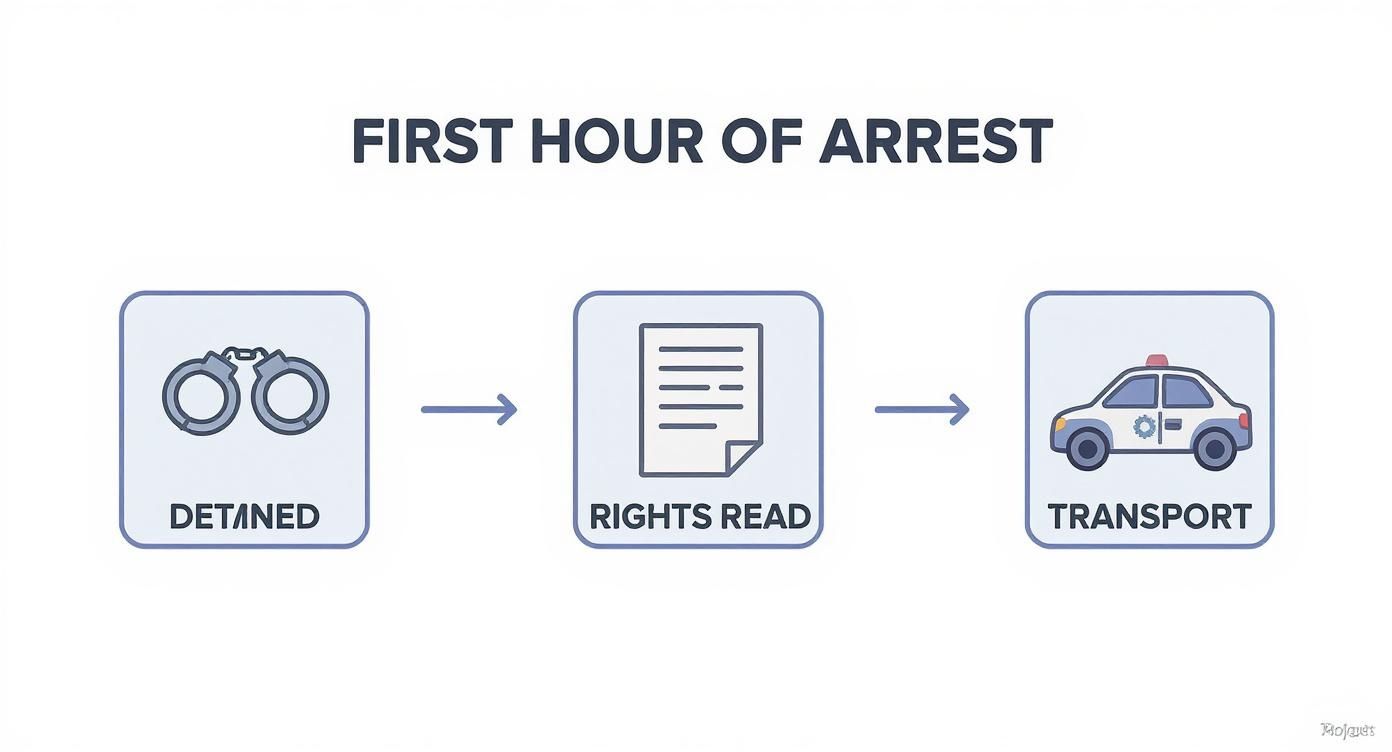
The infographic really drives home that each step—detainment, rights notification, and transport—is a distinct and necessary part of officially kicking off the arrest process. It turns a confusing and stressful situation into a predictable sequence of events.
Navigating the Police Station Booking Process

After you've been transported from the scene of the arrest, the next phase of what happens when you get arrested is a purely administrative one known as "booking." It's less of an interrogation and more like the system is creating an official file for you. This is the standardized, impersonal process of formally entering you into the jail or detention center's records.
When you arrive at the police station or county jail, you'll be taken to a processing area. The main goal here isn't to get more information about the case; it's to gather all the details needed to create a record of the arrest. It's a methodical procedure with a clear set of steps designed to create a paper trail.
The Steps of Booking
The booking process itself involves a few key actions. While it can feel intimidating, knowing what to expect can definitely take some of the anxiety out of the experience. Remember, this part is just about documenting who you are and the fact that you've been arrested.
First, the officers will take down your basic personal information. This usually includes:
- Full Name and Date of Birth: To make sure they have the right person.
- Physical Characteristics: Your height, weight, hair and eye color, and any distinguishing marks like scars or tattoos.
- Address and Other Contact Information: This is for official records and any necessary notifications.
Next up are fingerprints. Your prints are run through state and national databases to check for any outstanding warrants or to see if they match any from unsolved cases. You’ll also have a mugshot taken—the classic front-and-side profile photos that create a visual record for your file.
Securing Personal Property
A really important part of booking is when they inventory your personal belongings. Everything on you at the time of the arrest—wallet, phone, keys, jewelry, even your shoelaces—is collected, cataloged, and stored away for safekeeping.
This inventory isn't just for them; it's for your protection, too. You should be given a receipt for your items, which ensures that everything is accounted for. This simple step prevents any arguments later on about lost or stolen property.
Once your property is secured, you might undergo a more thorough search. This is just a standard safety check to make sure no contraband is brought into the holding areas.
With all those administrative tasks out of the way, you'll likely be placed in a holding cell. From there, you'll wait for the next steps in the process, which could be posting bail, being released on your own recognizance, or waiting for your first court appearance.
Your First Appearance in a Georgia Court

Once the booking process is done, the case moves from the police station to the courthouse. In Georgia, you can expect your first court appearance to happen fairly quickly, usually within 48 to 72 hours of your arrest.
This hearing is often called an arraignment, and it’s the official start of the judicial process. This is not a trial. No one is deciding guilt or innocence here. Instead, think of it as the formal kickoff where the court officially gets involved. Its purpose is to make sure you know exactly what charges you're facing and to decide if you can be released while the case proceeds.
Who Is in the Courtroom
Walking into a courtroom for the first time can be intimidating, but it helps to know who the key players are.
- The Judge: This is the person in charge. The judge runs the hearing, makes sure everyone follows the rules, and makes the big decisions—most importantly, whether to set a bond.
- The Prosecutor: This is the lawyer for the state. They will formally present the charges against you and often argue for a specific bond amount or certain conditions for your release.
- Your Defense Attorney: If you've hired an attorney, they will be by your side to speak for you, challenge the prosecutor's arguments, and fight for your release.
This first appearance is a formal, public hearing. It’s all about getting the case officially into the court system.
What Happens During the Hearing
The arraignment unfolds in a predictable order. First, the judge will read the official charges that the prosecutor has filed against you. This is the moment the state formally accuses you of a crime.
Next, you'll be asked to enter a plea. Your options are usually guilty, not guilty, or no contest. At this early stage, it is almost always standard practice for someone to plead "not guilty." An attorney hasn't had a chance to review the evidence yet, and this plea protects a person's rights as the case moves forward. You can learn more about the specifics of what happens at an arraignment hearing in Georgia.
The two most critical things that happen at a first appearance are the formal reading of the charges and the judge’s decision on your pre-trial release. This hearing decides whether you get out of jail and what strings are attached.
Finally, a huge part of this hearing is dedicated to the issue of bond. The judge will listen to arguments from both sides to decide if you can be released from custody. They'll look at things like the seriousness of the charge, your past record, and whether you might be a flight risk before setting a bond amount or other release conditions.
Understanding Bail Bonds and Pre-Trial Release
After an arrest, the first and most pressing question is almost always, "How does someone get out of jail?" This is where the concepts of bail and pre-trial release become critically important. Think of bail not as a punishment or a fine, but as a financial guarantee—a promise to the court that a person will show up for all their future court dates.
In Georgia, a judge will set the bail amount, usually during your first court appearance. This isn't just a random number pulled out of a hat. The judge has to carefully weigh several key factors to assess the risk of releasing you back into the community.
How Judges Determine Bail Amounts
The judge’s main job here is to strike a balance between a person's right to be free while their case is pending and the need to protect public safety. They look at the specific situation to arrive at a fair number.
Some of the factors that influence a judge's decision include:
- The Seriousness of the Charges: As you might expect, more severe alleged crimes almost always lead to higher bail amounts.
- Your Criminal History: A long record, or especially a history of failing to appear in court, will likely result in a higher bond.
- Ties to the Community: Does the person have a steady job, family, and a home in a place like Alpharetta or Forsyth County? Strong community ties suggest they're less of a flight risk, which can work in their favor.
- Public Safety Concerns: If the court believes a person poses a danger to the community or a specific person, bail might be set extremely high—or even denied completely.
This evaluation is a pivotal moment in the arrest process because it directly impacts immediate freedom. Globally, this process is a cornerstone of most judicial systems, where suspects must be brought before a judge, often within 24-48 hours, to determine the conditions of their release or continued detention. To get a broader perspective, you can read about global incarceration rates and judicial systems.
Cash Bonds vs. Bail Bonds Companies
Once the judge sets a bail amount, there are generally two main ways to post it.
A cash bond is exactly what it sounds like: you pay the full bail amount directly to the court. If bail is set at $5,000, the person or their family would need to come up with that entire sum. The good news? As long as all court appearances are made, that money is returned when the case is over (minus any small administrative fees).
Of course, not many people have thousands of dollars in cash just lying around. That’s where a bail bonds company can help. Instead of paying the full amount, a person pays the bondsman a non-refundable fee, which in Georgia is typically 10-15% of the total bail. The company then posts the full bond amount with the court. That fee won’t be returned, but it makes securing a release much more affordable in the short term.
The key difference is simple: a cash bond requires the full amount but is refundable, while a bail bond requires a smaller, non-refundable fee. The choice depends entirely on a person's financial situation.
Other Forms of Pre-Trial Release
Sometimes, a judge will allow someone to be released without any money changing hands at all. This is known as being released on your "Own Recognizance" (O.R.). An O.R. release means the court is trusting a person based on their written promise to appear for future court dates.
This option is typically reserved for people with little to no criminal history, strong roots in the community, and who are facing less serious charges. But no matter how a person is released, it almost always comes with conditions. These can include things like no-contact orders, regular check-ins with a supervising officer, or other requirements that must be followed to remain free while the case proceeds.
The Role of a Criminal Defense Attorney
Facing the justice system after an arrest can feel like being dropped into a maze with the lights off. A criminal defense attorney is the guide who knows the way out—the person who carries the flashlight and makes sure no wrong turns are taken. Their work starts the second they are needed, acting as a crucial shield for a person's rights from the very beginning.
An attorney’s first job is to look at the situation from every possible angle. They will dig into the prosecution's evidence, searching for weaknesses, inconsistencies, or any sign that rights were violated during the arrest or investigation. This is where a strong defense begins.
Protecting Your Rights and Building a Defense
From the initial bond hearing all the way to pre-trial motions, an experienced lawyer takes over all communication with the court and the prosecutors. They speak the complex language of the system, making sure a person's side of the story is told clearly and effectively.
Their role boils down to a few key actions:
- Evidence Analysis: They pore over police reports, witness statements, and any physical evidence to find the strengths—and more importantly, the weaknesses—of the state’s case.
- Negotiation with Prosecutors: A huge number of criminal cases never see a trial. An attorney can negotiate with the prosecution to potentially get charges reduced or work out a more favorable outcome.
- Courtroom Representation: If a case does go to trial, the lawyer is the champion in the courtroom. They’ll argue motions, cross-examine witnesses, and present a defense to the judge or jury.
Navigating the justice system takes more than just knowing the law. It requires a deep understanding of local court procedures and the specific prosecutors and judges involved. A good attorney provides this specialized knowledge, putting people on a level playing field.
Ultimately, a defense attorney is there to make sure you understand the charges, the potential fallout, and all the options in front of you. Having that professional support makes a stressful process far more manageable and ensures your rights are protected every step of the way. Choosing the right lawyer is a massive decision, and it’s vital to understand how to find a good criminal lawyer who fits your specific situation. Their guidance is invaluable when trying to figure out what happens after an arrest.
Arrest Procedures in Alpharetta and North Fulton County
While the basic steps of an arrest are the same across Georgia, where that arrest happens makes a huge difference. The journey through the system looks very different if someone is arrested in Alpharetta, Roswell, or Johns Creek compared to other parts of the metro area. Knowing the local landscape is the first step in understanding what happens when you get arrested in North Fulton.
If an Alpharetta police officer makes the arrest, the person will almost certainly be taken to the Alpharetta jail for initial processing. The same goes for an arrest in Roswell—they will likely end up at the Roswell Detention Center. These are city jails, built for short-term holding while the initial booking process gets sorted out.
But for more serious charges, or if a person isn't bonded out quickly, they won't stay in that city jail for long. The next step is usually a transfer to the main Fulton County Jail, which most people know as the Rice Street jail. This is a much larger, more serious facility where people are held while they wait for trial or other court dates.
Navigating Local Court Appearances
A person's first time in front of a judge, called an arraignment, also depends entirely on who arrested them and where. If arrested for a city ordinance violation or a misdemeanor in Alpharetta or Milton, the case will start in that city's municipal court.
These courts have their own judges and prosecutors who only handle local cases. However, if felony charges are involved, or if a municipal court judge sends a misdemeanor case up the chain, it will land at the Fulton County Superior Court. Simply knowing which courthouse to go to is a critical piece of the puzzle.
Understanding the jurisdictional flow—from a local police department to a city jail, and potentially to a larger county facility—is key. Each step involves different personnel and procedures unique to that specific location in the North Fulton area.
To make it easier, here is a quick reference guide to the common jails and courts someone might have to deal with after an arrest in the Alpharetta area.
Key Locations in the North Fulton Arrest Process
This table breaks down the roles of the main facilities involved.
| Location/Facility | Typical Role in the Arrest Process | Area Served |
|---|---|---|
| Alpharetta Jail | Initial booking and short-term holding for arrests made by the Alpharetta Police Department. | City of Alpharetta |
| Roswell Detention Center | Serves as the primary booking and temporary holding facility for arrests within Roswell city limits. | City of Roswell |
| Fulton County Jail | The main county facility where individuals are often transferred for longer-term pre-trial detention. | All of Fulton County |
| Municipal Courts | Handle first appearances, bond hearings, and trials for misdemeanors and traffic offenses. | Respective cities (e.g., Alpharetta, Milton) |
Knowing these locations and their specific roles can help demystify what can otherwise be a very confusing and stressful process.
Common Questions About the Georgia Arrest Process
When someone is arrested, questions and uncertainties pile up fast. Here are some straightforward answers to the questions heard most often.
How Long Can Police Hold You Before Seeing a Judge?
Georgia law is very clear on this point. If someone was arrested with a warrant, the police have 72 hours to bring them before a judge for their first appearance.
If the arrest was made without a warrant, that timeline gets shorter—they must have a hearing within 48 hours. This initial hearing is critical. It's where a judge reviews the charges and decides on the terms of release, including whether to set a bond and for how much.
What Is the Difference Between Being Detained and Arrested?
It's easy to confuse these two, but from a procedural standpoint, they are worlds apart.
Think of detainment as a temporary pause. An officer might stop a person for questioning, and while they aren't free to just walk away, they haven't been formally charged with a crime. It's an investigative stop.
An arrest, on the other hand, is the official start of a criminal case. It means law enforcement believes they have probable cause that a crime was committed and are taking a person into custody. This kicks off the formal booking process and court proceedings. To get a better handle on the full timeline, you can review the complete steps in the criminal justice process.
Being detained is a temporary stop for investigation, while an arrest is the official start of a criminal case. The two are fundamentally different stages with different procedural implications.
Will an Arrest Show Up on a Background Check?
Yes, an arrest creates a public record, and it can absolutely appear on various background checks.
What surprises many people is that this record can still show up even if the charges are later dropped or the case is dismissed. Whether it appears, and for how long, depends on the type of background check being run and Georgia's specific laws on record maintenance and restriction.
Facing an arrest is a serious, often frightening, experience. Having a skilled attorney in your corner from the very beginning is crucial. The team at Brian Hansford Law is here to protect your rights and help you make sense of your situation. Visit us online at https://challengemycharge.com to learn more about how we can help.
