
You've probably seen them before—flashing blue lights, a line of cars, and officers directing traffic. It’s a DUI checkpoint, and it's a completely different animal than a regular traffic stop.
Unlike a typical situation where an officer needs a specific reason to pull you over—like speeding or swerving—a checkpoint is a pre-planned roadblock. Law enforcement sets up in one spot and stops vehicles based on a neutral, predetermined pattern, like stopping every third or fifth car. The whole idea is to check drivers for signs of impairment in a systematic way.
What Is a DUI Checkpoint?
Think of a DUI checkpoint as a net cast across a busy road. Instead of patrolling and hunting for individual drivers who might be breaking the law, officers establish a fixed point to screen a high volume of traffic. This lets them interact with dozens, or even hundreds, of drivers in a short amount of time.
This is a critical distinction. For a normal traffic stop, an officer must have reasonable suspicion that you've committed a traffic violation. At a checkpoint, the stop itself isn't based on your driving. Instead, it’s a brief, temporary seizure that courts have allowed because it balances the government's interest in public safety against individual rights.
For a quick overview, here are the essential components of a DUI checkpoint.
Key Aspects of a DUI Checkpoint at a Glance
| Aspect | Description |
|---|---|
| Nature | A pre-planned, stationary roadblock set up by law enforcement. |
| Purpose | To detect and deter impaired driving (DUI/DWI). |
| Stop Basis | Systematic and non-discriminatory, such as stopping every Nth vehicle. |
| Standing | An exception to the usual "reasonable suspicion" rule for traffic stops. |
| Driver Interaction | Brief questioning and observation for signs of impairment. |
This table shows how a checkpoint is a unique law enforcement tool, very different from the traffic stops most drivers are used to.
The Purpose Behind the Roadblock
DUI checkpoints are designed to do two things at once: enforce the law and deter potential offenders.
Their high visibility is intentional. When checkpoints are announced in advance or are clearly visible from a distance, they send a powerful message to the community: if you drink and drive, you might get caught. Just knowing a checkpoint could be ahead is often enough to make someone think twice about getting behind the wheel after a few drinks.
At the same time, they are an active enforcement strategy. Officers are trained to quickly look for signs of impairment during that brief conversation with a driver at the checkpoint line.
A sobriety checkpoint is a law enforcement tool that has become increasingly prevalent across the United States as a strategic method for detecting and deterring impaired driving.
Currently, 37 states and the District of Columbia use sobriety checkpoints. You can find more DUI checkpoint statistics on lowcostinterlock.com.
What Makes a Checkpoint Permissible in Georgia?
Here’s where it gets tricky, especially in a state like Georgia with very specific rules. A checkpoint can’t just be thrown together on a whim by a couple of officers. To be considered constitutional, it must follow strict protocols designed to protect drivers from arbitrary stops.
Several key requirements must be met:
- Supervisory Approval: The decision to establish the checkpoint must be made by a supervisor, not by an officer in the field.
- Legitimate Purpose: The checkpoint’s primary goal must be roadway safety, specifically catching impaired drivers. It can't be a general crime-fighting tool.
- High Visibility: The checkpoint must be clearly marked with signs, lights, and uniformed officers so that drivers know what’s ahead.
- Systematic Stops: Officers have to stick to a neutral formula (e.g., "stop every third car") to ensure they aren’t targeting people based on hunches or prejudice.
These rules are what separate a lawful public safety operation from an unconstitutional seizure of drivers. As we’ll explore next, if law enforcement fails to meet these Georgia-specific requirements, any evidence they find—including a DUI arrest—can be challenged in court.
The Requirements for Georgia DUI Checkpoints
While DUI checkpoints are a common sight on Georgia roads, they aren't a free-for-all for law enforcement. A checkpoint operates in a very unique constitutional space. Normally, an officer needs a specific reason—what is called reasonable suspicion—to pull over your vehicle. Checkpoints are a rare exception to this rule, but only if they follow a very strict set of guidelines designed to protect people from arbitrary, random stops.
The U.S. Supreme Court has given these roadblocks a constitutional green light, framing them as a necessary tool for public safety. At the same time, the Court was clear that the intrusion on drivers had to be minimal. This created a delicate balancing act: the state's interest in getting impaired drivers off the road versus an individual's right to be free from unreasonable seizures.
This is where Georgia's own state laws and court decisions step in. In fact, Georgia has established a much tougher set of requirements that police must meet for a DUI checkpoint to be considered valid. If these specific rules aren't followed to the letter, the entire checkpoint could be deemed unlawful, and any evidence gathered could be thrown out.
The Foundation of a Lawful Georgia Checkpoint
For a checkpoint to stand up in a Georgia court, it has to be more than just a few officers deciding to flag down cars. The courts have laid out a clear, multi-part test to determine if a checkpoint is legitimate. The entire operation must be planned, approved, and carried out with absolute precision.
The core idea is to remove any discretionary decision-making from the officers on the scene. The goal is to make sure the stop is systematic and not based on an individual officer’s hunch, bias, or gut feeling.
The decision to set up a DUI checkpoint cannot be made by officers in the field. It must come from supervisory personnel, who are responsible for establishing a legitimate purpose and a neutral formula for stopping vehicles before the checkpoint even begins.
This foundational rule ensures the checkpoint is part of a planned public safety initiative, not just an impromptu operation. Grasping why these rules are so important comes down to understanding the Fourth Amendment's protection against unreasonable searches. To get a better handle on this, you can find more information in our article on the expectation of privacy.
Georgia's Specific Criteria for Checkpoint Validity
Beyond just getting a supervisor's approval, Georgia courts look at several other critical factors to decide if a checkpoint was run properly. Each one is designed to safeguard drivers' rights while still allowing law enforcement to do its job.
If even one of these requirements isn't met, it can create major problems for any case that comes out of that checkpoint. Here are the essential components that absolutely must be in place:
- A Legitimate Primary Purpose: The checkpoint has to be set up for a valid reason directly tied to roadway safety, like catching drunk drivers. It can't be used as a general dragnet for crime detection or to check for licenses and registration without that clear safety goal.
- Minimal Inconvenience and Delay: The stop must be brief. Drivers shouldn't be detained any longer than it takes for an officer to do a quick check for impairment. The whole operation must be designed to keep traffic moving as smoothly as possible.
- Clear Visibility and Identification: The checkpoint has to be clearly marked and visible to drivers as they approach. This means official signs, emergency lights, and uniformed officers. The idea is to give advance warning so drivers aren't surprised or alarmed by the sudden stop.
- Safety of the Public: The physical location and setup must be safe for everyone—both the public and the officers running it. It should be in a well-lit area with enough room to pull vehicles over without creating a traffic hazard.
- A Neutral and Uniform Procedure: Officers must follow a predetermined, non-discriminatory formula for stopping cars. For instance, they might be instructed to stop every third car or every single car for a five-minute stretch. This prevents officers from singling out drivers based on the type of car they're driving or any other arbitrary factor.
What to Expect When Approaching a Checkpoint
You’re driving down a familiar road in Roswell or Cumming when you see it—a wall of flashing red and blue lights painting the night sky. As you get closer, you see the orange cones funneling a slow-moving line of cars toward uniformed officers. This is what a DUI checkpoint looks like from the driver's seat, and it’s a very deliberate and structured event.
The whole encounter is designed to be predictable and systematic. You should see clear signs, like "DUI CHECKPOINT AHEAD," well before you get to the stop itself. In Georgia, this kind of advance warning is a requirement; the goal isn't to surprise drivers. The scene is set up to keep traffic moving while officers perform their brief screenings safely.
Once you’re at the front of the line, an officer will direct you to stop and roll down your window. This first conversation is almost always short and to the point.
The First Conversation with an Officer
The officer will likely offer a quick greeting, state why you've been stopped, and ask to see your documents. It's a standard part of any traffic stop, so having these items handy can expedite the process.
- Driver's License
- Vehicle Registration
- Proof of Insurance
While you're looking for your wallet or digging through the glove box, the officer is doing more than just waiting. They are trained to observe everything about a person—coordination, speech, and any physical signs that might point to impairment. It’s a critical part of their initial, quick assessment.
In that very brief exchange, officers are watching for subtle cues. They’re noticing how you handle your documents, listening for slurred words, and checking for the smell of alcohol or other substances.
This multi-tasking is how they screen dozens, or even hundreds, of drivers in a short amount of time. If there are no signs of impairment, the entire stop should only last a minute or two before you’re waved on your way.
When an Officer Becomes Suspicious
Things change if the officer sees or hears something that raises a red flag. This doesn't mean you're about to be arrested. It just means the officer has developed reasonable suspicion to investigate further.
What could trigger this? Maybe the officer smells alcohol on your breath, sees an open container in your car, or notices that your eyes are bloodshot and your speech is slurred. Any combination of these factors gives them grounds to detain you for a more in-depth look. At this point, you'll be asked to pull your car over to a designated secondary screening area, away from the main line of traffic.
This is a key step. It separates the drivers who need a closer look from everyone else passing through. Once you're in this secondary area, the tone of the stop shifts, and the officer will begin a more focused DUI investigation.
Moving to the Secondary Investigation Stage
In the secondary screening area, the officer will likely start asking more direct questions, like where you’re coming from or if you’ve had anything to drink tonight. This is also when they will probably ask you to step out of the car to perform a few tests.
The two main tools they use at this stage are:
- Field Sobriety Tests (FSTs): These are a series of standardized exercises—like the walk-and-turn, the one-leg stand, and the HGN (eye) test—designed to check your balance, coordination, and ability to follow instructions.
- Preliminary Breath Test (PBT): The officer may also ask you to blow into a small, handheld breathalyzer. This device gives a quick, on-the-spot estimate of your blood alcohol concentration (BAC) and helps the officer decide if there is probable cause for an arrest.
Based on how you do on these tests and everything else they’ve observed, the officer makes a final call. If they believe there's enough evidence to establish probable cause that you are driving under the influence, they will place you under arrest.
A Look at Individual Rights During a Checkpoint Stop
Knowing what to expect when you see the flashing lights of a DUI checkpoint is one thing, but understanding individual rights is another. An encounter with law enforcement can be stressful, and it's easy to feel pressured into saying or doing things you aren’t required to do. Even though DUI checkpoints are generally permissible in Georgia, they don’t strip a person of constitutional protections.
The whole point of the initial stop is for the officer to quickly screen for signs of impairment. A person has to provide their driver's license, registration, and proof of insurance. But beyond that, the conversation can be very limited.
This flowchart gives a visual idea of how a checkpoint encounter typically unfolds.
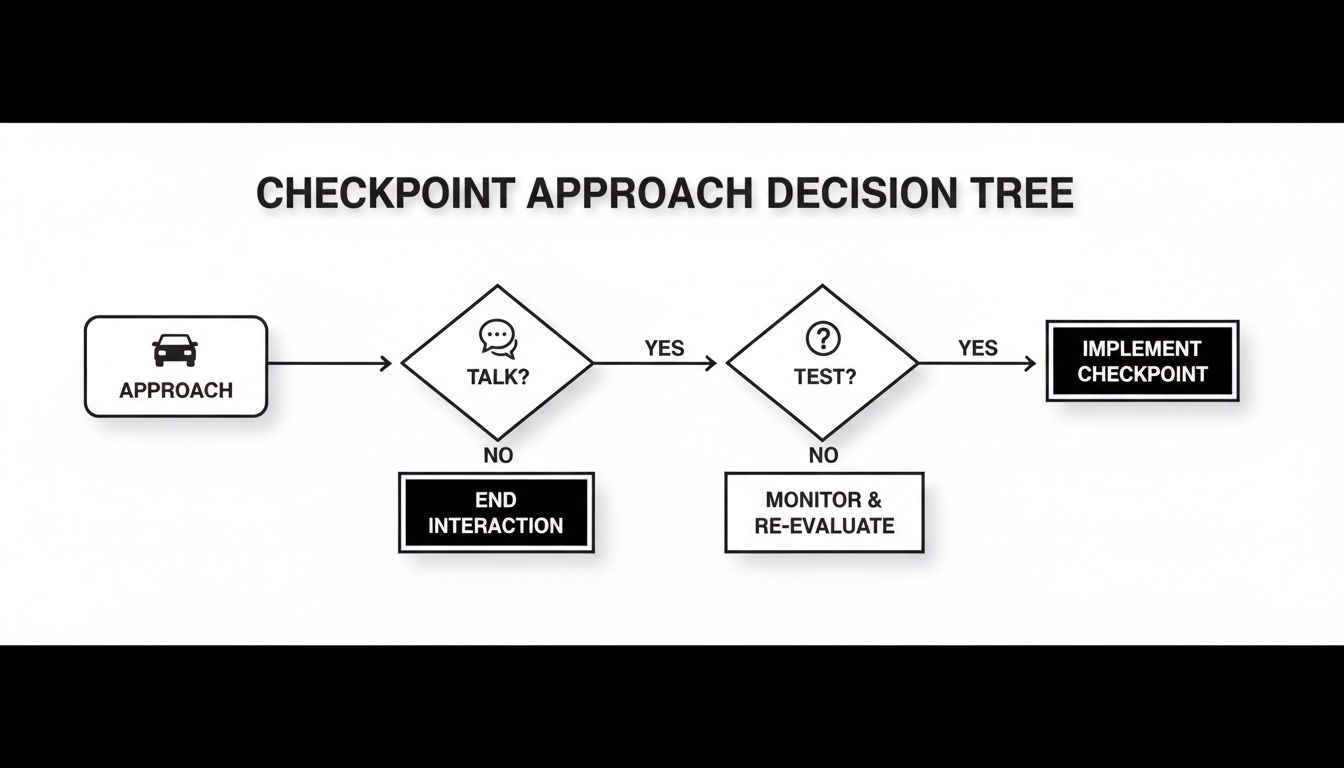
As you can see, the situation only escalates from a simple document check to a full-blown investigation if the officer develops some suspicion during that first brief interaction.
The Right to Remain Silent
We've all heard it on TV, but the right to remain silent is very real and applies at a checkpoint. While you must hand over your documents, you are not obligated to answer questions designed to incriminate you. Officers are trained to ask questions like, "Where are you coming from?" or "Have you had anything to drink tonight?"
Their goal is to get a person talking and gather information that might build "reasonable suspicion." Answering these questions is completely voluntary. It's possible to politely decline to answer anything beyond providing basic identification.
Consenting to a Vehicle Search
Another critical right involves vehicle searches. An officer can't just decide to search your car because you were stopped at a roadblock. To do that, they need one of two things: consent, or probable cause to believe the vehicle contains evidence of a crime.
If an officer asks to search a car, the driver has the absolute right to say no.
Saying "yes" means a person has waived Fourth Amendment protection against unreasonable searches for that specific moment. To learn more about this, check out our guide on whether police can search your car. The bottom line is that being at a DUI checkpoint doesn't automatically give police a free pass to rummage through private property.
If an officer asks, "Do you mind if I take a look inside your vehicle?" they are asking for consent. A simple and polite "Officer, I do not consent to a search" is a clear way to assert this position.
This isn't about being difficult; it's about clearly communicating a decision. It removes any doubt about whether a person voluntarily agreed to let them search the vehicle.
Field Sobriety Tests and Preliminary Breath Tests
If an officer starts to suspect someone might be impaired, they will probably ask the person to get out of the car for Field Sobriety Tests (FSTs) and a preliminary breath test. It's crucial to know that in Georgia, these pre-arrest evaluations are voluntary.
A person can politely decline to perform these roadside tests. The walk-and-turn or the one-leg stand are often difficult for anyone to do perfectly, even when completely sober. Nerves, fatigue, or even a minor physical limitation can make someone look impaired when they're not.
The same goes for that small, handheld breathalyzer, often called an Alco-Sensor or PBT.
- Field Sobriety Tests (FSTs): These are physical exercises used by officers to look for clues of impairment. Refusing them is not a crime.
- Preliminary Breath Test (PBT): This is just a screening tool used at the roadside. It is not the same as the official state-administered chemical test a person would be asked to take after an arrest.
It’s worth noting that sobriety checkpoints have overwhelming public support. A 2009 survey found that 73% of people supported using checkpoints in their community multiple times a month. This strong community backing is a big reason these operations continue. However, public opinion doesn't change individual rights when a person is the one being stopped.
How Checkpoint Locations Are Typically Chosen
You might think a DUI checkpoint pops up at random, but that’s almost never the case. The placement of a roadblock in North Georgia is a calculated decision made by law enforcement supervisors, not the officers you see on the road.
They're not trying to set up on quiet neighborhood streets. Instead, they strategically position these checkpoints in spots designed for maximum impact, based on hard data and public safety needs across communities like Alpharetta, Marietta, and Cumming.
Targeting High-Traffic and High-Risk Areas
The first thing police command staff looks at is traffic volume. They set up on major roads, key intersections, and busy thoroughfares—especially during the evening and late-night hours. The goal is simple: screen a high number of drivers efficiently.
But it’s more than just picking a busy road. Data analysis is a huge part of the equation. Law enforcement will zero in on areas based on:
- Accident Statistics: Roads with a history of alcohol-related crashes are prime candidates.
- Previous DUI Arrests: Hotspots where they’ve made a lot of DUI arrests in the past are always on their radar.
- Proximity to Entertainment Districts: You’ll often find checkpoints on the main routes leading away from areas packed with bars, restaurants, and concert venues.
Think about a major road in Roswell or Johns Creek that connects a bustling downtown area to the highway. That’s a classic example. The logic is to intercept drivers who might be impaired as they head home.
Local Knowledge in Forsyth and Cobb Counties
In places like Forsyth County and Cobb County, officers use their deep local knowledge to pinpoint the best locations. They know the back roads and main routes people take after a night out, whether it's in East Cobb or Milton. This boots-on-the-ground intelligence helps them place checkpoints where they are most likely to make a difference.
The selection of a checkpoint location is a deliberate, data-driven decision aimed at balancing public safety with minimal disruption. It’s about being in the right place at the right time to make the roads safer for everyone.
This methodical approach isn’t just good police work—it's a necessity for the checkpoint to be considered constitutional. Its location must be chosen for a legitimate safety reason. The site also has to be physically safe for both the public and the officers, meaning it needs good lighting, enough space to pull cars over safely, and clear visibility for any driver approaching the stop.
How a Defense Firm Scrutinizes a DUI Checkpoint Case

When someone is arrested at a DUI checkpoint, it’s easy to feel like the case is open-and-shut. But from an analytical perspective, that's rarely true. Georgia’s courts have established very strict rules for these roadblocks, and that’s where an experienced defense firm starts looking for weaknesses.
The process often involves putting the checkpoint itself on trial. Because these stops are a major exception to the normal requirement for reasonable suspicion, every single procedure must be followed perfectly. Any misstep by law enforcement can call the entire stop—and any evidence gathered—into question.
Examining the Checkpoint's Foundation
The investigation starts long before a car ever pulled up. A good defense involves digging into the police department’s internal documents to scrutinize the very blueprint of the checkpoint operation.
The focus is on four critical areas to see if the police followed the letter of the law:
- Supervisory Approval and Purpose: Did a supervisor authorize the checkpoint, or was it a last-minute decision by officers in the field? The primary purpose must be roadway safety, not general crime control, and that decision has to come from the top.
- The Operational Plan: Was there a formal, written plan? This document should outline everything from the location and duration to the specific, neutral formula for stopping cars (like "every third vehicle" or "every fifth vehicle").
- Officer Conduct and Adherence: Did every officer on scene stick to the plan? If they were supposed to stop every third car but started picking and choosing, that deviation can invalidate the stop.
- Safety and Visibility: Was the checkpoint clearly marked with signs and lights? A properly run checkpoint should be set up in a safe spot that minimizes risks and doesn't cause unnecessary anxiety for drivers.
The strength of a DUI checkpoint case often has less to do with what happened during a specific stop and more to do with the administrative paperwork and planning that took place before the first car was even flagged down.
If this deep dive reveals that the police cut corners or violated constitutional procedures, it can completely change the outcome of a case. An improperly run checkpoint can lead to the suppression of all evidence gathered from the stop. This is often accomplished by filing a specific legal challenge, which you can learn more about in our guide explaining what a motion to suppress evidence is.
Ultimately, the goal is to protect individual rights by holding law enforcement accountable to the strict standards Georgia law demands. If someone was arrested at a DUI roadblock, a thorough review of the stop’s details isn't just an option—it's essential.
Commonly Asked Questions About DUI Checkpoints
Even when you understand the basics of a DUI checkpoint, a few specific questions always seem to pop up. Let's get straight to the answers for some of the most common things drivers ask about these unique traffic stops.
Can a Person Legally Turn Around Before a Checkpoint?
This is easily one of the most common questions. The short answer is yes—a person can make a U-turn or turn onto a different street before entering the official checkpoint area, but only if it's done safely and without breaking traffic laws.
Police, however, know this. They often place officers nearby specifically to watch for cars that turn away suddenly. If a driver makes an illegal maneuver—like turning over a double yellow line or forgetting a signal—that officer now has a perfectly valid reason to pull the car over for a traffic violation, completely separate from the checkpoint.
Is a Person Required to Answer All of an Officer's Questions?
No. A person must provide their driver's license, registration, and proof of insurance when asked. But beyond that, they have the right to remain silent when it comes to questions that could be incriminating.
Officers are trained to ask investigative questions like, "Where are you headed?" or "Have you had anything to drink tonight?" Their goal is to gather evidence. A person can politely decline to answer. Simply exercising this right is not, by itself, grounds for an arrest.
It's important to remember that the initial checkpoint stop is just a brief screening. Beyond handing over documents, the conversation is almost entirely voluntary on the part of the driver.
The key is to stay calm and polite. A simple, respectful statement that one does not wish to answer any further questions is all that is needed.
What Is the Difference Between a Roadside Breath Test and an Official One?
This is a critical distinction that trips a lot of people up. The two breath tests used during a DUI stop happen at different times, serve very different purposes, and have vastly different levels of reliability.
The small, handheld device an officer asks you to blow into on the side of the road is called a preliminary breath test (PBT), sometimes known as an Alco-Sensor. Think of it as a screening tool—it’s there to help the officer decide if they have probable cause to arrest someone.
- PBT (Roadside Test): In Georgia, taking this test before an arrest is voluntary. The results are often considered too unreliable to be used in court as direct proof that someone was intoxicated.
- Official State Test (Post-Arrest): This is the much larger, more accurate machine usually located back at the police station or jail. Under Georgia's implied consent law, refusing this test after a lawful arrest triggers an automatic driver's license suspension.
So, the PBT is a quick field estimate. The official test back at the station is the one used as formal evidence. Knowing the difference is crucial for understanding what's being asked at each stage.
If you were arrested at a DUI checkpoint in Alpharetta, Cumming, or anywhere in North Georgia, the specifics of the stop matter immensely. At Brian Hansford Law, we meticulously examine every detail of the checkpoint procedure to ensure your rights were protected. For a detailed review of your case, visit us at https://challengycharge.com.
