
When a judge in Fulton County appoints a Guardian ad Litem (GAL), it is a sign that your case has become significantly more serious. If you live in Alpharetta, GA, and a GAL has been assigned to your case, you need to understand that this person, who is almost always an attorney, is appointed by the court for one specific reason: to serve as the eyes and ears of the court. A GAL’s only job is to investigate the facts of a case involving a child and make a recommendation about what is in that child’s best interests.
Do not speak to a GAL without legal representation. Deadlines in Fulton County move quickly. Call Brian Hansford now at 770-642-4900 for a confidential consultation.
Understanding the Guardian Ad Litem's Role in Alpharetta, GA
For a parent in Alpharetta, Roswell, or anywhere in North Fulton, having a GAL appointed means a third party now has the authority to investigate your life, your home, and your interactions with your child. This is a critical moment in any legal proceeding, from a high-conflict custody battle to a dependency (DFCS) action in Fulton County Juvenile Court.
The GAL does not represent you or the other parent. Their client is the child’s "best interests"—a legal standard that gives them broad power to conduct their investigation. Their final report and recommendation to the judge carry enormous weight and often shape the final outcome on issues of custody, visitation, and even the termination of parental rights. Your first interaction with a GAL matters.
What Does a GAL Do?
A Guardian ad Litem’s investigation is designed to be thorough. In cases across the North Atlanta metro, including in Johns Creek, Milton, and Cumming, a GAL is given the authority by a Fulton County judge to:
- Interview Everyone Involved: This starts with you, the other parent, and the children themselves (depending on their age and maturity).
- Speak to Collateral Witnesses: GALs routinely contact teachers, doctors, therapists, coaches, family members, and new significant others to gather information.
- Conduct Home Visits: Expect the GAL to schedule a visit to your home in Alpharetta or a nearby city. They will observe the living conditions and how you interact with your child in your own environment.
- Review All Relevant Documents: This includes everything from school report cards and medical records to police reports from agencies like the Alpharetta Police Department and psychological evaluations.
A GAL's recommendation is not the final order, but it is often one of the most persuasive pieces of evidence a Fulton County judge will consider. Their findings can steer the entire direction of your case, which makes it absolutely critical to have a protective legal strategy in place from the very beginning.
To give you a clearer picture, here is a quick summary of how the GAL role functions in our local courts.
Guardian Ad Litem at a Glance in North Georgia Courts
| Aspect | Description in Georgia Courts |
|---|---|
| Appointment | A judge in Fulton County Superior Court appoints a GAL when they need more information about a child's best interests, typically in contested custody or DFCS cases. |
| Role | Acts as an independent investigator and fact-finder for the court, not as an attorney for either parent. |
| Authority | Has broad powers to interview witnesses, review confidential records (school, medical), and conduct home visits in places like Alpharetta, Sandy Springs, and Roswell. |
| Client | The "best interests of the child." The GAL represents this legal standard, not the child's personal wishes, though those wishes are considered. |
| Final Product | The GAL submits a written report to the Fulton County court and often testifies, providing a detailed recommendation on custody and visitation. |
| Weight of Recommendation | While not legally binding, a judge gives the GAL's findings significant weight. Challenging a negative recommendation requires a strong, evidence-based strategy. |
Knowing what a GAL does is the first step. The next, more important step is knowing how to interact with them to protect your parental rights while showing you are a fit and capable parent. For families facing this in the court systems of Milton, Sandy Springs, or Dunwoody, a GAL's involvement demands immediate and strategic legal advice.
The GAL Investigation Process in Fulton County Courts
When a judge in Fulton County appoints a Guardian ad Litem (GAL), it is the official start of a deep dive into your family’s life. The whole point is for the GAL to gather enough information to make a solid recommendation about what’s in your child’s best interests. This process is methodical and can feel incredibly invasive, which is exactly why parents in Alpharetta and across North Fulton need to understand every step.
The investigation kicks off with a round of interviews. A GAL will schedule separate, private meetings with you, the other parent, and your child—assuming they’re old enough to talk about the situation. This is your chance to tell your side of the story and show you’re a fit parent. But make no mistake, these are not casual chats. Every word counts.
Conducting Interviews and Gathering Information
A GAL’s authority goes way beyond just talking to the parents. They are an investigator for the court, plain and simple. They have the power to reach out to pretty much anyone who has real insight into your child's world.
This often includes:
- Educators: Teachers, principals, and school counselors at schools in Alpharetta, Roswell, or Johns Creek.
- Medical Professionals: Your child's pediatrician, therapists, or any other specialists they see.
- Community Members: Coaches, daycare staff, family friends, and neighbors in your North Fulton community.
- Extended Family: Grandparents, aunts, and uncles who are part of the child's life.
This broad reach lets the GAL build a complete picture that isn’t just based on what you or the other parent says. Being honest and cooperative is critical. Any hint that you’re trying to block the investigation will not look good to the court.
Home Visits and Document Review in Alpharetta Cases
Home visits are a standard and very important part of any GAL investigation in Fulton County. The GAL will schedule a time to come to your home, see the living conditions, and watch how you interact with your child in your own space. They’re looking for proof of a safe, stable, and supportive environment.
It's crucial to understand that a GAL is not looking for a perfect, magazine-ready home. They are looking for a safe one. They check for basic cleanliness, safety measures, and whether the child has what they need. How you engage with your child during the visit is just as important as the state of your house.
Beyond interviews and home visits, the GAL will also ask for and review a mountain of documents. This typically includes school records, medical files, psychological evaluations, and any reports from police departments like the Alpharetta Police or the Fulton County Sheriff's Office. This paper trail helps the GAL confirm what they've been told and spot any red flags that need a closer look, especially if there are allegations related to a DUI, drug charge, or domestic violence incident.
This entire process, as you can see below, is designed to move from a wide-ranging investigation to a very specific, influential recommendation to the court.
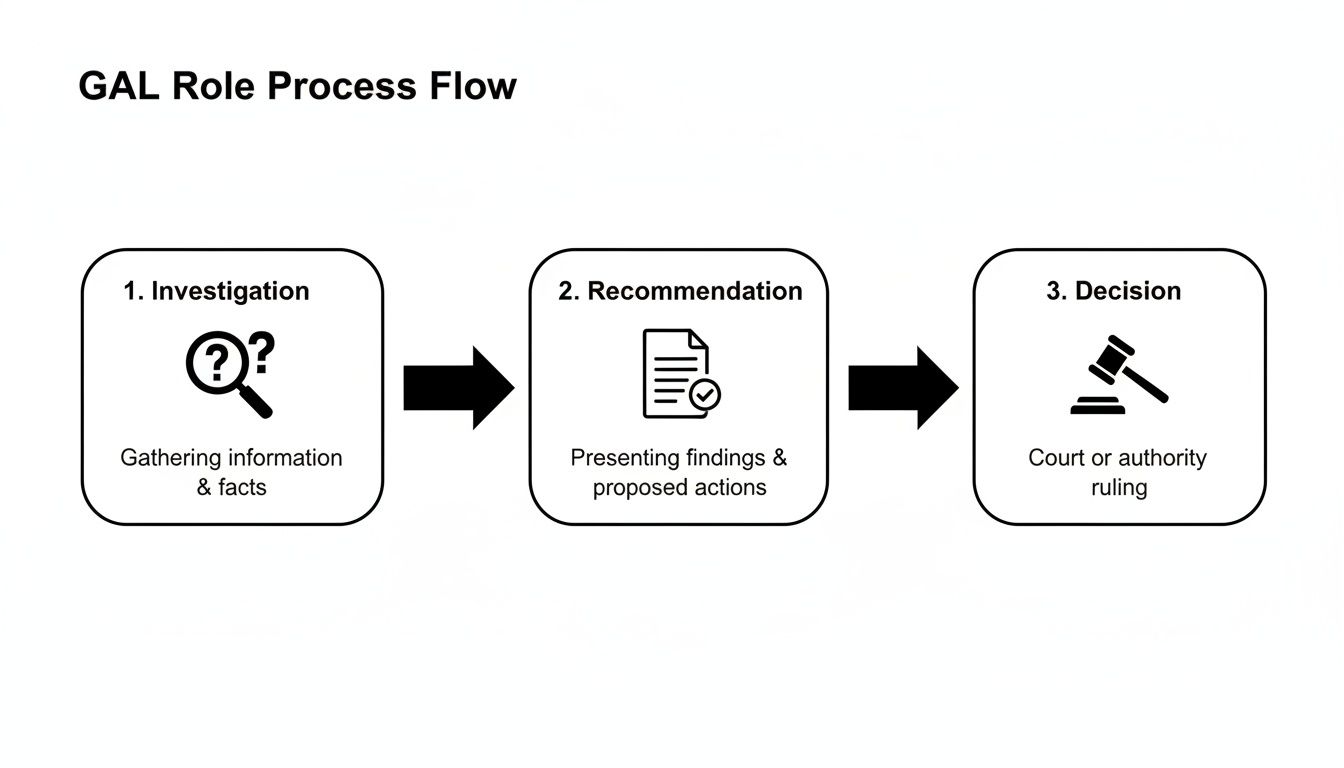
This flow shows how the GAL’s fact-finding work feeds directly into the recommendation they give the judge, which in turn heavily shapes the final court order.
The Final Report and Recommendation
Once the investigation is over, the GAL puts everything they’ve found into a formal written report for the judge. This report summarizes the interviews, home visits, and documents, and ends with a specific recommendation on custody, visitation, or any other contested issues.
You and your lawyer will get a copy, but the report is written for the judge. Studies show that judges who appoint GALs rely heavily on these reports to make their final decision, especially in messy custody battles. When criminal accusations are part of the case, the GAL’s findings can be a game-changer.
Trying to prepare for all of this on your own is a bad idea. An experienced attorney can prep you for interviews, help you get your documents in order, and make sure you present yourself to the GAL in a way that protects your parental rights. Call Brian Hansford at 770-642-4900 to protect your record and your family.
When Does a Judge Appoint a GAL in an Alpharetta Case?
Not every family law case gets a Guardian ad Litem (GAL). A judge in the Fulton County court system, for example, won't appoint one unless the circumstances are serious enough to demand an independent investigation into what's best for a child.
For parents in Alpharetta, Johns Creek, or Milton, understanding what triggers a GAL appointment is the first step in navigating a contentious legal fight. The decision almost always comes down to three specific types of cases.
High-Conflict Custody and Divorce Cases
This is the most common reason we see GALs get involved in North Fulton. When parents in Alpharetta or Roswell are so locked in conflict that they can’t agree on custody, visitation, or basic decisions about their child’s life, the court steps in.
A judge will appoint a GAL when the fighting becomes so intense that they can no longer trust either parent to see past their own anger. The GAL’s job is to cut through that noise, investigate the situation from a neutral perspective, and give the court a recommendation focused only on the child’s well-being and stability.
DFCS Dependency and Neglect Cases
GALs are almost always appointed in juvenile court cases involving the Department of Family and Children Services (DFCS). If DFCS files a dependency petition claiming a child has been abused, neglected, or abandoned, a GAL becomes the child's legal advocate. These are incredibly serious matters, often heard in the Fulton County Juvenile Court, and can end in the loss of parental rights.
In a DFCS case, the GAL is tasked with:
- Investigating the specific allegations of abuse or neglect.
- Figuring out if the child’s home is currently a safe place.
- Recommending services or court orders needed to protect the child.
- Advocating for a safe, permanent home for the child, whether that means returning to a parent, living with relatives, or another outcome.
For any parent in Sandy Springs or Cumming dealing with a DFCS investigation, the GAL's findings will be a huge factor in the outcome of their case.
A GAL’s involvement is a clear signal that the court has serious concerns. Their role isn't to pick a side between the parents; it's to act as an independent voice for the child caught in the middle of a legal battle.
When Criminal Charges Overlap with Family Law in Alpharetta
This is the difficult intersection where many of our clients at Brian Hansford Law find themselves. A criminal charge against a parent can be the direct cause for a GAL appointment in a family law case. A judge’s top priority is always the child’s safety, and a criminal accusation throws that safety into question.
For example, a parent arrested for DUI in Alpharetta or facing a domestic violence charge in Milton will almost certainly see that charge used against them in a custody battle. The other parent can argue you are unfit, forcing a Fulton County judge to appoint a GAL to investigate. That GAL will dig into the police reports, the facts of your arrest, and how it all might affect your ability to be a parent.
The use of GALs isn't a new concept; it dates back to the very beginnings of the U.S. juvenile justice system. As family conflicts, addiction, and other societal issues have become more complex, the need for these court-appointed investigators has grown. Today, for anyone in Fulton County or surrounding communities facing criminal charges that could impact their custody rights, the possibility of a GAL investigation is a very real threat. You can learn more about the legal history from various ongoing academic discussions.
Because criminal charges can completely derail your parental rights, you need a defense lawyer who gets it. You need a strategy that protects you in criminal court—like Alpharetta Municipal Court—while also defending your rights in family court.
How a GAL Report Can Shape Your Alpharetta Case
Let’s be direct: the final report from a Guardian ad Litem is one of the single most influential documents in a family law case. While it's officially just a "recommendation," judges in Fulton County Superior Court and throughout our local area give these reports incredible weight when making decisions about custody and visitation.
A bad report can be absolutely crushing. It can trigger court orders that drastically reduce your time with your child, sometimes forcing you into supervised visitation. In the most severe cases, it can lead to a complete loss of primary custody or become the foundation for terminating parental rights.
For our clients in Alpharetta, a negative GAL report can also spill over into a related criminal matter. If a GAL questions your fitness as a parent, you can be sure North Fulton prosecutors will try to use those findings to make you look bad, complicating your defense against a DUI, drug charge, or other crime.
Your Strategy for the GAL Investigation
This is not a time to sit back and wait. You need a proactive, organized strategy for interacting with the Guardian ad Litem from day one. Your job is to make their job easier by giving them clear, compelling proof of your stability and your commitment to your child.
That means you should be actively gathering and presenting helpful information, like:
- Character References: Get letters from credible people who know you well—think employers, neighbors, or long-time friends in Alpharetta who can vouch for your character and parenting.
- Proof of Stability: Show them you have a steady home and income. Collect your pay stubs, lease agreement, or mortgage statements.
- Evidence of Proactive Steps: If you've completed parenting classes, anger management, or any alcohol and drug evaluations (often required in DUI cases), get the certificates. Show them you’re taking this seriously.
Working with an attorney to professionally package all this is key. Handing the GAL a tidy, organized binder of documents makes a far better impression than a scattered pile of papers.
Think of the GAL investigation as your chance to tell your side of the story. Your full cooperation and the way you present the facts can absolutely shape the GAL's final recommendation.
Analyzing the GAL Report for Flaws and Bias
Once the GAL submits the report, our job switches to analysis. A GAL's report is not gospel. We dig into it line by line, looking for bias, factual mistakes, or shortcuts in their investigation that led to a bad conclusion.
For example, did the GAL spend two hours with the other parent but only 30 minutes with you? Did they ignore key witnesses you told them about? Did they completely misread a police report or overlook a crucial medical record? These are the kinds of weaknesses we can use to challenge a report in Fulton County Superior Court.
In the legal trenches of criminal defense and parental rights cases across Johns Creek, Milton, and East Cobb, we know that GALs are human. They often have huge caseloads, and sometimes that means investigations aren't as thorough as they should be. For clients in Alpharetta whose custody is on the line, we have to be ready to push back hard against a flawed GAL report.
For any parent in Roswell, Sandy Springs, or Cumming, it's vital to know that you have the right to question a GAL's findings. This isn’t about being difficult; it's about making sure the judge has a complete and accurate picture before making a decision that will change your family's life forever. Our job is to protect you from an unfair result.
How to Respond to a GAL Recommendation in Georgia
When you get the Guardian ad Litem’s report in your Fulton County case, it can feel like a final judgment, especially if it doesn't go your way. It's important to know this isn't the end of the road. An unfavorable report is a serious hurdle, but it’s one you can—and must—address with a solid, evidence-based legal plan.
You can't just walk into court and tell the judge you don't like what the GAL said. To successfully challenge a report, you have to show why it's flawed, biased, or incomplete. This is a formal process that requires hard evidence and a skilled hand in the courtroom, not just your personal feelings about the matter. If you believe the report is unfair, you have options, but you need to act quickly and strategically.
Filing Objections and Preparing for Court
The first move is to file a formal objection to the GAL’s findings with the court. Your attorney can file a motion that details the specific problems with the report, which officially puts the judge on notice that you are contesting it. This isn't just about filing paperwork; it's the opening play in a courtroom battle where the GAL's conclusions will be put under a microscope.
The main event in this fight is cross-examination. During a court hearing, your attorney gets the chance to question the GAL under oath. This is where we expose the weaknesses in their investigation.
For instance, we can ask pointed questions to show the court that the GAL:
- Spent way more time talking to the other party.
- Never bothered to call key witnesses you provided, like your child's teachers or doctors.
- Relied almost entirely on biased statements from the other parent’s friends or relatives.
- Ignored crucial documents, like your child’s school records from their Alpharetta school or proof of your steady job.
This process demands a deep understanding of court rules. For a better idea of how we compel people and records to appear in court, check out our article explaining what it means to be served with a subpoena. Our objective is to take the report's credibility apart, piece by piece.
Introducing Your Own Counter-Evidence
Challenging the GAL is only half the battle. You also have to present your own powerful evidence to give the judge a different—and more accurate—picture of the situation. While the GAL is presenting their findings, we need to be ready with a strong counter-narrative.
This means bringing forward the documents, witness testimony, and facts the GAL either missed or misinterpreted. For example, if the GAL claims your home in Roswell or Milton is unstable, we would fire back with your lease agreement, photos of your clean and well-kept home, and testimony from neighbors who can vouch for you.
A judge in Fulton County Superior Court has the final word, not the GAL. Our job is to give that judge every reason to second-guess the GAL’s recommendation and choose a path that truly protects your parental rights and your child’s best interests.
Navigating your interactions with a GAL requires a careful approach. Some actions can build trust and show you are a cooperative parent, while others can severely damage your case. Here’s a quick guide on what to do and what to avoid.
Strategic Interactions with a Guardian Ad Litem
| Do This | Avoid This |
|---|---|
| Provide a concise, organized list of potential witnesses with their contact information. | Bombarding the GAL with daily emails or texts from you and your friends. |
| Schedule a formal time to speak and come prepared with organized documents and specific points. | Trying to have "off-the-record" chats or making surprise phone calls. |
| Treat the GAL with the same respect you would show a judge, even if you disagree with them. | Arguing, being defensive, or speaking negatively about the other parent. |
| Focus your conversations on the child's needs, well-being, and best interests. | Making the conversation all about your grievances with the other parent. |
| Answer questions honestly and directly. If you don't know, it's okay to say so. | Guessing, exaggerating, or making up information to make yourself look better. |
| Keep all interactions professional and documented. Follow up with a brief, polite email summarizing talks. | Treating the GAL like your therapist or a friend you can vent to. |
Ultimately, your goal is to show the GAL—and the court—that you are a responsible, stable, and child-focused parent. Everything you do and say should reinforce that image.
Why Litigation Skills Matter in Alpharetta
Successfully pushing back against a GAL report isn't for amateurs. It takes a lawyer with real courtroom experience who understands how judges in North Fulton think and rule. It's an adversarial process that requires an attorney who isn't afraid to cross-examine court-appointed officials and argue complex issues of evidence.
Whether your case is in Cumming, Dunwoody, or East Cobb, you need a lawyer who can build a powerful counter-narrative. If you've received a GAL report that threatens your relationship with your child, don't just accept it. Call our office now to talk about how we can build a strategy to fight back. The deadlines for challenging these reports are tight, and your response has to be immediate.
Why You Need an Alpharetta Attorney When a GAL Is Involved

When a Guardian ad Litem (GAL) is appointed, your legal situation becomes twice as complicated. You're not just facing a criminal charge in Alpharetta Municipal Court or Fulton County State Court. You're also now part of a separate, intensive investigation that will directly impact your future with your child.
Attempting to handle both of these challenges on your own is a recipe for disaster. The things you say to the GAL to protect your parental rights can easily be turned against you in your criminal case. And anything you say in your criminal matter will certainly find its way to the GAL. You need a single, cohesive strategy, which means you need an attorney who knows how to navigate both of these legal minefields at the same time.
A Former North Fulton Prosecutor on Your Side
Brian Hansford’s experience as a former North Fulton prosecutor provides a unique advantage in these delicate cases. With over 25 years in the legal field, he knows exactly how court-appointed officials operate and how judges in Alpharetta, Cumming, and Johns Creek view GAL reports in the context of criminal allegations like DUI or domestic violence.
We work to create a unified defense, where every decision made in your criminal case is carefully considered for its impact on the family court matter, and vice-versa. Our goal is to provide strategic and protective representation. You can find more practical advice in our guide on how to find a criminal lawyer who understands your specific situation.
When your criminal record and your relationship with your child are both on the line, you cannot afford a disjointed defense. You need one experienced advocate protecting you on all fronts.
Protect Your Rights and Your Future
The stakes are incredibly high. A negative report from the GAL can make it much more difficult to get a fair result in your criminal case. In the same way, a conviction gives the GAL all the evidence they need to recommend limiting your time and rights with your child.
If a GAL has been assigned to your case in Alpharetta or anywhere in Fulton County, the time to act is now. Their investigation is already underway. Call Brian Hansford Law for a confidential consultation to start building the comprehensive defense you need.
FAQs About Guardians Ad Litem in Alpharetta, GA
When a court appoints a Guardian ad Litem (GAL) in your North Fulton case, it’s bound to stir up a lot of questions and uncertainty. Here are some straightforward answers to the concerns we frequently hear from our clients in Alpharetta and surrounding cities.
Q: Who pays for the Guardian ad Litem in a Fulton County case?
A: In most family law cases in Fulton County Superior Court, the judge will order both parents to split the Guardian ad Litem’s fees. However, a judge can, and often will, divide the costs differently based on each party’s income and financial resources. It's critical to talk about these potential costs with your attorney immediately so you aren't caught off guard.
Q: Can I refuse to let a Guardian ad Litem into my home in Alpharetta?
A: You can, but you absolutely should not. Refusing to cooperate with a court-appointed GAL is one of the worst mistakes you can make. A judge in Fulton County Superior Court will almost certainly interpret that refusal as a sign you have something to hide. It can destroy your credibility and cause serious, sometimes irreversible, damage to your case.
Q: How much power does a GAL recommendation have in North Fulton?
A: A GAL's report is not a binding court order, but it carries immense weight. Judges in Fulton County, and across Georgia, see the GAL as their "eyes and ears" and rely heavily on these reports as an impartial basis for their final decisions. If you want to fight back against a negative recommendation, you'll need a skilled attorney to help you present strong, compelling evidence to counter the GAL's findings.
Q: Does my child get to decide custody if a GAL is involved in my Alpharetta case?
A: Under Georgia law, a child who is 14 years of age or older can state their preference for which parent they want to live with. Courts almost always honor this choice unless there's evidence the chosen parent is unfit. The GAL’s role here is to investigate the reasons behind the child's decision, making sure it’s their own free choice and is truly in their best interest.
Q: Can I talk to the GAL without my lawyer present?
A: You can, but we strongly advise against it. The GAL is not your friend or your advocate. Anything you say to a GAL is not confidential and can end up in their report to the judge. It’s always best to have your attorney prep you before any meeting. We can help you organize your key points and ensure you present your side of the story effectively while protecting your rights.
When a Guardian ad Litem gets involved, the stakes in your case get higher, especially if you're also facing a related criminal charge in Alpharetta. Protecting your record and your parental rights demands a unified defense. At Brian Hansford Law, we have the specific experience needed to defend you on both fronts. Contact our Alpharetta office today to schedule a confidential case review by calling 770-642-4900 or by visiting our contact page.
