
Think of a motion to dismiss as a legal challenge that can happen right at the beginning of a criminal case. It's a formal request made to a judge, asking them to throw out one or more charges—or even the entire case—before it ever gets to a trial.
The key thing to understand is that this motion isn't about arguing whether a person is innocent or guilty. Instead, it targets fundamental legal flaws in the prosecution's case. It essentially tells the judge, "Even if everything the prosecutor is saying is true, they still don't have a valid legal case against this person."
What a Motion to Dismiss Really Means

Here’s a good way to think about it: imagine a builder wants to construct a house, but the foundation they poured is cracked and completely unsound. A motion to dismiss is like an inspector stepping in and saying, "Stop. This foundation is legally defective, and you can't build anything on top of it."
In the courtroom, this motion challenges the very framework of the prosecution's argument on technical or procedural grounds. It’s one of the most effective pre-trial tools in a defense attorney's arsenal. When it succeeds, it can stop a case cold, saving a person from the immense stress, time, and money of a full-blown trial.
The Core Purpose and Function
At its heart, the goal is simple: get the case thrown out early. This is done by showing the court that the prosecution has failed to meet basic legal requirements, regardless of the alleged facts.
A motion to dismiss can be used to attack:
- A single weak charge in a multi-charge case.
- The entire case, which would mean all charges are dropped.
- Key pieces of evidence that were obtained illegally or are fundamentally flawed.
In the high-stakes world of criminal defense right here in Georgia, this motion can be a true game-changer for people facing charges in communities like Alpharetta, Cumming, and Forsyth County. While every case is different, some data has shown that motions to dismiss were granted in approximately 28% of certain DUI cases before they ever reached trial, which shows just how impactful they can be.
Motion to Dismiss at a Glance
To make this even clearer, here's a quick breakdown of what this motion is all about.
| Concept | Simple Explanation | Primary Goal |
|---|---|---|
| What It Is | A formal request to a judge to throw out a case before trial. | Get charges dropped early. |
| The Argument | The prosecution's case has critical legal or procedural flaws. | Avoid a full trial. |
| Timing | Filed after charges are brought but before the trial begins. | Stop a legally weak case. |
This table sums up why this motion might be considered as soon as a crack in the prosecution's foundation is identified.
When Is This Motion Used?
This isn't some last-ditch effort. It's a proactive, strategic move made early in the legal process, usually right after charges have been filed. It acts as a critical check on the prosecution, ensuring that cases without a solid legal footing are filtered out of the system before they can do any more damage. Understanding this is the first step toward building a defense that truly protects a person's rights.
Common Grounds for Filing a Motion to Dismiss in Georgia
To get a case thrown out with a motion to dismiss, an attorney can't just walk into court and say the charges feel unfair. They have to give the judge a specific, legally recognized reason—what are known as "grounds"—that proves the prosecutor's case is fundamentally broken from the get-go.
Think of it like a puzzle. If a critical piece is missing right out of the box, you can never complete the picture. In Georgia criminal law, there are several powerful grounds to show the court that a key piece of the state's case is missing, making it impossible for them to proceed.
Lack of Probable Cause
One of the most frequent reasons a motion to dismiss is filed is because of a lack of probable cause. Before police can pull someone over, arrest them, or get a warrant, they need more than a gut feeling. They have to point to specific, concrete facts that would lead a reasonable person to believe a crime was committed. If they can't, the entire case that follows can be challenged.
Let's say a person is driving through Roswell late at night. An officer can't just decide to pull them over because they have a "hunch." They need to see the driver swerve, speed, or commit some other traffic violation first. If they stop someone without witnessing any of that, it can be argued the entire stop was illegal. Any evidence they found after that point—like from a breathalyzer—was illegally obtained.
A case built on an illegal stop is like a tree with poisoned roots—it simply cannot stand, no matter how strong the branches appear. The foundation must be legally solid from the very beginning.
Failure to State a Claim or Offense
Another critical argument is the prosecution's failure to state a claim. This is a more technical, but equally powerful, ground for dismissal. It means the formal charging document itself—the accusation or indictment—is defective. Even if every fact the prosecutor wrote down is true, those facts might not legally add up to the crime they're charging the person with.
Imagine a theft charge in Forsyth County. Under Georgia law, "theft by taking" requires proving a person took someone's property with the intent to permanently deprive them of it. If the prosecutor’s official accusation describes someone borrowing something with every intention of giving it back, it fails to include that crucial element of permanent intent. A motion can be filed arguing that the document, on its face, doesn't actually describe the crime of theft.
Sometimes, the evidence itself is the problem, not just the charging document. For more on how improperly seized evidence is challenged, you can learn more about a motion to suppress evidence in our related guide.
Violations of Constitutional Rights
A person's constitutional rights are a shield, and when the government violates them, it can be grounds to have a case dismissed entirely. Here are a few key rights that often come into play:
- Speedy Trial Rights: The Sixth Amendment doesn't just grant a right to a trial; it grants a right to a speedy one. If the prosecution drags its feet and causes unreasonable delays that hurt a person's ability to defend themselves, a dismissal can be requested.
- Jurisdictional Errors: A court has to have the proper authority, or jurisdiction, to hear a case. If a crime is alleged to have happened entirely within Cobb County, a court in Gwinnett County has no business hearing it.
- Statute of Limitations: The state doesn't have forever to charge someone with a crime. For most misdemeanors in Georgia, they have two years. For many felonies, it's four years. If they file charges after that deadline has passed, the case is usually barred and must be thrown out.
To make these concepts clearer, let's break down how these different grounds apply in real-world scenarios. The table below compares these legal reasons and gives you an idea of how they might look in a typical criminal case.
Grounds for Dismissal Explained
| Legal Ground | What It Means | Common Example (e.g., DUI, Theft) |
|---|---|---|
| Lack of Probable Cause | The police didn't have a valid, fact-based reason to stop, search, or arrest a person. | A DUI case where the officer pulled the driver over for "looking suspicious" without any actual traffic violation. |
| Failure to State an Offense | The official charging document doesn't legally describe the crime a person is accused of. | A shoplifting charge where the paperwork fails to allege an intent to steal the item. |
| Speedy Trial Violation | The government took an unreasonably long time to bring a case to trial, harming the defense. | A misdemeanor case that sits for three years with no action, and now a key defense witness has moved away. |
| Jurisdictional Defect | The court hearing a case doesn't have the legal authority over the person or the alleged crime. | A crime that happened entirely in Milton (Fulton County) is improperly charged in a Forsyth County court. |
| Statute of Limitations | The prosecutor filed charges after the legal deadline to do so had already expired. | The state files charges for a simple battery that allegedly occurred over two years ago. |
Understanding these grounds is the first step in building a strong defense strategy. Identifying a fatal flaw in the prosecution's case early on can save the time, stress, and expense of a trial by getting the charges dismissed from the start.
The Step-by-Step Process for Filing the Motion
So, a potential legal flaw has been spotted in the prosecution's case. What now? This is where the process of filing a motion to dismiss kicks into gear. It's not as simple as just telling the judge something is wrong; it's a formal, structured process that demands careful preparation and an ironclad understanding of court rules.
It all begins with drafting a powerful legal document. This isn't just filling out a form. It's a detailed, persuasive argument that lays out exactly why the case should be thrown out. Specific Georgia laws must be cited and prior court decisions—what lawyers call precedent—must be referenced to prove to the judge that the law is on the filer's side. This document is the legal bedrock of the entire challenge.
Navigating the Court System
Once the motion is drafted, it has to be officially filed with the clerk of the court handling the case, whether that's in Forsyth County, Cobb County, or elsewhere in Georgia. This filing creates a formal record. At the same time, a copy has to be delivered to the prosecutor’s office, a step known as service. This ensures the other side is officially notified and has a fair chance to prepare their response.
This chart breaks down a few of the core reasons that can get this whole dismissal process started.
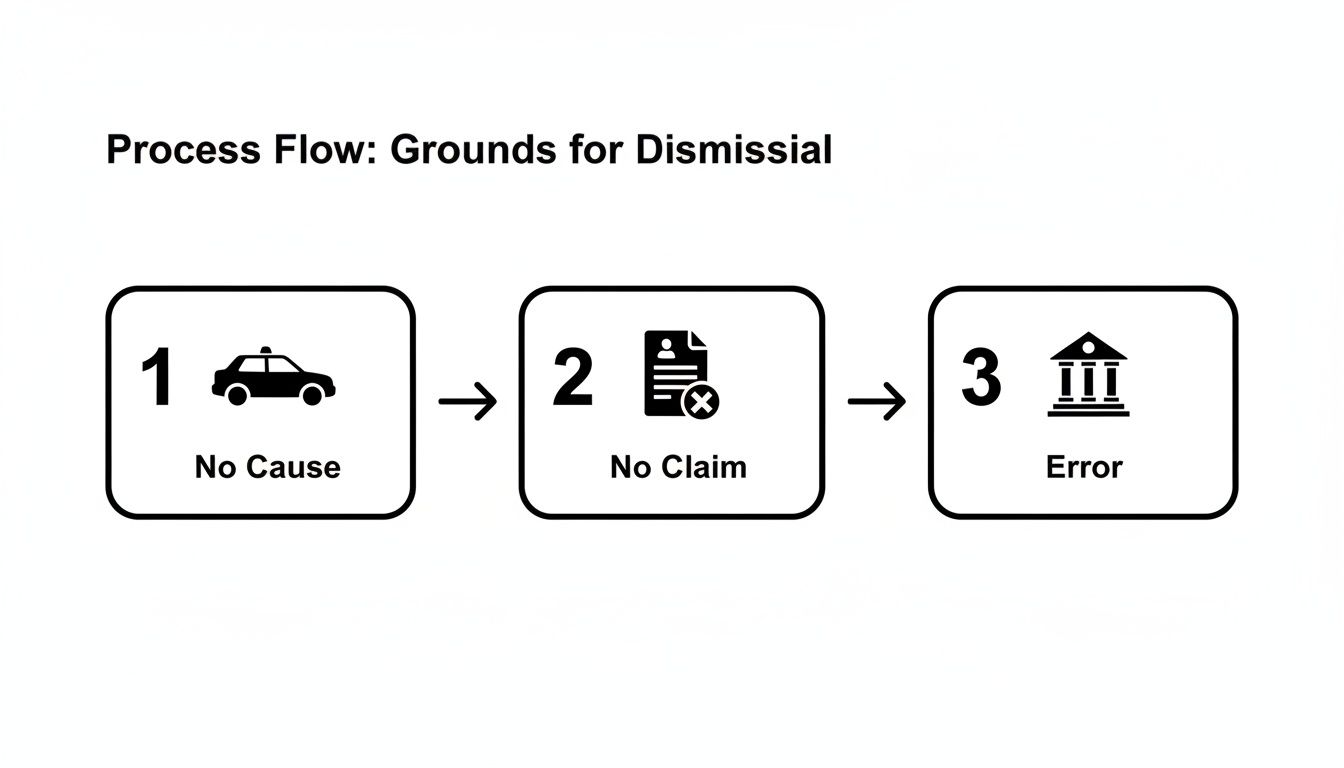
As you can see, the basis for a motion can spring from anywhere—from a problem with police procedure all the way to a fundamental error in the courtroom. Once a motion is filed and served, the clock starts ticking on the next phase.
What Happens After Filing
Filing the motion forces the prosecution's hand. They are given a set amount of time to draft and file their own written response. In it, they'll argue against the motion, offering their own legal interpretations and explaining why they believe the case is solid enough to proceed.
The filing of a motion to dismiss forces a critical pause in the proceedings. It shifts the focus from the facts of the case to the legality of the prosecution's foundation, compelling both sides to present their legal arguments directly to the judge.
After both sides have put their arguments in writing, the judge will often schedule a hearing. This is the chance to argue the motion in person, answer the judge’s direct questions, and debate the finer legal points with the prosecutor. Not every motion gets a hearing, but for complex issues, they are very common.
Finally, the moment of truth. After reviewing everything and listening to the arguments, the judge makes a decision. They can either grant the motion, which means the charge or the entire case is dismissed, or deny the motion, meaning the case continues moving toward a potential trial. Knowing how to get a case dismissed before trial is all about successfully navigating this exact procedural journey.
The Strategic Value in a Criminal Defense Case
A motion to dismiss is so much more than just a procedural step. Think of it as a powerful strategic tool in a defensive arsenal. Its value goes far beyond simply getting a case thrown out—even if the judge ultimately denies it, the act of filing the motion can dramatically shift the landscape of a case.
When a motion to dismiss is filed, it essentially forces the prosecution to lay some of its cards on the table, and to do it early. They can't just ignore it. To fight back, they have to file a response with legal arguments and evidence, which gives a crucial sneak peek into their strategy. It’s a chance to see what they think their strongest points are and, more importantly, where their case is weak.
Gaining Leverage and Uncovering Weaknesses
This early showdown often creates powerful leverage for plea negotiations. Once prosecutors realize a serious legal flaw in their case has been identified, they become much more open to offering a favorable deal. Why? Because they'd rather cut their losses with a reduced charge than risk having the entire case collapse at a pre-trial hearing. It completely changes the negotiation dynamics, putting the defense in a much stronger position.
The process also doubles as a fantastic discovery tool. It provides a formal platform to challenge the state's evidence, probe for inconsistencies, and hunt for constitutional violations that weren't obvious from the initial police reports. It puts the prosecution on the defensive and makes them justify every single move they've made.
A strategically filed motion to dismiss is like a legal x-ray. It allows a view beneath the surface of the prosecution's claims to find the fractures and weak points in their case structure.
And these aren't just Hail Mary passes; they work. Federal courts in the U.S. have granted roughly 30% of these motions in recent years, a success rate often reflected in Georgia's local courts. In the Cumming and Alpharetta circuits, for instance, DUI dismissals have hit 41% based on improper venue arguments alone. You can dig deeper into the stats with this detailed legal analysis.
Dismissed With Prejudice vs. Without Prejudice
It’s also critical to know that not all dismissals are created equal. The two types have completely different outcomes for a person's future.
- Dismissal With Prejudice: This is the grand slam—the best possible outcome. It means the judge has tossed the case permanently because of a fatal legal error or a violation of rights. The prosecutor is legally blocked from ever refiling the same charges against that person. It's over.
- Dismissal Without Prejudice: This is a win, but a temporary one. The case is dismissed, but it's usually because of a procedural mistake the prosecution can fix. While the current case is dead, the prosecutor can correct their error and refile the charges down the road.
The distinction is everything. A dismissal "with prejudice" is a final victory. A dismissal "without prejudice" provides breathing room but means staying vigilant is necessary. For anyone facing charges in places like Roswell, Marietta, or East Cobb, understanding these strategic layers is key to seeing the true power of a well-crafted motion to dismiss.
Why an Experienced Attorney Is Essential

Successfully filing a motion to dismiss isn't about filling out a form. It's about knowing the law inside and out—the statutes, the procedural rules, and the massive library of past court decisions that set legal precedent in Georgia. An experienced attorney is often the deciding factor between a motion that gets ignored and one that ends a case.
Think of it like trying to navigate a dense, unmarked forest with a basic map. A person might head in the right general direction, but they’re almost guaranteed to miss the hidden shortcuts and walk right into dangerous traps. A seasoned lawyer is a guide who knows every inch of that forest. They spot the subtle weaknesses in the prosecution's case that almost everyone else would miss.
The Advantage of Prosecutorial Experience
A defense attorney who has spent time as a prosecutor brings a game-changing perspective to a case. This background offers a rare look into how the other side thinks, how they build cases, and what kinds of arguments they fear most. It allows for a defense strategy that's proactive, not just reactive.
This kind of insight is invaluable when picking apart the details of a case. A former prosecutor can often see the state's next move coming and identify procedural blunders or constitutional violations that aren't obvious on the surface. They know what a strong case is supposed to look like from the inside, which makes them uniquely skilled at finding the cracks in a weak one.
The ability to craft a compelling, evidence-based legal argument is not just a skill—it's an art refined through years of courtroom experience. This expertise is crucial for tailoring a motion to the specific facts of the case and the particular judge who will be hearing it.
Tailoring the Argument for Maximum Impact
Every case in Forsyth County, Cobb County, or Johns Creek is different, and so is every judge. A generic, one-size-fits-all motion just doesn't work. A veteran attorney knows how crucial it is to customize every legal argument to resonate with the specific judge presiding over a case.
This isn't a simple task. It involves:
- Deep Legal Research: Digging into Georgia case law to find specific rulings that directly back up the reasons for dismissal.
- Persuasive Writing: Clearly and forcefully explaining to the court why the law demands that the case be thrown out.
- Strategic Framing: Presenting the facts and legal arguments in the most compelling light possible.
The legal system is a minefield of complexities. Having an attorney on your side who truly understands what a motion to dismiss can accomplish ensures that every available tool is used to protect a person's rights and future.
Answering Your Questions About Motions to Dismiss
When a person is navigating the criminal justice system, legal terms and procedures can feel overwhelming. A motion to dismiss is one of the most powerful tools in a defense attorney's arsenal, but it's also widely misunderstood. Let's clear up some of the most common questions people have.
Can a Motion to Dismiss Be Used in Any Criminal Case?
Not exactly. A motion to dismiss isn't something that can be filed just because someone disagrees with the charge. It's a technical legal tool that targets specific, identifiable flaws in the prosecution's case.
The type of charge itself—whether it's a DUI in Cumming or a theft charge in Marietta—doesn't matter as much as the presence of a fundamental legal or procedural error. Think of it like a problem with the foundation of a house. For example, a motion might be filed because the police conducted an illegal search, the court doesn't have the proper jurisdiction to hear the case, or the prosecutor missed a critical deadline like the statute of limitations. The motion's success depends entirely on these kinds of technical grounds, not on the nature of the crime.
What Happens if a Motion to Dismiss Is Denied?
If the judge denies the motion, it just means the case keeps moving forward toward a potential trial. It's important to understand that a denial is not a judgment on a person's guilt or innocence. It’s simply the court’s way of saying that, at this early stage, the legal arguments weren't strong enough to throw the case out entirely.
But filing the motion is almost never a wasted effort. It forces the prosecution to put some of their cards on the table, revealing key parts of their strategy and evidence. This discovery process provides valuable insight that can be used to build a much stronger defense as the case progresses. Even in denial, it’s a strategic step that clarifies the strengths and weaknesses on both sides.
Does a Dismissal Automatically Clear a Person's Record?
This is a critical point and a very common misconception. A case dismissal and a record restriction (what many people call expungement) are two completely different things.
A dismissal means the court has thrown out the current charges, and that specific case is over. But the record of the arrest and the original charge can still exist in public and government databases.
To get those records sealed from public view, a separate legal process has to be started to request a record restriction. Getting the case dismissed is often the necessary first step, but it doesn't automatically wipe the slate clean.
How Long Does This Process Usually Take?
There's no single answer here, as the timeline for a motion to dismiss can vary a great deal from one case to the next. Several factors come into play:
- The Court's Schedule: Busy courts in places like Forsyth County or Cobb County often have packed dockets, which can mean a longer wait for a hearing date.
- Complexity of the Issue: A motion based on a simple statute of limitations issue might get resolved fairly quickly. One involving complex constitutional arguments, on the other hand, will require more extensive legal briefs and a much longer hearing.
- The Prosecution's Response: The prosecutor is given a certain amount of time to file a written response to the motion, and that can naturally extend the timeline.
Because of all these variables, the entire process could take anywhere from a few weeks to several months to resolve.
Facing a criminal charge is a heavy burden. If you have questions about a case in Alpharetta, Cumming, Johns Creek, or the surrounding communities, the team at Brian Hansford Law is available. With a former prosecutor's insight, they understand how these cases are built—and how to take them apart. Contact them today for a consultation at https://challengemycharge.com.
