
Most articles answering what is a second degree felony give you the wrong starting point if you're in Georgia. They explain Florida. They explain Texas. They explain a numbered degree system that Georgia doesn't formally use.
That matters more than many individuals realize. If you were arrested in Alpharetta, Roswell, Johns Creek, Milton, Cumming, Sandy Springs, Marietta, or elsewhere in North Atlanta, generic advice can cause real damage. The label you searched for may not appear in your charging documents at all, even though the exposure is still severe. In Georgia, the fight usually turns on the specific statute charged, the sentencing range attached to it, the facts the prosecutor can prove, and the court where the case is pending.
If you're facing a serious charge, the first useful question isn't "Is this a second degree felony?" It's "What exact Georgia offense am I charged with, what punishment does that statute allow, and what can be done now to reduce the risk?"
Searching for Second Degree Felonies in Georgia
Here is the short answer many Georgia clients need and rarely get from national articles. Georgia does not have a formal, general category called a second degree felony.
That does not make your case less serious. It means the label you searched for will not control what happens in Fulton, Forsyth, or Cobb County. The charge on the warrant, accusation, or indictment will.
Why this search still matters in Georgia
People use the phrase what is a second degree felony because they are trying to measure risk. They want to know whether they are dealing with probation, prison exposure, bond problems, immigration consequences, or a record that follows them for years. That instinct is sound.
In practice, this search usually points to the Georgia equivalent of a serious felony. The legal work is figuring out which offense the state filed, how that statute is punished, and whether the facts support the charge at all. That is a different analysis from states that sort felonies into numbered degrees.
If you are still trying to figure out whether the case is misdemeanor-level or felony-level, this guide on the difference between a felony and misdemeanor in Georgia can help frame the issue before you review the exact statute.
Practical rule: In Georgia, the search term is only a starting point. The real question is which Georgia felony the prosecutor says you committed.
Where people go wrong
The mistake I see most often is assuming there must be one standard Georgia punishment that matches a "second degree felony" from another state. There is not. Georgia treats offenses individually, and the exposure can change sharply depending on the statute, prior record, alleged victim, weapon allegations, drug weight, and county practice.
That local piece matters more than outsiders realize. A serious case in Fulton may move differently from a similar case in Forsyth or Cobb because bond conditions, negotiation posture, diversion availability, and courtroom expectations are not identical. The law is statewide. The handling of the case is still local.
A useful first review in a North Atlanta felony case looks at:
- The exact Georgia charge
- The court and county where the case is pending
- The facts behind the arrest, including searches, statements, identification issues, and witnesses
- Any related charges or collateral problems, such as license exposure, probation issues, or immigration concerns
Someone searching for a DUI lawyer in Alpharetta, a drug possession lawyer in Johns Creek, or a felony defense lawyer near me usually needs the same thing. Clear Georgia-specific advice tied to the charging statute, the local court, and the decisions that need to be made early.
How Georgia Classifies Felony Offenses
Georgia uses a different framework. Instead of placing most felonies into numbered degrees, Georgia generally classifies offenses by the specific crime and the sentence authorized by statute.
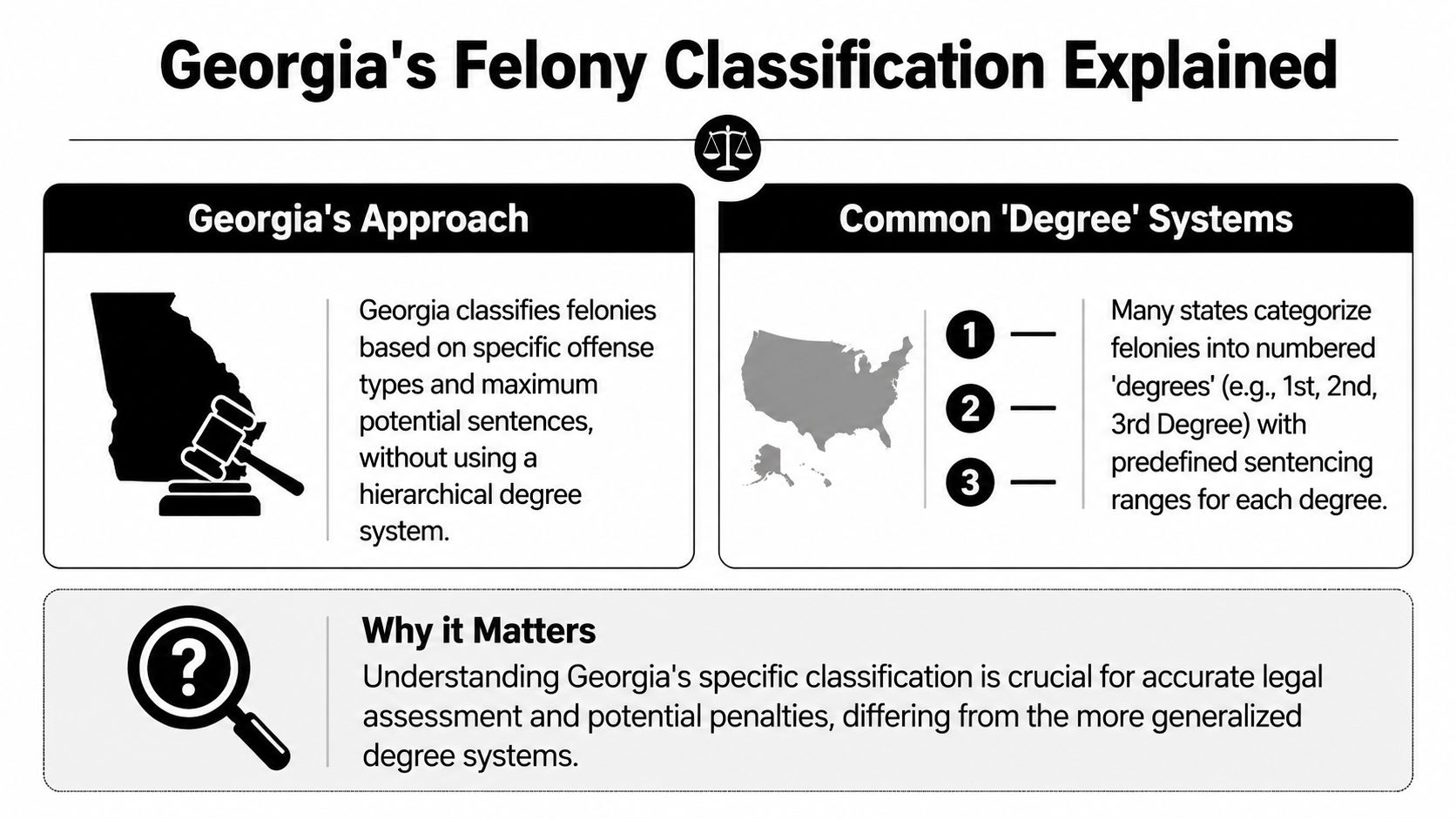
Georgia uses offense-based sentencing
A helpful way to think about it is this. In many states, the degree tells you the punishment range first, and the statute fits into that degree. In Georgia, the statute usually comes first, and the punishment range is built into that offense.
A Georgia felony analysis often sounds like this:
| Question | Georgia approach |
|---|---|
| What is the charge called | Look at the specific offense statute |
| How serious is it | Look at the sentence attached to that offense |
| Can punishment increase | Check for mandatory minimums, recidivist rules, weapon allegations, and other aggravating facts |
| Can it be reduced | Review defenses, negotiation posture, diversion options, and sentencing alternatives |
Existing online content often misses this distinction. As explained in this discussion of Georgia's felony structure, Georgia does not formally use second-degree felonies, while many serious offenses still carry sentencing ranges that align with what other states might call second-degree severity.
Why this changes your defense
The charge name alone doesn't tell the whole story. Two people can both say, "I was charged with a felony," and face very different risks depending on the statute, prior history, and facts. That's also why the line between misdemeanor and felony matters so much in the first place. If you need that distinction clarified, this guide on the difference between felony and misdemeanor is a useful starting point.
A Georgia felony case is rarely won by arguing about labels. It's won by attacking elements, evidence, procedure, and sentencing exposure.
What this looks like in North Atlanta courts
In Alpharetta, Roswell, Cumming, Marietta, and the surrounding counties, serious cases move on local habits as much as legal theory. Some courts move quickly toward indictment. Some prosecutors push hard on probation conditions or bond terms. Some cases look negotiable early, then tighten up once the state locks in a theory.
That is why broad internet advice doesn't help much with urgent decisions such as:
- Whether to speak to investigators
- Whether to accept an early plea offer
- Whether a traffic stop, vehicle search, or home search can be challenged
- Whether a case tied to DUI, drug possession, or reckless driving could trigger a much larger felony problem
When someone asks what is a second degree felony in Georgia, the answer is this. Georgia doesn't use that exact label, and you need to identify the offense and the sentencing range immediately.
Common Examples of Serious Felonies in Georgia
If you are searching for a "second degree felony" in Georgia, you are usually trying to identify the kind of charge that carries real prison exposure and changes the entire posture of a case. In Forsyth, Cobb, and Fulton County courts, that usually means offense-specific felonies such as aggravated assault, burglary, robbery, trafficking, or certain sex crimes. The label from another state does not control what happens here.

Charges Georgians often mean when they ask about a "second degree felony"
Georgia prosecutors do not sort felony cases into a formal second-degree category. They charge the statute that fits the allegation, then build the case around the facts, criminal history, and any aggravating details. For a person charged with a felony in Georgia, that difference matters immediately because the defense strategy depends on the exact offense, not a borrowed label.
Common examples include:
Aggravated assault
These cases often involve allegations of a weapon, a serious threat, or conduct the state says could cause violent injury. In practice, the hard fights are usually over self-defense, mutual combat, identity, intent, and whether the witnesses can hold up under scrutiny.Burglary
Burglary is rarely as simple as "someone went where they should not have gone." The state has to prove unlawful entry or unlawful remaining, plus criminal intent. Permission, shared access, family relationships, business disputes, and mistaken assumptions about who had the right to enter can all change the case.Robbery and related theft-by-force allegations Robbery charges turn on force, intimidation, or sudden snatching theories. Video quality, witness timing, and identification procedures matter a great deal. I often see cases where the police summary sounds strong, but the proof gets weaker once you examine who saw what.
Drug trafficking and other high-exposure drug felonies
These charges often grow out of a traffic stop, a home search, or a conversation with police that should never have happened without counsel. Weight, packaging, location of the drugs, and alleged possession by more than one person can all become major issues.Serious sex offense allegations
These cases carry immediate reputational damage and intense pressure from investigators. They also demand careful review of digital evidence, interview methods, timelines, prior communications, and whether the accusation changed over time.
What makes these cases difficult
The same felony charge can mean very different things in a Roswell case than in downtown Atlanta or Marietta because local prosecutors evaluate risk differently and juries react differently to the same fact pattern. That is one reason broad online definitions do not help much in Georgia.
Actual questions are narrower:
- Can the state prove each element of the charged statute
- Is the alleged victim or witness consistent
- Did police obtain statements legally
- Was the stop, search, or seizure lawful
- Is the conduct overstated compared with what happened
A serious felony case is often decided in those details. A weak identification, an unlawful search, a missing intent element, or a credible self-defense claim can change the direction of the prosecution fast.
I tell clients this early. In Georgia, the charge name gets your attention. The facts decide your options.
Potential Penalties and Sentencing in Georgia Courts
Once a felony charge is filed, the court doesn't just ask what happened. It asks what punishment the statute allows, whether any minimum sentence applies, and whether the state can argue for more time based on the surrounding facts.
What sentencing really turns on
In Georgia, sentencing exposure often depends on a combination of factors:
- The offense charged
- Any mandatory minimum tied to that offense
- A prior criminal record
- Use of a weapon
- Injury allegations
- Whether the case is resolved by plea or trial
That means the same charge can produce very different outcomes. One person may be negotiating for a reduced count or probation-focused resolution. Another may be defending against a state position that seeks prison time from the beginning.
How an underlying felony can multiply the stakes
Some people do not realize how quickly a serious felony can become something even more severe. In jurisdictions with felony murder rules, a death during a dangerous felony can increase the charge to murder. Massachusetts provides one example. There, second-degree murder carries life imprisonment with parole eligibility after a minimum of 15 years, as explained in this discussion of second-degree murder and felony murder. Georgia has its own felony murder principles under O.C.G.A. § 16-5-1.
That matters because a client may think the only issue is the underlying assault, burglary, or robbery allegation. If a death is involved, the charging situation changes immediately.
Enhancements and prior record issues
Sentencing isn't just about the current accusation. In Georgia courts, prior convictions can reshape the whole negotiation. A case that might have room for compromise can become much harder if the prosecutor believes recidivist treatment applies.
A few practical realities matter here:
| Sentencing factor | Why it matters |
|---|---|
| Prior convictions | They can reduce flexibility and increase pressure at plea and sentencing |
| Mandatory minimum offenses | Judges may have less room to craft alternatives |
| Violence allegations | Prosecutors often treat these cases as high-risk from the outset |
| Case posture | Early intervention can change how the state evaluates the file |
If you've already been charged with a felony in Georgia, don't assume the first number you hear is the final outcome. The state's theory can be narrowed. The facts can change. Suppression issues can alter your position. Mitigation can matter. But those opportunities are strongest early.
The Lifelong Consequences of a Felony Record
Individuals often focus primarily on incarceration. While that concern is valid, it does not encompass the entire situation. A felony record can continue to impact your life long after the legal proceedings conclude.
Daily life gets harder after conviction
A felony conviction can affect work, housing, professional licensing, firearm rights, and educational opportunities. Even when someone avoids a long prison sentence, the record itself can keep showing up at the worst moments. Job applications, rental screenings, and licensing boards don't need a dramatic story. They just need a record entry.
That is why families often panic after a loved one is arrested in Cobb County or Gwinnett County. They understand that the charge isn't only about punishment. It's about future access.
Background checks are part of the problem
Employers, landlords, and private parties often search public records or screening tools before making a decision. If you want to understand how records are commonly surfaced online, this guide to conducting ethical digital footprint searches offers a useful overview from the public-facing side.
A lot of people don't realize how persistent criminal record information can be. If you need a basic explanation of record duration and visibility, review how long a criminal record lasts.
A manageable sentence can still leave an unmanageable record if the case isn't resolved strategically.
Why early defense protects more than the court case
The goal in a serious felony case isn't only to avoid the harshest sentence. It may also be to preserve options. That can mean pushing for a reduction, a diversion path where available, a First Offender outcome, or another structure that limits long-term damage.
People often make a costly mistake. They focus on what happens at the next hearing and ignore what the case will look like on a background check years later. A strong defense keeps both timelines in view.
Building Your Defense Against Felony Charges
The strongest felony defenses start before the case hardens. Waiting usually helps the prosecution. Acting quickly gives the defense more room to challenge evidence, shape negotiations, and protect the record.

What actually works early
Pre-trial work matters. A lot. For Georgia-equivalent serious felony cases, proactive defense may include diversion efforts, suppression motions, witness review, and targeted mitigation before the state's position becomes fixed. One source discussing these approaches notes that, in drug or theft cases in Johns Creek courts, pre-trial diversion strategies can lead to record restriction in a high percentage of cases and help preserve employment opportunities, as outlined in this discussion of second-degree felony defense strategy.
That doesn't mean every case qualifies. It means early action creates options that often disappear later.
Core defense moves in a serious Georgia case
A real defense usually combines several tracks at once:
Attack the stop or arrest
If the case began with a vehicle stop, home entry, interview, or warrant execution, legality matters. This issue comes up often in cases that start as traffic matters and expand into drug or firearm allegations.Challenge the state's proof on intent
The prosecution often overstates what it can prove about intent, knowledge, or possession. That's especially true in shared-car, shared-home, and group-activity cases.Control statements early
Clients often damage their own cases by trying to explain too much. Once a statement is recorded, it becomes the framework the prosecutor uses against you.Negotiate from a prepared position
Plea discussions work better when the defense has already identified legal weaknesses, factual disputes, and mitigation.
What doesn't work
Some approaches almost always make things worse:
Waiting for the indictment before getting help
By then, the prosecutor may already be fully committed to the charge.Assuming a first court date is routine
Early hearings can affect bond conditions, case posture, and negotiation advantage.Talking to police to "clear it up"
Most felony cases aren't dismissed because a suspect gave a longer explanation.Relying on generic internet answers
A person looking for a reckless driving lawyer in Marietta, a traffic ticket attorney in Alpharetta, or a DUI attorney in Cumming may have a case that is no longer just a traffic matter. The strategy has to fit the actual charge.
The best plea negotiation usually comes after the defense has shown it is ready to litigate.
Why local court knowledge matters
Court culture matters in Fulton, Forsyth, Cobb, Cherokee, and Gwinnett. Prosecutors differ. Judges differ. Diversion eligibility differs. Timing differs. A defense lawyer who regularly handles North Atlanta criminal cases knows where a prosecutor may bend, where a judge wants mitigation documented, and when a case should be pushed toward trial posture.
For firms trying to educate clients online about these issues, strong visibility also matters. This overview of SEO for legal practices explains why law firms invest in publishing clear local guidance in the first place. People need usable answers fast when the consequences are severe.
Frequently Asked Questions About Georgia Felony Defense
Can a Georgia felony be reduced to a misdemeanor
Yes, in some cases. Whether that is possible depends on the charging statute, the facts, the strength of the evidence, and the person's prior record. In Georgia courts, reductions usually come from pressure points in the case, such as a weak identification, a bad search, inconsistent witness statements, or proof problems the State does not want to test at trial.
A reduction is negotiated from strength, not requested as a favor.
Can a felony case be resolved without a conviction
Yes, sometimes. Depending on the charge and the county, a case may end through dismissal, diversion, a negotiated reduction, or a First Offender resolution that avoids a standard conviction if completed successfully.
That said, Georgia does not use a formal "second degree felony" category. If you searched that term after an arrest in Forsyth, Cobb, or Fulton, the right question is what felony you are charged with under Georgia law and what options that specific court allows.
What is the First Offender Act and can it help
For eligible defendants, Georgia's First Offender Act can be one of the most useful tools in a felony case. It allows certain cases to resolve without a standard conviction if all conditions are completed successfully.
It is not automatic. It is also not available or wise in every case. I review First Offender carefully before any plea because the wrong plea structure can create long-term consequences a person did not expect.
How soon should I hire a criminal defense attorney after an arrest
Immediately.
Early representation affects bond arguments, protects you from making damaging statements, and gives the defense a chance to examine the warrant, accusation, or indictment before the State's theory hardens. In serious Georgia felony cases, lost time usually means lost options.
Can challenging intent reduce exposure
Yes. In many felony cases, intent is where the fight is.
If the State cannot prove what you meant to do, or whether you knew what was happening, the case may become harder to prosecute as charged. That can affect whether a felony holds, whether a lesser offense makes more sense, or whether the prosecutor is willing to negotiate from a different position. A Pennsylvania-focused discussion of second-degree felony sentencing strategy makes that general point, but Georgia results depend on Georgia statutes, Georgia evidence rules, and the local court handling the case.
What if my case started as a DUI, speeding, or reckless driving stop
That is common. A stop for speeding or reckless driving can turn into drug possession, firearm charges, suspended license allegations, or obstruction. I see that problem often in North Atlanta courts because a case that looked like a traffic citation at roadside can be filed later as something much more serious.
If you're searching for a speeding ticket lawyer, traffic ticket attorney near me, license suspension lawyer, or how to fight a traffic ticket, do not assume the case stays minor. Have every citation, warrant, and charging document reviewed together.
Should I talk to the police if I know I'm innocent
No.
Innocent people talk themselves into charges every week. If law enforcement wants an interview, officers are usually collecting proof, testing your story, or locking in statements they may use against you later.
If you were arrested or charged in Alpharetta, Roswell, Johns Creek, Milton, Cumming, Marietta, or anywhere in North Atlanta, get case-specific advice now. Brian Hansford Law handles DUI, traffic, drug, misdemeanor, and serious felony defense with the urgency these cases require. If you need immediate guidance on court deadlines, license risk, or how to protect your future after an arrest, reach out for a free consultation.
