
So, you’ve heard the term "suppression hearing" tossed around, but what does it actually mean? Think of it as a pre-trial showdown. It’s a formal court hearing where a defense attorney can challenge whether the evidence the prosecution wants to use against a defendant was legally obtained.
Essentially, it’s like a referee reviewing a questionable play in a football game. If the evidence was gathered by breaking the rules, the judge can suppress it. That means it’s out of the game—it can't be used at trial. This entire process is a critical safeguard for constitutional rights.
The Purpose of a Suppression Hearing
At its heart, a suppression hearing isn't about guilt or innocence. It’s a laser-focused examination of one thing: the conduct of law enforcement while they were investigating the case and collecting evidence.
The big question here is simple: Did the police play by the rulebook—the U.S. and Georgia Constitutions—when they found the evidence? If they didn't, that evidence might get thrown out. This is thanks to a powerful legal principle called the "exclusionary rule."
How It Protects Rights
Imagine a world where police could use any evidence, no matter how they got it. An illegal search would become just another investigative tool. This would undermine our rights and could encourage law enforcement to take shortcuts. Suppression hearings are the firewall that prevents this from happening.
This hearing is a chance, through an attorney, to stand up and formally object to how the evidence was gathered. The argument isn't that the evidence isn't relevant; the argument is that the way it was collected violated fundamental rights, making it inadmissible in a court of law.
A successful motion to suppress does more than just get rid of a piece of evidence. It sends a clear message that the way a conviction is secured is just as important as the conviction itself.
To help you quickly understand the moving parts of these hearings, here's a simple breakdown of the core components.
Key Elements of a Suppression Hearing at a Glance
| Element | Description |
|---|---|
| Purpose | To determine if evidence was obtained illegally by law enforcement in violation of constitutional rights. |
| Key Players | Defense Attorney, Prosecutor, Judge, and Law Enforcement Officer(s) who gathered the evidence. The defendant is present but rarely testifies. |
| Focus | The actions and procedures used by the police during the search, seizure, or interrogation—not the defendant's guilt or innocence. |
| Legal Standard | The prosecutor must prove by a "preponderance of the evidence" that the evidence was obtained legally. |
| Potential Outcome | Evidence is either suppressed (excluded from trial) or deemed admissible (allowed at trial). |
This table simplifies a complex process, but it highlights how each piece fits together to ensure rights are protected.
What Is Challenged in a Suppression Hearing
An attorney kicks things off by filing a motion to suppress. This is a formal legal document that asks the judge to take a hard look at how specific evidence was collected. Just about any type of evidence can be challenged, but some of the most common targets include:
- Physical Evidence: This could be anything—drugs found in a car during a traffic stop in Alpharetta, a weapon found inside a home in Forsyth County, or any other tangible item.
- Statements or Confessions: If a statement was given without the proper advisement of rights, or if it was coerced or pressured, that confession could be suppressed.
- Testimonial Evidence: This often involves what an officer saw or heard, but only if their observation was the direct result of an illegal stop or unconstitutional search.
There's a legal concept known as the "fruit of the poisonous tree." It means that if the initial police action was illegal (the "poisonous tree"), then any evidence discovered because of that action (the "fruit") is also tainted and can be challenged.
Winning a motion to suppress can completely change the trajectory of a case. It can weaken the prosecution's hand so much that they are forced to offer a better plea deal, reduce the charges, or, in some cases, dismiss the case entirely before it ever gets to a jury.
The Constitutional Rights That Form the Basis for a Hearing

A suppression hearing isn't just a technicality or a procedural hoop to jump through. It's where the rubber meets the road for the fundamental rights guaranteed to every single one of us by the U.S. Constitution. These aren't loopholes; they're the very foundation of our justice system, designed to hold law enforcement accountable.
At the heart of almost every motion to suppress is the Fourth Amendment. This is the constitutional shield protecting people from "unreasonable searches and seizures." In plain English, it means the government can't just barge in and search a car, house, or pockets on a whim.
This protection is the basis for what is called a reasonable expectation of privacy. You can learn more about the expectation of privacy in our article to get a deeper understanding.
The Fourth Amendment and Unreasonable Searches
Think of the Fourth Amendment as a lock on personal life. For law enforcement to legally open that lock, they generally need a key—a valid search warrant. A warrant isn't just any piece of paper; it's a court order signed by a judge after police have shown probable cause.
Probable cause is a reasonable belief, based on facts, that a crime has occurred and that evidence of that crime will be found in the specific place they want to search. If the police search without a warrant, or without a legally recognized exception, any evidence they find is at risk of being thrown out.
Let's say an officer in Roswell pulls someone over for no legitimate reason and decides to search their car. That's a textbook example of an unreasonable seizure and search. A suppression hearing is precisely where an attorney stands up and argues that whatever was found during that stop can't be used.
The Role of the Exclusionary Rule
So, what’s the consequence when the police violate someone's rights? That's where the Exclusionary Rule comes into play. It’s the enforcement mechanism that gives the Fourth Amendment its teeth.
The rule is simple: if evidence is obtained illegally, it’s excluded from court. It’s like a penalty in a football game—if the police break the rules to get the evidence, that evidence is inadmissible.
The purpose of the Exclusionary Rule is to deter police misconduct. By taking away the benefit of an illegal search, the rule forces law enforcement to respect the constitutional lines they cannot cross.
This is a powerful legal tool that ensures rights are more than just words on a page. They have real-world impact on how the police and prosecution must build their case.
Other Constitutional Safeguards
While the Fourth Amendment often gets the spotlight, other constitutional rights are just as crucial in a suppression hearing. These protections work hand-in-hand to ensure the entire process is fair.
- The Fifth Amendment: This is the right against self-incrimination. A person can't be forced to be a witness against themselves. It's the source of the famous "right to remain silent."
- The Sixth Amendment: This guarantees the right to a fair trial, which importantly includes the right to have an attorney.
These rights are all connected. For instance, imagine someone being questioned by police in a Cumming jail. If they weren't informed of their right to an attorney (a Sixth Amendment violation) and they confessed (a Fifth Amendment issue), that confession could be suppressed.
In the high-stakes world of drug cases across Cobb County and Forsyth County, a suppression hearing is often the make-or-break moment that decides whether seized drugs or other evidence ever make it to a jury. These hearings frequently turn on Fifth Amendment violations, such as when a confession is coerced without a Miranda warning. The landmark 1966 Miranda v. Arizona decision is why officers must read you your rights before an interrogation, and it remains a key reason why evidence gets suppressed in cases nationwide.
Common Reasons for Filing a Motion to Suppress
Constitutional rights can feel like abstract ideas on paper until you see them put to the test in a real courtroom. A suppression hearing is where those principles come to life, turning theoretical protections into a powerful tool for a defense.
The most common reasons for filing a motion to suppress often come from everyday encounters with law enforcement where a procedural line was crossed. It might only be a few seconds of an officer's decision-making that makes all the difference. Let's break down how an illegal stop or search can become a successful challenge in court.
Lack of Reasonable Suspicion for a Stop
One of the most frequent triggers for a suppression hearing is a traffic stop made without reasonable suspicion. For an officer to legally pull someone over in Alpharetta or Roswell, they need more than just a hunch. They must have a specific, factual reason to believe a traffic violation has been committed or criminal activity is afoot.
A vague feeling or simply driving in a so-called "high-crime area" late at night isn't enough. The officer has to be able to point to something concrete—speeding, weaving between lanes, or a broken taillight.
If an officer initiates a stop without that required level of suspicion, the stop is considered an illegal seizure under the Fourth Amendment. Everything that comes from that stop—from the officer's observations to items found in the car—is "fruit of the poisonous tree" and can be thrown out.
For instance, an officer pulling someone over just because they looked "nervous" at a stoplight would almost certainly not meet the standard for reasonable suspicion.
Illegal Searches of a Vehicle or Person
Even after a legal stop, an officer's power to search is still strictly limited. They can’t just start rummaging through a vehicle or pockets because they feel like it. A lawful search generally requires one of three things:
- A Warrant: A judge has signed off on the search based on probable cause.
- Probable Cause: The officer develops a reasonable belief that the car contains evidence of a crime, like the distinct smell of marijuana or seeing drugs in plain view.
- Consent: The person voluntarily and clearly gives the officer permission to search.
Many suppression hearings zero in on whether probable cause truly existed or if consent was freely given without pressure. If an officer coerces someone into "consenting" or conducts a search without a valid reason, any evidence they find can be challenged. This is a critical area, and you can learn more about what makes a search illegal in our guide to illegal search and seizure.
Warrantless Entry Into a Home
The Fourth Amendment gives its strongest protections to the home. Law enforcement almost always needs a warrant to enter and search a private residence. Any warrantless entry is automatically considered unreasonable unless the situation falls into a very narrow set of exceptions.
These exceptions include:
- Consent: A resident with the authority to do so voluntarily lets them inside.
- Exigent Circumstances: There's an emergency, like the belief someone inside is in immediate danger or evidence is actively being destroyed.
- Hot Pursuit: An officer is chasing a fleeing suspect who runs into a home.
If police enter a home in Cumming or Johns Creek without a warrant and none of these rare exceptions apply, anything they find—from drugs to weapons—is a prime target for a motion to suppress.
Invalid Search Warrants
Even when officers have a warrant, the warrant itself can be challenged. A search warrant is only valid if it was issued based on a sworn affidavit that truly establishes probable cause. A defense attorney can file a motion to suppress by arguing that:
- The affidavit contained false or misleading information.
- The information used to get the warrant was old and stale.
- The warrant was too broad and didn't specifically describe the place to be searched or the items to be seized.
If a judge agrees the warrant was improperly issued, the search is deemed illegal. The evidence gets suppressed, just as if no warrant ever existed.
Think about it: if someone is facing DUI charges in Alpharetta, a stop made without probable cause could be their entire defense. In federal courts, motions to suppress are filed in about 11% of criminal cases, with success rates hitting 20-25% when probable cause is successfully challenged. Here in Georgia, particularly in Forsyth and Cobb counties, successful suppression hearings have led to the dismissal of over 15% of DUI and drug cases in the last five years due to warrantless searches. You can discover more insights about these suppression hearing tactics on MuscaLaw.com.
How a Suppression Hearing Unfolds
It helps to understand what really happens during a suppression hearing. The whole process can feel a lot less intimidating when you know what to expect. Think of it as a mini-trial, but there’s no jury. Instead, a judge is the only one who decides if the police followed the rules.
The process kicks off when a defense attorney files a formal document called a Motion to Suppress. This is basically a written argument telling the court exactly what evidence is being challenged—maybe it's a physical item, a statement made, or something an officer saw—and why it was obtained illegally. The motion lays out the legal reasons why constitutional rights were violated. You can get a deeper look into this critical first step by reading more about what a motion to suppress evidence entails.
Once that motion is filed, the court puts the hearing on the calendar. This all takes place in a courtroom, but it feels very different from a full-blown trial.
The Hearing and Key Participants
When the day of the hearing arrives, you'll see a few key people in the courtroom. Each has a very specific job focused entirely on the legal issue at hand.
- The Judge: The judge is the decision-maker here. Their job is to listen to the testimony and the legal arguments, then rule on whether the evidence in question can be used.
- The Prosecutor: The prosecutor is there for the government. Their goal is to convince the judge that the police did everything by the book when they gathered the evidence.
- The Defense Attorney: The role of the defense attorney is to argue for suppression. This is done mainly by questioning the police officer who was involved in the search or arrest.
- The Witness: Most of the time, the main witness is the police officer who performed the search, seized the evidence, or conducted the interrogation.
The defendant will be there, but they usually don't have to testify. The hearing is almost entirely focused on the actions of law enforcement, not whether the defendant is guilty or innocent.
The Questioning and Cross-Examination
The real heart of a suppression hearing is the officer's testimony. The prosecutor goes first, asking questions to build a story that makes the police's actions look legal. Then, it's the defense attorney's turn to cross-examine the officer.
This is where a good defense attorney can be effective. They use precise, targeted questions to look for any gaps or contradictions between what the officer says on the stand, what’s in their police report, and what any body camera footage shows. The goal is to expose any mistakes or constitutional violations that happened.
A suppression hearing is where a defense attorney’s preparation and courtroom skill truly shine. It's an opportunity to deconstruct the prosecution's case piece by piece, challenging the very foundation upon which it was built.
For cases right here in Alpharetta, Cumming, and the surrounding Forsyth County courts, these hearings are often game-changers. They usually take place weeks before a potential trial. While the defense has to first show there might be an issue, the burden then shifts to the prosecution to prove the search was legal. A win here can completely collapse the state's case. For example, getting drugs or a weapon suppressed in a possession case leads to a dismissal 40-50% of the time. Federal data shows these motions win in 24% of search-related cases, and that number jumps to 35% when there are issues with body-cam footage.
The Final Ruling from the Judge
After all the testimony is heard and the arguments are made, the judge makes the final call. There is no jury. The judge will either grant the motion, which means the evidence gets suppressed, or deny the motion, which means the prosecutor can use it at trial.
This decision is based strictly on the law and the facts that came out in the hearing. That single ruling can change everything about a case, often deciding whether it goes to trial, ends in a plea deal, or gets dismissed entirely.
The Impact of the Judge's Decision on a Case
After all the arguments are made and the officer has been cross-examined, the hearing comes down to one thing: the judge's ruling. This is the moment that can completely change the direction of a case. The outcome will send things down one of two very different paths, and each one has major consequences for what comes next.
This simple graphic shows the basic journey from filing the motion to the judge's final decision.
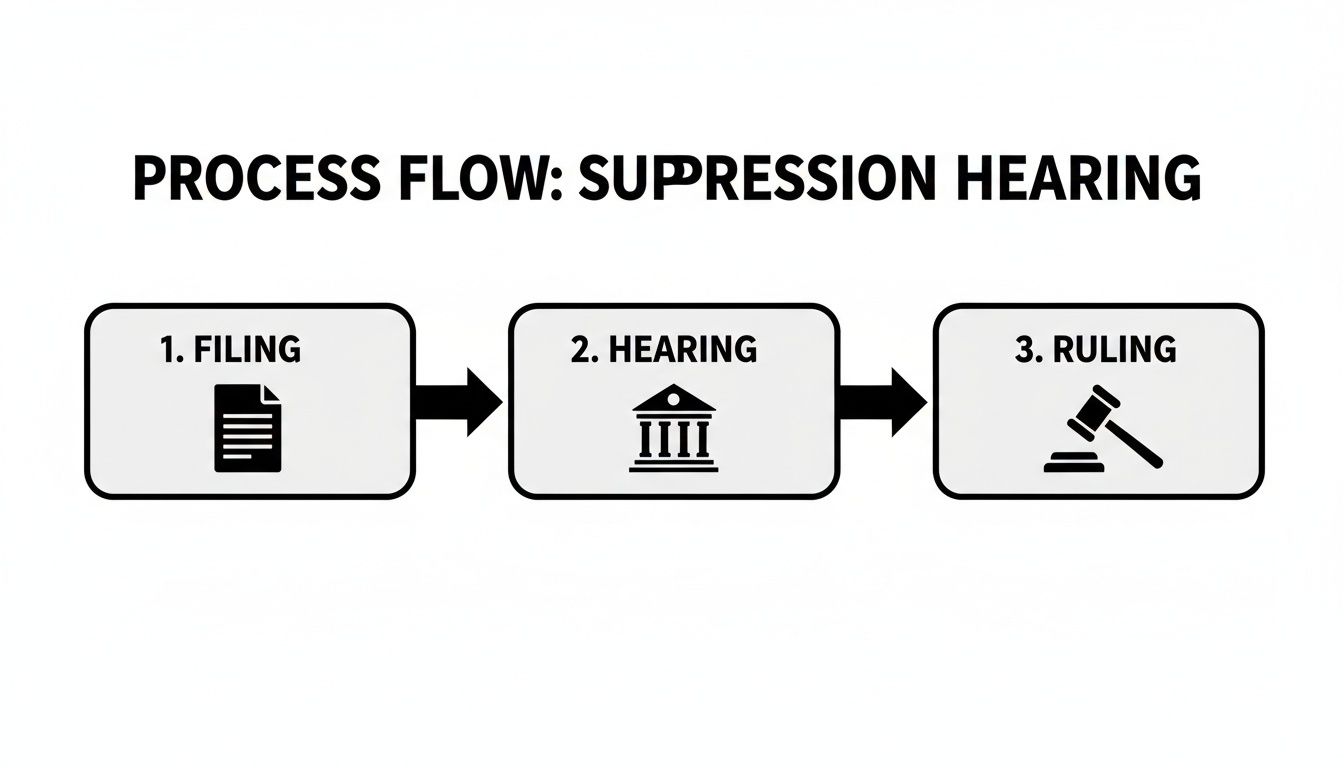
As you can see, it’s a clear progression from the initial legal challenge to the court hearing and, finally, the ruling that determines what happens to the evidence.
When the Judge Grants the Motion to Suppress
If the judge sides with the defense and grants the motion, the illegally obtained evidence is thrown out. This means the prosecutor is forbidden from ever using that evidence in a trial. The real-world impact of this is huge.
Let's say a case involves drugs, and the drugs—the most important piece of evidence—were found during an illegal car search. If the judge suppresses that evidence, the prosecution's case often collapses. Without the drugs to show a jury, they might have nothing left.
A successful motion can lead directly to several positive outcomes:
- Case Dismissal: More often than not, suppressing key evidence leaves the State with no case to prove, and they are forced to dismiss the charges.
- Reduced Charges: If there’s other evidence but the case is now much weaker, the prosecutor may offer to reduce the charges to something far less serious.
- Favorable Plea Agreements: A weakened case gives the defense powerful leverage to negotiate a much better plea offer than what was originally on the table.
This is exactly why a suppression hearing is such a potent tool in a defense lawyer's arsenal. It's about more than just a legal technicality; it's about strategically dismantling the prosecutor’s case.
When the Judge Denies the Motion to Suppress
On the other hand, if the judge denies the motion, the evidence is ruled admissible, meaning the prosecutor can use it at trial. While this isn’t the aimed-for outcome, the hearing still provides tremendous strategic value. The fight isn't over; the defense is just better prepared for the next stage.
Think of the hearing as a "test run" of the prosecution's case. It forces the arresting officer to get on the stand and testify under oath, long before a jury trial would ever happen.
Even when a motion is denied, the suppression hearing is a critical intelligence-gathering opportunity. It locks in the officer’s testimony, reveals the strengths and weaknesses of the state’s evidence, and provides a roadmap for building a trial defense.
This "discovery" is priceless. The defense gets to see how the officer handles the pressure of cross-examination and pinpoint any inconsistencies between their written report and what they say in court. That information can be valuable when preparing for trial or negotiating a plea deal down the road.
No matter the outcome, the hearing serves a critical purpose. A win can end the case right there. A loss still arms the defense with the information needed to keep fighting effectively. It's a vital tactical step in any strong defense strategy.
Why an Experienced Attorney Is Crucial
Handling a suppression hearing can be like walking into a maze blindfolded. These aren't just simple procedural steps; they are full-blown legal fights where the rules of evidence and courtroom procedure are everything. Success takes more than just knowing the law—it's about understanding police tactics and having a sharp courtroom strategy.
A good attorney does way more than just show up and argue. They dig into every single detail the prosecutor has, from the first police report to the body cam footage, looking for that one tiny inconsistency that can unravel their case. That's where a strong argument for suppression begins—in the details.
The Art of Cross-Examination
When the hearing starts, the ability to cross-examine the testifying officer is what separates a good lawyer from a great one. This isn't just about asking aggressive questions; it's a specific skill. It involves asking laser-focused questions designed to expose mistakes in procedure, a shaky foundation for probable cause, or flat-out constitutional violations. It’s a methodical process of revealing the cracks in the state's case.
Having a background as a former prosecutor can give a defense attorney a huge advantage here. They have been on the other side and know how cases are built and how officers are prepped to testify.
That kind of insider knowledge allows them to see the strategy coming from a mile away. It allows for building counter-arguments before the other side even knows what's happening, and that can be the single thing that gets a key piece of evidence thrown out.
In the end, whether a suppression hearing is won or lost often comes down to the quality of the legal arguments and how persuasively they're made in front of the judge. Here’s what a seasoned lawyer brings to the fight:
- Deep Legal Knowledge: They live and breathe the nuances of Fourth Amendment case law and know the local court procedures in places like Cumming and Alpharetta inside and out.
- Strategic Questioning: They know how to steer the conversation during testimony and effectively challenge what an officer says on the stand.
- Meticulous Preparation: They put in the hours, poring over every document and video to build the most powerful case possible for suppression.
Protecting rights during a what is a suppression hearing isn't something to take lightly. Professional legal guidance may be needed to properly challenge the state's evidence and fight for the best possible outcome.
Frequently Asked Questions About Suppression Hearings
When navigating the criminal justice system, a lot of questions pop up. Here are some plain-English answers to the most common things people ask when they first hear about a suppression hearing. Hopefully, this clears a few things up.
How Long Does a Suppression Hearing Usually Take?
Honestly, it varies a lot. A really straightforward hearing, maybe one focused on a single issue like the reason for a traffic stop with just one officer testifying, might be wrapped up in an hour or two.
But things can get complicated fast. Cases with multiple witnesses, hours of body camera footage to go through, or complex legal arguments over a search warrant can easily take up the better part of a day. Sometimes, they even have to be continued over several days. An experienced attorney can give a much better estimate once they dig into the specific facts of a case.
Does a Person Have to Testify at Their Own Suppression Hearing?
In almost every case, the answer is no. A defendant does not typically testify at their own suppression hearing. The entire point of the hearing is to put the actions and decisions of the police officers under a microscope, not to determine guilt or innocence.
The star witness is almost always the officer who made the arrest, conducted the search, or performed the questioning. The lawyer's job is to cross-examine that officer and challenge whether what they did was legal. Putting a defendant on the stand is a major strategic decision, and it’s one that should only happen after a very serious talk with their lawyer, since anything said could potentially be used later on.
What Is the Difference Between a Motion to Suppress and a Motion to Dismiss?
They sound similar, and sometimes winning a suppression motion can lead to a dismissal, but they are two totally different legal tools with different jobs.
- A Motion to Suppress is surgical. It targets one specific piece of evidence and asks the judge to ban it from the trial because it was obtained illegally.
- A Motion to Dismiss is a knockout punch. It asks the judge to throw out the entire case for a fundamental reason, like a violation of the right to a speedy trial or because the prosecutor just doesn't have enough evidence to even move forward.
Think of it this way: suppressing evidence is like pulling a critical Jenga block from the prosecutor's tower, making it unstable. Dismissing the case is knocking the whole tower over.
Can a Motion to Suppress Be Filed If I Consented to a Search?
Absolutely. It’s still possible to file a motion to suppress even if someone told the officer "yes." For consent to be valid under the law, it has to be given freely and voluntarily. It can’t be the result of police pressure, intimidation, or coercion.
A common argument here is that the "consent" wasn't really voluntary at all. Someone might have felt like they had no other choice but to agree, or maybe they didn't even know they had the right to say no in the first place.
A good lawyer will pick apart every detail of that interaction—what the officer said, their tone of voice, whether they were blocking the way, the whole environment—to see if there’s a solid argument that the consent wasn’t freely given.
Understanding what a suppression hearing is and how it can change a case is the first step in building a real defense. If you're facing charges in Alpharetta, Cumming, or anywhere in Forsyth or Cobb County, you need someone in your corner who knows how to challenge the state's evidence from the ground up. At Brian Hansford Law, we use our experience to protect your rights at every single stage. For a detailed review of your case, contact us today by visiting https://challengemycharge.com.
