
When you hear the terms "assault" and "battery," it's easy to think of them as one and the same. People use them interchangeably all the time. But in the eyes of Georgia law, they are two completely different things. Getting this distinction right is the first step in understanding the nature of these charges.
Think of it this way: assault is the threat, while battery is the physical follow-through. It's a simple but critical difference that shapes how a case is charged and defended in places like Forsyth County, Cobb County, and right here in Cumming.
An assault can occur without a battery ever happening. But a battery charge almost always starts with an action that could be considered an assault.
What Is Assault in Georgia?
In Georgia, an assault charge isn't about physical contact at all. It’s about what the other person felt. Under the official state code, O.C.G.A. § 16-5-20, an assault happens when a person's actions put someone else in reasonable fear of immediately getting hurt.
Let’s say a heated argument breaks out in a parking lot in Alpharetta. One person clenches their fist, raises it, and steps toward the other. No punch is ever thrown, but that menacing act is enough. The victim reasonably believed they were about to be struck. That fear is the core of the assault charge.
The key elements are:
- An attempt to commit a violent injury.
- An act that places another person in reasonable fear of that injury.
The real "harm" in an assault case isn't a black eye or a broken bone; it's the genuine fear that you’re about to be injured. This is exactly why a person can be arrested for assault without ever touching another person.
What Is Battery?
Battery, on the other hand, is all about the contact. According to O.C.G.A. § 16-5-23.1, battery occurs when a person intentionally makes physical contact of an insulting or provoking nature with someone else or intentionally causes them physical harm.
Going back to our Alpharetta parking lot scenario: if the person with the raised fist actually followed through and landed the punch, the situation immediately escalates to battery. The crime is in the contact itself—whether it's a punch, a shove, or even an unwanted touch meant to provoke or insult.
Assault and battery are fundamental concepts in criminal law. The charges can range from misdemeanors to serious felonies depending on the specifics of the incident. For a broader look, government data can provide more information about criminal victimization trends.
Assault vs. Battery at a Glance
To make it even clearer, here’s a quick summary table to help instantly grasp the fundamental differences between assault and battery in Georgia.
| Element | Assault in Georgia | Battery in Georgia |
|---|---|---|
| Core Action | Creating fear of imminent injury | Making unwanted physical contact |
| Physical Contact | Not required | Required for the charge |
| The "Harm" | The victim's reasonable fear or apprehension | Physical harm or offensive contact |
| Example | Shaking a fist and threatening to hit someone | Actually hitting, pushing, or shoving someone |
| Key Statute | O.C.G.A. § 16-5-20 | O.C.G.A. § 16-5-23.1 |
Understanding this table is a helpful first step, but remember that every situation is unique. The line between a heated argument and a criminal charge can be incredibly thin.
Exploring Different Types of Assault and Battery Charges
Now that we've covered the basic difference between the threat (assault) and the act (battery), it's time to dig into how these charges can vary. In Georgia, not all incidents are treated the same. The specific circumstances of what happened can dramatically elevate a charge from a simple misdemeanor to a very serious felony.
The key is to understand that these offenses exist on a spectrum. A heated verbal threat in a Roswell coffee shop is worlds away from a physical fight in a Marietta parking lot that involves a weapon. Let's break down this progression to give a clearer picture.
Simple Assault Versus Aggravated Assault
The most basic charge is Simple Assault, which lines up with the core definition we’ve discussed—placing someone in reasonable fear of getting hurt. This is usually a misdemeanor. Things get much more serious, however, when certain factors come into play, bumping the charge up to Aggravated Assault.
In Georgia, an assault charge becomes "aggravated" if it's committed with:
- An intent to murder, rape, or rob. This zeroes in on the accused person's mindset and what they were trying to accomplish with the threat.
- A deadly weapon or any object that, when used offensively, is likely to cause serious bodily injury. This could be a gun or a knife, but it could also be a heavy object used to threaten someone.
- The discharge of a firearm from inside a vehicle.
Let's imagine two drivers arguing over a parking spot in downtown Alpharetta. If one driver just yells a threat, it’s probably simple assault. But if that same driver pulls out a weapon while yelling, the charge immediately escalates to aggravated assault—a felony with life-altering consequences. You can learn more about what makes an assault charge serious to better understand these critical distinctions.
Simple Battery Versus Aggravated Battery
Just like assault, battery charges have different levels. Simple Battery involves intentional, unwanted physical contact that is insulting, provoking, or causes minor harm. This is generally a misdemeanor.
The charge intensifies to Aggravated Battery when the physical contact results in a serious injury. The law is very specific here, looking for instances where the battery maliciously causes:
- Loss of a limb.
- Serious disfigurement of the body or a body part.
- Rendering a part of the body useless.
Think about a dispute that turns physical outside a venue in Johns Creek. A shove that causes someone to stumble might be simple battery. But if that same shove leads to a fall where the person suffers a broken bone or a permanent scar, the prosecution could absolutely pursue an aggravated battery charge. The outcome of the physical contact is the critical factor.
This visual decision tree helps illustrate the key questions that separate these charges.
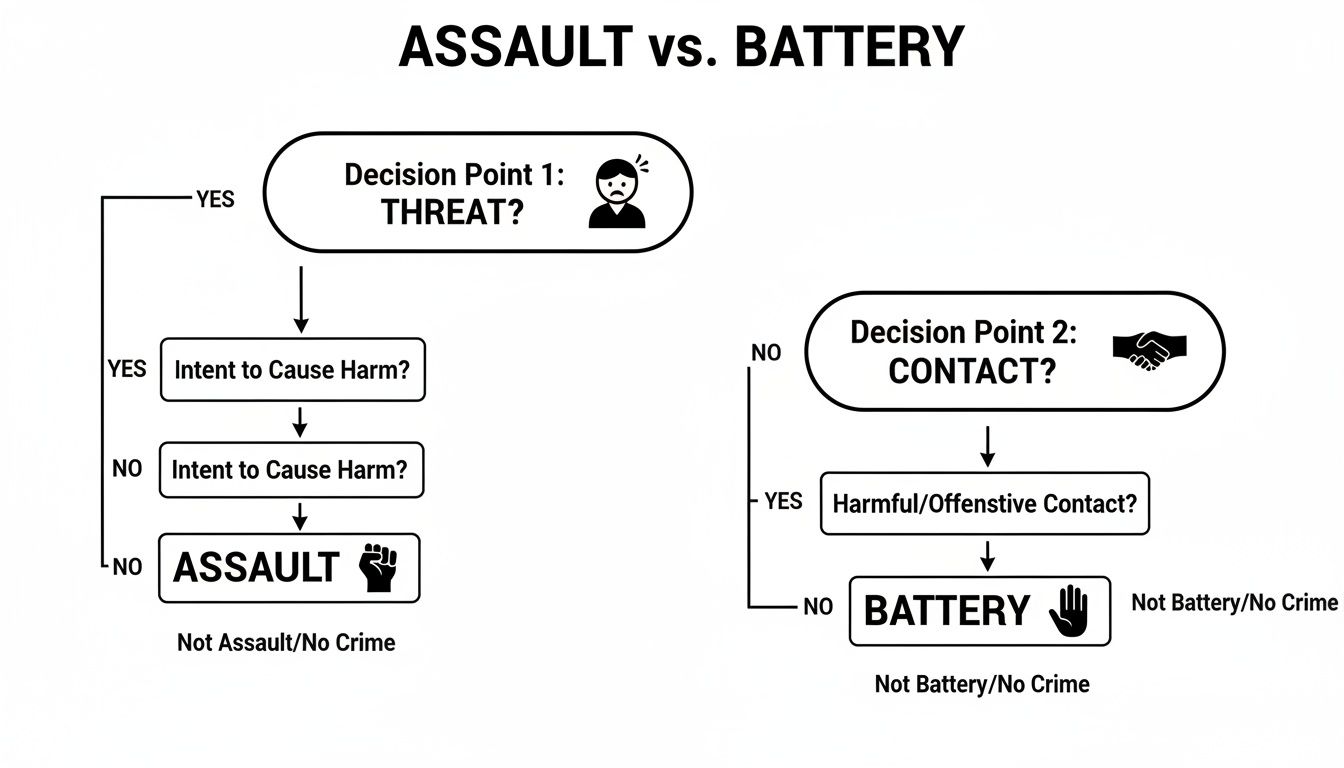
The flowchart clearly shows how the presence of a weapon or the severity of an injury acts as a dividing line, quickly escalating a situation from a less severe charge to a serious felony.
These distinctions aren't just legal jargon; they have a massive real-world impact. The 2023 Bureau of Justice Statistics data shows that in the U.S., assaults make up the majority of violent victimizations at 13.6 per 1,000 people. Even more telling, aggravated assaults—which often involve serious injury—impacted over 812,180 individuals in 2023 alone. Understanding these different charge levels is the first, most important step in recognizing the seriousness of an accusation.
Potential Penalties for a Conviction in Georgia
Understanding the legal definitions of assault and battery is one thing, but facing the real-world consequences of a conviction is another matter entirely. In Georgia, a guilty verdict can follow a person far beyond the courtroom, impacting their freedom, finances, and future. The penalties aren't a simple one-size-fits-all formula; they swing widely depending on whether the charge is a misdemeanor or a felony.
The potential sentences are laid out in Georgia law, giving judges a framework to work within. For lesser charges, a person might be looking at local jail time and fines. But for more serious offenses, the stakes get much higher, and fast, potentially leading to years in a state prison.
Penalties for Misdemeanor Offenses
Here in Georgia, Simple Assault and Simple Battery are usually classified as misdemeanors. While that’s the less severe category, the penalties can still create significant life disruption. A conviction for a standard misdemeanor can result in a county jail sentence of up to 12 months.
On top of that, a judge can impose fines of up to $1,000, not including court costs and surcharges that often increase the total. But the sentence frequently doesn't end there. It's common to see other requirements tacked on, like:
- Probation: A person could be placed on probation for up to a year, either instead of or in addition to jail time. This means regular check-ins with a probation officer and following a strict set of rules.
- Mandatory Classes: Courts frequently order people to complete anger management courses or other counseling programs as part of their sentence.
- Community Service: An individual might also be required to complete a certain number of hours of unpaid work in the community.
These consequences are meant to be both a punishment and a deterrent, but they can create huge headaches for anyone trying to hold down a job and take care of their family.
Steeper Consequences for Felony Convictions
When an assault or battery charge gets bumped up to Aggravated Assault or Aggravated Battery, the potential penalties become much more severe. These are felony offenses, which means a person is no longer facing time in a local county jail—they are facing a sentence in a state prison. The sentencing ranges are significantly longer, reflecting just how serious the state considers these crimes.
For instance, a conviction for Aggravated Assault in Georgia could mean a prison sentence of one to twenty years. Aggravated Battery is just as serious, carrying a mandatory minimum of one year and a maximum of up to twenty years behind bars.
It’s absolutely critical to know that certain factors can make these penalties even worse. If the offense involved a firearm, or if it was committed against a police officer, a senior citizen, or a family member, the sentencing guidelines get much tougher and often include mandatory minimum prison terms that a judge cannot go below.
Before we dive into the hidden consequences, let’s lay out the potential sentences in a clear format.
Potential Penalties for Assault & Battery in Georgia
The table below breaks down the typical sentencing ranges for common assault and battery charges. It's a stark reminder of what's on the line when facing these accusations.
| Charge | Classification | Potential Jail/Prison Time | Potential Fines |
|---|---|---|---|
| Simple Assault | Misdemeanor | Up to 12 months in jail | Up to $1,000 |
| Simple Battery | Misdemeanor | Up to 12 months in jail | Up to $1,000 |
| Aggravated Assault | Felony | 1 to 20 years in prison | Up to $100,000 |
| Aggravated Battery | Felony | 1 to 20 years in prison | Up to $100,000 |
Seeing these numbers in black and white makes it clear why a strong defense is not just an option—it's a necessity.
The Hidden Consequences of a Conviction
Perhaps the most damaging penalties are the ones that stick with a person long after they've served time and paid fines. These are often called "collateral consequences," and they can create lifelong roadblocks. A criminal record, especially for a violent offense like assault or battery, will pop up on background checks for years.
These long-term impacts can touch nearly every part of life:
- Employment: Many employers may not take a chance on someone with a history of violent charges, making it incredibly hard to find or keep a good job.
- Housing: Landlords run background checks, too. A conviction could be the reason a rental application gets denied.
- Firearm Rights: A felony conviction in Georgia means the permanent loss of the right to own or possess a firearm.
- Professional Licenses: For a career that requires a state license—like nursing, teaching, or real estate—a conviction could make it impossible to continue in that profession.
These hidden penalties show why an assault or battery charge is so serious. It's not just about the immediate threat of jail time; it’s about a conviction that can fundamentally change the entire course of a person's life.
How the Prosecution Builds Its Case
To get a handle on how assault and battery charges are defended, it’s helpful to first see things from the other side of the courtroom. Let's pull back the curtain on what a prosecutor in Forsyth County or Cobb County has to prove to get a conviction. The entire weight of the case rests squarely on their shoulders.
This responsibility is called the burden of proof. In every single criminal case, the state—represented by the prosecutor—has to prove its case beyond a reasonable doubt. This is the highest standard in our justice system. It means the evidence they present has to be so convincing that there's no other logical explanation for what happened, except that the person accused actually committed the crime.

Establishing the Core Elements of the Crime
Every crime is defined by a specific set of components, known as "elements." To win their case, the prosecutor must prove every single one of those elements. If they fail on even one, the whole case can fall apart.
For an assault charge, the prosecution has to show the court that the accused person's actions were intentional and created a genuine, reasonable fear of immediate harm in the alleged victim. They'll bring evidence to establish that a threat was made and that any normal person in the victim’s shoes would have felt afraid.
When it comes to a battery charge, the focus shifts entirely to physical contact. Here, the prosecutor’s job is to prove the contact was intentional, illegal, and either caused physical harm or was insulting or provoking. They must convince the judge or jury that the contact wasn't just an accident or something the other person agreed to.
The prosecutor's strategy is like building a structure brick by brick. Each piece of evidence is a brick, and if even one is missing or weak, the entire argument can become unstable.
The state’s attorney has a tremendous amount of control over how a case moves forward. To get a clearer picture of their role and decision-making power, you can find some great information explaining the concept of prosecutorial discretion and its impact on a criminal case.
The Evidence Used to Prove a Case
So, how does a prosecutor in a place like Cumming or Alpharetta actually build this case? They rely on different types of evidence to paint a compelling picture for the judge or jury, piecing together a story that leaves no room for reasonable doubt.
Here are the common types of evidence you'll see in assault and battery cases:
- Witness Testimony: This is often the cornerstone of the prosecution’s case. Statements from the alleged victim and any eyewitnesses who saw or heard the incident are powerful tools.
- Police Reports: The official report filed by the responding officer gives a detailed account of the scene, what people said initially, and any observations the officer made about injuries or how everyone was acting.
- Medical Records: In battery cases, medical documents are crucial. Records from a hospital or doctor can prove the extent of the physical harm, which is essential for more serious charges like Aggravated Battery.
- Video and Photographic Evidence: In this day and age, this kind of evidence is more and more common. Surveillance footage from businesses, doorbell cameras, or videos from cell phones can provide an objective look at what really happened.
- Physical Evidence: This could be anything from torn clothing and a weapon allegedly used in the incident to other objects collected at the scene that help back up the story.
By putting all this evidence together, the prosecution tries to build an undeniable account of events. Understanding how they do this is the first step in knowing how an experienced defense attorney can start taking that case apart.
Common Defenses Against Assault and Battery Allegations
Getting hit with an assault or battery allegation is a serious, often overwhelming experience. But it's critical to remember one thing: an accusation isn't a conviction. The prosecution has a high bar to clear, needing to prove its case beyond a reasonable doubt. Just as they build their case brick by brick, a skilled defense attorney works to dismantle it.
These defenses aren't loopholes or legal tricks. They're established, legitimate arguments grounded in the actual facts of what happened—or what didn't happen. Challenging a charge successfully often comes down to presenting a credible, alternative version of events that creates that all-important reasonable doubt.
Arguing Self-Defense or Defense of Others
One of the most common and widely understood defenses is self-defense. This argument doesn't deny that physical contact was made. Instead, it asserts that the actions were justified because they were necessary to protect oneself from immediate harm.
For a self-defense claim to hold up in court, the force used must be both reasonable and proportional to the threat being faced. Think about it this way: if someone shoves another person during an argument in a Johns Creek parking lot, pushing them back to create space might be seen as reasonable. But if the response to that same shove was to pull a weapon, that would almost certainly be considered excessive force, and the self-defense claim would fall apart.
The same logic applies to the defense of others. If a person had a reasonable belief that another person was about to be harmed, using proportional force to step in and protect them can be a valid defense. In both scenarios, the key is whether the response matched the level of the immediate threat.
The core principle of self-defense is not about winning a fight, but about ending a threat. The law looks at whether the actions were a necessary response to a genuine and immediate danger, not an escalation of the conflict.
Questioning the Element of Intent
Every assault or battery charge hinges on the concept of intent. It's not enough for the prosecutor to show that contact happened; they have to prove the person intended to cause fear or make harmful contact. If the contact was a pure accident, it simply doesn't meet the legal definition of battery.
Imagine being in a crowded restaurant in Roswell and stumbling, accidentally bumping into someone and causing them to fall. Yes, there was physical contact and maybe even an injury, but there was absolutely no criminal intent. Arguing a lack of intent means proving the incident was an unfortunate accident, not a malicious act.
This defense gets right to the heart of the state of mind at the time. It forces the prosecution to prove—beyond a reasonable doubt—that the actions were deliberate. If you want to dig deeper into this, the guide on how assault charges can be addressed and potentially dropped provides more context.
Other Potential Defense Strategies
Beyond self-defense and lack of intent, a number of other arguments can be made, all depending on the specific facts of a case. Each one is designed to pick apart a key element of the prosecution's narrative.
- Consent: In certain situations, the person making the allegation may have consented to the contact. This is common in activities like football or martial arts, where everyone involved understands and accepts the risk of physical contact.
- Misidentification: Eyewitness testimony can be notoriously unreliable. A misidentification defense argues that police arrested the wrong person. This claim is often supported with an alibi, conflicting descriptions from other witnesses, or surveillance footage.
- False Accusation: Sadly, allegations are sometimes completely fabricated out of anger, jealousy, or revenge. In these difficult cases, a defense can be built by exposing inconsistencies in the accuser's story, revealing their motive to lie, and presenting evidence that contradicts their claims.
Each of these defenses requires a thorough, meticulous investigation into the evidence. Understanding what assault and battery are also means understanding the many ways an accusation can be effectively challenged in court.
The Role of an Experienced Criminal Defense Attorney
When someone is facing an assault and battery allegation, it can feel like the ground has completely fallen out from under them. The legal system is confusing and frankly, pretty intimidating, especially in places like Alpharetta and Milton where local court procedures really matter. This is exactly when a seasoned criminal defense attorney becomes a critical ally, stepping in to manage the process and protect a person's rights from day one.
Their first move is to dive deep into the evidence. This isn't just about giving the police report a quick glance. It means tearing into witness statements to find inconsistencies, poring over surveillance footage frame-by-frame, and challenging every assumption the prosecution is making about what happened.

Developing a Tough Defense Strategy
Once they've taken the evidence apart, an attorney starts looking for the weak spots in the prosecution's case. Do the facts actually line up with the specific charge? Was the evidence gathered legally? How credible is their main witness, really? Asking these hard questions is how a real defense is built.
This detailed analysis allows a lawyer to build a strategy that fits the unique situation. They might find solid grounds to argue for:
- Self-defense or the defense of another person.
- Lack of intent, proving the contact was purely accidental.
- Misidentification or even a case of a false accusation.
This strategy becomes the blueprint for every move made, from filing pretrial motions to negotiating with the prosecutor. The end goal is always to secure the best possible outcome—whether that's getting the case dismissed entirely, having the charges reduced, or winning an acquittal at trial. A good attorney knows how to tell a person's side of the story in a way that resonates.
The Advantage of a Former Prosecutor
An attorney's background can make a huge difference in a criminal case. A defense lawyer who used to be a prosecutor, for instance, has a perspective most others don't. They've been on the other side of the courtroom, building the very same types of cases that are now being brought against clients.
This kind of background provides an invaluable ability to see what the prosecution is planning. An attorney with this experience understands their playbook, knows how they value evidence, and can often predict the arguments they’ll make in court before they even make them.
This foresight is a massive advantage. It allows the defense to be proactive, not just reactive, preparing counter-arguments and spotting opportunities for negotiation that others might miss. Whether it's working out a plea for lesser charges or gearing up for a jury trial in Forsyth County or Cobb County, that insider's perspective can be a game-changer. Ultimately, their job is to be a guide and a champion through one of the toughest fights of a person's life.
Questions We Hear All the Time About Assault and Battery
When someone is caught up in the legal system, it’s natural to have a million questions running through their head. Here are some of the most common ones people ask when they're facing assault and battery allegations in Georgia.
Can a Person Be Charged with Assault If They Never Touched Anyone?
Yes, absolutely. This is one of the biggest points of confusion, and the answer surprises a lot of people. In Georgia, an assault charge is not based on physical contact at all; it’s about creating a reasonable fear that harm is about to happen.
The whole case hinges on the other person's state of mind. If someone does something like clench their fists and make a direct threat, and that person genuinely believes they are in immediate danger of being hit, that's enough for an assault charge. No physical touch is required for an arrest to be made.
What Makes a Battery Charge a Domestic Violence Case?
This is a critical distinction that changes everything. The difference between a regular simple battery charge and a family violence battery charge comes down to one thing: the relationship between the two people involved. The physical act itself—the unwanted contact—could be exactly the same.
But if that battery happens between people who are:
- Current or former spouses
- Parents and children
- Stepparents and stepchildren
- Living under the same roof
The charge gets reclassified as family violence battery. This isn't just a different name; a conviction carries far more serious and unique consequences, like the mandatory loss of the right to own a firearm under federal law and court-ordered counseling programs.
What Steps Can Be Taken If Someone Is Under Investigation?
If a person finds out they’re being investigated for assault or battery, the first priority is self-protection. Anything said to law enforcement can and will be used by the prosecutor to build their case.
A person has the right to remain silent and the right to have an attorney present during any questioning. Using these rights is not an admission of guilt. It's one of the most fundamental protections our system offers.
The most important step is often to call an experienced criminal defense attorney right away. Getting a skilled lawyer involved early—even before an arrest—can completely change the direction of a case. An attorney can handle all communication with investigators, prevent someone from accidentally saying something that hurts their case, and start building a defense from day one. This initial stage is often where the entire trajectory of a case is decided, making it a critical time to act.
If you or someone you care about is facing an assault or battery charge in Cumming, Alpharetta, or anywhere in Forsyth or Cobb County, you don’t have to go through this alone. At Brian Hansford Law, we know what’s on the line and are here to defend your rights and your future. Contact us today for a consultation to discuss your case by visiting https://challengemycharge.com.
