
At its core, the burden of proof is the obligation on one party to prove their claim. Think of it as the courthouse version of “put up or shut up.” If someone makes an accusation, they’re the one who has to back it up with solid evidence.
It’s not enough to just point a finger; the system demands that you show why your claim is true.
Demystifying The Burden Of Proof
Imagine two friends arguing over who won a video game. If one insists they won, it’s their job to prove it—maybe by showing the final scoreboard. They carry the “burden of proof.” The other friend doesn’t have to prove anything at all; they can just wait for the evidence to appear.
This is a foundational concept in the justice system. It establishes which side has the duty to convince a judge or jury that their version of events is the correct one. In nearly every setting, the person bringing the claim or accusation is the one who shoulders this responsibility from the start.
A Principle With Deep Roots
This isn’t some new trend; its roots run deep. The idea goes all the way back to Roman law, where the principle of onus probandi placed the duty to prove a claim squarely on the person making it. This simple, powerful rule is essential for fairness.
Without it, the system would be turned on its head. Anyone could make a wild accusation, forcing the other person to prove their innocence. Instead, the burden of proof ensures that the process starts by assigning the duty to prove a case to the accuser. Understanding this is critical, especially when you consider what happens when someone is arrested and the formal process kicks off.
Key Takeaway: The burden of proof isn’t about achieving absolute, 100% certainty. It’s about meeting a specific standard of evidence required for that particular situation, making sure decisions are based on facts, not just accusations.
Of course, not all cases are the same. There are different “levels” of proof required depending on what’s at stake. As we’ll see, the evidence needed to win a civil lawsuit is worlds away from what the prosecution needs to secure a criminal conviction.
The Three Key Standards Of Proof Explained
Getting a handle on the concept of the burden of proof is one thing. But the real key is understanding that not every case requires the same amount of evidence. The justice system actually has three distinct standards of proof, and each one represents a different level on a “scale of certainty.”
This is by design. The system makes sure that the level of proof required matches how serious the consequences are. A simple dispute over a contract doesn’t need the same rock-solid evidence as a case where someone’s freedom is on the line. Each standard has its purpose, creating a balanced and fair framework.
This infographic is a great way to visualize how these different standards stack up.
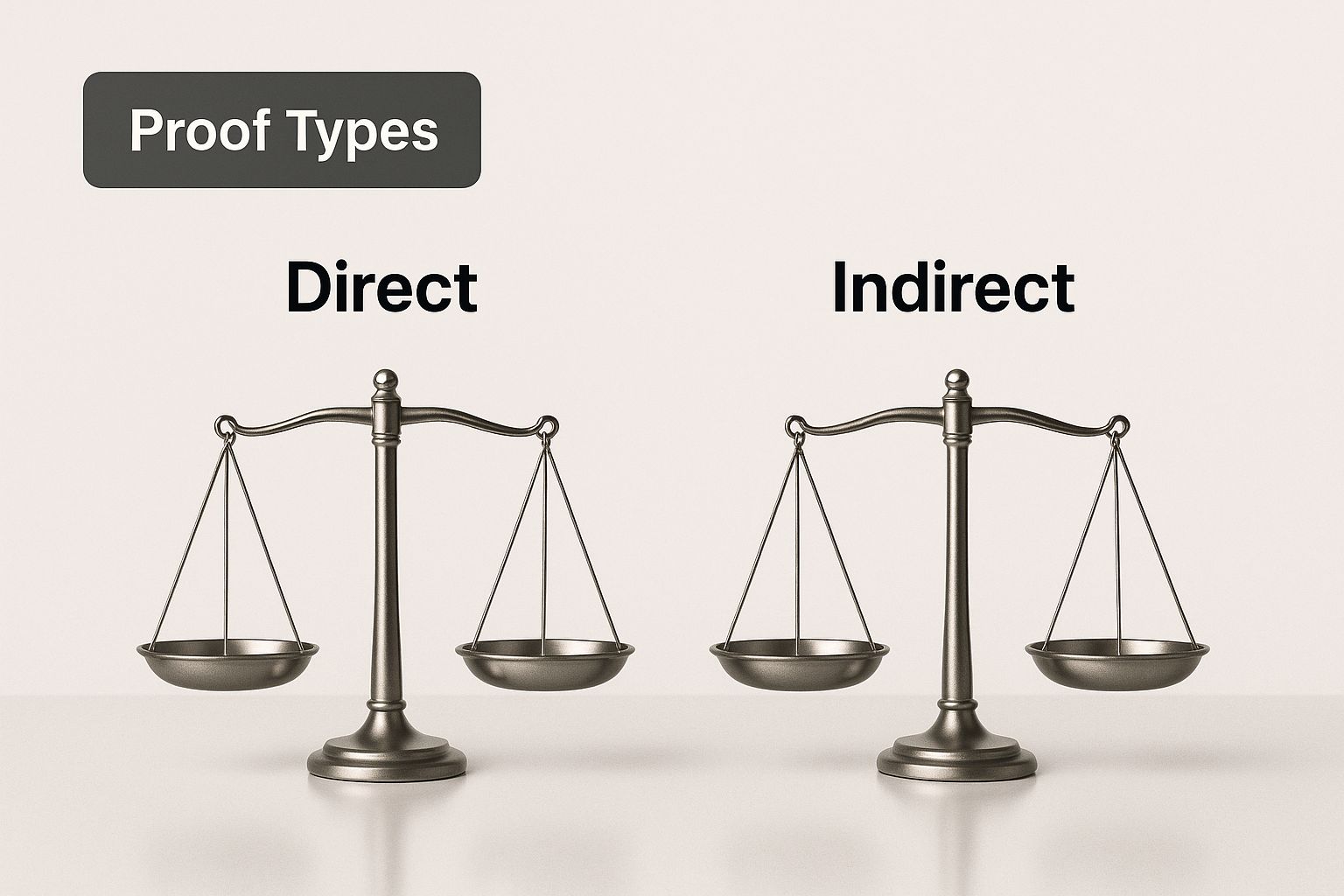
As you can see, the standards are like weights on a scale. Each level demands progressively more evidence to tip the balance of justice.
Preponderance Of The Evidence: The Tipping Scale
The most common standard, especially in civil lawsuits, is the preponderance of the evidence. It’s the lowest bar to clear.
Think of it as a set of perfectly balanced scales. To win, a party just needs to present enough evidence to make those scales tip ever so slightly in their favor. It doesn’t have to be a dramatic slam dunk—just enough to show that their version of events is more likely true than not.
This standard is often boiled down to being 51% certain. If a judge or jury believes there’s even a slight edge favoring one party, that party has met their burden. This is the go-to standard for most civil cases, like personal injury claims or contract disagreements.
Clear And Convincing Evidence: A Firmer Belief
Moving up the ladder, we get to the clear and convincing evidence standard. This one demands more certainty than just barely tipping the scales.
With this standard, the evidence has to be strong enough to give the judge or jury a firm belief that a claim is true. It’s a middle ground—much tougher than “more likely than not,” but not as strict as what’s required in a criminal trial.
This standard is reserved for certain civil cases where the stakes are much higher than just money. You’ll often see it in situations like:
- Fraud Cases: Accusing someone of fraud is a serious claim that requires a higher degree of proof.
- Will Contests: To prove a will is invalid, there is often a need for clear and convincing evidence.
- Terminating Parental Rights: Because of the gravity of the outcome, courts apply this higher standard.
Essentially, the evidence must be highly and substantially more probable to be true than not. This helps ensure that decisions with life-altering consequences are made with a much greater degree of confidence.
Beyond A Reasonable Doubt: The Highest Standard
Finally, we arrive at beyond a reasonable doubt, which is the highest and most demanding standard of proof in the entire justice system. This is the bedrock of criminal justice.
The analogy here isn’t just about tipping scales anymore. It’s about the prosecution building a case so solid that there are no other logical explanations for the facts except that the defendant is guilty. It doesn’t mean proof beyond all doubt—that’s an impossible standard—but any doubt that remains cannot be a reasonable one.
This incredibly high bar is set for a reason. It’s rooted in the fundamental principle that it’s far better to let a guilty person go free than to wrongly convict an innocent one. Since a person’s liberty is at stake, the prosecution’s case must be practically airtight, leaving no room for any other plausible explanation.
Interestingly, researchers have even tried to put numbers on these concepts. A study of federal judges found that ‘beyond a reasonable doubt’ averaged around 90.1% certainty. ‘Clear and convincing evidence’ was pegged at about 73.4%, and ‘preponderance of the evidence’ came in at 54.4%. If you’re interested, you can learn more about these fascinating legal standards by the numbers.
How Burden Of Proof Works In Civil Cases
When you step out of the high-stakes world of criminal law, the idea of what constitutes the “burden of proof” shifts quite a bit. Civil cases aren’t about someone’s freedom; they’re about disputes between people or organizations. Usually, these disagreements are over money, property, or whether someone held up their end of a deal.
Since the consequences are far less severe—nobody is going to jail—the required standard of proof is much lower. This is where the “preponderance of the evidence” standard comes into play. It’s the default setting for almost all civil lawsuits, designed to settle disputes fairly without demanding the near-certainty needed in criminal court.
The person or entity that files the lawsuit, called the plaintiff, has the initial burden. Their job is to present enough evidence to convince a judge or jury that their version of events is more likely true than not.
Tipping The Scales Just Slightly
Think of it this way: to win a civil case, the plaintiff really only needs to prove their claim is 51% likely. They don’t have to eliminate every shred of doubt or build an airtight case. They just need to make the scales of justice tip ever so slightly in their favor.
This lower bar makes a lot of practical sense. In a civil dispute, one party is seeking compensation or a specific action from another. The system is designed to find a fair resolution, and if the standard of proof were impossibly high, many legitimate claims would never succeed.
Take a common dispute between a landlord and a tenant over a security deposit. The landlord claims the tenant caused thousands in damages, but the tenant swears the apartment was left in great shape.
- The landlord (the plaintiff) might show photos of the alleged damage and a receipt from a contractor.
- The tenant (the defendant) could present their own move-out photos and the initial inspection checklist.
The judge simply weighs the two piles of evidence. If the landlord’s photos and repair bill seem just a little more convincing than the tenant’s evidence, the landlord wins. It’s not about proving anything beyond all doubt, just establishing which story is more probable.
In civil litigation, the preponderance of the evidence standard is the default because the system balances the interests of both parties. It recognizes that while the defendant might have to pay damages, the plaintiff also has a right to be compensated for a legitimate harm they have suffered.
A quick comparison can make the distinctions even clearer.
Civil vs Criminal Cases At A Glance
| Feature | Civil Cases | Criminal Cases |
|---|---|---|
| Parties Involved | Plaintiff (brings the lawsuit) vs. Defendant | State/Government (prosecutor) vs. Defendant |
| Purpose of Case | To resolve a dispute and compensate for harm (damages) | To punish an offense and protect society |
| Burden of Proof | Preponderance of the Evidence (more likely than not) | Beyond a Reasonable Doubt (near certainty) |
As you can see, the entire framework of a civil case is built on a different foundation, which is why a lower burden of proof is not only appropriate but necessary for the system to function.
Common Examples Of Civil Burden Of Proof
This standard applies to a massive range of everyday disputes. You see the preponderance of the evidence rule in action constantly in situations that have nothing to do with criminal charges.
Let’s say you’re in small claims court because a product you bought was defective right out of the box. To meet your burden of proof, you’d likely need to show:
- Proof of Purchase: A simple receipt or a bank statement.
- Evidence of the Defect: Photos or a video showing the product doesn’t work as advertised.
- Proof of Attempted Resolution: Emails you sent to the company asking for a refund.
The seller might try to argue that you broke it yourself. But again, the judge just has to decide whose story is more believable based on the evidence presented. It’s a straightforward weighing of the facts, and that’s the essence of how burden of proof works in the civil system.
Why The Standard Is Higher In Criminal Cases
When the conversation turns from civil lawsuits to criminal charges, the entire game changes. The stakes are profoundly different. We’re no longer talking about money or property—we’re talking about a person’s freedom, their reputation, and in some cases, their very life.
This massive jump in consequences demands a much higher, more protective standard of proof. It’s why the American justice system is built on the cornerstone of “beyond a reasonable doubt.” This isn’t just jargon; it’s a fundamental shield designed to protect every individual from the immense power of the government.
The Presumption Of Innocence Is Key
At the heart of every criminal case is a principle that can’t be overstated: the presumption of innocence. In simple terms, this means every single person accused of an offense is considered innocent until the prosecution proves otherwise. It is never the defendant’s job to prove they are innocent. That entire weight rests on the prosecution’s shoulders.
This flips the whole idea of an argument on its head. An accused person can say nothing, offer zero evidence, and still be found not guilty if the prosecution fails to meet its incredibly high burden.
The presumption of innocence is the shield that protects citizens. It ensures that the government, with all its resources, must build a virtually irrefutable case before it can deprive someone of their liberty.
This forces the prosecution to prove every single element of the offense they’re alleging. If just one piece of their argument doesn’t hold up “beyond a reasonable doubt,” their entire case can fall apart.
What Does Reasonable Doubt Actually Mean?
“Beyond a reasonable doubt” doesn’t mean proof beyond any and all doubt, or some kind of absolute certainty. It simply means the evidence is so convincing that a reasonable person wouldn’t hesitate to believe the defendant is guilty.
If there’s a real, logical reason to doubt the defendant’s guilt based on the evidence—or lack thereof—that’s a reasonable doubt. It can’t be a wild or imaginary what-if. It has to be a doubt that would make a sensible person pause before making an important decision in their own life.
Think of it like a jigsaw puzzle. The prosecutor’s job is to put all the pieces together to create a clear picture for the jury.
- If they assemble a complete puzzle with no gaps, that’s proof beyond a reasonable doubt.
- But if there’s a huge piece missing that could totally change the picture, that’s a reasonable doubt.
- Even if all the pieces are there but they could logically form a different picture, that also creates reasonable doubt.
This is exactly where a criminal defense attorney comes in. The primary job isn’t always to prove innocence. More often, it’s to show the jury that the prosecutor’s puzzle is missing pieces or could be put together in another way.
A Theft Scenario In Practice
Let’s walk through a simple theft case. Imagine someone is accused of stealing a laptop from a coffee shop.
To get a conviction, the prosecution has to prove several things beyond a reasonable doubt:
- The laptop was stolen (not just misplaced by the owner).
- The defendant is the one who took it (and not someone else).
- The defendant intended to permanently keep it (they didn’t just grab it by mistake, thinking it was theirs).
The prosecution might show security footage of the defendant near the table and have a witness testify they saw them leave with a similar laptop.
Now, the defense doesn’t have to prove their client was at home watching TV. Their goal is to inject reasonable doubt. They might argue:
- The security footage is too grainy to be certain.
- The witness admits they were distracted and only got a quick look.
- The defendant owns an identical laptop and grabbed the wrong one by accident, meaning there was no criminal intent.
If the jury finds it reasonably possible that it was a simple mistake, they have to acquit. The defense didn’t prove innocence—they just showed the prosecution’s story had enough holes to create reasonable doubt. This high standard is especially critical in cases with severe penalties. For a detailed look at the complexities of such cases, you can learn more about defending against serious charges like first-degree assault.
Ultimately, this higher burden reflects a core value of our society: it is far worse to convict an innocent person than to let a guilty one go free. This standard is a powerful check on the justice system, demanding near certainty before it can take away someone’s freedom.
Who Carries The Burden And Can It Shift?
When we talk about the burden of proof, the next logical question is always, “Okay, so who has to do the proving?” It’s a simple question with a straightforward answer: the party bringing the claim.
In a criminal case, that’s the prosecutor. In a civil lawsuit, it’s the plaintiff. They are the ones making the accusation, so the system puts the responsibility squarely on their shoulders to back it up with evidence. The defendant doesn’t have to prove their innocence at the start; their job is to poke holes in the evidence presented against them.
But it’s not always that static. While the main, ultimate burden of proof rarely moves, a smaller, related burden can—and often does—get passed back and forth like a hot potato.
The Two Types Of Burdens
To really get how this works, you have to understand that there are two different kinds of burdens in any trial. They work together, but they do very different things.
- Burden of Persuasion: This is the big one. It’s the ultimate responsibility to convince the judge or jury of your case. This burden almost never shifts. The prosecution in a criminal case carries this from day one until the final verdict is read.
- Burden of Production: This is simply the job of presenting some evidence on a specific issue. This is the burden that can and does shift between the parties during a trial.
Think of the burden of persuasion as the finish line of a marathon. The burden of production is like the baton in a relay race—once one side presents enough evidence to make a point, the baton is passed, and the other side now has the responsibility to respond. This back-and-forth happens in all sorts of settings, whether there is a bench trial vs. a jury trial.
How The Burden Can Shift In Practice
Let’s look at a classic criminal defense scenario: self-defense. Imagine someone is charged with assault but argues they were only defending themselves. This is what’s known as an affirmative defense.
First, the prosecution has the initial burden of production. They need to put evidence on the table—maybe a witness or a doctor’s report—showing that an assault took place. If they do that, they’ve met their first obligation.
Now, the baton passes. The burden of production shifts to the defense team. They now have to produce some evidence backing up the self-defense claim. This could be the defendant’s own testimony about being threatened or photos of injuries they sustained while fighting back.
Once the defense puts forward credible evidence of self-defense, the ultimate burden of persuasion snaps right back to the prosecution. Now, they don’t just have to prove an assault happened. They have to prove beyond a reasonable doubt that the defendant was not acting in self-defense.
It’s a high bar, and this shifting dynamic is what makes a strong defense so critical.
Common Questions About Burden of Proof
It’s natural to have questions when trying to wrap your head around a concept like the “burden of proof.” It’s a core rule in our justice system, but the different standards can get confusing. Let’s clear up a few of the most common points of confusion with some straightforward answers.
Think of this as a quick reference guide to reinforce what we’ve already covered.
Why Do We Even Need a Burden of Proof?
At its core, the burden of proof is all about fairness. Without it, our justice system would be chaotic. Anyone could accuse you of anything, and you’d be forced to prove you didn’t do it. This would flip the entire principle of “innocent until proven guilty” on its head.
This rule establishes a clear starting line: the person making the claim is the one responsible for backing it up with facts. It ensures our courts make decisions based on evidence, not just accusations, creating a predictable and structured way to handle disputes.
What Is The Main Difference Between Civil And Criminal Burdens?
The biggest difference comes down to what’s at stake. In a civil lawsuit, the fight is usually over money or property. Because of this, the burden is lower—a preponderance of the evidence. This just means the jury has to believe one side’s story is “more likely than not” true.
Criminal cases are a different world entirely. A person’s freedom is on the line. Since the consequences are so severe, the system demands the highest standard possible: proof beyond a reasonable doubt. This high bar is a critical protection against wrongful convictions and the immense power of the state.
This distinction ensures that the level of certainty required to win a case is proportional to the potential outcome. A financial penalty and a prison sentence are treated with appropriately different levels of caution.
Does The Defendant Ever Have a Burden of Proof?
Yes, but it’s very specific and limited. The prosecution always, always has the ultimate burden of persuasion—they must convince the jury of guilt. However, the burden of production can sometimes shift to the defense.
A classic example is a self-defense claim. If someone argues they acted in self-defense, they have the initial burden to produce some credible evidence supporting that argument. Once they have done that, the ball is back in the prosecution’s court. They now must prove, beyond a reasonable doubt, that the person was not acting in self-defense. The defendant never has to prove their own innocence, just raise the issue for the prosecution to defeat.
Can a Person Be Found Not Guilty But Still Lose a Civil Case For The Same Thing?
Absolutely. This happens more than you might think and is a major source of confusion for the public. The O.J. Simpson case is the most famous example of this. He was acquitted of murder in his criminal trial but was later found liable for wrongful death in a civil trial brought by the victims’ families.
How is that possible? It all goes back to the different standards of proof. To convict him of murder, the criminal jury needed to be convinced of his guilt beyond a reasonable doubt. The civil jury, however, only needed to find that it was more likely than not that he was responsible for the deaths to award damages.
Facing criminal charges means confronting the highest burden of proof in our justice system. At Brian Hansford Law, we understand what it takes to challenge the prosecution’s case and protect your rights. If you need an experienced defense, learn how we can help at https://challengemycharge.com.
