
When you hear the term “white collar crime,” you probably picture a scene from a movie—a powerful executive in a high-rise office, orchestrating a complex scheme for millions. While that's certainly one version, the reality is much broader and often hits closer to home.
These aren't crimes of brute force. Instead of a weapon, the tool of the trade is deceit, concealment, or a simple violation of trust. Think of it less like a back-alley mugging and more like a sophisticated con played out from behind a desk. The core elements are always the same: a financial motive, a non-violent method, and often, the abuse of a professional position.
Understanding White Collar Crime Beyond the C-Suite

It’s a common misconception that these offenses are only committed in the C-suite. The truth is, anyone in a position of trust could face these types of charges—accountants, managers, government officials, and even local small business owners.
Here's a simple way to think about it: a burglar breaks into your house to steal your TV. A white-collar offender, on the other hand, might convince you to sign a document that gives them your TV willingly. The goal is the same—illegal financial gain—but the approach couldn't be more different. That fundamental distinction is what separates white collar offenses from other different types of crime in our detailed guide.
The Defining Elements
At its heart, a white collar crime is defined by how it's committed, not who commits it. The "white collar" name comes from the traditional attire of an office worker, but today it covers any financially motivated crime that doesn't involve violence.
There are a few key ingredients prosecutors look for:
- Deception: The act involves misleading someone, whether through false statements or clever manipulation.
- Intent: This wasn't just an accounting error or an honest mistake. The action was deliberate and planned.
- Financial Gain: The whole point was to get money, property, or services they weren't entitled to.
- Violation of Trust: Very often, the person accused was abusing a professional or fiduciary duty owed to someone else.
These offenses are notoriously difficult to spot because they're often buried in complex transactions, digital records, or what looks like normal, everyday business.
The Scale and Impact
The term was coined back in 1939 by sociologist Edwin Sutherland, but its relevance has only grown. The FBI estimates these crimes cost the U.S. more than $300 billion a year, a staggering figure that absolutely dwarfs the losses from street crime. And with modern technology, the opportunities for committing these offenses are expanding every day.
A white collar crime is never victimless. It can wipe out a family's life savings, bankrupt a small business, or erode public trust in our financial systems. The consequences ripple through entire communities, affecting employees, investors, and taxpayers.
To simplify these concepts, the table below breaks down the essential characteristics that define white collar crime.
Key Characteristics of White Collar Crime
| Characteristic | Description |
|---|---|
| Motive | Primarily financial gain or professional advantage. |
| Method | Deception, concealment, fraud, or violation of trust. |
| Location | Typically occurs in a professional or business environment. |
| Violence | The act is non-violent and does not involve physical force. |
Ultimately, what sets these offenses apart is their reliance on intellect and access rather than intimidation.
Common Examples of White Collar Offenses

The theory behind white-collar crime is one thing, but seeing how these offenses play out in the real world makes it all click. These aren't just abstract ideas; they are specific actions with very real consequences, often happening in familiar places like a family business or a corporate office.
To really get a handle on the scope of these financial schemes, it helps to look at concrete examples. Each one shows a different method of deception, but they all share two common threads: the act is non-violent, and the motive is all about financial gain.
Embezzlement: The Betrayal of Trust
At its heart, embezzlement is a profound breach of trust. It’s what happens when someone who has been given lawful access to money or assets decides to take them for their own use. This isn't a stranger breaking in; it's an insider abusing their position.
Picture a trusted, long-time bookkeeper for a small business. For years, they create a fake vendor in the accounting system. Every month, they issue small payments to this "vendor," which is really just a personal bank account they control. Because the amounts are small and the bookkeeper is so well-regarded, the theft flies under the radar for a long time, slowly siphoning thousands of dollars from the company.
This classic scenario shows the key elements of embezzlement:
- A Position of Trust: The person had legitimate control over the company's money.
- Fraudulent Conversion: They intentionally took those assets for themselves.
- Intent: It was deliberate, not just an accounting error.
Fraud: The Many Faces of Deception
Fraud is a massive category that covers any intentional act of deception meant to secure an unfair or illegal gain. The methods can be wildly different, but the goal is always the same: to trick someone out of their money, property, or a right they are entitled to. Some of the most common types are wire, mail, and bank fraud.
Think about a small construction contractor trying to get a line of credit to buy new equipment. To make his business look healthier than it is, the owner knowingly inflates asset values and creates fake invoices for his bank application. This deliberate lie is a perfect example of bank fraud.
What turns a simple lie into a federal crime often comes down to how the deception was communicated. If fraudulent messages cross state lines using electronic means—like an email or phone call—it can become wire fraud. If the U.S. Postal Service is used, it’s mail fraud.
These charges are so common because they apply to a huge range of schemes. From complex investment scams to simpler plots involving false insurance claims, using mail or electronic communications can quickly elevate a state issue into a federal case.
Identity Theft: Stealing More Than Money
While many white-collar crimes target businesses, identity theft is deeply personal. It involves illegally getting and using someone's personal information—like a Social Security number, credit card, or bank account details—for financial gain.
Imagine a criminal gets a list of names and personal details from a data breach. They use that information to open new credit card accounts, take out loans, or file fake tax returns in their victims' names. The financial damage can be devastating, but the real harm is often the months or even years it takes for victims to restore their credit and good name.
Money Laundering: Hiding the Dirty Money
Criminal organizations generate a lot of cash, but that money is a liability if it can be traced back to illegal activity. Money laundering is the process of making "dirty" money from crime look "clean" by funneling it through a series of legitimate-looking transactions.
For example, a group involved in illegal drug sales might buy a cash-heavy business like a car wash. They then mix their illicit cash with the business's real daily revenue, over-reporting sales to the IRS. This makes the illegal funds appear to be legitimate profits, effectively washing them clean and hiding where they came from.
Tax Evasion: Defrauding the Government
Tax evasion is the illegal act of intentionally avoiding taxes owed to the government. This is way more than making a simple mistake on a tax return; it involves a willful attempt to defraud the IRS or a state's Department of Revenue.
Common methods of tax evasion include:
- Underreporting Income: Deliberately not reporting all sources of income.
- Claiming False Deductions: Making up or inflating deductions to lower taxable income.
- Hiding Money: Using offshore accounts or complex business structures to hide assets.
For instance, a self-employed consultant might insist on being paid in cash and then intentionally fail to report that income on their tax filings. This isn't a mistake—it's a deliberate choice to defraud the government, which is the very definition of tax evasion and a serious crime.
How These Complex Financial Crimes Are Uncovered
White-collar crimes are often called "paper crimes" for a good reason. They’re designed to be invisible, buried deep inside spreadsheets, digital transactions, and the quiet trust that exists in a professional relationship. Unlike a robbery, there’s no broken window or blaring alarm. So, how do these carefully built schemes eventually fall apart?
The discovery is almost never a single, dramatic event. It’s more like finding a loose thread on a sweater; once you start pulling, the whole thing can unravel. The process usually kicks off with small, nagging inconsistencies that just don’t feel right to someone on the inside.
The Human Element in Discovery
While technology certainly plays a role, the initial spark that ignites an investigation is almost always human. A suspicious colleague, a detail-oriented manager, or an alert vendor might be the first to notice something is off.
Common triggers that bring these crimes to light include:
- Internal Tips and Whistleblowers: An employee spots unusual transactions, sees a coworker living far beyond their means, or stumbles upon doctored financial reports.
- Routine Internal Audits: An impartial review of the books flags irregularities that don’t line up with standard company procedures.
- External Audits: An outside accounting firm conducting its annual review finds discrepancies that require a much deeper explanation.
- Customer or Vendor Complaints: Clients report billing errors, or vendors start asking about missing payments, revealing a much larger pattern of fraud.
Surprisingly, the person at the center of the investigation often fits a familiar profile. Research shows the typical offender is male (81% of cases), between 36 and 55 years old, and has been a trusted employee for over six years. These schemes often succeed by exploiting weak internal controls and are frequently uncovered thanks to the vigilance of others.
Following the Digital and Paper Trails
Once a red flag is raised, investigators begin the painstaking process of piecing the evidence together. This means following the money, which in today's world involves navigating a complex web of both digital and physical records. Investigators methodically trace the flow of funds to expose the deception.
The core of a white-collar investigation isn't about finding a smoking gun; it's about connecting a long, faint trail of digital breadcrumbs. Each transaction, email, and altered document is a single step in a path that ultimately reveals the full scope of the scheme.
Investigators rely on specific tools and techniques to build their case. They might spend months analyzing years of financial statements, searching for telltale patterns of fraud. They also dig into email communications and server logs for evidence of intent or collaboration.
A key tool in their arsenal is the subpoena, a formal demand for documents or testimony. Understanding how subpoenas are served and what they require is important, as they compel banks, individuals, and businesses to produce the very records that can prove a crime occurred. From bank statements to internal memos, these documents are the building blocks of a prosecutor's case.
The Building Blocks of a White Collar Crime Case
For an accusation to become a formal white-collar crime case, prosecutors can't just point to a financial loss. They need to build a case piece by piece, proving that specific elements were present. Think of it like a recipe: a simple accounting mistake might be one ingredient, but it's not the finished dish. For a prosecutor to succeed, they have to show that a person’s actions were much more than just an accident.
This process involves proving two fundamental components beyond a reasonable doubt: the criminal act itself (actus reus) and a guilty state of mind (mens rea). Without both of these building blocks firmly in place, a case can quickly fall apart. Understanding these core concepts is key to seeing why the standard of proof is so high in financial crime cases.
The Criminal Act: The Physical Component
First, there has to be a tangible action—or in some cases, a failure to act when there's a duty to do so. In the world of white-collar crime, this isn't a physical assault. It’s a specific, identifiable action like altering a document, making a false statement on a loan application, or transferring funds without authorization. This is the "what" of the crime.
For instance, an executive might be accused of securities fraud. The criminal act wouldn't be the stock price falling; instead, it would be the specific act of knowingly publishing a misleading financial report to inflate the stock’s value. The prosecution must be able to pinpoint this exact action.
Simply being associated with a business where financial wrongdoing occurred is not enough. A prosecutor's case hinges on proving that a specific person took a specific, prohibited action that formed the basis of the alleged crime. This action must be voluntary and concrete.
The Guilty Mind: The Mental Component
This is often the trickiest part for prosecutors to prove in what is considered a white-collar crime. They have to demonstrate that the person acted with a specific intent to deceive, defraud, or break the law. An honest mistake, a moment of carelessness, or a simple miscalculation is not a crime.
This concept of intent is what separates an innocent accounting error from a deliberate scheme to embezzle. For example:
- Accident: A bookkeeper accidentally enters $10,000 instead of $1,000 for an expense, causing a temporary discrepancy.
- Intentional Act: That same bookkeeper intentionally creates a fake invoice for $9,000 and directs the payment to their personal account.
The second scenario involves a clear "guilty mind," or criminal intent. Investigators will hunt for evidence of this intent in emails, text messages, and patterns of behavior that show the action was planned and deliberate—not just a simple oversight.
The following flowchart shows how these crimes typically come to light, starting with the offender's position of trust.
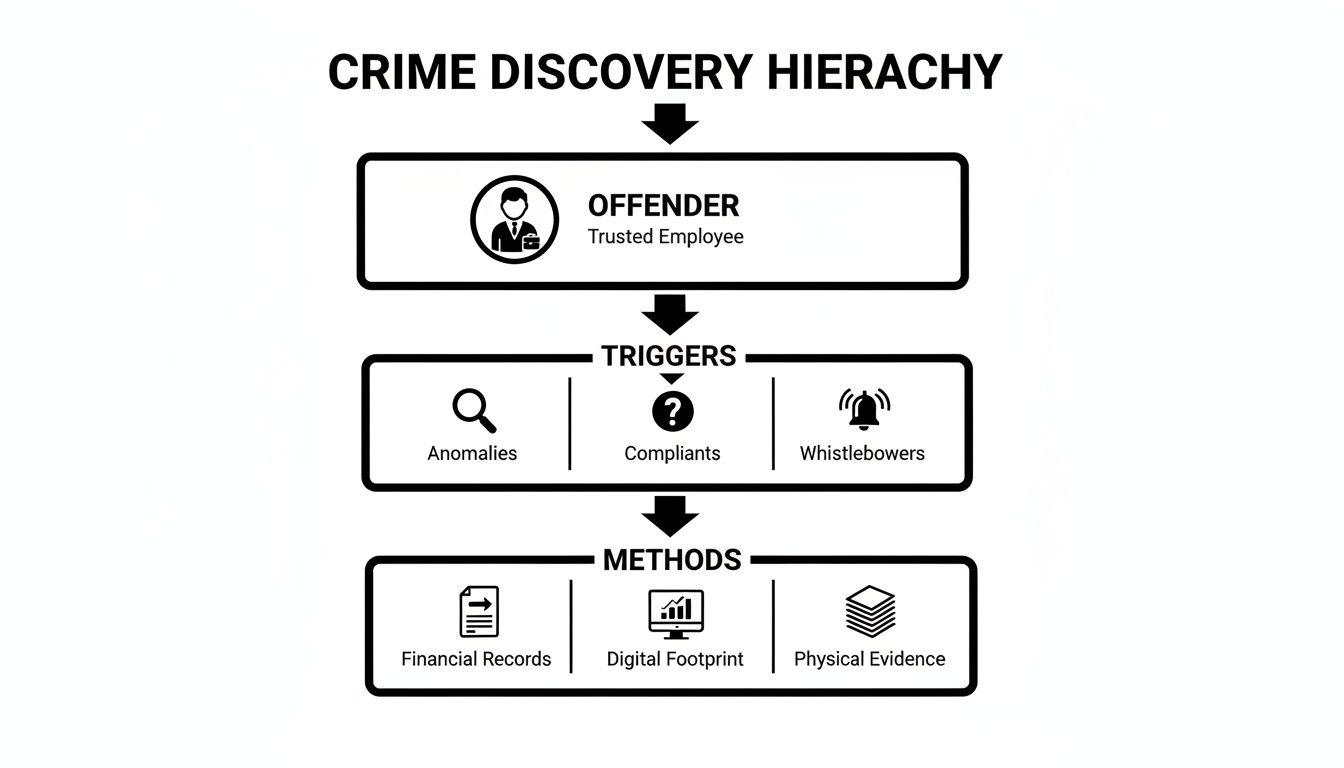
As you can see, an offender's actions trigger discovery, which leads investigators to trace the methods used. This process helps them establish both the criminal act and the intent behind it.
The Far-Reaching Consequences of a Conviction

Most people get their ideas about white-collar crime from the news. They see headlines about huge fines or a CEO getting a prison sentence. But that’s only half the story. The true impact of a conviction is a cascade of consequences that can permanently change a person's life, career, and family’s future.
These penalties fall into two buckets: the direct penalties handed down by a judge and the collateral consequences that quietly follow a person long after the official sentence is served. For anyone facing an investigation, it is important to understand the full picture.
Direct Penalties Imposed by the Court
When a guilty verdict comes in, a judge has several tools to impose punishment. These are the immediate, court-ordered penalties that can be faced.
The most common direct penalties include:
- Incarceration: Jail or prison is a very real threat. The length of the sentence often depends on how much money was involved and how many people were affected.
- Fines: Courts almost always impose heavy monetary fines. These are meant to punish the offender and send a message to the community.
- Restitution: This isn’t a fine paid to the government. Restitution is a court order to pay back every dollar the victims lost.
Restitution is a huge component because the financial damage from these crimes is staggering. The FBI estimates that white-collar crime costs the U.S. over $300 billion a year. Other data shows that the average business loses 5% of its annual revenue to internal fraud. You can learn more about these white collar crime statistics to see just how widespread the problem is.
Collateral Consequences: The Hidden Penalties
As tough as the direct penalties are, it’s often the collateral consequences that do the most lasting damage. These are the “hidden penalties” that aren't part of the official sentence but can feel like a life sentence all on their own. They are the doors that slam shut in a person's professional and personal life, often for good.
A conviction for a financial crime can become a permanent stain on your record, affecting your ability to earn a living, secure housing, and even maintain personal relationships. These consequences are not temporary; they follow you long after any formal sentence is served.
Think about a CPA convicted of fraud. He isn't just looking at jail time and fines. He’s almost guaranteed to lose his CPA license—the foundation of his entire career. This happens across countless professions.
Other major collateral consequences include:
- Loss of Professional Licenses: Doctors, lawyers, financial advisors, and real estate agents can see their licenses revoked.
- Industry Blacklisting: It can be extremely difficult to get another job in the same field.
- Damage to Reputation: A conviction is public. It can destroy a lifetime of personal relationships and professional trust.
- Ineligibility for Federal Benefits: A person could be barred from receiving certain government loans or benefits.
- Challenges with Housing and Credit: A felony record makes it incredibly difficult to rent an apartment, get a mortgage, or even secure a car loan.
The table below breaks down how these consequences play out for some of the most common offenses we see.
Potential Consequences for Common White Collar Offenses
Here’s a look at the range of possible penalties and life impacts associated with different white-collar crime convictions.
| Offense Type | Potential Direct Penalties (Fines, Incarceration) | Common Collateral Consequences |
|---|---|---|
| Embezzlement | Varies based on amount; can range from probation to lengthy prison sentences. Full restitution is usually required. | Loss of employment, professional license revocation (e.g., CPA), difficulty finding roles with financial responsibility. |
| Wire/Mail Fraud | Often federal charges with significant prison time (up to 20 years per count) and heavy fines. | Permanent damage to business reputation, ineligibility for government contracts, industry blacklisting. |
| Tax Evasion | Prison time, steep fines (up to $100,000 for individuals), and payment of back taxes plus interest and penalties. | Loss of professional licenses, damaged credit, public record of conviction. |
| Securities Fraud | Severe penalties including long prison sentences (up to 25 years) and multi-million dollar fines. | Lifetime ban from the securities industry, loss of investment licenses, complete loss of professional credibility. |
As you can see, the consequences of a conviction are deep and far-reaching. It’s not just about what happens in the courtroom—it’s about what happens to the rest of a person's life.
Navigating a White Collar Crime Investigation
That moment when a person realizes they're at the center of a white collar crime investigation is jarring. Their professional life, reputation, and entire future are suddenly under a microscope. It almost never starts with a warning, leaving them feeling completely blindsided and unsure of what to do next.
The first sign something is wrong can show up in a few different ways. A person might get a formal target letter in the mail from the FBI or IRS, which is an official notice that they are the subject of an inquiry. Just as often, investigators might show up unannounced at a home or office, wanting to "just ask a few questions."
Sometimes, the initial alert is less direct. Someone might go to use a debit card and discover their bank accounts are frozen. Or, they could get a call from their bank letting them know they've received a subpoena for their financial records. These aren't just administrative hiccups; they are unmistakable signs that a serious investigation is underway.
First Steps and Critical Decisions
Let's be clear: each of these scenarios is designed to be intimidating. This is a moment where every single decision made has serious consequences. Investigators are highly trained to gather information, and anything said can—and will—be used to build a case. Their job isn't to help clear up a misunderstanding; it's to collect evidence.
The first few hours and days of an investigation are absolutely critical. The choices made right then can set the tone for the entire case and dramatically affect the final outcome. It's a time for clarity, caution, and expert guidance.
The weight of the situation also influences how prosecutors will handle the case. The evidence they gather and whether the subject appears cooperative can shape their decisions, which is all part of what prosecutorial discretion is and how it works. That makes any initial moves even more important.
Getting through this process requires a clear head and a solid plan. If someone has been contacted by law enforcement—or even just suspects they are under investigation—it's important to understand the situation fully.
Frequently Asked Questions About White Collar Crime
After digging into the definitions and examples, it's natural to have more questions about how these cases work in the real world. Here are some straightforward answers to the questions we hear most often.
Can Someone Be Charged if They Did Not Personally Profit from the Act?
Yes, absolutely. The law often focuses on whether there was intent to deceive someone, not whether any cash was pocketed. The heart of the matter is the fraudulent act itself and whether there was knowing participation.
For instance, if someone helped a co-worker falsify company records so they could get a bigger bonus, they could still face charges. Even if they didn't get a dime, their intentional involvement in the deception is what prosecutors will look at.
Are All White Collar Crimes Considered Felonies?
Not all of them, but a lot of the common ones certainly are. Whether an offense is a misdemeanor or a felony usually comes down to the specific crime and, critically, the amount of money involved in the alleged scheme.
A minor fraudulent act might get classified as a misdemeanor. But offenses like large-scale embezzlement, wire fraud, or money laundering are almost always prosecuted as serious felonies, carrying the potential for years in prison and crippling fines.
What Is the Difference Between State and Federal Investigations?
The key differences are jurisdiction and who’s doing the investigating. State investigations are handled by local or state agencies like the Georgia Bureau of Investigation (GBI). These cases involve violations of state laws that took place entirely within the state.
A white collar crime often becomes a federal matter when it crosses state lines, involves a federally insured institution like a bank, or uses federal systems like the U.S. Mail or electronic communications for fraudulent purposes.
Federal investigations, on the other hand, are run by powerful agencies like the FBI, IRS, or Secret Service. These cases typically come with far more resources, a different set of procedural rules, and often, much tougher sentencing guidelines than what you’d see at the state level. Knowing which jurisdiction is in charge is one of the first and most critical pieces of the puzzle.
If you are facing questions or an investigation related to a white collar crime in Alpharetta, Cumming, Johns Creek, or anywhere in Forsyth and Cobb counties, you need clear and immediate answers. Contact Brian Hansford Law for a confidential consultation to understand your situation by visiting us at https://challengemycharge.com.
