
When you see flashing blue and red lights in your rearview mirror, a million questions race through your mind. If you've had anything to drink, one of the first things people search for is "what is DWI," which stands for Driving While Intoxicated.
In Georgia, however, the official legal term you'll see on police reports and in court is DUI, or Driving Under the Influence. It's a small difference in letters but a big deal under the law.
What DWI Actually Means For Georgia Drivers

While people often use DWI and DUI interchangeably in conversation to describe drunk or drugged driving, Georgia law is very specific. Understanding what "under the influence" actually means here is the key.
Many people think a DUI charge is only about alcohol. That's a common and costly mistake. The definition is much broader and covers any impairment that makes you a "less safe" driver, regardless of the substance.
DWI vs DUI At A Glance in Georgia
To clear up any confusion, it helps to see the terms side-by-side. While other states might use DWI, Georgia has consolidated everything under the DUI statute.
| Term | Meaning | Official Georgia Term | Substances Covered |
|---|---|---|---|
| DWI | Driving While Intoxicated | Not Used | Commonly refers to alcohol but varies by state. |
| DUI | Driving Under the Influence | DUI | Alcohol, drugs (prescription, OTC, illegal), or any substance causing impairment. |
Essentially, if you hear someone mention DWI in Georgia, they are almost certainly talking about a DUI charge. The framework and penalties all fall under the DUI umbrella.
The Scope of Impairment in Georgia
The phrase "under the influence" isn't limited to illegal drugs or a few beers. It's a wide-ranging standard that includes anything that can affect your ability to operate a vehicle safely. The core issue is whether your physical or mental faculties are compromised.
This means you could face a DUI charge for impairment caused by:
- Alcohol: This is the most common reason for a DUI arrest.
- Prescription Drugs: You can be charged even if you have a valid prescription. If the medication affects your driving, it counts as impairment.
- Over-the-Counter Medications: Common allergy or cold medicines that cause drowsiness can absolutely lead to a DUI charge.
- Illegal Substances: Any controlled substance that messes with your judgment, coordination, or reaction time is included.
A DUI is a serious criminal charge in Georgia, not just a traffic ticket. The state prosecutes these cases aggressively because of the potential for real harm on our roads.
Why These Charges Are Taken So Seriously
Across the country, impaired driving is one of the most heavily enforced crimes because it is directly linked to roadway deaths and devastating injuries.
According to the National Highway Traffic Safety Administration (NHTSA), in 2023 alone, 12,429 people were killed in crashes involving an alcohol-impaired driver. For drivers in our local communities like Alpharetta, Cumming, and Roswell, a DUI charge immediately places you within this sobering national context. Prosecutors and judges know these statistics well, which is why enforcement is so strict. You can read the full research about these national statistics to understand the bigger picture.
How a DWI Charge Is Proven in Georgia
To really understand what is involved with a DWI charge in places like Cobb or Forsyth County, you have to know how the state builds its case. In Georgia, prosecutors have two main angles they can use to prove someone was driving under the influence.
These two methods are known as DUI Per Se and DUI Less Safe. Think of them as two different roads that both lead to the same place—a potential conviction. Depending on the evidence they find, the arresting officer and prosecutor can try to use one or both of these angles.
The Clear Line of DUI Per Se
The easiest way to think about a DUI Per Se charge is to compare it to a speeding ticket. If the sign says 55 mph and you’re going 65, you’ve broken the rule. It’s that simple. The same logic applies here: if your Blood Alcohol Concentration (BAC) is over the limit, the law says you are, by definition, an impaired driver.
With a DUI Per Se case, the prosecutor doesn't have to prove you were swerving or driving badly. The number is all that matters. If a chemical test—like the breathalyzer or a blood draw—shows your BAC is over the line, the law presumes you were impaired.
Georgia sets different BAC limits depending on who you are:
- Drivers Over 21: The limit is 0.08% BAC.
- Commercial Drivers: For anyone behind the wheel of a commercial truck, the limit is a much stricter 0.04% BAC.
- Drivers Under 21: Georgia has zero tolerance for underage drinking and driving, setting the limit at just 0.02% BAC.
The "Per Se" rule is black and white. Go over that number, and the state’s job gets much, much easier, no matter how steady you thought your driving was.
The Judgment Call of DUI Less Safe
Now, let's look at the "Less Safe" approach. This one is more of a judgment call. It’s like getting a ticket for reckless driving even if you weren’t speeding—the officer believes your actions were dangerous, regardless of the numbers.
A DUI Less Safe charge means the state is arguing that alcohol or drugs made you a less safe driver, even if they don't have a BAC reading over the limit. This is the go-to charge when someone refuses a chemical test, or when the substance involved isn't alcohol but a drug that a breathalyzer can’t detect.
The core of a 'Less Safe' case is the total picture of impairment. It relies on the officer's observations and other evidence to show that your ability to drive safely was compromised.
To build a Less Safe case, the prosecutor pieces together a puzzle of evidence, including things like:
- Driving Behavior: Were you weaving, driving too slow, braking erratically, or forgetting to use your turn signal?
- Physical Appearance: The officer will note things like bloodshot eyes, a flushed face, or fumbling to get your license out.
- Speech Patterns: Slurred words or incoherent answers are classic pieces of evidence mentioned in police reports.
- Field Sobriety Test Performance: How you did on tests like the walk-and-turn or one-leg stand will be used to argue you lacked the coordination and balance to drive safely.
Understanding both the Per Se and Less Safe angles is critical. It shows that a DUI case in Georgia isn’t always about a number on a machine. It can be built entirely on an officer’s observations and interpretation of your behavior, from the second they first saw your car.
Understanding Field Sobriety and Chemical Tests

If you get pulled over for a suspected DWI or DUI in places like Marietta or Johns Creek, the officer's investigation isn't just a simple conversation. It typically involves two kinds of tests designed to gather evidence that you’re impaired.
First, you’ll likely face Standardized Field Sobriety Tests (SFSTs), which are roadside physical and mental exercises. After that comes the request for chemical tests, which are designed to measure the amount of alcohol or drugs in your body. Knowing how both work is crucial to understanding what unfolds during a traffic stop.
What Are Field Sobriety Tests?
Field sobriety tests are a set of three specific exercises that police use to gauge a driver's level of impairment. They aren't just random activities; they are designed to test your balance, coordination, and ability to divide your attention between mental and physical tasks.
The three SFSTs approved for use are:
- Horizontal Gaze Nystagmus (HGN) Test: The officer holds an object, like a penlight or a finger, and asks you to follow it with just your eyes. They’re watching for an involuntary jerking of your eyes, which they are trained to believe is an indicator of intoxication.
- Walk-and-Turn Test: This is a classic "divided attention" test. You'll be instructed to take nine steps, heel-to-toe, down a straight line, turn around in a very specific way, and then walk nine steps back.
- One-Leg Stand Test: Just like it sounds, you will be told to stand on one foot, raise the other foot about six inches off the ground, and count out loud for roughly 30 seconds.
It is critical to remember that these tests are far from perfect. So many things besides alcohol or drugs can throw off someone's performance.
An officer is trained to look for specific "clues" during these tests, but perfectly sober individuals can struggle with them due to nerves, a pre-existing medical condition, age, physical injuries, or even wearing certain types of footwear.
Something as simple as confusing instructions or an uneven, poorly lit spot on the side of the road can also cause an officer to misinterpret your actions as signs of impairment. These external factors are exactly the kinds of details that are scrutinized when examining a DWI case.
Chemical Tests and Implied Consent
After the field sobriety tests, if an officer believes they have probable cause, they will almost certainly request a chemical test. These are the more "scientific" tests that measure the concentration of alcohol or other substances in your system, most commonly through breath, blood, or urine samples.
This is where a huge concept in Georgia law comes into play: Implied Consent. Simply by having a Georgia driver’s license, you have already given your consent to take a state-administered chemical test if you are lawfully arrested for DUI.
Now, this doesn't mean you are physically forced to take the test. You can still refuse. But refusing comes with its own serious administrative consequences, which are completely separate from the criminal DWI charge. Refusing a chemical test triggers an automatic driver's license suspension—an administrative penalty from the Georgia Department of Driver Services. For a deeper look, you can learn more about Georgia’s implied consent law and what happens if you refuse a chemical test in our detailed guide.
This distinction is crucial. Even if the criminal DWI charge is reduced or dismissed, the license suspension for refusing the test can still stand on its own. It’s a perfect example of how a single DWI stop can create multiple layers of issues.
The Full Impact of a DWI Conviction

When facing a DWI charge in Georgia, it’s easy to get tunnel vision and focus only on the upcoming court date. But a conviction isn't a single event that’s over and done with when you walk out of the courtroom. It’s the start of a long, branching path of consequences that can touch nearly every part of your life.
These penalties are designed to be serious, reflecting the state’s tough stance on impaired driving. Understanding the full picture of what’s at stake is a critical first step in grasping the gravity of the situation.
Immediate Court-Ordered Penalties
For a first-time DWI (or DUI) conviction in Georgia, the court doesn’t have unlimited flexibility. It has to impose a set of mandatory minimum penalties. A judge has some discretion, but they simply cannot go below these legally required minimums. These are the direct consequences you’ll face right away.
The typical penalties include:
- Jail Time: Even for a first offense, you’re looking at 24 hours to 12 months behind bars.
- Fines: The base fine usually runs from $300 to $1,000, but that’s not the whole story. Once court costs and various surcharges get tacked on, the total amount you owe can swell dramatically.
- Community Service: You will be required to complete at least 40 hours of community service.
- DUI Risk Reduction Program: You must enroll in and complete a state-approved course, often called "DUI School," and you have to pay for it yourself.
These penalties are just the opening act. They represent the direct punishment from the criminal justice system, but they’re followed by a host of other consequences that can last for years.
The Long-Term Ripple Effects
Beyond the initial fines and community service, a DWI conviction sends ripples through your life that can cause disruptions for years to come. These are the consequences that most people don’t think about until it's too late, and they often end up being the heaviest burden to carry.
One of the most damaging impacts is on your criminal record.
A DWI in Georgia is a criminal offense, not a simple traffic ticket. A conviction will result in a permanent criminal record that can be seen by future employers, landlords, and anyone else who runs a background check.
This permanent mark can trigger a cascade of other challenges down the road. You can explore a more detailed breakdown of these far-reaching effects by reading our guide on the long-term consequences of a drunk driving charge.
Financial and Professional Fallout
The financial pain of a DWI conviction goes far beyond what you pay in court fines. It's a long-term economic blow that can be surprisingly costly.
Drastic Insurance Increases
After a conviction, your car insurance provider will immediately reclassify you as a high-risk driver. As a result, your premiums can double, triple, or even more. This massive increase isn't a temporary slap on the wrist; it can last for several years, costing you thousands of extra dollars over time.
Employment Challenges
Having a DWI on your record can throw up significant roadblocks in your career.
- Jobs Requiring Driving: If your job involves driving a company car or making deliveries, you could be terminated or find yourself ineligible for hire.
- Professional Licenses: Certain licensed professionals—think nurses, pilots, or commercial drivers—may face disciplinary action from their licensing boards. This could lead to a suspension or even a full revocation of the license you worked so hard to earn.
- Background Checks: More employers than ever conduct background checks, and a recent DWI conviction is a major red flag that could cost you a great job opportunity.
The total impact of a DWI conviction in areas like Forsyth County, East Cobb, or Alpharetta is immense. It's a powerful combination of immediate penalties and long-lasting personal, financial, and professional hardships that truly underscore why these charges are taken so seriously.
Common Defenses Explored in Every DWI Case
A DWI arrest in Georgia isn't the final word—it's just the beginning of a very detailed process. When a case is examined, the goal isn't to look for some magic loophole. The purpose is to make sure every single step of the arrest was done by the book and that the evidence is actually reliable.
This means putting the entire interaction under a microscope, from the moment you saw flashing lights in your rearview mirror to the final breath or blood test. Every detail matters, because a case can turn on whether the officer followed standardized protocols at each and every stage.
The Reason for the Traffic Stop Itself
The whole case hinges on one simple question: did the officer have a legitimate reason to pull you over in the first place? Here in Georgia, whether you're in Milton or Marietta, an officer can't just stop a car based on a hunch.
They need what the law calls "reasonable articulable suspicion"—a fancy way of saying they must be able to point to specific, observable facts that made them believe a crime or traffic violation was happening.
Some common reasons officers use to justify a stop include:
- Obvious Traffic Violations: Things like speeding, running a red light, or failing to stay in your lane are clear-cut reasons.
- Erratic Driving: Weaving, even within your lane, braking for no reason, or driving way too slow can also be enough to raise suspicion.
- Vehicle Equipment Problems: A broken taillight or an expired tag is a perfectly valid reason for an officer to initiate a traffic stop.
If the initial stop was invalid, any evidence gathered after that moment can potentially be thrown out. This is often the first and most critical area to investigate in any DWI arrest.
Putting the Field Sobriety Tests Under Scrutiny
As we've discussed, the Standardized Field Sobriety Tests (SFSTs) are a huge piece of the puzzle in "Less Safe" DWI cases. But here's the thing: their results are only as good as the way they were administered.
The National Highway Traffic Safety Administration (NHTSA) has incredibly strict, standardized procedures for how officers are supposed to instruct and score these tests. If the officer deviates from the script in any way, the results can be compromised.
An officer's failure to follow the exact, standardized instructions for a field sobriety test is a major weak point. For instance, if they mumble the directions or make you perform the test on a sloped or uneven surface, the results may not be a fair reflection of your abilities at all.
This is exactly why dashcam and bodycam footage is meticulously reviewed. It’s often the best evidence of what really happened on the side of the road.
Was the Chemical Test Equipment Reliable?
When a case involves a "Per Se" charge, meaning it's based on your BAC reading, the accuracy of the testing machine is everything. Breathalyzer machines aren't perfect; they are sensitive pieces of equipment that need constant maintenance and calibration to work right.
For a breath test to hold up in court, a few key things need to be confirmed:
- Was the machine recently and properly calibrated according to Georgia's regulations?
- Was the officer who ran the test properly certified to do so?
- Was the machine’s software current and free of any known glitches?
The same level of scrutiny applies to blood tests. The entire process is reviewed, from ensuring the blood was drawn by qualified medical personnel to confirming the chain of custody. This is the paper trail that documents every single person who handled the blood sample. Any gap or mistake in that chain can call the integrity of the entire sample into question.
Figuring out the best way to challenge this evidence is a crucial part of building a strong defense, and you can learn more about the different strategies for how to approach DUI charges in Georgia. Analyzing these procedural details is fundamental to how every single DWI case is reviewed.
What to Do Immediately After a DWI Arrest
The hours and days following a DWI arrest are often a blur of confusion and anxiety. While every case is different, knowing which steps to take—and when—can help you get organized and start protecting your rights. This isn't just about waiting for a court date; there are critical administrative deadlines that can affect your driver's license long before your criminal case ever sees a courtroom.
One of the most urgent deadlines in Georgia is what's known as the "30-day rule." You have just 30 days from the date of your arrest to request an Administrative License Suspension (ALS) hearing. If you miss this window, your driver's license will likely be automatically suspended. It's a separate process from your criminal charge, and it moves fast.
A thorough DWI defense involves looking at every stage of the process, from the initial stop to the final evidence gathered.
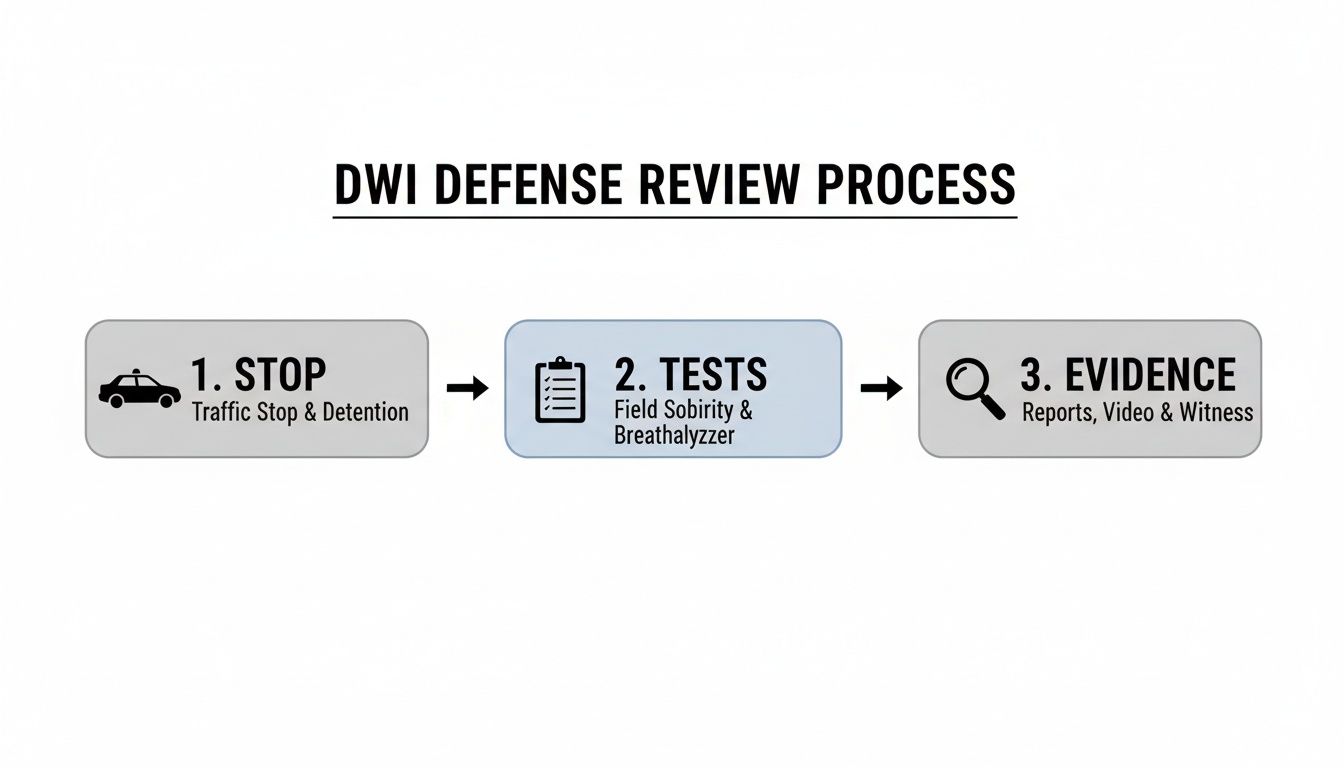
As this shows, a strong defense starts by reviewing the traffic stop itself and then carefully analyzing the tests and evidence that followed.
Document Everything While It’s Fresh
Your memory is one of your most valuable assets right now, but details fade quickly. Take the time to write down everything you can remember about the arrest as soon as possible.
The goal is to build a clear, detailed timeline from your point of view. This personal account can be incredibly useful later when recalling specific facts.
Try to capture these key details:
- The Traffic Stop: Why did the officer say they pulled you over? Where were you, and what time did it happen?
- The Conversation: What questions did the officer ask? How did you respond?
- The Tests: What do you remember about the field sobriety tests or any chemical tests (breath, blood, urine)? Did the officer give clear instructions? Where were the tests performed?
- The Timeline: Jot down the sequence of events from the moment you were pulled over until you were released. Note any long waits or gaps in time.
Beyond writing things down, you need to gather all your paperwork. This means your citation, any bond or release forms, and especially the temporary driving permit and notice of license suspension (Form DS-1205). Keep everything together in one safe place so it's easy to find.
To help you stay on track during this critical time, here is a simple checklist of immediate action items.
Post-Arrest Action Checklist
| Action Item | Why It's Important | Key Deadline/Note |
|---|---|---|
| Request ALS Hearing | This is the only way to fight the automatic suspension of your driver's license. | Strictly 30 days from your arrest date. |
| Write Down Everything | Your memory of events is crucial evidence that can fade over time. | Do this within 24-48 hours for the best recall. |
| Organize All Paperwork | Keep your citation, bond papers, and Form DS-1205 in a single, safe place. | Crucial for your first meeting with an attorney. |
| Contact a DWI Attorney | An experienced attorney can explain the process and protect your rights from day one. | The sooner, the better, especially with the 30-day rule looming. |
Taking these steps provides a solid foundation for building your defense.
Finally, the most important step you can take is to speak with a criminal defense attorney who handles DWI cases every day in your area—whether that's Alpharetta, Cumming, Forsyth County, or Cobb County. An attorney can review the facts of your case, explain what to expect, and give you clear, straightforward information to make informed decisions.
Common Questions About Georgia DWI Charges
When you're stopped for a DWI, your mind is probably racing with questions. It's a confusing and stressful situation. Below are answers to some of the most frequent questions we hear from good people in communities like Alpharetta, Roswell, and Marietta.
Can I Really Get a DWI for My Prescription Medication?
Yes, you absolutely can. This is a huge point of confusion for many drivers. They assume that because a doctor prescribed the medication, they're automatically in the clear. That's not how Georgia law works.
Georgia's DUI law is built around the concept of being a "Less Safe" driver. It doesn't matter if the substance that's impairing you is alcohol, an illegal drug, or a perfectly legal prescription. If that medication affects your ability to drive safely—maybe it causes drowsiness, slows your reaction time, or hurts your coordination—you can be charged. The prosecutor's focus won't be on the prescription, but on whether you were safe behind the wheel.
What’s the Difference Between the Court Case and the ALS Hearing?
A DWI arrest in Georgia actually kicks off two separate processes that run at the same time. It's critical to understand that they are independent of each other.
-
The Criminal Court Case: This is the one everyone thinks about. It's where you face the criminal charge of DUI. The potential outcomes here involve things like fines, probation, community service, and possibly jail time. This is where the charge itself is handled.
-
The Administrative License Suspension (ALS) Hearing: This process is completely separate and is handled by the Department of Driver Services. Its only concern is your driver's license. After an arrest, you have just 30 days to request this hearing to challenge the automatic suspension of your license. Miss that deadline, and your license is suspended, no questions asked.
It's possible to win your criminal case but still lose your license in the ALS hearing, or the other way around. You have to address both fronts, and each requires a distinct strategy.
I Have an Out-of-State License. Will a Georgia DWI Affect Me?
Almost certainly, yes. Don't think you can just go home and forget about it. Georgia is part of the Driver License Compact, which is an agreement between most states to share information about traffic offenses and license suspensions.
What this means is that a DWI conviction or license suspension from Forsyth County or Cobb County will be reported straight to your home state's DMV. Your home state will then likely take action against your license according to its own laws, which could be just as bad—or even worse—than Georgia's penalties. A Georgia arrest will follow you home.
Facing a DWI charge is overwhelming, but you don't have to figure it out alone. With over 25 years of experience, including time as a prosecutor, this firm understands the system from both sides. At Brian Hansford Law, they're here to protect your rights and fight for the best possible result for you in Alpharetta, Cumming, and across North Georgia. To talk about your case, get in touch with them at https://challengemycharge.com.
