
When law enforcement conducts a search that violates your constitutional right to privacy, it's considered an illegal search and seizure. This usually happens when the police search your property—whether it's your home, car, or person—without a valid warrant or a legitimate reason recognized by law. If a search is deemed illegal, any evidence they collect can often be thrown out of court.
Understanding an Illegal Search and Seizure

Think about someone just walking into your home in Alpharetta or Cumming and rummaging through your personal belongings without permission. That feeling of violation is the very heart of what an illegal search is. This protection isn't just for your house; it covers your vehicle, your papers, and even your digital devices.
This fundamental right comes from the Fourth Amendment to the U.S. Constitution, which protects citizens from "unreasonable searches and seizures." In practice, it acts as a privacy shield between you and the government. For a search to be considered "reasonable" and lawful, law enforcement almost always needs one of two things:
- A Valid Search Warrant: This is a document signed by a judge. To get one, the police must show there is probable cause to believe a crime has occurred and that evidence of that crime will be found in the specific place they want to search.
- A Recognized Exception: The law carves out a few specific situations where police can search without a warrant. The most common examples include getting your clear consent or facing an emergency situation where there's no time to get a warrant.
When law enforcement steps over these lines, the search is no longer lawful—it becomes an illegal search and seizure.
The Core of the Issue
At its core, the Fourth Amendment is about preventing government overreach. It ensures police can't just invade your privacy based on a hunch or vague suspicion. They need a solid, factual reason for their actions. This principle is a cornerstone of the justice system, protecting everyone from Forsyth County to East Cobb from the government intruding where it doesn't belong.
The feeling of overreach is a real concern for many people. According to the Bureau of Justice Statistics, while only about 3.5% of drivers in police stops reported being searched, the circumstances were often questionable. Of those who were searched, more than 40% said officers never even asked for permission, and a staggering 61% felt the search was illegitimate. These numbers highlight a widespread belief that these actions may have violated Fourth Amendment protections. You can dig deeper into data related to search and seizure statistics.
An illegal search is like a foul in a football game. When a player breaks the rules to gain an advantage, the play gets called back. Similarly, when the police break the rules of a search, any evidence they find is often disallowed in court.
Understanding this concept is the first step in knowing your rights. It draws a clear line between a justified investigation and an unconstitutional intrusion—a line that is critically important in any interaction with police in communities from Roswell to Marietta.
Lawful vs. Potentially Illegal Searches at a Glance
To make this even clearer, it helps to see the key differences side-by-side. This table breaks down what separates a search that's generally above-board from one that could be challenged in court.
| Element | Generally Lawful Search | Potentially Illegal Search |
|---|---|---|
| Justification | Based on a valid search warrant or probable cause combined with a recognized exception. | Lacks a warrant and probable cause; based on a hunch, profiling, or a vague suspicion. |
| Scope | Limited to the specific people, places, and items listed in the warrant or justified by the situation. | Exceeds the scope of the warrant (e.g., searching a house when the warrant is for the car) or goes beyond the consent given. |
| Consent | Freely and voluntarily given by someone with the authority to do so, without coercion. | Obtained through threats, intimidation, or by misleading someone about their right to refuse. |
| Exigent Circumstances | A genuine emergency exists, like preventing the destruction of evidence or a suspect's escape. | No real emergency; the situation is used as a pretext to bypass the warrant requirement. |
Remember, every situation is unique, and the line between lawful and illegal can be complex. But knowing these core differences gives you a powerful framework for understanding your rights.
Your Fourth Amendment Privacy Shield

It’s helpful to think of the Fourth Amendment as your personal privacy shield. The nation’s founders wrote it because they deeply distrusted unchecked government power. They wanted to make absolutely sure that ordinary citizens were secure in their own homes and with their personal belongings.
This isn’t just some abstract idea from a history book. It’s a vital safeguard that applies directly to your encounters with law enforcement right here in places like Alpharetta, Johns Creek, and Cobb County.
The amendment specifically protects your "persons, houses, papers, and effects" from government intrusion. It draws a clear line, making sure police can’t just interfere with your life on a whim. The entire principle boils down to one critical word: any government search must be reasonable.
What Does "Reasonable" Mean in Practice?
That word, "reasonable," is the key to understanding illegal search and seizure. While it might sound a little vague, it has a very specific meaning in a court setting. A search is generally considered reasonable when it is backed by probable cause.
Probable cause is much more than a gut feeling or a hunch. An officer needs a solid foundation of facts and circumstances that would lead any reasonable person to believe a crime has been committed, and that evidence of that crime will be found in the specific place they want to search.
The Fourth Amendment states: "The right of the people to be secure in their persons, houses, papers, and effects, against unreasonable searches and seizures, shall not be violated, and no Warrants shall issue, but upon probable cause…"
This means an officer can't just pull you over in Roswell and search your car because they "think" you look suspicious. They need specific, factual reasons to point to criminal activity. This requirement is what gives your privacy shield its strength.
The Expectation of Privacy
Another crucial piece of your Fourth Amendment protection is the "reasonable expectation of privacy." This standard helps figure out where your privacy shield is strongest. Certain areas get the highest level of protection, no question.
- Your Home: This is the most sacred space. Law enforcement almost always needs a warrant to set foot inside your house or apartment to conduct a search.
- Your Body and Clothing: You have a very high expectation of privacy in your own person.
- Private Communications: Your phone calls, texts, and emails are generally protected from prying eyes.
- Enclosed Areas: A locked glove box in your car or a zipped-up backpack has a much higher expectation of privacy than something left out in plain sight on the passenger seat.
Understanding where you have a legitimate expectation of privacy is everything. It dictates when and how law enforcement must get a warrant before they can start searching.
The fight against illegal searches isn't new; it’s been a known problem for nearly a century. A historical study from the Yale Law Journal looking at early 20th-century policing found that by 1933, there were an estimated 3.5 million illegal arrests in the U.S. in a single year. To combat abuses like these, the Supreme Court ruled in 1961 that state courts had to exclude illegally obtained evidence from trials. This "exclusionary rule" was extended nationwide to ensure that evidence from an illegal search and seizure couldn't be used against someone in court.
Recognizing Search Scenarios in Real Life
It’s one thing to read about search and seizure principles, but it's another thing entirely to see how they play out in the real world. These concepts don’t just live in law books; they come up during routine, everyday encounters with police right here in our communities. Trying to figure out the difference between a lawful request and a potential illegal search in the heat of the moment can be incredibly tough.
Let's walk through some of the most common situations where searches happen in places like Cumming, Johns Creek, and Milton. By looking at these scenarios, you can get a much clearer idea of how your rights actually work in practice.
The Routine Traffic Stop
Imagine you're driving home in Roswell and see those flashing blue lights in your rearview mirror. You get pulled over for a broken taillight—a completely valid reason for a traffic stop. After dealing with the citation, the officer asks, "Hey, you mind if I have a look inside your car?"
This is a critical moment. Being stopped for a minor traffic violation doesn't automatically give an officer a green light to search your vehicle. Without a warrant or probable cause to believe there’s evidence of another crime inside, the officer needs your voluntary consent to go any further.
- Lawful Scenario: The officer smells a strong odor of marijuana coming from the car or sees what appears to be drugs in plain sight on your passenger seat. This could establish probable cause, potentially allowing a search without your consent.
- Potentially Illegal Scenario: The officer has zero reason to suspect any criminal activity beyond that broken taillight. If they pressure you into saying "yes" or conduct a search after you’ve clearly said "no," that search could be thrown out as illegal.
The distinction here is huge. The initial reason for the stop—the taillight—justifies the stop itself, but it doesn't provide a blank check for a full-blown search of your car.
Police Knocking on Your Door
Here’s another common one: police officers show up at your home in Marietta or Forsyth County. Maybe a neighbor called in a noise complaint, or they're investigating something that happened down the street. An officer knocks and asks if they can come inside to "look around."
Your home has the highest level of Fourth Amendment protection. Unless the police have a warrant or there's a genuine emergency—like hearing someone inside crying for help—they cannot enter without your permission.
Just like a traffic stop, a knock on the door is a request, not a command. You are generally not obligated to open your door or consent to a search just because law enforcement is present.
Giving consent for police to search your home means you're waiving significant privacy rights. If you agree, anything they find in the areas you let them search can potentially be used as evidence against you. Simply refusing to consent is how you preserve your constitutional protections.
Encounters in Public Spaces
What about when you’re just walking through a park in East Cobb or standing on a public street corner in Alpharetta and an officer approaches you? While your expectation of privacy is lower in public than in your home, that doesn’t mean your rights disappear.
An officer can always approach you and ask questions. But for them to physically stop and frisk you (what's known as a "Terry frisk"), they need reasonable suspicion that you are involved in criminal activity and that you may be armed and dangerous. This is a step above a simple hunch, but it's less than the probable cause needed to make an arrest.
A search in this context has to be limited. A frisk is supposed to be a pat-down of your outer clothing to check for weapons, not a full-on search of your pockets for other items. If an officer feels something that is clearly not a weapon but removes and examines it anyway, that could cross the line into an illegal search and seizure. In these public encounters, every single detail matters when a court decides if a search was justified.
When Police Can Search Without a Warrant
The Fourth Amendment is our shield against unreasonable searches, and that shield is strongest when it comes to the warrant requirement. But like any rule, there are important exceptions. These aren't loopholes; they're specific, court-recognized situations where the need to act quickly or other circumstances make getting a warrant impractical.
Understanding these exceptions is the key to knowing the difference between a lawful search and one that violates your rights. These situations come up constantly in real life, from traffic stops in Milton to police calls in Marietta.
Giving Your Consent
One of the most common ways police can search without a warrant is simple: they ask, and you say yes. If an officer asks to search your car, your home, or your pockets, and you freely agree, you have just given consent.
When you give consent, you are temporarily waiving your Fourth Amendment protections for that specific search. The critical part here is that your consent must be voluntary—it can't be the result of threats, intimidation, or coercion.
For the consent to be valid, the person giving it must also have the authority to do so. A driver can consent to a search of their car, for example, but a passenger usually can't give permission for officers to search the entire vehicle.
This flowchart maps out some of the common decision points in different search scenarios.
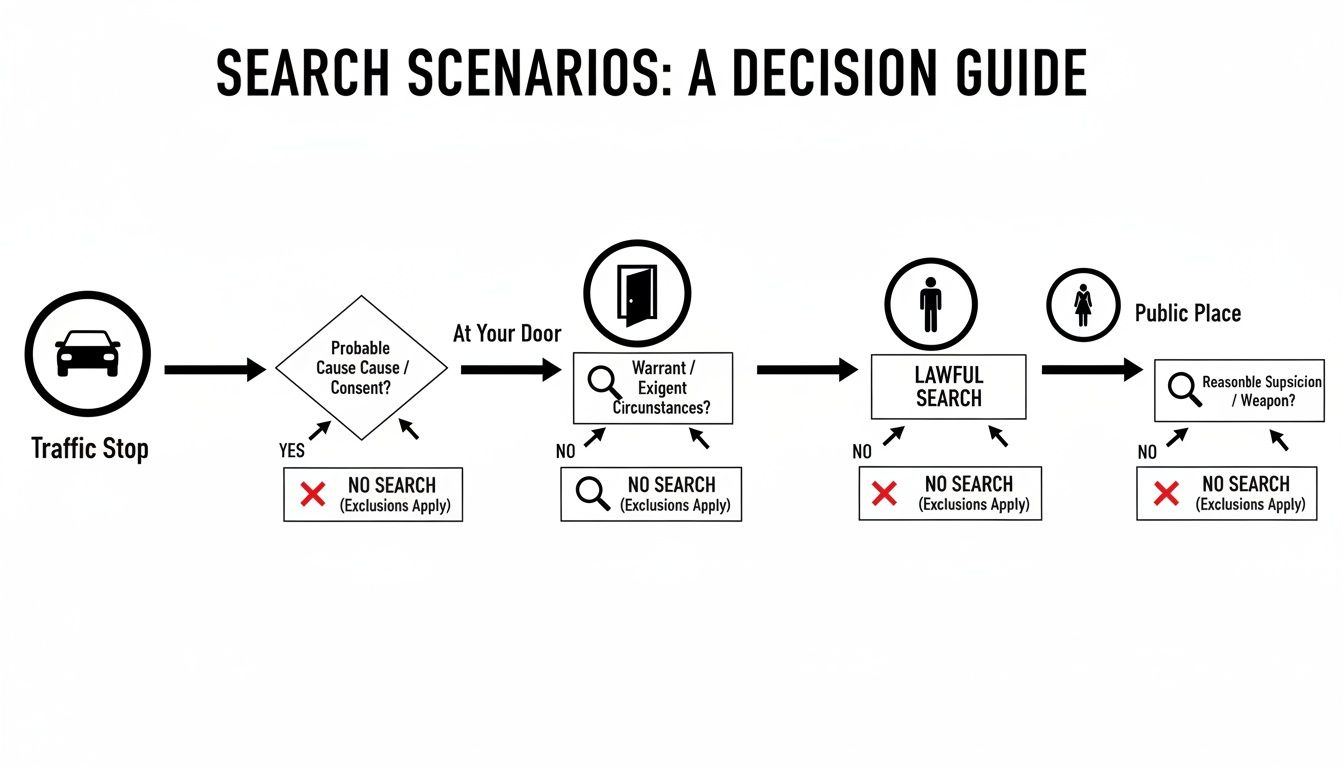
As you can see, a simple "yes" or "no" can send an encounter down a completely different path.
The Plain View Doctrine
Another major exception is the plain view doctrine. This rule is exactly what it sounds like: if an officer sees evidence of a crime out in the open from a place they are lawfully allowed to be, they can seize it without a warrant.
Think about a routine traffic stop in Cumming. If an officer pulls you over for speeding and sees illegal drugs sitting on the passenger seat while standing by your window, they can seize that evidence. The key is that the officer was in a lawful position when they saw it.
The plain view doctrine isn't a license to rummage. An officer cannot move things around to get a better look or open a closed container just to see what’s inside. The incriminating nature of the item must be immediately apparent.
This doctrine simply means officers don't have to ignore obvious criminal activity happening right in front of them.
Search Incident to a Lawful Arrest
When police make a lawful arrest, they are allowed to conduct a search of the person and the area immediately around them. This is called a search incident to a lawful arrest.
There are two main reasons for this rule:
- Officer Safety: Police need to check for weapons the person could use to harm them.
- Preservation of Evidence: It prevents the arrested individual from destroying or hiding evidence related to the crime.
If someone is arrested in Roswell, an officer can search their pockets, their backpack, and the "grab zone" within their immediate control at that moment. The search is tied directly to the arrest itself.
Exigent Circumstances
Finally, exigent circumstances create another powerful exception to the warrant rule. This term refers to emergency situations where police must act immediately, leaving no time to go before a judge and get a warrant.
These are high-stakes scenarios where waiting would lead to danger or the loss of critical evidence.
A few key exceptions are worth knowing, as they come up more often than you might think.
Key Exceptions to the Warrant Rule
| Exception | What It Means | Common Example |
|---|---|---|
| Consent | You voluntarily give an officer permission to search. | An officer asks, "Do you mind if I look in your trunk?" and you say, "Sure, go ahead." |
| Plain View | Evidence of a crime is clearly visible from a lawful vantage point. | During a traffic stop, an officer sees a bag of marijuana on the car's floorboard. |
| Search Incident to Arrest | A search of the arrested person and their immediate surroundings. | After being arrested for shoplifting, an officer searches your pockets and backpack. |
| Exigent Circumstances | An emergency situation requires immediate action. | Police hear screams from inside a house and enter to check if someone is in danger. |
| Automobile Exception | A vehicle can be searched if there is probable cause to believe it contains evidence of a crime. | An officer smells a strong odor of marijuana coming from a car and has reason to believe more is inside. |
These exceptions are not blank checks for law enforcement. If police in Marietta enter a home claiming an emergency, they must be able to prove that a genuine, time-sensitive crisis existed. Courts look very closely at these situations to make sure the "emergency" wasn't just an excuse to bypass the warrant process.
So, what happens when a court decides a search was illegal? It's not just a procedural hiccup for the police; it's a critical turning point that can completely reshape a criminal case. This is where a safeguard known as the Exclusionary Rule comes into play.
Think of it like this: if law enforcement finds evidence by breaking the rules, that evidence is considered tainted. It’s essentially "fruit from a poisonous tree." No matter how incriminating the evidence might seem, the way it was obtained was unlawful. Because of that, the evidence is unusable in court.
This rule is the system’s most powerful tool for protecting Fourth Amendment rights. It takes away the incentive for police to conduct illegal searches because they know anything they find will be thrown out, making their efforts worthless for the prosecution.
Using a Motion to Suppress Evidence
The mechanism used to challenge illegally obtained evidence is a Motion to Suppress. It's a formal request filed with the court, asking the judge to prohibit the prosecution from using specific evidence because it was gathered in violation of constitutional rights.
Filing this motion kicks off a hearing where both sides make their case. A defense team will lay out exactly why the search was unconstitutional, and the prosecutor will try to argue that it was lawful. The judge then weighs the arguments and makes a decision.
A successful Motion to Suppress can be a game-changer. If key evidence is thrown out, the prosecution’s case can weaken dramatically—sometimes to the point where it falls apart entirely.
This isn't a minor technicality; it’s a fundamental check on government power. When evidence is successfully suppressed, it can lead to a few different outcomes:
- Reduced Charges: Without their strongest evidence, prosecutors might be forced to offer a plea bargain for a much less serious offense.
- Case Dismissal: If the suppressed evidence was the only thing tying a person to the crime, the prosecution may have no choice but to drop the case altogether.
This process ensures that the protections guaranteed by the Constitution have real teeth. To learn more about how this works, you can read our detailed guide explaining the definition of the exclusionary rule.
The "Fruit of the Poisonous Tree" Doctrine
The exclusionary rule doesn't stop with just the initial evidence found. It extends even further through a concept called the "fruit of the poisonous tree" doctrine. This means that not only is the direct evidence from an illegal search thrown out, but so is any additional evidence discovered as a result of that first illegal act.
For example, imagine police illegally search a car in Johns Creek and find a key to a storage unit. They then use that key, open the unit, and find more evidence inside. That secondary evidence is also considered "fruit of the poisonous tree." Because the key (the tree) was found illegally, everything that came from it (the fruit) is also tainted and can be suppressed.
Concerns about illegal searches are very real, especially with today's aggressive police tactics and the rise of digital device searches. A landmark 1985 study of warrant hearings revealed something startling: judges decided 65% of warrant applications in about 2.5 minutes or less, with a median review time of just 2 minutes and 12 seconds. That raises serious questions about how thoroughly probable cause is actually being reviewed.
For anyone in Alpharetta, Roswell, Marietta, or Cumming arrested after a home raid or phone search, these numbers show exactly why every detail of a warrant affidavit needs to be scrutinized. You can explore more about these findings on unwarranted warrants.
The Role of a Criminal Defense Attorney

Trying to figure out what makes a search and seizure illegal is incredibly tough without deep knowledge of this area of law. This is exactly where an experienced criminal defense attorney steps in, becoming a critical shield for individual rights when facing a tough situation. They provide a much-needed layer of scrutiny over law enforcement's actions.
Think of an attorney as a detective working for their client. They dig into the tiny details that most people would completely overlook. This means combing through police reports for inconsistencies, watching body camera footage frame by frame, and dissecting the exact wording of a search warrant to find procedural mistakes or constitutional oversteps.
This kind of professional analysis is vital for anyone who feels their rights were crossed during an encounter with the police. It’s the single most effective way to start building a strong defense.
Uncovering Critical Flaws in the Case
The small details of a police search can make or break a criminal case. A skilled defense attorney knows exactly what to look for when they review the evidence and the specific circumstances of the search.
Here are some key things that are often investigated:
- Warrant Validity: Was the search warrant actually based on solid probable cause, or was it just issued on a flimsy hunch?
- Scope of the Search: Did the officers stick to the areas the warrant allowed, or did they go exploring in places they weren't supposed to?
- Consent Issues: Was the consent to a search truly voluntary, or did the person feel pressured or intimidated into agreeing?
- Procedural Errors: Did law enforcement follow every single required step when they got and executed the warrant?
Finding problems in these areas is often the first step toward getting the prosecution's evidence thrown out. An attorney can spot a seemingly minor mistake that could completely unravel the case.
The difference between a valid search and an illegal one can hinge on the smallest details—a signature missing from a warrant, a fact misrepresented in an affidavit, or a search that goes one step too far.
If you're facing charges in places like Alpharetta, Roswell, or anywhere in Cobb and Forsyth County, getting a professional to examine every angle of the case is important. Knowing the key factors involved in how to find a criminal lawyer can be a crucial first move. An experienced attorney brings a deep knowledge of Fourth Amendment law and local court procedures to the table, making sure every possible defense is explored. This level of review is what truly protects constitutional rights.
Answers to Common Search and Seizure Questions
The laws surrounding police searches can feel complicated and intimidating. To help bring some clarity, here are a few straightforward answers to the questions we hear most often from folks in communities like Alpharetta, Cumming, and across Forsyth and Cobb counties.
Can I Say No If Police Ask to Search My Car or Home?
Yes, absolutely. If an officer does not have a search warrant, you have the right to refuse their request to search your property, whether it's your car or your home.
You don't need a prepared speech. A simple, polite, and clear statement like, "I do not consent to a search," is all that's required. If you give them consent, you’re essentially waiving your Fourth Amendment rights for that search. While they might still be able to search if they have probable cause or another exception applies, refusing consent is crucial to preserving the ability to challenge the search later.
What if I Believe I Was Searched Illegally?
The most important thing to do is to not physically resist the officers, even if you are certain the search is unlawful. Instead, stay calm and be a good witness.
Take mental notes of everything: the officers' names, what they say, and exactly what they do. As soon as you can, write down every detail you can remember. Your very next step should be to call a criminal defense attorney who can analyze what happened and figure out if constitutional rights were violated.
It's critical to remember that for consent to be valid, it must be given voluntarily. If you felt pressured, intimidated, or coerced into agreeing to a search, that consent can be challenged in court.
How Does the “Plain View” Rule Work?
The plain view doctrine is an exception to the warrant rule. It allows an officer to seize evidence without a warrant, but only if two specific conditions are met.
First, the officer has to be lawfully in the spot where they see the item. Second, it must be immediately obvious that the item is illegal contraband or evidence of a crime. For example, if you're pulled over for a legitimate traffic stop in Forsyth County and the officer sees what is clearly an illegal drug on your passenger seat, they can seize it. This rule does not give them permission to start moving things around or open up a closed container to get a better look.
Can the Police Search My Phone After an Arrest?
Generally, no. The U.S. Supreme Court has made it very clear that police almost always need a warrant to search the data on your cell phone, even if you are under lawful arrest. Our phones hold an incredible amount of our private lives, and the courts have recognized they deserve a high level of privacy protection.
While police can take your phone from you when you're arrested, they cannot start scrolling through your texts, photos, or apps without getting a judge to sign a warrant first.
If you believe you have been the victim of an illegal search and seizure, your rights may have been violated. The team at Brian Hansford Law is committed to defending individuals in Alpharetta, Cumming, Johns Creek, and the surrounding North Georgia communities. Contact us for a consultation to review the details of your case.
